Accurately forecast sales volumes despite market volatility
Integrate the impact of exogenous and endogenous factors
Optimize inventory and procurement in line with reality
Adapt strategies starting with the finest level: product and store
Simulate the impacts of business decisions before implementing them
Ensuring the reliability, traceability, and governance of forecasts

Forecast of the request AI-assisted
BOOPER MPS models purchasing behavior using machine learning and deep learning algorithms capable of predicting:
- Sales by product, category, point of sale, and period
- The effects of seasonality and business cycles
- The impact of promotions and price variations
- All this, taking into account competition, trend reversals, and weak signals.
The models are continuously retrained to improve their accuracy over time.
Result: a reliable and dynamic view of future volumes to guide commercial and logistics activities.

Integration factors endogenous and exogenous
The performance of forecasts relies on the intelligent integration of multiple data sources:
Interns:
- Sales history
- Promotional plans
- Prices and price changes
- Store locations
External:
- Competitive data
- Weather: sunshine, rain
- Special days: Christmas, Valentine's Day, Mother's Day...
- Exchange rates, inflation, etc.
BOOPER MPS consolidates these factors to produce realistic and contextualized scenarios.


+2 to +5%
accuracy of sales forecasts
-20 to -30%
stock shortages
-15 to -25%
of excess stock
-50 %
time spent on manual forecasting


Alerts intelligent and proactive management
BOOPER MPS identifies and alerts users in the event of:
- Price variation: purchase, competitor price,
- Deviation from objectives: Significant margin deviation, inconsistency in product range
- Optimization opportunities detected by AI
Pricing becomes a proactive rather than reactive process.

Reporting and analysis performance comparison
BOOPER MPS offers advanced management tools:
- Customizable dashboards
- Monitoring markdown KPIs (sell-through, margin, velocity)
- Comparison between stores, regions, and categories
- Time analysis of markdown campaigns
- Exports for finance, supply chain, and senior management
Teams have a clear, shared, and actionable view of inventory reduction performance.

BOOPER MPS incorporates a price simulation engine (PSS) based on elasticity and AI to measure the impact of a pricing scenario on volume, revenue, and margin. It combines historical data, forecasts, and business rules to manage multiple objectives under constraints and support operational decision-making.
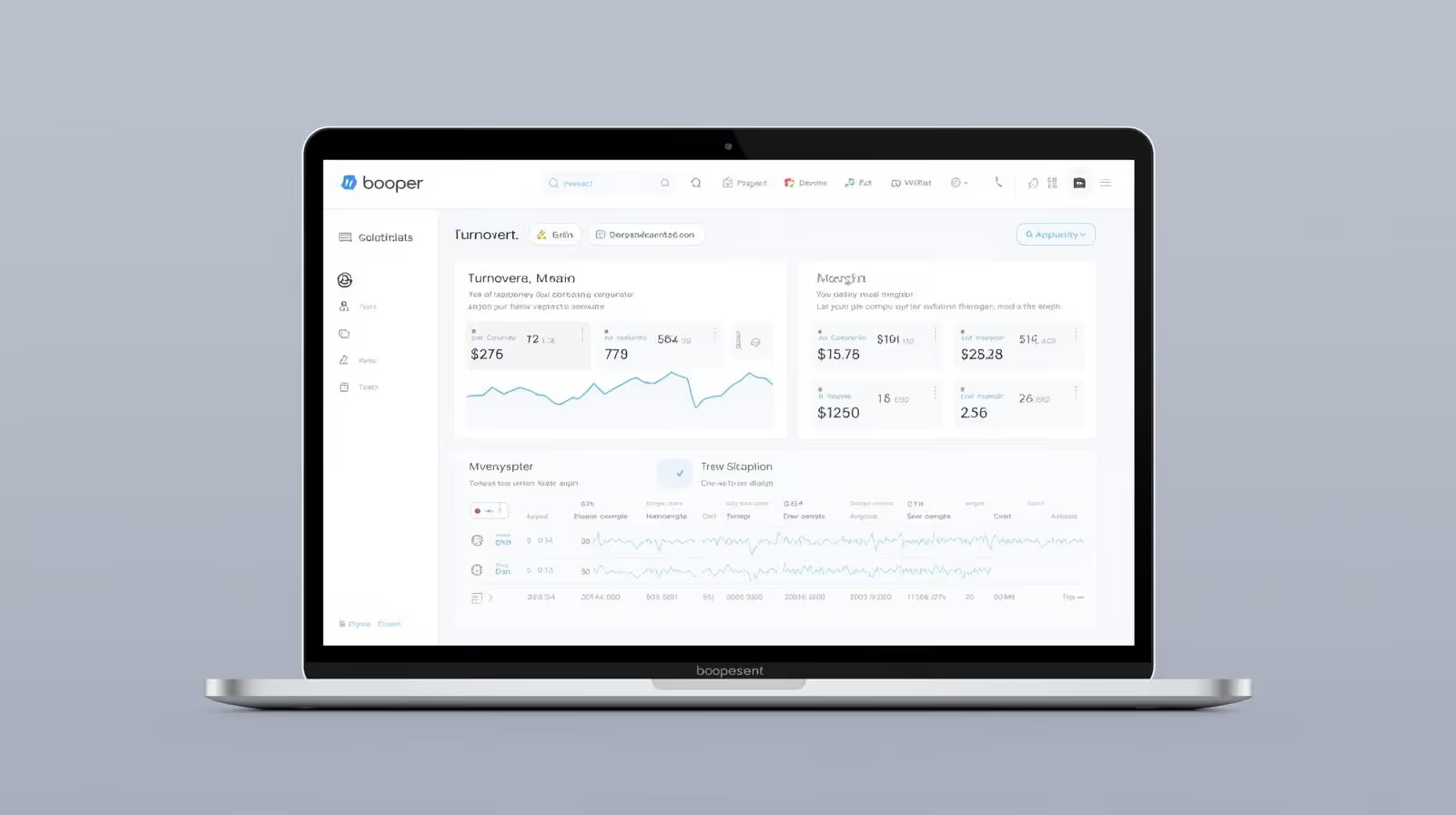

BOOPER MPS manages geo-pricing and price tiers. Prices are simulated and optimized according to elasticity levels, margin targets, and business constraints, ensuring global consistency, local differentiation, and multi-level performance management.


BOOPER manages assortments according to formats, zones, and channels, integrating packaging sizes, sales forecasts, and product life cycles. Margin simulations enable decisions to be made on whether to introduce or withdraw products based on economic performance and profitability targets.


BOOPER secures pricing decisions through structured governance based on explainable models, business rules, and complete traceability of simulations. Multi-level validations ensure strategic consistency, risk control, auditability, and control of margin and performance variances.


AI analyzes large volumes of historical and contextual data to identify patterns that are invisible to human analysis. For example, it takes into account seasonality, promotions, prices, weather, and competition to produce dynamic and continuously adjusted forecasts.
MPS primarily uses historical sales, prices, promotions, commercial calendars, store data, and external drivers (weather, events, competition). The richer the data, the more accurate the models. We recommend a minimum of one year of historical data.
Traditional methods rely on averages and past trends. Machine learning integrates hundreds of variables simultaneously, detects non-linear relationships, and automatically adapts to changes in consumer behavior.
By more accurately anticipating future demand, MPS makes it possible to adjust order volumes, reduce shortages and overstocking, improve service levels, and limit the financial immobilization associated with inventory.
BOOPER projects show a rapid ROI thanks to reduced investment in pricing, increased volumes, inventory optimization, reduced time spent on manual forecasting, and overall improvement in price image. The first gains are seen immediately.
Yes. MPS is designed for large retail accounts with multi-country, multi-store, multi-category management and centralized governance while maintaining local flexibility.
Yes. MPS is also designed to be adopted by simpler organizations. The vocabulary and indicators remain those of the client. The quality of the algorithms is the same as in larger structures.