Sell off excess stock without unnecessarily reducing margins
Avoid uniform, untargeted markdowns
Anticipating the real impact of markdowns on sales
Determining the right time to trigger a markdown
Adapt destocking strategies by store, region, or channel

Forecast of the impact of markdowns upon request
BOOPER MPS models purchasing behavior using machine learning algorithms capable of predicting:
- The impact of markdowns on sales volumes
- Customer sensitivity to different levels of discount
- The effects of seasonality and product life cycle
- The risks of cannibalization between products
- Weak signals indicating a slowdown in sales
The models are continuously retrained using real data to improve their accuracy over time.
The result: a reliable and dynamic view of the real impact of markdowns on sales performance.

Integration of inductors internal and external
The performance of forecasts relies on the intelligent integration of multiple data sources:
Interns:
- Sales history
- Promotional plans
- Prices and price changes
- Store locations
External:
- Competitive data
- Weather: sunshine, rain
- Special days: Christmas, Valentine's Day, Mother's Day...
- Exchange rates, inflation, etc.
BOOPER MPS consolidates these factors to produce realistic and contextualized scenarios.

Calculation of elasticities prices and customer feedback
BOOPER MPS automatically estimates:
- Price elasticity by product, category, and store
- Threshold effects (10%, 20%, 30%, etc.)
- Cross elasticities (substitution, complementarity)
- Indirect promotional impacts
This modeling allows us to understand precisely how demand reacts to each level of discounting.
Markdown strategies can thus be differentiated by store cluster rather than by a uniform approach.

+3 to +8%
margin on destocking operations
-20 to -40%
unnecessary markdowns
-25 %
of dormant stocks

Reporting and analysis performance comparison
BOOPER MPS offers advanced management tools:
- Customizable dashboards
- Monitoring markdown KPIs (sell-through, margin, velocity)
- Comparison between stores, regions, and categories
- Time analysis of markdown campaigns
- Exports for finance, supply chain, and senior management
Teams have a clear, shared, and actionable view of inventory reduction performance.

BOOPER MPS incorporates a price simulation engine (PSS) based on elasticity and AI to measure the impact of a pricing scenario on volume, revenue, and margin. It combines historical data, forecasts, and business rules to manage multiple objectives under constraints and support operational decision-making.
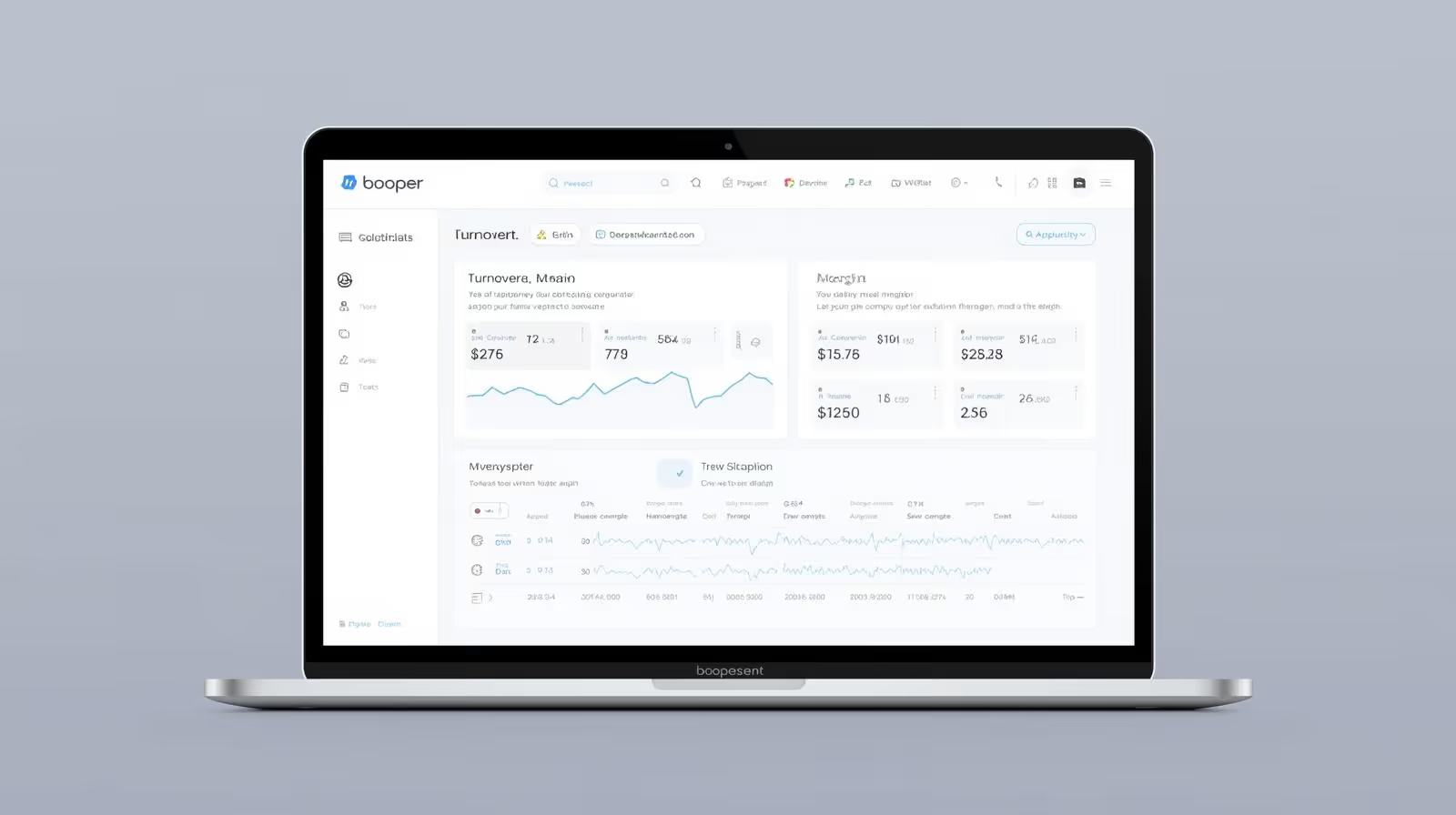

BOOPER MPS manages geo-pricing and price tiers. Prices are simulated and optimized according to elasticity levels, margin targets, and business constraints, ensuring global consistency, local differentiation, and multi-level performance management.


BOOPER manages assortments according to formats, zones, and channels, integrating packaging sizes, sales forecasts, and product life cycles. Margin simulations enable decisions to be made on whether to introduce or withdraw products based on economic performance and profitability targets.


BOOPER secures pricing decisions through structured governance based on explainable models, business rules, and complete traceability of simulations. Multi-level validations ensure strategic consistency, risk control, auditability, and control of margin and performance variances.


AI analyzes sales history, inventory levels, seasonality, prices, and customer behavior to predict the actual impact of markdowns. It identifies the right level of discount at the right time to maximize sales while protecting margins.
BOOPER primarily uses historical sales, inventory, prices, promotional calendars, store data, and external factors such as weather and competition. The richer the data, the more accurate the recommendations.
Manual markdown is based on generic rules and intuition. AI-driven markdown relies on predictive models that simulate the actual impact of each reduction level per product and per store.
Yes. BOOPER anticipates the periods when markdowns have the greatest impact on demand and avoids reductions that are too early or too late.
The solution calculates markdowns at a granular level (SKU, store, region) in order to tailor the discount to actual sales potential and avoid unnecessary discounts.
BOOPER projects deliver a rapid ROI by reducing excessive markdowns, improving inventory turnover, and reducing the time spent on manual decisions. Initial gains are typically seen in less than three months.
Yes. MPS is designed for large retail accounts with multi-country, multi-store, multi-category management and centralized governance while maintaining local flexibility.