Check that your sales prices are aligned with your business strategy.
Identify inconsistencies within your pricing structure
Understanding your price positioning relative to your competitors
Objectively measure your price image among consumers
Prioritize quick wins
Structure a sustainable pricing roadmap
Secure your decisions with traceable and explainable analyses

Analysis of positioning price per point of sale
BOOPER MPS analyzes your current prices at the product, category, and store level to assess their internal consistency and strategic alignment:
• Consistency of sales prices within the price list
• Structuring of price grids and compliance with pricing architectures
• Advanced product analyses: ABC, ranking, price tertiles, price ranges, TOP 100 products
• Mapping and clustering of stores according to their pricing behavior
• Identification of suppliers and discontinued products
This analysis reveals performance gaps between stores and allows strategies to be adapted locally.

Competitive analysis and price monitoring
BOOPER MPS incorporates a rigorous approach to monitoring and auditing competitor data:
• Audit of the quality, frequency, and reliability of competing statements
• Analysis of the pricing strategies of the main market players
• Analysis of positioning gaps by category and brand
• Identification of areas of over- and under-positioning
You benefit from a clear view of your competitive environment to accurately manage your pricing policy.

Measurement image price
The BOOPER Price Diagnosis includes a structured assessment of your price image:
• Analysis of customer perception by product family
• Identification of "benchmark" products in terms of image and price
• Correlation between actual prices and market perception
• Identification of levers for improving commercial attractiveness
This approach allows for informed decisions to be made between margin and competitiveness.
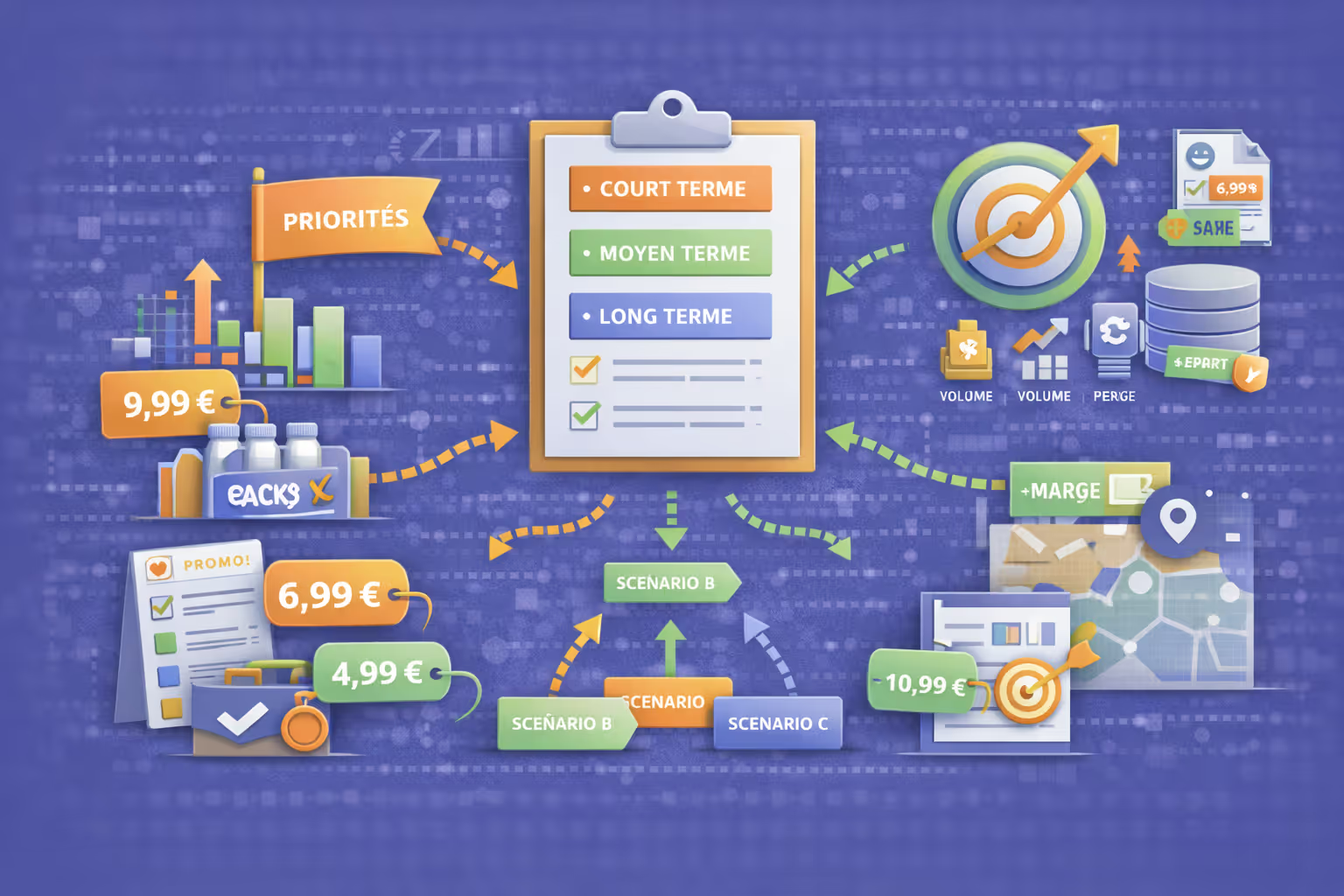
Identification of quick wins and optimization scenarios
Proposal for priority action plans. BOOPER MPS formalizes an operational pricing roadmap including:
• Prioritization of short-, medium-, and long-term actions
• Strategic recommendations on shelf space and promotions
• Proposal of new pricing scenarios
• Alignment with your business objectives (margin, volume, price image)
Amélioration de la cohérence tarifaire sur l’ensemble du réseau
Gains de marge identifiés dès les premières recommandations
Meilleure maîtrise du positionnement concurrentiel

Simulation and estimation economic impacts
Each scenario is evaluated quantitatively and qualitatively:
• Impact on margin
• Effect on price positioning
• Contribution to revenue
• Risks and opportunities by category and by store
This gives you a quantitative overview to help you make strategic decisions.

Governance and security pricing decisions
The BOOPER Price Diagnosis is part of a pricing decision governance approach:
- Documented assumptions and explainable models
- Complete traceability of analyses and recommendations
- Historical record of scenarios and choices made
- Multi-level approval processes (commerce, finance, management)
This approach strengthens the credibility of pricing decisions among senior management and finance departments.
The questions to which BOOPER helps you answer:
- What is your pricing governance system and how often do you adjust prices?
- What data and indicators shape your pricing decisions?
- What levers do you use to manage the performance and streamlining of your portfolio of offerings?
- How do you factor market uncertainty and risk exposure into your pricing decisions?
- What is your support and communication strategy during price increases?
- How do you structure your customer segmentation from an economic and strategic perspective?
- What price-value positioning do you claim compared to your main competitors?
- What trends are you seeing in your priority segments, and how are they influencing your pricing policy?
- What tools or methods do you use to estimate your customers' price sensitivity?
Our detailed analysis report includes:
- A prioritized map of the main risks likely to impact your pricing performance
- Concrete areas for optimization to develop your pricing strategy and strengthen your management processes
- An assessment of the organizational implications to be anticipated (governance, roles, tools, coordination)
- A selection of key performance indicators tailored to the specific characteristics of your market
- An operational illustration of a pricing architecture aligned with your distribution model
A pricing diagnosis is a comprehensive analysis of your pricing policy aimed at assessing its consistency, effectiveness, and positioning in relation to the market. It identifies concrete levers for optimization in terms of shelf space and promotions.
BOOPER relies primarily on your sales data, price lists, promotional history, store data, and competitor price reports. The richer and more reliable the data, the more accurate the recommendations.
The BOOPER diagnosis combines retail expertise, artificial intelligence, and advanced analytics (ABC, clustering, price mapping). It goes beyond simple observation to offer quantified scenarios and quick wins that can be implemented immediately.
Yes. Each recommendation is accompanied by a quantitative and qualitative estimate of its effects on margin, revenue, and price positioning.
Yes. BOOPER is designed for complex organizations with analyses by store, cluster, region, and country, while ensuring centralized governance of decisions.
BOOPER projects deliver rapid ROI by identifying quick wins, improving pricing consistency, and optimizing competitive positioning. Initial gains are typically seen within three months.