Sell off excess stock without unnecessarily reducing margins
Avoid uniform, untargeted markdowns
Anticipating the real impact of markdowns on sales
Determining the right time to trigger a markdown
Adapt destocking strategies by store, region, or channel

Forecast of the impact of markdowns upon request
BOOPER MPS models purchasing behavior using machine learning algorithms capable of predicting:
- The impact of markdowns on sales volumes
- Customer sensitivity to different levels of discount
- The effects of seasonality and product life cycle
- The risks of cannibalization between products
- Weak signals indicating a slowdown in sales
The models are continuously retrained using real data to improve their accuracy over time.
The result: a reliable and dynamic view of the real impact of markdowns on sales performance.

Integration of inductors internal and external
The performance of forecasts relies on the intelligent integration of multiple data sources:
Interns:
- Sales history
- Promotional plans
- Prices and price changes
- Store locations
External:
- Competitive data
- Weather: sunshine, rain
- Special days: Christmas, Valentine's Day, Mother's Day...
- Exchange rates, inflation, etc.
BOOPER MPS consolidates these factors to produce realistic and contextualized scenarios.

Calculation of elasticities prices and customer feedback
BOOPER MPS automatically estimates:
- Price elasticity by product, category, and store
- Threshold effects (10%, 20%, 30%, etc.)
- Cross elasticities (substitution, complementarity)
- Indirect promotional impacts
This modeling allows us to understand precisely how demand reacts to each level of discounting.
Markdown strategies can thus be differentiated by store cluster rather than by a uniform approach.

User-guided simulations
BOOPER MPS allows you to test different hypotheses before implementing them:
- Period and number of discounts
- Discount interval
- Application at the point of sale or warehouse
Each simulation measures the projected impact on:
- The volumes
- The margin
- Revenue
Monitoring and management proactive
BOOPER MPS manages and communicates price execution dates to the ERP:
- Period management
- Flow monitoring
- Alerts
Inventory reduction becomes a proactive rather than reactive process.

Reporting and analysis performance comparison
BOOPER MPS offers advanced management tools:
- Customizable dashboards
- Monitoring markdown KPIs (sell-through, margin, velocity)
- Comparison between stores, regions, and categories
- Time analysis of markdown campaigns
- Exports for finance, supply chain, and senior management
Teams have a clear, shared, and actionable view of inventory reduction performance.
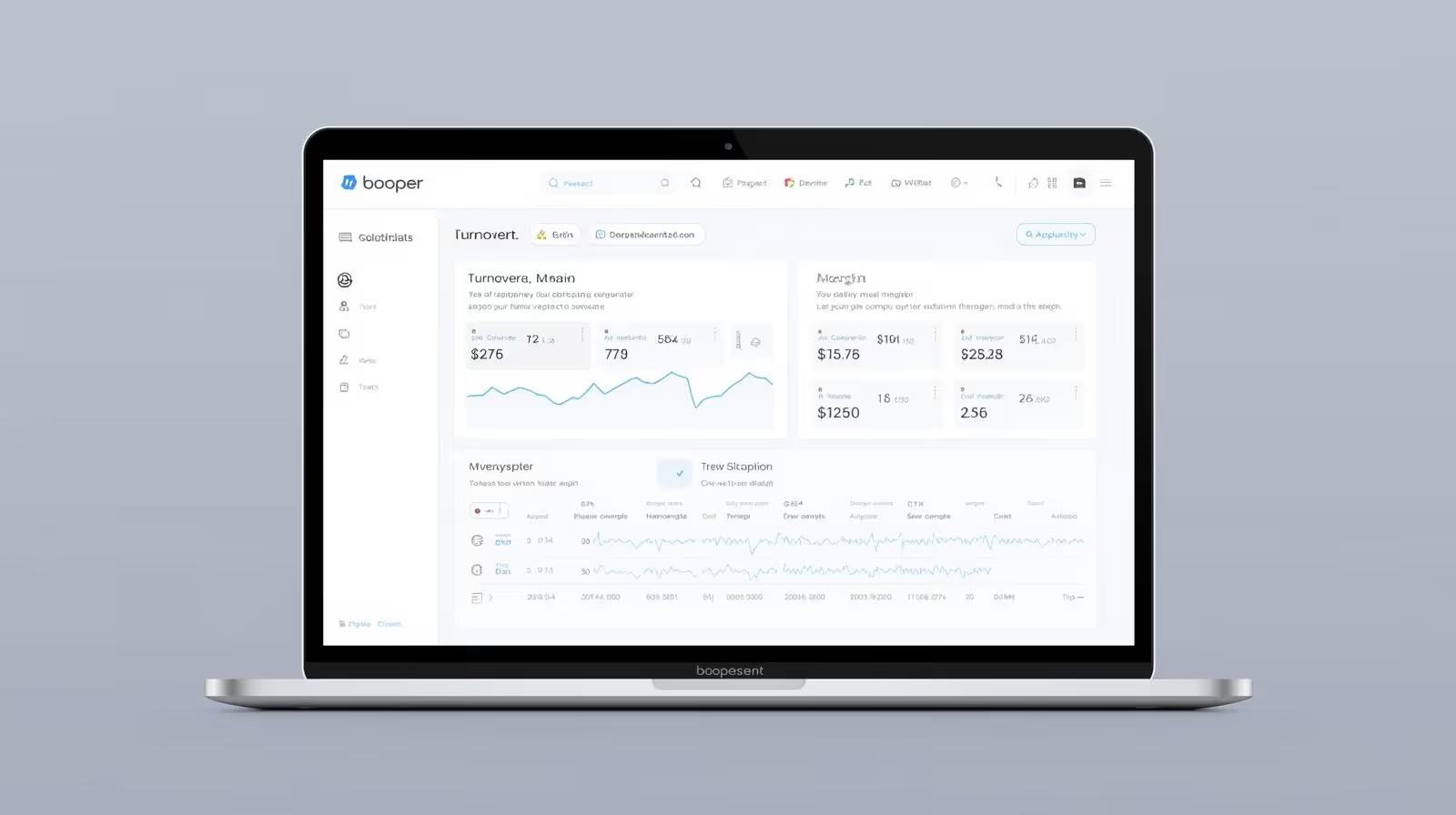
 Price simulation
BOOPER MPS incorporates a price simulation engine (PSS) based on elasticity and AI to measure the impact of a pricing scenario on volume, revenue, and margin. It combines historical data, forecasts, and business rules to manage multiple objectives under constraints and support operational decision-making.
 Geopricing and Price Tiers
BOOPER MPS manages geo-pricing and price tiers. Prices are simulated and optimized according to elasticity levels, margin targets, and business constraints, ensuring global consistency, local differentiation, and multi-level performance management.

 Assortment management
BOOPER manages assortments according to formats, zones, and channels, integrating packaging sizes, sales forecasts, and product life cycles. Margin simulations enable decisions to be made on whether to introduce or withdraw products based on economic performance and profitability targets.

 Governance and management
BOOPER secures pricing decisions through structured governance based on explainable models, business rules, and complete traceability of simulations. Multi-level validations ensure strategic consistency, risk control, auditability, and control of margin and performance variances.

How does AI improve markdown strategies in retail?
Artificial intelligence transforms the process of setting markdowns from an empirical decision into a predictive one: by cross-referencing sales history, inventory levels, seasonality, prices, and purchasing behavior, it estimates the actual impact of each markdown level before applying it, and identifies the timing and discount rate that maximize sales without sacrificing more margin than necessary. Specifically, BOOPER MPS combines this predictive analysis with an operational research engine: the models do more than just observe past trends; they simulate multiple markdown scenarios (varying in timing and intensity) and project their effects on demand, remaining inventory, and margin—product by product and store by store. This approach corrects the classic biases of manual markdowns—markdowns applied too late, which tie up cash in inventory, or too early, which erode margins on products that would have sold at full price. The AI also refines its recommendations based on actual sales data observed after each markdown wave, allowing the strategy to be adjusted mid-season rather than being locked into a rigid plan. For a retailer, this predictive markdown management has a direct impact on end-of-season profitability and inventory turnover: less leftover overstock, fewer last-minute markdowns decided under pressure, and better control over pricing strategy, since discounts are justified by data rather than a generic schedule.
What data is needed to optimize destocking with BOOPER?
BOOPER MPS relies primarily on five categories of data to optimize inventory turnover: sales history, inventory levels, current prices, promotional schedules, and store data (location, format, customer demographics). External factors such as weather or competitors’ prices may also be factored in to further refine the recommendations. Sales history is the most fundamental data set: it allows the model to learn the specific sales velocity of each product and each store location, and thus to distinguish between an item that simply needs more time and one that is truly at the end of its commercial life cycle. When cross-referenced with inventory levels, it determines the relative urgency of each markdown decision. Promotional calendars, meanwhile, prevent a price reduction from cannibalizing a sales campaign already planned for the same period. BOOPER does not require a perfect data foundation to get started: a Data Loader adapts to existing data streams (ERP exports, flat files, databases, APIs), allowing you to connect already available sources without waiting for an overhaul of the information system. Recommendations become more accurate as the historical data grows, but the platform already produces actionable results using basic sales and inventory data. For pricing or category management teams, the quality of the input data remains the key factor in the reliability of the recommendations: the more sales history spans seasons and promotional cycles, the more the model learns to anticipate atypical behaviors (end-of-line items, competitor stockouts, weather-related issues) rather than simply extending a past trend.
What is the difference between manual markdown and AI-driven markdown?
Manual markdowns rely on generic rules (for example, “30% off after 6 weeks without sufficient turnover”) and the teams’ intuition, applied relatively uniformly across an entire category. AI-driven markdowns, on the other hand, rely on predictive models that simulate the actual impact of each discount level—product by product and store by store—before implementing it. The difference lies primarily in granularity and foresight. A generic rule treats an item that is still selling well the same as an item nearing the end of its commercial life in the same store, since it cannot analyze thousands of SKUs individually. The AI-driven approach, on the other hand, evaluates each product’s unique sales dynamics, inventory level, and seasonality to propose a specific markdown rate and timing. The other difference lies in the correction loop: manual markdowns are rarely reassessed once decided, whereas AI-driven management readjusts its recommendations based on actual sales observed after each round of markdowns, allowing a trajectory to be corrected before it becomes costly. The two approaches can coexist: teams retain control over business rules (minimum margin thresholds, commercial constraints) while allowing the predictive engine to refine the optimal level within that framework. For a multi-store retailer, this shift from manual markdowns to predictive markdowns primarily changes the scale at which granular decisions can be made: it becomes possible to customize thousands of markdown decisions without increasing the teams’ workload, with a direct impact on the overall margin preserved at the end of the season.
Can we predict the best time to launch a sale?
Yes. For each product, BOOPER MPS identifies the period during which a price reduction has the greatest impact on demand, in order to avoid two common pitfalls: a price reduction launched too early, which sacrifices margin on sales that would have occurred at full price, and a price reduction launched too late, which is no longer sufficient to clear inventory before the end of the season. This timing is based on a cross-analysis of several indicators: the product’s actual sales velocity since its launch, the remaining inventory level relative to its expected shelf life, the seasonality of the category, and, when available, competitive data. The predictive engine simulates the likely evolution of demand week by week and triggers a recommendation as soon as the optimal trigger threshold is reached. This proactive approach also avoids the classic “bottleneck” effect, where several product families reach the end of their commercial life at the same time and are marked down simultaneously—which dilutes customer attention and increases pressure on the period’s overall margin. By spacing out markdowns according to each product’s actual sales rhythm, the platform smooths out the markdown burden over time. For pricing and purchasing teams, this ability to predict the right moment transforms inventory clearance from a reactive decision—often made in a rush at the end of the season—into a continuous management process, with a direct impact on margin preservation and inventory turnover, two metrics closely monitored by every sales department.
How can you avoid uniform markdowns that destroy margins?
Avoiding uniform markdowns requires calculating each discount at the most granular level—SKU, store, or even region—rather than applying an identical sale rate to an entire category. BOOPER MPS determines the appropriate discount level based on the actual sales potential of each SKU, ensuring that only necessary items are marked down. Specifically, the platform combines artificial intelligence and operational research to simulate—before implementation—the effect of a given markdown level on inventory turnover, store by store. A product that is still selling well at one retail location does not need the same discount as the same item nearing the end of its lifecycle elsewhere—a uniform markdown, calculated based on a national average, ignores precisely these differences and sacrifices margin on SKUs that did not need it. This granular approach draws on sales history, remaining inventory levels, seasonality, and—when available—competitive data to propose, on a product-by-product basis, the discount rate that maximizes inventory turnover without unnecessarily eroding margins. Teams retain control over the scenarios and can adjust parameters according to their current priorities (margin, turnover, or price perception). For a multi-store retailer, the stakes go beyond line-by-line savings: more precise markdowns prevent the cumulative effect of thousands of unjustified discounts across an entire network, protect the overall margin, and limit the need for deep, last-minute markdowns at the end of the season due to a lack of sufficient foresight.
What is the ROI of an AI-powered markdown optimization solution?
An AI-powered markdown optimization solution delivers a rapid return on investment by acting on three directly measurable levers: reducing excessive markdowns, improving inventory turnover, and reducing the time teams spend on manual markdown decisions, product by product. The first lever—fewer excessive markdowns—directly translates into preserved margins: every discount point avoided on a product that would have sold at full price (or with a smaller discount) represents margin retained. The second lever—inventory turnover—reduces capital tied up at the end of the season and limits the need for last-minute deep discounts. The third lever frees up time for pricing and category management teams, who were previously occupied with low-value-added, product-by-product decision-making. These benefits typically become apparent as early as the first markdown campaigns driven by the platform, since the mechanism does not require an organizational overhaul: BOOPER fits into the existing clearance schedule and gradually refines its recommendations as actual sales confirm or adjust the forecasts. However, the actual ROI depends on the volume of SKUs involved, the maturity of the available historical data, and the frequency of clearance campaigns specific to each retailer—a chain with multiple waves of sales per year and a rich sales history will see faster returns from this predictive approach than an organization with limited historical data.
Is the solution suitable for complex, international store networks?
Yes. MPS is designed for large retail accounts, offering multi-country, multi-store, and multi-category management combined with centralized forecast governance, while maintaining local flexibility tailored to each market. This multi-country management takes into account the fact that demand behaves differently from one market to another—with varying seasonality, country-specific promotional calendars and holidays, and price sensitivity that varies according to local purchasing power. The predictive engine incorporates these specificities on a market-by-market basis rather than applying a single model across the entire network. Centralized governance enables group management to maintain a consolidated view of forecasts across the entire network, which is useful for balancing supply priorities between markets or standardizing methods across subsidiaries, without imposing assumptions on local teams that are ill-suited to their own markets. For a multi-country group, this balance between central management and local granularity is what makes the forecast truly actionable on a market-by-market basis, rather than a consolidated average that is of little use for operational decision-making.
Solutions
Pricing Optimization Software
A pricing tool focused on margin performance and effective business governance.
Sales forecasting using AI
Anticipate demand and improve your business decisions with AI
Product matching: Cloning and chaining
Make your product comparisons more reliable with AI
Promotion management
Manage your promotions with precision and maximize their profitability
Markdown and Clearance Sale
Optimize your markdowns and accelerate the sale of your inventory
Studies & Data
Price surveys and web scraping
Monitor your competitors' prices online and offline
Diagnosis Price
Optimize your pricing strategy and secure your decisions
Price strategy development
Use your pricing strategy as a lever for creating sustainable value
Council
Operational Pricing Consulting
Bring clarity and control to your pricing decisions
Change management
Make your teams the driving force behind your pricing transformation
Pricing Training
Develop your operational or strategic skills

Lorem ipsum dolor sit amet, consectetur adipiscing elit. Suspendisse varius enim in eros elementum tristique. Duis cursus, mi quis viverra ornare, eros dolor interdum nulla, ut commodo diam libero vitae erat. Aenean faucibus nibh et justo cursus id rutrum lorem imperdiet. Nunc ut sem vitae risus tristique posuere.
Lorem ipsum dolor sit amet, consectetur adipiscing elit. Suspendisse varius enim in eros elementum tristique. Duis cursus, mi quis viverra ornare, eros dolor interdum nulla, ut commodo diam libero vitae erat. Aenean faucibus nibh et justo cursus id rutrum lorem imperdiet. Nunc ut sem vitae risus tristique posuere.
Heading 1
Heading 2
Heading 3
Heading 4
Heading 5
Heading 6
Lorem ipsum dolor sit amet, consectetur adipiscing elit, sed do eiusmod tempor incididunt ut labore et dolore magna aliqua. Ut enim ad minim veniam, quis nostrud exercitation ullamco laboris nisi ut aliquip ex ea commodo consequat. Duis aute irure dolor in reprehenderit in voluptate velit esse cillum dolore eu fugiat nulla pariatur.
Block quote
Ordered list
- Item 1
- Item 2
- Item 3
Unordered list
- Item A
- Item B
- Item C
Bold text
Emphasis
Superscript
Subscript