
Promotion management
Promotion management
Promotion management: orchestrate your campaigns with precision using AI
BOOPER MPS enables retail brands to design and manage their Promotional Action Plans according to specific business objectives: revenue, margin, inventory turnover, and price image.
Leveraging AI, you can build high-performing promotional plans, anticipate their impacts, and secure your decisions before deployment.
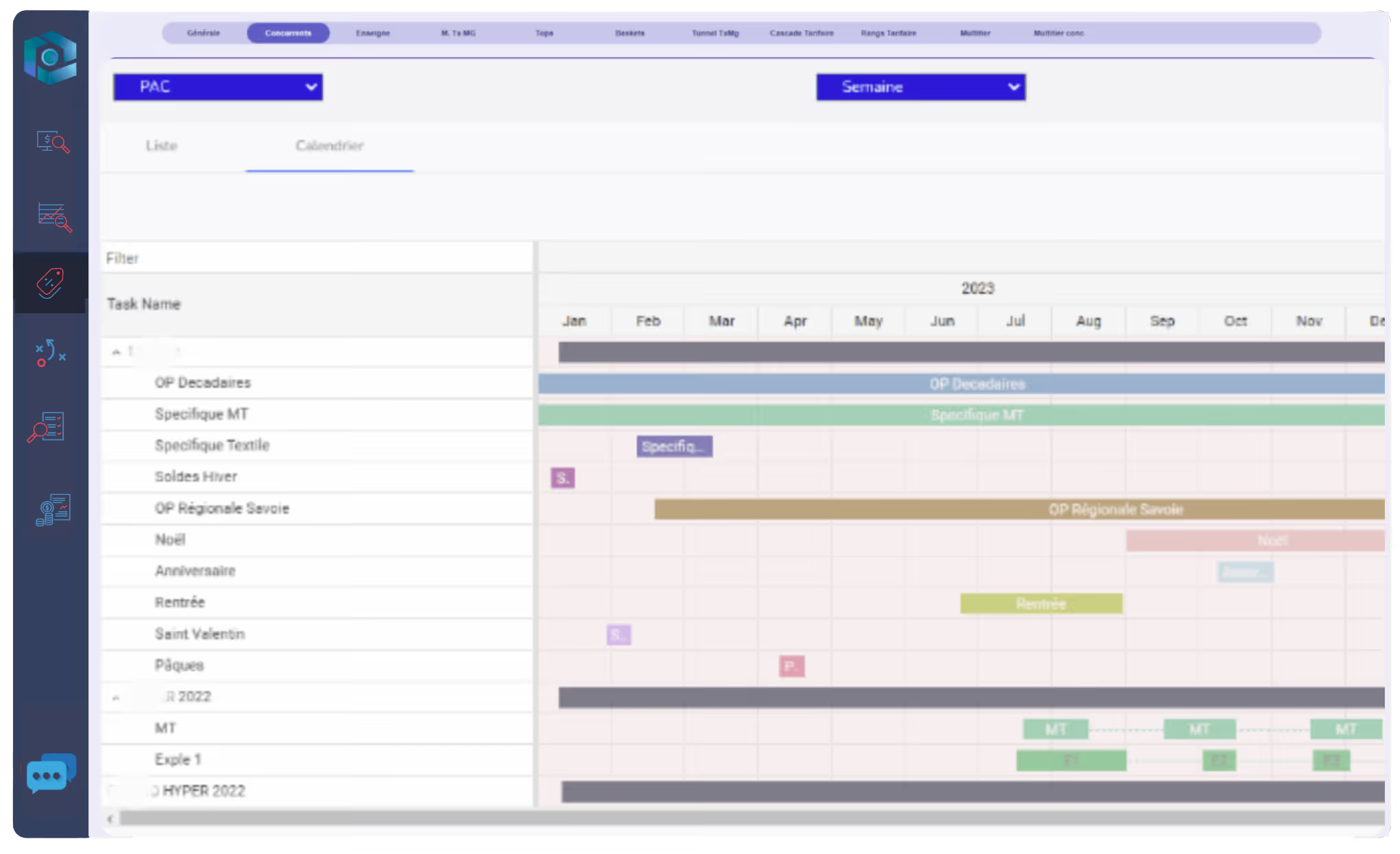














Optimize the commercial and financial impact of your operations
Promotions remain a major lever for driving traffic and boosting sales. However, without robust modeling, their true impact is often difficult to measure. The Promotion Management module allows you to model, simulate, and orchestrate promotional campaigns.
Volume and margin impact forecasting
Simulate the impact of a promotion before launching it.
Optimized Selection of Promotional Mechanics
Select the most profitable products and promotional formats for each objective.
Analysis of Past Campaign Performance
Capitalize on historical data to refine your upcoming campaigns.
Managed Promotions, Not Just Triggered Ones
Beyond calculating discounts, the module helps maintain budget control and the consistency of your promotional operations.
Compliance with Budget Constraints
Maintain control over your overall promotional budget, category by category.
Omnichannel Consistency
Ensure uniform promotional mechanics across physical stores, web, and marketplaces.
Detection of Low-Margin Promotions
Identify mechanics that erode margins without generating incremental traffic.
Marketing-Pricing Collaboration
Shared data across teams to align commercial objectives with profitability.
AI analyzes past sales, promotional strategies, pricing, seasonality, and customer behavior to predict the actual impact of promotions. It helps select the best promotional strategies, the right discount level, and the right targeting to maximize ROI. Specifically, this analysis draws on historical data from past campaigns to identify recurring patterns: which mechanics (direct discounts, multi-purchase offers, loyalty cards) work best by category, which discount levels generate sufficient uplift without eroding margins, and which external factors—seasonality, events, competitive pressure—influence a campaign’s results. BOOPER MPS translates these analyses into concrete recommendations before a campaign is launched and offers a “What If” simulation module to test different promotional scenarios and measure their projected impact on volumes, revenue, and margin before any budget commitments are made. For a retailer, this approach changes the way promotional plans are developed: instead of repeating the same strategies out of habit, decisions are based on an objective impact assessment, which limits unprofitable campaigns and focuses the promotional budget on what actually works.
MPS uses historical sales data, promotional schedules, prices, margins, store data, inventory levels, and external factors (seasonality, events, competition) to manage promotions. Each type of data plays a specific role: historical sales data and past promotional calendars help identify which strategies actually work across different categories; inventory data prevents the promotion of SKUs at risk of running out of stock or, conversely, helps clear out excess inventory; external factors refine impact forecasts by taking into account the actual context of the promotion rather than just average historical data. The promotional calendar can be created directly within the tool or imported from a third-party solution via API, and updated collaboratively by various departments based on their level of responsibility—management control for objectives, marketing for scope definition, category management for products, and supply chain for orders and sell-through rates. For a retailer, the richness and reliability of this data directly determine the accuracy of the recommendations: a promotional plan based on incomplete inventory or sales data remains unreliable, regardless of how sophisticated the models used to analyze it may be.
Yes. The “What If” simulation module allows you to test different promotional scenarios and measure their projected impact on volume, revenue, and margin before any actual launch. Specifically, this module uses historical sales data and previously tested promotional strategies to project the likely outcome of a new campaign: the proposed discount level, the chosen promotional strategy, and the scope of products or stores involved. It allows you to compare multiple scenarios side by side before selecting the most favorable configuration. This simulation does not replace actual measurement once the promotion is launched, but it significantly reduces the risk of discovering after the fact that a mechanism was poorly calibrated: a discount level that is too generous, a target audience that is too broad, or a poorly chosen time frame can be adjusted in advance rather than identified after the fact, once the budget has been committed. For a retailer, this simulation capability changes the way promotional plans are developed: trade-offs between commercial appeal and profitability are made based on quantitative projections, which ensures decisions are sound before deployment rather than requiring urgent corrections during the campaign.
MPS identifies unprofitable promotions, measures their actual ROI, and proposes more effective alternatives. Decisions are based on objective data, not solely on historical data or intuition. Over-promotion is a common pitfall in retail: promotional strategies are repeated year after year simply because they’ve become routine, without their actual profitability being systematically reevaluated. By comparing actual sales to expected sales without promotions, MPS highlights campaigns that primarily result in markdowns without sufficient uplift to offset them. The “What If” simulation module complements this upstream analysis: it allows you to test different scenarios before launching a campaign, thereby limiting the risk of over-promotion right from the planning stage, rather than discovering it after the fact once the budget has been committed. For a retailer, avoiding over-promotion has a direct impact on margins: every euro of discount granted without sufficient uplift represents a pure erosion of profitability—one that is often invisible unless measured on a per-promotion basis rather than at the overall promotional plan level.
Yes. MPS is designed for large retail accounts, offering multi-country, multi-store, and multi-category management with centralized governance while maintaining local flexibility. This multi-level management addresses a common need for complex retail networks: to develop a coherent promotional plan at the central level while giving local teams the flexibility to adapt to specific market conditions—such as varying price sensitivity across countries, local sales calendars, and regulatory constraints specific to certain regions. MPS enables collaborative management of the promotional calendar: objectives can be defined by financial planning, the framework established by marketing, the selection of relevant products handled by category management, and the monitoring of orders and sales rates managed by the supply chain, with each function contributing according to its level of responsibility. Data can also be imported from a third-party solution via API or created directly within the tool. For a multi-country retailer, this structure avoids two opposing pitfalls: overly centralized management that ignores local realities, or overly decentralized management that results in a loss of consistency in brand image, pricing, and governance at the group level.
MPS compares actual sales to expected sales (excluding the promotion) in order to isolate the uplift generated by the campaign. ROI is calculated by factoring in margin, costs, and additional volumes. This metric is based on a model of what sales would have been in the absence of the promotion—a counterfactual baseline derived from historical data and contextual factors (seasonality, underlying category trends). The difference between actual sales and expected sales represents the uplift actually attributable to the campaign, rather than a natural sales trend that would otherwise be mistakenly attributed to the promotion. Once this uplift has been isolated, the ROI calculation incorporates all the economic parameters of the campaign: the margin reduced by the discount offered, the additional costs associated with promoting the product, and the extra volume generated—to obtain a comprehensive measure of profitability rather than a simple markdown rate. For a retailer, this measurement method is a game-changer compared to a purely volume- or revenue-based analysis: a promotion that generates a lot of sales may turn out to be unprofitable once margins and costs are taken into account, and vice versa—it is this actual profitability that MPS makes it possible to objectively assess.
BOOPER projects deliver a rapid ROI through the optimization of the promotional budget, the reduction of stockouts, and improved margins, with initial gains typically seen within a few months. This rapid return is due to the nature of the measures implemented: identifying unprofitable promotions and correcting or discontinuing them has an immediate impact on margins, without having to wait for a full production cycle to end. Similarly, better forecasting of promotional impact allows for more accurate inventory planning in advance, which limits both stockouts during the promotion and residual overstock once the promotion ends. This ROI, however, depends on the quality of the available data and the teams’ ability to implement the recommendations generated by AI: a solution that correctly identifies promotions needing correction has no effect if the decisions aren’t reflected in the promotional plan that’s actually implemented. For a retailer, this rapid gain on the promotional budget—one of the most significant and least finely controlled expense items in many chains—is often the first visible result, even before a broader transformation of pricing management takes place.