Check that your sales prices are aligned with your business strategy.
Identify inconsistencies within your pricing structure
Understanding your price positioning relative to your competitors
Objectively measure your price image among consumers
Prioritize quick wins
Structure a sustainable pricing roadmap
Secure your decisions with traceable and explainable analyses

Analysis of positioning price per point of sale
BOOPER MPS analyzes your current prices at the product, category, and store level to assess their internal consistency and strategic alignment:
• Consistency of sales prices within the price list
• Structuring of price grids and compliance with pricing architectures
• Advanced product analyses: ABC, ranking, price tertiles, price ranges, TOP 100 products
• Mapping and clustering of stores according to their pricing behavior
• Identification of suppliers and discontinued products
This analysis reveals performance gaps between stores and allows strategies to be adapted locally.

Competitive analysis and price monitoring
BOOPER MPS incorporates a rigorous approach to monitoring and auditing competitor data:
• Audit of the quality, frequency, and reliability of competing statements
• Analysis of the pricing strategies of the main market players
• Analysis of positioning gaps by category and brand
• Identification of areas of over- and under-positioning
You benefit from a clear view of your competitive environment to accurately manage your pricing policy.

Measurement image price
The BOOPER Price Diagnosis includes a structured assessment of your price image:
• Analysis of customer perception by product family
• Identification of "benchmark" products in terms of image and price
• Correlation between actual prices and market perception
• Identification of levers for improving commercial attractiveness
This approach allows for informed decisions to be made between margin and competitiveness.
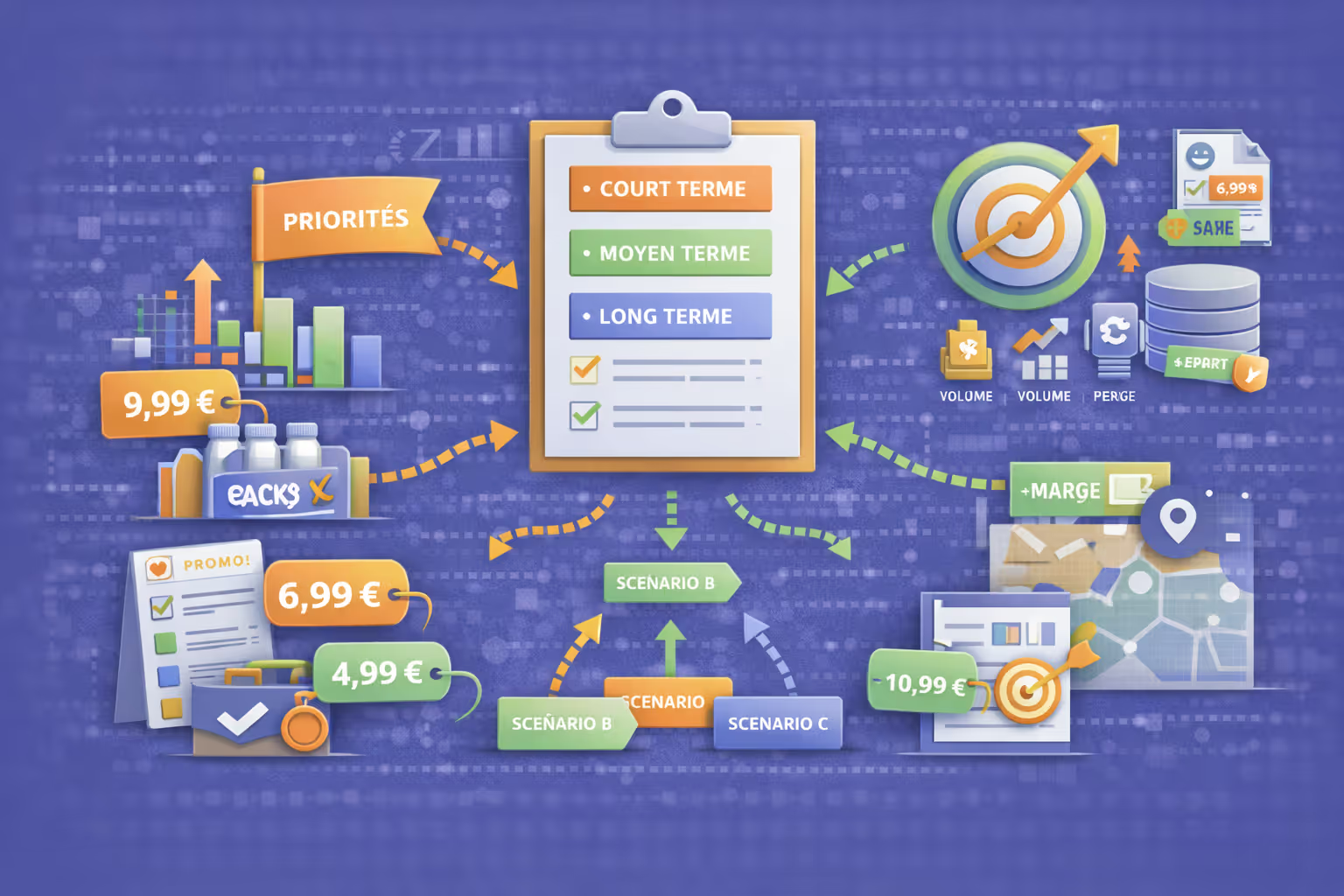
Identification of quick wins and optimization scenarios
Proposal for priority action plans. BOOPER MPS formalizes an operational pricing roadmap including:
• Prioritization of short-, medium-, and long-term actions
• Strategic recommendations on shelf space and promotions
• Proposal of new pricing scenarios
• Alignment with your business objectives (margin, volume, price image)

Simulation and estimation economic impacts
Each scenario is evaluated quantitatively and qualitatively:
• Impact on margin
• Effect on price positioning
• Contribution to revenue
• Risks and opportunities by category and by store
This gives you a quantitative overview to help you make strategic decisions.
Governance and security pricing decisions
The BOOPER Price Diagnosis is part of a pricing decision governance approach:
- Documented assumptions and explainable models
- Complete traceability of analyses and recommendations
- Historical record of scenarios and choices made
- Multi-level approval processes (commerce, finance, management)
This approach strengthens the credibility of pricing decisions among senior management and finance departments.
The questions to which BOOPER helps you answer:
- What is your pricing governance system and how often do you adjust prices?
- What data and indicators shape your pricing decisions?
- What levers do you use to manage the performance and streamlining of your portfolio of offerings?
- How do you factor market uncertainty and risk exposure into your pricing decisions?
- What is your support and communication strategy during price increases?
- How do you structure your customer segmentation from an economic and strategic perspective?
- What price-value positioning do you claim compared to your main competitors?
- What trends are you seeing in your priority segments, and how are they influencing your pricing policy?
- What tools or methods do you use to estimate your customers' price sensitivity?
Our detailed analysis report includes:
- A prioritized map of the main risks likely to impact your pricing performance
- Concrete areas for optimization to develop your pricing strategy and strengthen your management processes
- An assessment of the organizational implications to be anticipated (governance, roles, tools, coordination)
- A selection of key performance indicators tailored to the specific characteristics of your market
- An operational illustration of a pricing architecture aligned with your distribution model
What is a pricing diagnosis?
A pricing assessment is a comprehensive analysis of your pricing policy designed to evaluate its consistency, effectiveness, and positioning relative to the market. It helps identify concrete opportunities for optimization regarding shelf space and promotions. Specifically, the assessment combines data from several sources: internal sales and margin data, pricing structure, promotional history, and price positioning relative to the competition. This analysis highlights discrepancies that are often invisible at the aggregate level—inconsistencies in price tiers across stores, recurring promotions with low profitability, and SKUs that are poorly positioned relative to the market. BOOPER complements this analysis with advanced analytical methods (ABC analysis, clustering, price mapping) and, depending on the scope, artificial intelligence to prioritize levers based on their estimated impact, rather than simply providing a snapshot of the current situation. For a retailer, a pricing assessment often serves as the starting point for a broader initiative: it clarifies priorities before undertaking, if necessary, a pricing strategy overhaul, change management support, or the deployment of a management platform such as BOOPER MPS.
What data is needed to perform a price diagnosis?
BOOPER relies primarily on your sales data, pricing grids, promotional history, store data, and competitor price reports to conduct a pricing analysis. The richer and more reliable the data, the more accurate the recommendations. Sales and margin data allow you to measure the actual performance of each SKU and identify discrepancies between your stated strategy and observed results. Pricing schedules and promotional histories reveal inconsistencies that have accumulated over time—drifting price tiers, repeated promotions without impact measurement. Competitor price data, whether from an existing monitoring system or a dedicated data collection effort, positions the retailer relative to the market on key SKUs. When certain data is missing or of insufficient quality—such as incomplete historical data or poorly structured product databases—the assessment explicitly flags this rather than making recommendations based on a shaky foundation: this is an honest limitation that should be anticipated before launching the process. For a retailer, this requires preparatory work beforehand: consolidating and ensuring the reliability of available data sources is often the first step that determines the quality of the entire analysis, even before the analysis itself begins.
How does the BOOPER price diagnosis differ from a traditional audit?
The BOOPER pricing assessment differs from a traditional audit by combining retail industry expertise, artificial intelligence, and advanced analytics—ABC analysis, clustering, and price mapping—to go beyond simply identifying issues and instead propose quantified scenarios and immediately actionable quick wins. A traditional audit generally limits itself to taking a snapshot of the current situation: price discrepancies, observed inconsistencies, and a raw comparison with the competition. The BOOPER analysis goes further by cross-referencing these findings with analytical methods that prioritize key issues: ABC analysis identifies the SKUs with the greatest business impact; clustering groups stores or products with similar behaviors; and price mapping visually positions the product offering relative to the market. This approach moves beyond a static report to deliver operational recommendations, prioritized based on their estimated impact and ease of implementation—which distinguishes actions that can be implemented immediately from more structural initiatives to be carried out over the long term. For a retailer, this difference is crucial: an audit that merely presents findings often goes unacted upon, whereas an action-oriented analysis provides pricing teams with a concrete and measurable roadmap as soon as the results are presented.
Can we measure the impact of recommendations on margins and price image?
Yes, each recommendation from the BOOPER pricing analysis is accompanied by a quantitative and qualitative assessment of its impact on margins, revenue, and price positioning. This assessment draws on the retailer’s historical data—sales, margins, and observed price elasticities by category—to simulate the impact of a price change or pricing policy adjustment before it is actually implemented. This is not a guaranteed forecast, but rather an order of magnitude that allows actions to be prioritized based on their potential impact rather than treating them all with the same sense of urgency. This analysis also addresses effects that are less directly quantifiable, such as the price image perceived by customers in a given aisle: the assessment thus combines quantitative indicators (price differentials, competitive positioning) with a qualitative assessment of the commercial risk associated with a price adjustment that is too visible. For a retailer, this dual approach prevents blindly implementing price changes: it allows for informed decision-making among several scenarios, taking into account both the expected margin gain and the risk to price image or foot traffic.
Is the diagnosis suitable for multi-store and multi-country networks?
Yes, the BOOPER pricing analysis tool is designed for complex organizations, offering the ability to analyze data by store, cluster, region, or country, while ensuring centralized decision-making. This capability is based on the diagnostic’s analytical structure: data is segmented according to levels relevant to the retailer (store type, catchment area, country), which makes it possible to identify competitiveness or price-image gaps specific to a local area without losing sight of the network as a whole. For a multi-country network in particular, this level of granularity is essential: price levels, customer sensitivity, and the intensity of competition vary significantly from one market to another. The analysis therefore makes it possible to distinguish between legitimate local adjustments and instances of governance inconsistencies that need to be corrected at the central level. This dual perspective—local and centralized—empowers pricing teams to balance field autonomy with brand consistency without sacrificing one for the other, which is a recurring challenge for retailers expanding internationally.
What is the ROI of a pricing diagnosis?
The ROI of a pricing assessment lies in its ability to quickly identify concrete areas for improvement: quick wins that can be implemented immediately, corrections to pricing consistency, and optimization of competitive positioning—with initial results typically visible within a few weeks to a few months. This rapid return is due to the very nature of the assessment: unlike a comprehensive transformation project, it focuses on targeted adjustments—correcting previously identified pricing inconsistencies, revising poorly calibrated pricing tiers, and discontinuing unprofitable promotional strategies—which do not require a major overhaul of systems to produce initial results. The full ROI, however, depends on the effective implementation of the recommendations: a diagnostic that is not followed up with operational action obviously yields no gains, regardless of the quality of the analysis. This is why BOOPER structures its deliverables around a prioritized action plan rather than a simple report of findings. For a retailer, this means that a well-utilized assessment can help fund part of its own implementation through the initial margin gains identified, even before embarking on a more comprehensive pricing project.
Solutions
Pricing Optimization Software
A pricing tool focused on margin performance and effective business governance.
Sales forecasting using AI
Anticipate demand and improve your business decisions with AI
Product matching: Cloning and chaining
Make your product comparisons more reliable with AI
Promotion management
Manage your promotions with precision and maximize their profitability
Markdown and Clearance Sale
Optimize your markdowns and accelerate the sale of your inventory
Studies & Data
Price surveys and web scraping
Monitor your competitors' prices online and offline
Diagnosis Price
Optimize your pricing strategy and secure your decisions
Price strategy development
Use your pricing strategy as a lever for creating sustainable value
Council
Operational Pricing Consulting
Bring clarity and control to your pricing decisions
Change management
Make your teams the driving force behind your pricing transformation
Pricing Training
Develop your operational or strategic skills

Lorem ipsum dolor sit amet, consectetur adipiscing elit. Suspendisse varius enim in eros elementum tristique. Duis cursus, mi quis viverra ornare, eros dolor interdum nulla, ut commodo diam libero vitae erat. Aenean faucibus nibh et justo cursus id rutrum lorem imperdiet. Nunc ut sem vitae risus tristique posuere.
Lorem ipsum dolor sit amet, consectetur adipiscing elit. Suspendisse varius enim in eros elementum tristique. Duis cursus, mi quis viverra ornare, eros dolor interdum nulla, ut commodo diam libero vitae erat. Aenean faucibus nibh et justo cursus id rutrum lorem imperdiet. Nunc ut sem vitae risus tristique posuere.
Heading 1
Heading 2
Heading 3
Heading 4
Heading 5
Heading 6
Lorem ipsum dolor sit amet, consectetur adipiscing elit, sed do eiusmod tempor incididunt ut labore et dolore magna aliqua. Ut enim ad minim veniam, quis nostrud exercitation ullamco laboris nisi ut aliquip ex ea commodo consequat. Duis aute irure dolor in reprehenderit in voluptate velit esse cillum dolore eu fugiat nulla pariatur.
Block quote
Ordered list
- Item 1
- Item 2
- Item 3
Unordered list
- Item A
- Item B
- Item C
Bold text
Emphasis
Superscript
Subscript