Understanding the real impact of price variations on volumes and margins
Implement differentiated strategies (price image, margin, traffic, stock turnover)
Integrate local complexity (catchment areas, competition, store types)
Simulate the effects before marketing
Ensuring consistency and governance in decision-making

Analysis elasticities price
BOOPER MPS models customer behavior:
- Price elasticity by product, category, store, and period
- Threshold and break effects
- Product interactions (substitution, complementarity)
Result: a detailed understanding of the impact of price variations on revenue, margins, and volumes.

Engine business rules and automated scenarios
Users can define automated simulation rules that align with their pricing strategy:
- Alignment with competitor prices
- Impact of a war list
- Convergence toward a price that maximizes either quantity, margin, or revenue
These rules can be combined to build complex scenarios that integrate both strategic vision and operational constraints.

Competitive intelligence and strategy analysis market price
BOOPER provides a service for monitoring and analyzing competitor prices, enabling you to:
- Monitor market price trends
- Identify positioning gaps
- Analyze competing strategies by geographic area
- Feed simulations and price recommendations
Monitoring your competitors' price trends becomes a real analytical lever integrated into your pricing strategies.

Analysis of cannibalization
The module detects:
- The effects of cross elasticities
- The impacts of cross-promotions
- Halo Effect: Substitution and Attractiveness
This helps avoid price decisions that destroy value.

Alerts intelligent and proactive management
BOOPER MPS identifies and alerts users in the event of:
- Price variation: purchase, competitor price,
- Deviation from objectives: Significant margin deviation, inconsistency in product range
- Optimization opportunities detected by AI
Pricing becomes a proactive rather than reactive process.
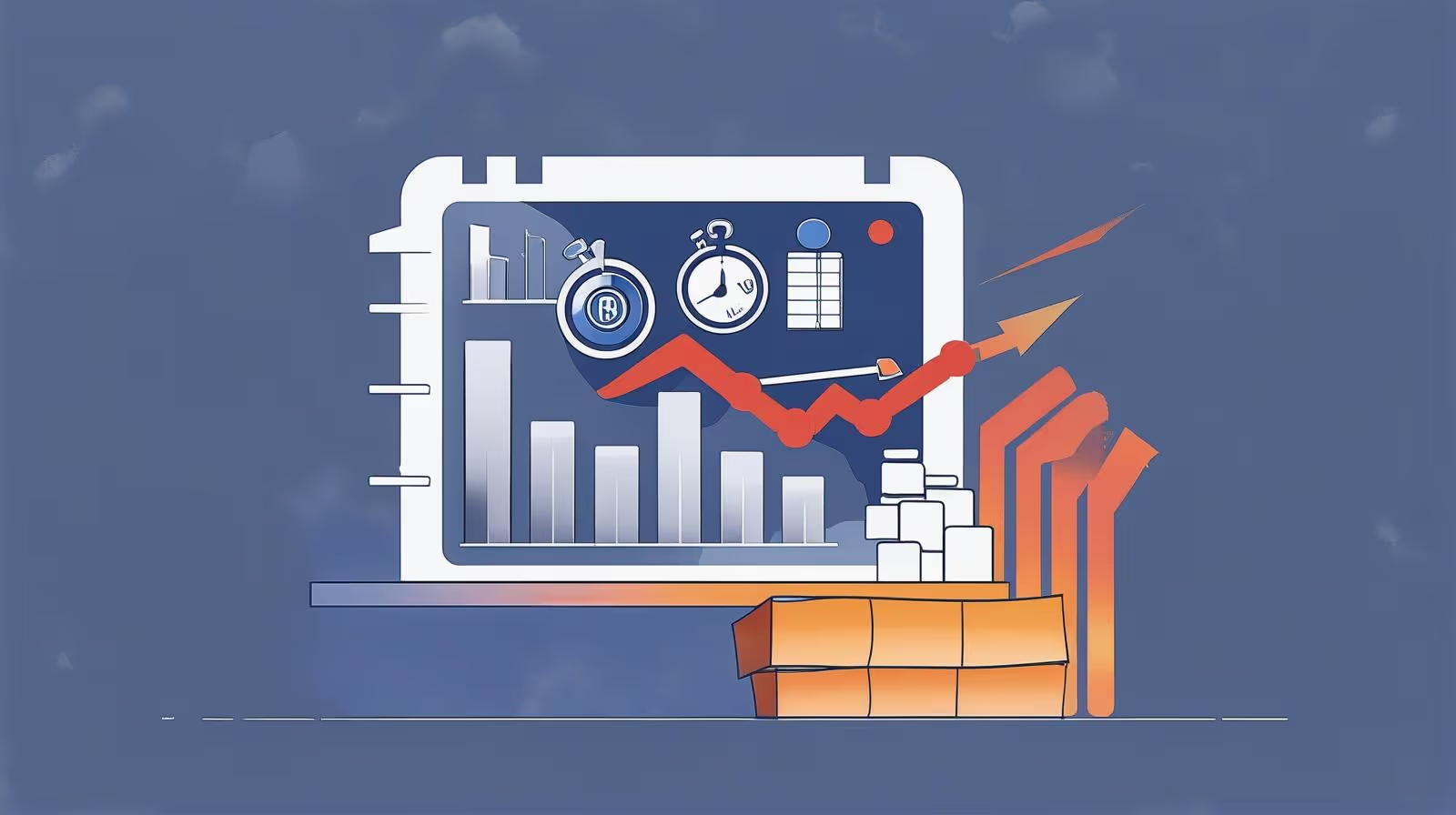
Reporting and comparative analysis simulations
BOOPER MPS offers advanced reporting tools:
- Creating custom reports
- Monitoring key performance indicators (KPI pricing)
- Comparison of performance between points of sale
- Analysis by department, category, and period
Teams have a clear, shared, and actionable view of pricing performance.
 Price simulation
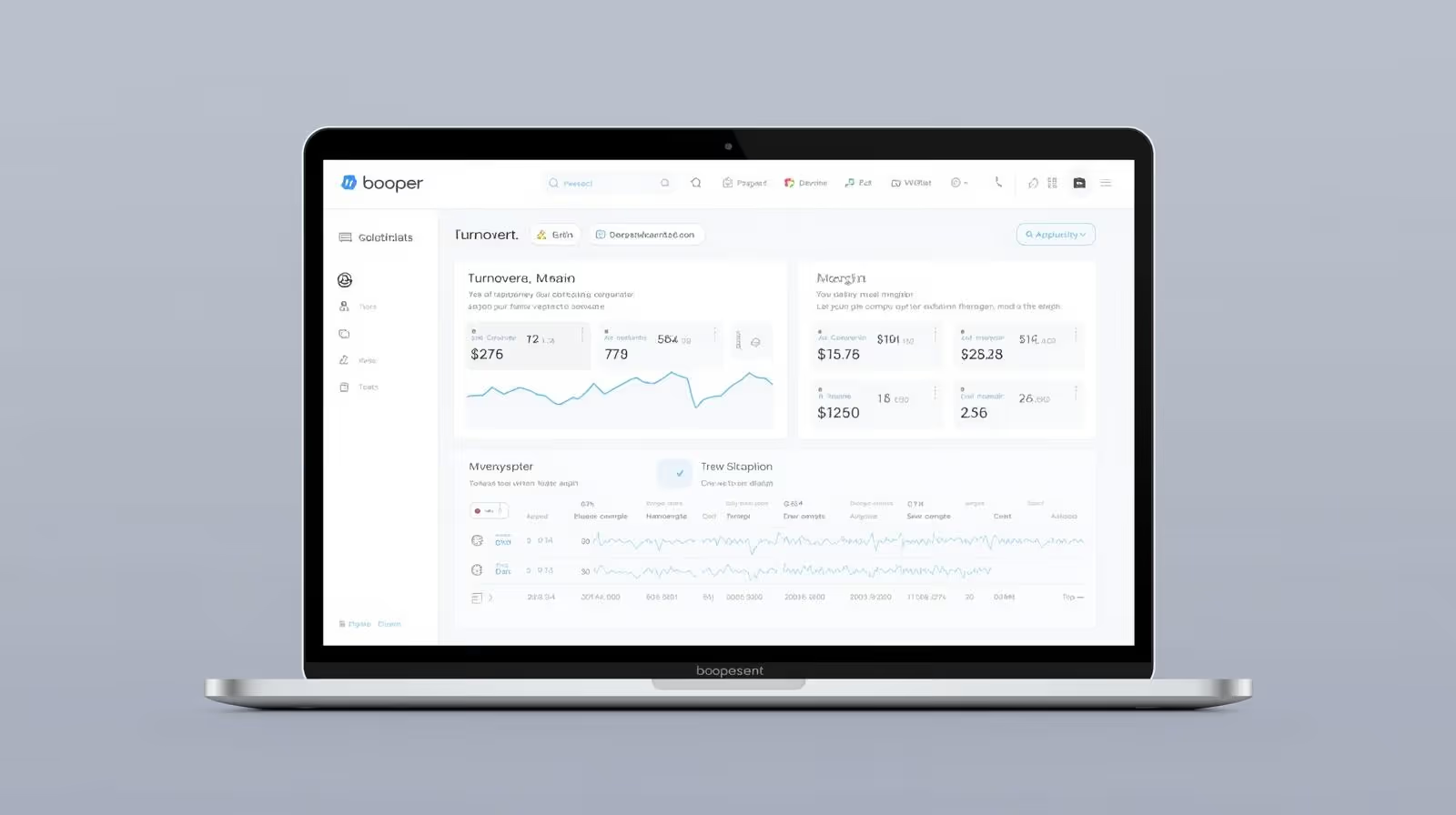
BOOPER MPS incorporates a price simulation engine (PSS) based on elasticity and AI to measure the impact of a pricing scenario on volume, revenue, and margin. It combines historical data, forecasts, and business rules to manage multiple objectives under constraints and support operational decision-making.
 Geopricing and Price Tiers
BOOPER MPS manages geo-pricing and price tiers. Prices are simulated and optimized according to elasticity levels, margin targets, and business constraints, ensuring global consistency, local differentiation, and multi-level performance management.

 Assortment management
BOOPER manages assortments according to formats, zones, and channels, integrating packaging sizes, sales forecasts, and product life cycles. Margin simulations enable decisions to be made on whether to introduce or withdraw products based on economic performance and profitability targets.

 Governance and management
BOOPER secures pricing decisions through structured governance based on explainable models, business rules, and complete traceability of simulations. Multi-level validations ensure strategic consistency, risk control, auditability, and control of margin and performance variances.

What is the " Pricing Optimization Software "?
Pricing Optimization Software encompasses all the methods and tools used to analyze price data to inform pricing decisions. In particular, it measures price elasticity, simulates various business scenarios, and assesses their impact on sales and margins to help a company develop a more effective and profitable pricing strategy. In practice, the Pricing Optimization Software draws on sales history, cost and margin data, and often competitive data, to generate actionable metrics: price elasticity (how demand responds to a price change), cannibalization effects between similar products, and store segmentation based on each store’s specific price sensitivity. These metrics replace intuition or generic rules with insights based on actual customer behavior. At BOOPER, this analytical component is not isolated: it directly feeds the price recommendation engine (Price Optimization) and the simulation modules, enabling a seamless transition from diagnosis (“what is the impact of a price change”) to decision (“what price to set”) without switching tools or data sources. This provides pricing, category management, and finance teams with a common foundation for making decisions. For a retailer, a robust " Pricing Optimization Software " is what enables a shift away from management based on gut feelings or spreadsheets toward measurable management of margins, competitiveness, and price perception—a prerequisite for any structured pricing governance approach at the network level.
What is the difference between " Pricing Optimization Software " and "Price Optimization" software?
Pricing Optimization Software provides an analytical understanding of pricing issues—elasticity models, store segmentation, and cross-product relationships—while Price Optimization transforms this analysis into operational recommendations for optimal prices, aligned with a defined strategy (margin, volume, price image, inventory management). BOOPER unifies these two dimensions within a single decision-making engine. In practice, the “ Pricing Optimization Software ” answers the question “what is happening and why”: it measures how demand responds to a price change (simple or cross-price elasticity), identifies cannibalization effects among similar SKUs, and segments stores based on their sales behavior. Price Optimization answers the question, “What price should be set?”: it draws on these analyses to calculate—subject to constraints (margin thresholds, rounding rules, competitive positioning)—the price that maximizes the retailer’s objective. Separating these two steps into distinct tools often creates a disconnect: the analysis yields insights that teams must then manually translate into pricing decisions, with the risk of information loss or delays. By integrating both into a single engine, BOOPER makes the analysis the direct input for pricing recommendations, which accelerates the transition from insight to decision and ensures consistency between what is measured and what is actually recommended. For a pricing department, this integration transforms the nature of the teams’ work: rather than juggling between an analytics tool and a separate decision-making process, they manage a continuous workflow where every pricing recommendation remains traceable back to the analysis that generated it—a direct benefit for the governance and auditability of pricing decisions.
What is Dynamic Pricing?
Dynamic Pricing involves continuously adjusting prices based on internal and external factors: changes in demand, inventory levels, seasonality, competitive positioning, price elasticity, margin targets, and sales constraints. Unlike a one-time, static price review, it relies on business rule scenarios and optimization algorithms to offer the right price, at the right time, for the right product. This continuous process does not mean uncontrolled management: each adjustment remains governed by the business rules defined by the retailer—minimum margin thresholds, maximum competitive alignment deviations, and product line consistency—so that the frequency of price changes supports the commercial strategy without destabilizing it. It is this combination of business rules and predictive models that distinguishes a controlled dynamic pricing approach from a purely algorithmic and opaque adjustment. In retail, dynamic pricing is typically applied to categories with high demand volatility or high competitive exposure—seasonal products, categories frequently shopped online, weather-sensitive products—where a traditional weekly or monthly price review does not allow for a fast enough response to market movements or spikes in demand. For a retailer, the challenge of dynamic pricing is not just about responsiveness: it’s about the ability to remain competitive at all times while maintaining its price image—a balance that requires robust governance to avoid price fluctuations that customers perceive as inconsistent or opportunistic.
Are there any limits to the integration of our business rules?
No, the solution operates through scenarios that combine an unlimited number of business rules. Each client can model its own constraints and decision-making logic: margin thresholds, rounding rules, product hierarchies, pricing strategies by category or brand, promotional constraints, or rules for aligning with or deviating from certain competitors. This scenario-based approach allows for testing multiple strategies in parallel—for example, a defensive stance against an aggressive competitor versus an offensive stance in a strategic category—and measuring their impact before going live. The rules are therefore not set in stone: they can be combined, prioritized relative to one another, and adjusted as the retailer’s business strategy evolves. This approach ensures both flexibility and risk management: the optimization engine provides pricing recommendations that consistently adhere to the constraints defined by the business teams, thereby preventing an algorithmic recommendation from deviating from the retailer’s pricing policy. The rules act as a framework within which the AI optimizes, rather than as a simple checklist applied after the fact. For a pricing department, this ability to model an unlimited number of business rules is what makes the transition to AI-assisted management acceptable to teams: consistency with the existing commercial policy is maintained, while the burden of manual, product-by-product verification gradually disappears.
Is it suitable for organizations with an older IT system?
Yes. BOOPER integrates with existing IT environments using a Data Loader capable of adapting to existing data flows—flat files, ERP exports, databases, or APIs—without requiring a prior overhaul of the information system. The goal is not to transform the existing IT system but to connect to it in a pragmatic way, in three steps: retrieving the necessary data (prices, costs, sales, inventory, product and store catalogs), processing and optimizing it within the platform, and then delivering pricing recommendations directly into the business tools already used by teams (ERP, point-of-sale systems, PIM). This approach minimizes the impact on the IT organization and enables a phased rollout, even in environments with technical constraints: an initial scope (a category, a channel) can be connected and then expanded, rather than requiring full integration from the project’s launch. This is a key factor for groups whose IT systems have been built in successive phases—through acquisitions or organizational changes—where a comprehensive overhaul would be neither realistic nor desirable in the short term. For both an IT department and a pricing department, this approach of connecting rather than replacing systems reduces project risk and accelerates deployment: the value of predictive price management becomes accessible without having to wait for an IT system modernization project, which often takes several years to complete.
Can we work on the MPS without competitor data?
Yes, competitor data is not a mandatory requirement for using BOOPER’s “ Pricing Optimization Software ” module. When competitor data is missing or incomplete, the platform draws on other internal sources to generate consistent pricing recommendations. These sources include, in particular, sales history, price sensitivity measured via elasticities, product-specific costs and profitability targets, product cycles and seasonality, as well as business expertise derived from comparable projects conducted in similar categories. This combination makes it possible to set prices that are consistent with the market while meeting the margin and volume targets set by the retailer, without relying on an external data feed. This flexibility is intended as a starting point, not a definitive limit: when competitive data becomes available—through web scraping, panelists, or field surveys—it is integrated as an additional building block into the recommendation engine, which refines the scenarios and enhances the accuracy of the proposed prices, without requiring any reconfiguration of the existing model. For a retailer launching a pricing project without a mature competitive intelligence system, this approach avoids delaying deployment while waiting for an external data collection initiative: pricing governance can already rely on solid internal fundamentals (margin, elasticity, turnover), with the competitive dimension subsequently enriching an already operational system.
Is it suitable for complex store networks?
Yes. BOOPER is designed for multi-store and multi-channel environments, with geopricing and store clustering that allow prices to be differentiated by area while maintaining overall consistency in the pricing strategy. Clustering groups stores based on criteria relevant to pricing—local competitive intensity, customer profile, and store format—rather than treating each store in isolation. Geopricing then adjusts prices within ranges defined by the central pricing policy, based on the actual competition surrounding each store, rather than a generic competitor tracked at the national level. This architecture enables a two-tiered approach: at headquarters, to steer strategy and monitor the network’s consolidated performance; and in-store, to give local teams the responsiveness needed to address competitor price movements without waiting for central approval for each product SKU. Governance, however, remains centralized, with local discretion exercised within the rules defined by the pricing department. For a complex, multi-brand, or multi-format network, this balance between central management and local flexibility makes it possible to reconcile a consistent price image across the group with true competitiveness against local competitors.
Can a strategy be simulated before deployment?
Yes. BOOPER’s “ Pricing Optimization Software ” module enables ex-ante simulations based on historical in-store and e-commerce data, allowing teams to compare multiple scenarios before rolling out any changes. Specifically, teams can test different scenarios—such as a targeted price increase, stricter competitive alignment, or a region-specific pricing strategy—and measure their projected impact on sales volume, revenue, and margin before implementing any changes in the field. Each scenario is based on price elasticity models specific to each product or category, which allows for a more nuanced estimate of demand response than a simple rule applied to historical data. This simulation capability is what convinced one of our clients in the food industry to evolve its approach to pricing: moving from reactive management—where the impact of a decision was measured only after the fact—to predictive management, where multiple scenarios are compared and evaluated before implementation. The ability to test the effect of the specific characteristics of each product category—rather than applying a one-size-fits-all rule—provides a direct lever for ensuring sound business decisions with high stakes. For a pricing department, simulating before rolling out a strategy reduces the risk associated with any fundamental pricing decision: a poorly calibrated price increase or overly aggressive competitive alignment can have a lasting impact on sales volumes or price perception—simulation allows these choices to be evaluated based on quantified projections rather than intuition alone.
How does BOOPER improve price governance?
BOOPER improves pricing governance by structuring the decision-making process around traceability: every scenario, every simulation, and every recommendation is documented, transforming previously scattered pricing decisions (Excel files, informal exchanges) into a measurable and auditable process. In practice, decisions go through validation workflows defined by the organization: a pricing recommendation generated by the engine can be submitted for validation by the pricing teams, shared with the sales department, and then approved by management before being implemented. Each step is logged—who proposed it, who approved it, based on which database, and according to which business rule—allowing the reasoning behind a price to be reconstructed retrospectively. This structure is built on BOOPER’s scenario engine: business rules (margin thresholds, product hierarchies, competitive alignment constraints) are explicitly defined and modeled within the tool rather than applied informally by individual analysts, which reduces variations in practice across teams or geographic regions and facilitates internal audits. This is the approach implemented at one of our clients in the food sector, where the challenge was not to add yet another tool but to improve the ability to make consistent pricing decisions at scale, by balancing automation, governance, and decision-making control by business teams. For a pricing department, this enhanced governance limits the risk of pricing inconsistencies across stores or channels, safeguards the brand’s price image, and provides sales and finance teams with shared visibility into margin-versus-competitiveness trade-offs—an issue that is all the more critical given the extensive retail network and high volume of SKUs.
Solutions
Pricing Optimization Software
A pricing tool focused on margin performance and effective business governance.
Sales forecasting using AI
Anticipate demand and improve your business decisions with AI
Product matching: Cloning and chaining
Make your product comparisons more reliable with AI
Promotion management
Manage your promotions with precision and maximize their profitability
Markdown and Clearance Sale
Optimize your markdowns and accelerate the sale of your inventory
Studies & Data
Price surveys and web scraping
Monitor your competitors' prices online and offline
Diagnosis Price
Optimize your pricing strategy and secure your decisions
Price strategy development
Use your pricing strategy as a lever for creating sustainable value
Council
Operational Pricing Consulting
Bring clarity and control to your pricing decisions
Change management
Make your teams the driving force behind your pricing transformation
Pricing Training
Develop your operational or strategic skills

Lorem ipsum dolor sit amet, consectetur adipiscing elit. Suspendisse varius enim in eros elementum tristique. Duis cursus, mi quis viverra ornare, eros dolor interdum nulla, ut commodo diam libero vitae erat. Aenean faucibus nibh et justo cursus id rutrum lorem imperdiet. Nunc ut sem vitae risus tristique posuere.
Lorem ipsum dolor sit amet, consectetur adipiscing elit. Suspendisse varius enim in eros elementum tristique. Duis cursus, mi quis viverra ornare, eros dolor interdum nulla, ut commodo diam libero vitae erat. Aenean faucibus nibh et justo cursus id rutrum lorem imperdiet. Nunc ut sem vitae risus tristique posuere.
Heading 1
Heading 2
Heading 3
Heading 4
Heading 5
Heading 6
Lorem ipsum dolor sit amet, consectetur adipiscing elit, sed do eiusmod tempor incididunt ut labore et dolore magna aliqua. Ut enim ad minim veniam, quis nostrud exercitation ullamco laboris nisi ut aliquip ex ea commodo consequat. Duis aute irure dolor in reprehenderit in voluptate velit esse cillum dolore eu fugiat nulla pariatur.
Block quote
Ordered list
- Item 1
- Item 2
- Item 3
Unordered list
- Item A
- Item B
- Item C
Bold text
Emphasis
Superscript
Subscript