Easily identify comparable products despite inconsistent descriptions and multiple reference systems
Maintain reliable and comprehensive competitive intelligence
Structure the product chain over time (new packaging, changes in product codes, innovations)
Managing the complexity of the three-pronged approach: National Brands (NB) / Private Label Brands (PLB) / First Prices (FPx)
Secure pricing decisions through relevant and audited comparisons
Drastically reduce the time spent on manual chaining
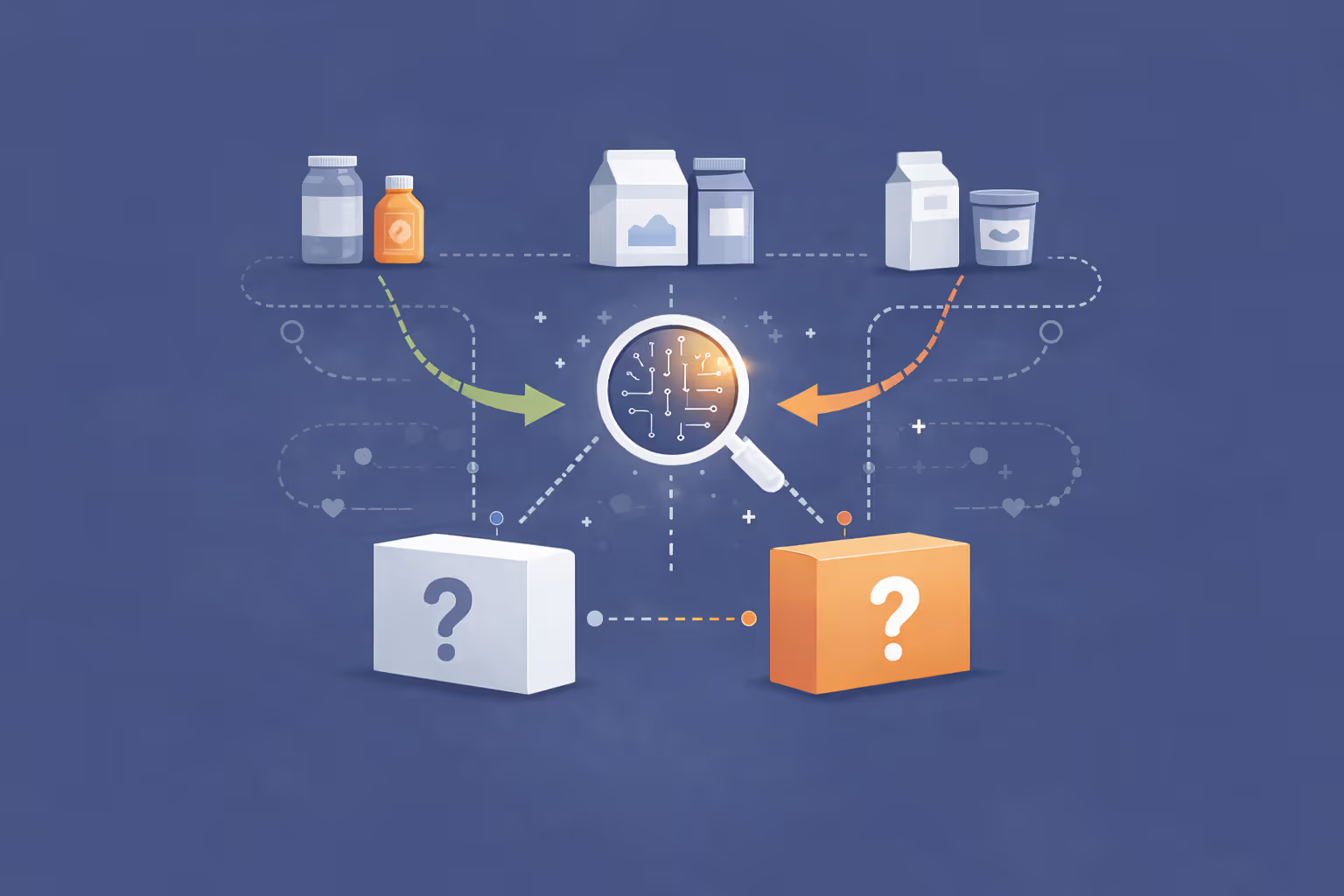
Smart association of non-comparable products
BOOPER MPS relies on visual recognition and machine learning algorithms capable of identifying matches between products even when labels and attributes are incomplete or inconsistent.
The models automatically analyze:
- Product labels and descriptions
- Technical attributes (weight, size, capacity, recipe, composition)
- Categories and subcategories
- Brand and price positioning
- Price behavior history
The association is based on multiple criteria in order to obtain reliable, contextualized associations that can be used by pricing teams.
The result: a consolidated view of product equivalencies across brands, formats, and markets.

Automatic chaining of your products
BOOPER MPS dynamically links your references to maintain continuity of analysis despite:
- Changes to item codes
- Packaging developments
- Range renovations
- Supplier substitutions
- Product innovations
Each product is linked to a logical chain that allows you to keep track of sales performance and price history.
You avoid breaks in analysis and ensure the temporal consistency of your indicators.

Cloning with competing products
BOOPER MPS allows you to automatically create product clones between your assortment and that of your competitors in order to:
- Compare equivalent products of the same brand, or simply those with a different EAN.
- Identify pricing positioning gaps
- Identify opportunities for adjustment • Monitor competitive developments over time
Competitive cloning directly feeds into the " Pricing Optimization Software " and "simulation" modules.
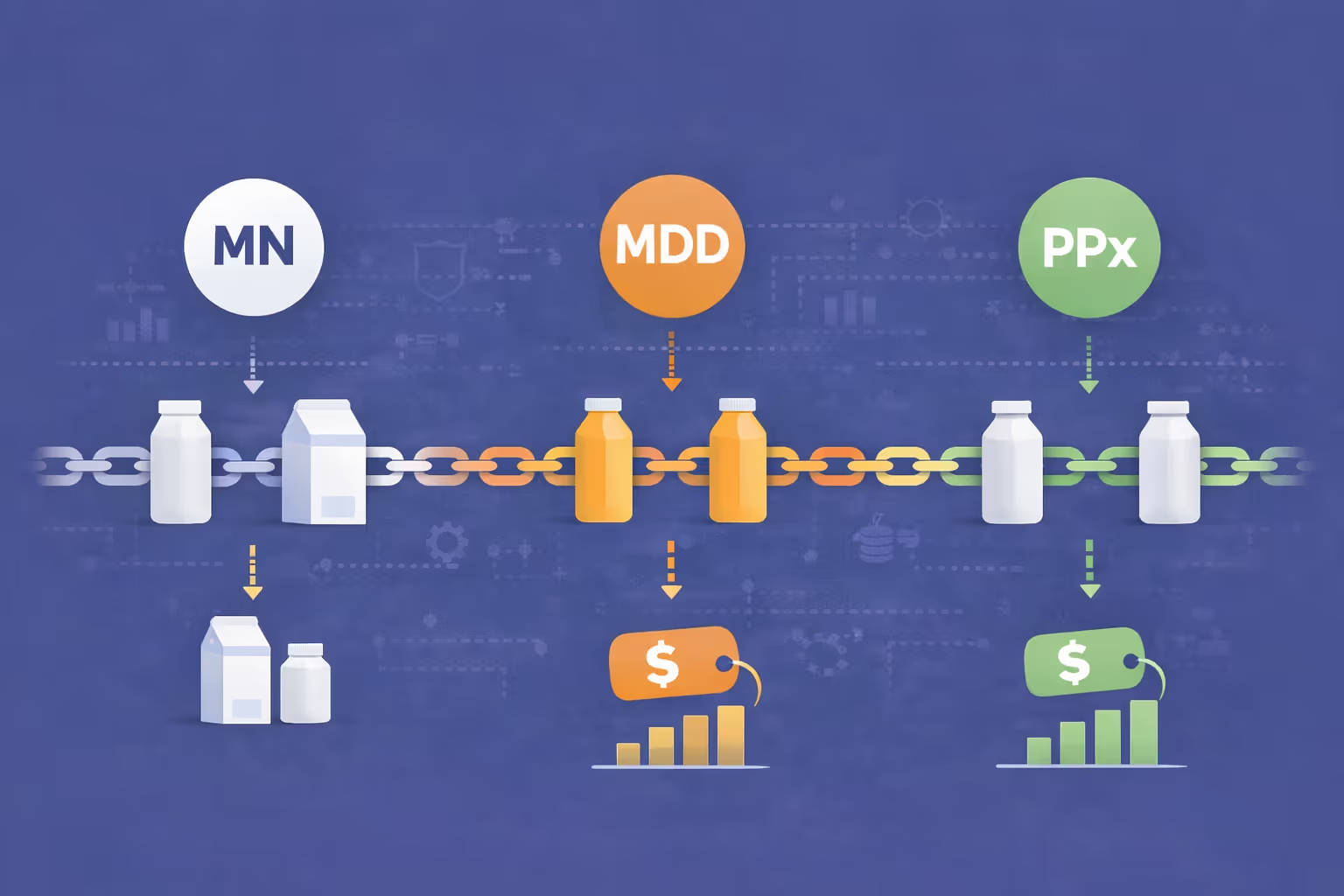
Chaining of the MN / MDD / PPx triptych
BOOPER MPS structures relationships between:
- National Brands (NB)
- Private Label Brands (PLB)
- First Prizes (PPx)
AI identifies substitutable and comparable products based on their functional attributes and price positioning.
This modeling allows:
- Analyze cannibalization effects • Optimize pricing architectures
- To steer strategies for moving upmarket or defending prices

Statistics and indicators of quality of associations
BOOPER MPS incorporates advanced statistical tools to manage the quality of associations:
- Competitive coverage rate
- Correspondence reliability rate
- Number of active chained products
- Product volumes matched by category
- History of human validations
These indicators ensure complete control over the data used for pricing decisions.

Dynamic dashboard and operational management
BOOPER MPS offers dashboards that enable you to:
- View product matches
- Filter by category, store, brand, or geographic area
- Monitoring product line developments
- Identify unmatched products
- Prioritize validation actions
The pricing, purchasing, and data teams have a clear, shared, and actionable view of the product repository.

Visual recognition products
To go beyond the limitations of text labels and attributes, BOOPER MPS incorporates AI-based image and label recognition technologies.
The algorithms automatically analyze:
- Packaging and product design
- Distinctive shapes, colors, and visuals
- Variations in format and appearance
This approach is particularly effective when:
- Product descriptions are incomplete or inconsistent
- References differ between brands (e.g., private labels).
- The products are visually similar but described differently.
Visual recognition enhances the reliability of associations and ensures competitive comparisons across complex categories (food, non-food, fresh produce, DIY, gardening, etc.).
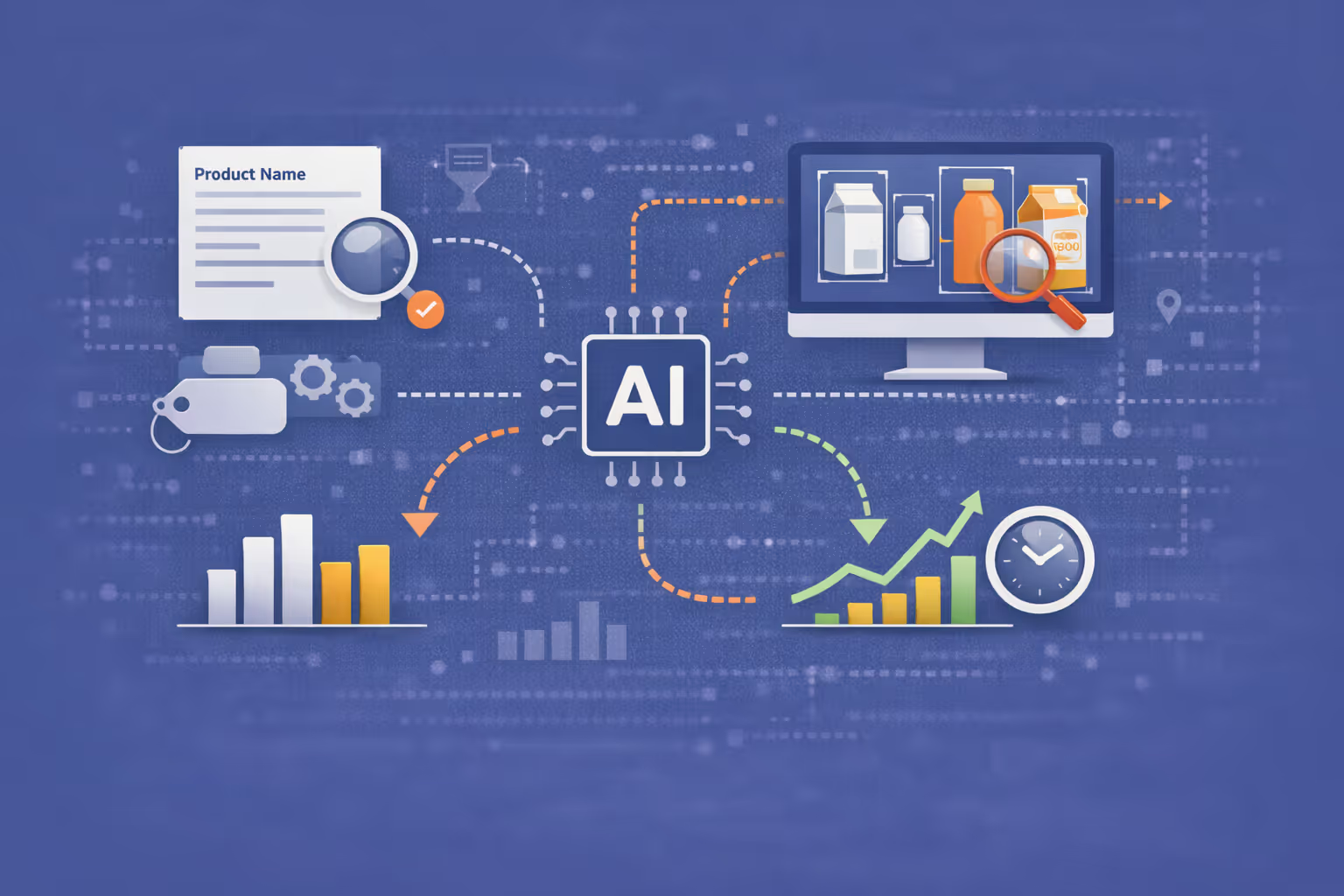
Associations multimodal (text + image + attributes)
BOOPER MPS combines multiple sources of analysis in a single engine:
- Semantic analysis of product labels
- Technical and categorical attributes
- Visual recognition by image
- Price and behavior history
This allows:
- To reduce false positives and false negatives
- Identify substitutable products that are not strictly identical
- Improve overall competitive coverage
The models continuously learn from business validations in order to increase accuracy over time.

Advanced identification substitutes and purchasing behaviors
Visual similarity directly influences consumer perception and substitution mechanisms.
By integrating images into associations, BOOPER MPS enables:
- Identify products that are truly competitive from the customer's perspective
- Anticipating cannibalization effects
- Better model interactions between MN, MDD, and PPx
- To enrich elasticity and pricing analyses
This approach improves the relevance of pricing decisions in highly competitive environments.
 Price simulation
BOOPER MPS incorporates a price simulation engine (PSS) based on elasticity and AI to measure the impact of a pricing scenario on volume, revenue, and margin. It combines historical data, forecasts, and business rules to manage multiple objectives under constraints and support operational decision-making.
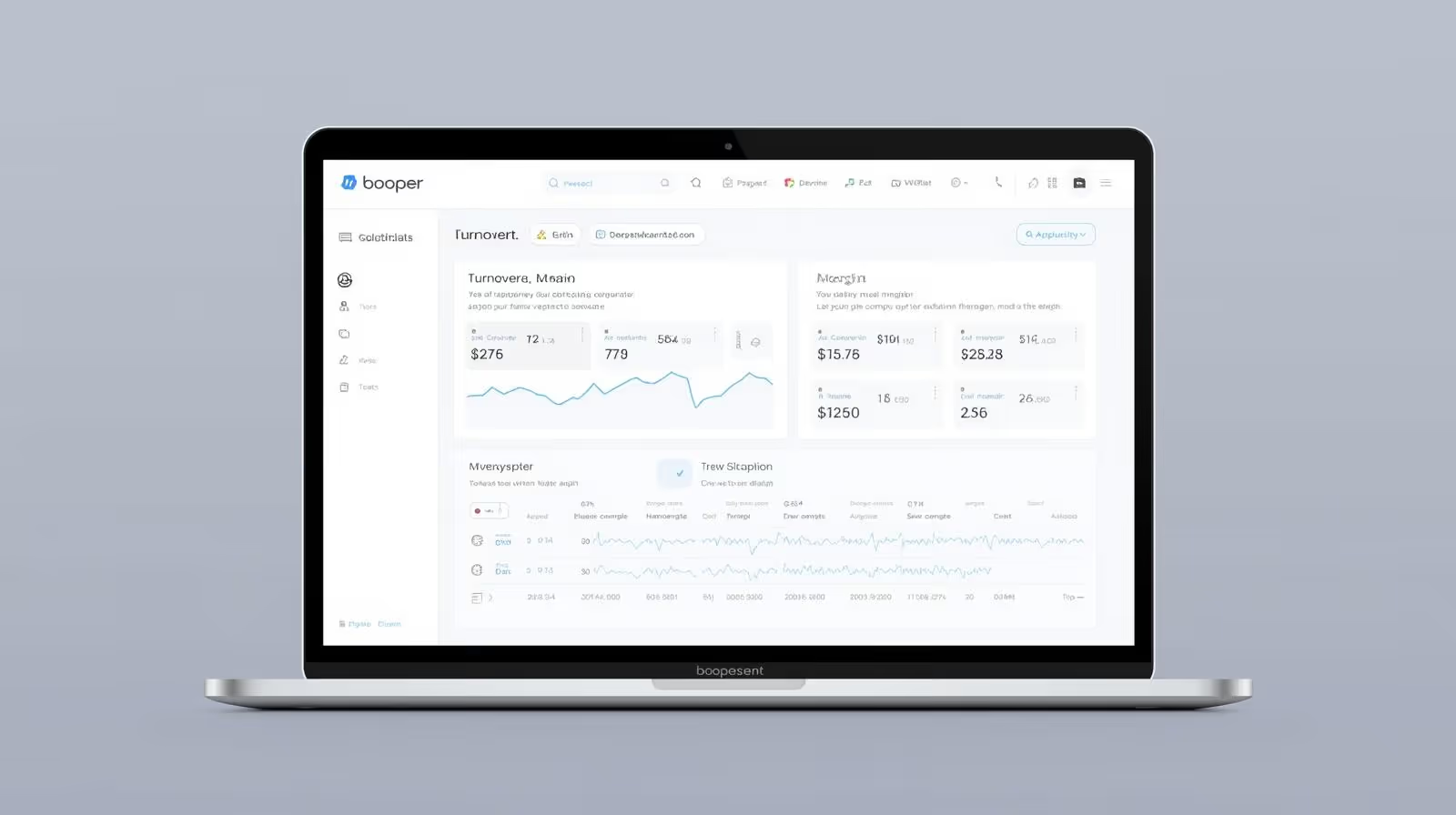
 Geopricing and Price Tiers
BOOPER MPS manages geo-pricing and price tiers. Prices are simulated and optimized according to elasticity levels, margin targets, and business constraints, ensuring global consistency, local differentiation, and multi-level performance management.

 Assortment management
BOOPER manages assortments according to formats, zones, and channels, integrating packaging sizes, sales forecasts, and product life cycles. Margin simulations enable decisions to be made on whether to introduce or withdraw products based on economic performance and profitability targets.

 Governance and management
BOOPER secures pricing decisions through structured governance based on explainable models, business rules, and complete traceability of simulations. Multi-level validations ensure strategic consistency, risk control, auditability, and control of margin and performance variances.

What is product bundling in retail pricing?
Product matching—or “matching” in certain situations—involves automatically identifying equivalent products across different retailers or product lines in order to compare their prices, performance, and competitive positioning on a consistent basis. This process addresses a simple yet fundamental issue: comparing prices only makes sense if one is comparing products that are truly equivalent. Without reliable matching, competitive intelligence risks comparing products that are similar but different—such as a distinct format or a slightly different composition—and thereby skewing conclusions about the retailer’s actual price positioning. BOOPER MPS structures this product association through several complementary mechanisms: automatic AI-powered matching for cases where matches can be detected via product names and attributes; cloning when no direct EAN match exists; and chaining to organize relationships among the retailer’s own products. For a retailer, this product association is an often-overlooked but essential prerequisite for any serious competitive pricing strategy: it determines the reliability of price monitoring and, consequently, the relevance of pricing decisions made in response to or in anticipation of market conditions.
How does artificial intelligence improve product pairing?
The AI simultaneously analyzes product descriptions, attributes, formats, brands, and pricing patterns to detect similarities that are invisible to human analysis. It continuously learns from user validations to improve its accuracy. When available, the AI also incorporates image recognition. The main benefit of AI in this area is its ability to handle heterogeneous product names: two different retailers rarely name the same product in the same way, making it impossible to reliably match items based solely on text correspondence. Natural language processing makes it possible to recognize that two items are the same product despite different names, by relying on attributes, format, and brand in addition to the product name. This accuracy improves over time thanks to a continuous learning mechanism: each validation or correction made by a user enriches the model, which gradually refines its recommendations for future matches rather than remaining fixed on its initial settings. For a retailer, this capability changes the scale at which matching can be performed: manual product matching quickly reaches its limits when dealing with an assortment of several thousand SKUs tracked across multiple competing retailers, whereas AI enables this volume to be handled while still allowing for human validation in uncertain cases.
What is the difference between product cloning and product chaining?
When there is no direct association via EAN, cloning takes over and links the retailer’s products with those of competitors; this applies equally to private-label and national brands. The other type of complementary relationship is chaining: the retailer’s products are grouped together to establish links based on hierarchy, coefficients, and historical patterns. These two mechanisms serve different purposes. Cloning facilitates competitive comparison: it allows a retailer’s product to be matched with a competitor’s equivalent when automatic matching via a standard identifier (EAN) is not possible—for example, for a private-label product that has no direct equivalent listed by the competitor. Chaining, on the other hand, operates internally within the retailer’s product assortment: it structures hierarchical links between closely related SKUs (variations in formats and packaging) and coefficients that enable the reconstruction of a coherent history even when SKUs evolve or are replaced over time. For a retailer, these two approaches are complementary rather than redundant: cloning ensures the accuracy of external competitive analysis, while chaining ensures the continuity and consistency of internal analysis, particularly when a product changes its SKU without actually changing its nature.
How does BOOPER handle MN, private label, and budget brands?
BOOPER identifies substitutable products based on their functional attributes and price positioning in order to structure MN/MDD/PPx chains and analyze the effects of cannibalization and up-selling. This structuring addresses a central challenge in category management: national brands, private labels, and budget brands are not isolated categories but product lines that interact with one another in customers’ purchasing decisions. Linking these products together makes it possible to analyze how a price change for one affects the sales of the others, rather than analyzing each product line in isolation. In practical terms, this analysis highlights cannibalization effects—a customer switching from a national brand to a private label when the price gap narrows too much—or up-selling effects, when the perceived difference in quality justifies a wider price gap without a loss in volume. For a retailer, this cross-analysis of national brands, private labels, and premium products is crucial for building a coherent pricing strategy within a category: setting the price of a private label without considering its positioning relative to the equivalent national brand amounts to ignoring a large part of the actual dynamics of demand on the shelf.
Is the association fully automated?
No, the association process is not fully automated. Although recommendations are becoming increasingly intelligent and automated, the association process requires human validation to enable the algorithms to learn. This choice is not a technical limitation but a methodological principle: an erroneous association subsequently skews all competitive analyses that rely on it, with a cascading effect on pricing decisions. Maintaining human oversight over uncertain cases prevents matching errors from silently propagating throughout pricing management. This approach is part of a continuous learning process: the more users validate or correct the AI’s suggestions, the more the model refines its accuracy and, over time, reduces the number of cases requiring manual intervention. Automation is therefore advancing, but it is always accompanied by business-side oversight of the less obvious price matching decisions. For a retailer, this balance between automation and human validation ensures reliability: it prevents the quality of the product database from being sacrificed for the sake of processing speed, given that this database directly determines the accuracy of pricing decisions based on competitive comparisons.
What data is needed to set up an effective association?
MPS utilizes product catalogs, product descriptions, technical attributes, price histories, and competitive data. The richer the data, the more accurate the product pairing recommendations. The product catalog and product descriptions form the basis of the matching process: the more complete and structured the available attributes are (format, brand, packaging, category), the more reliable information the AI has to distinguish between products that are truly equivalent and those that are merely similar. Price histories and competitive data then refine and validate these matches over time. When product catalogs are incomplete or poorly structured—with generic descriptions or missing attributes—the accuracy of the association suggestions suffers directly, which explains why human validation remains necessary in cases where the source data is of poor quality. For a retailer, this means that the quality of product matching depends in part on a foundational task that is often overlooked: structuring and ensuring the reliability of the internal product catalog, which determines the performance of all the modules that subsequently rely on it—from matching to competitive analysis.
What is the ROI of a product association and chaining module?
The benefits stem from reduced manual effort, reliable price comparisons, improved business decisions, and overall competitive performance. The first benefits are typically seen within a few months. The time saved on manual work is often the first visible benefit: comparing product lines across competing retailers is traditionally a time-consuming task when done manually, item by item, and is particularly difficult to keep up to date across a broad product range with a high product turnover rate. The gain in reliability, on the other hand, is less directly measurable but carries greater weight in the long term: competitive comparisons built on a reliable product database prevent pricing decisions from being skewed by inaccurate alignments, which improves the quality of pricing decisions over the long term rather than just for a single campaign. For a retailer, this module often serves as a foundational building block that is less visible but crucial: it does not directly generate profit margins on its own, but it determines the reliability of all competitive analyses and pricing decisions that subsequently rely on these product comparisons.
Solutions
Pricing Optimization Software
A pricing tool focused on margin performance and effective business governance.
Sales forecasting using AI
Anticipate demand and improve your business decisions with AI
Product matching: Cloning and chaining
Make your product comparisons more reliable with AI
Promotion management
Manage your promotions with precision and maximize their profitability
Markdown and Clearance Sale
Optimize your markdowns and accelerate the sale of your inventory
Studies & Data
Price surveys and web scraping
Monitor your competitors' prices online and offline
Diagnosis Price
Optimize your pricing strategy and secure your decisions
Price strategy development
Use your pricing strategy as a lever for creating sustainable value
Council
Operational Pricing Consulting
Bring clarity and control to your pricing decisions
Change management
Make your teams the driving force behind your pricing transformation
Pricing Training
Develop your operational or strategic skills

Lorem ipsum dolor sit amet, consectetur adipiscing elit. Suspendisse varius enim in eros elementum tristique. Duis cursus, mi quis viverra ornare, eros dolor interdum nulla, ut commodo diam libero vitae erat. Aenean faucibus nibh et justo cursus id rutrum lorem imperdiet. Nunc ut sem vitae risus tristique posuere.
Lorem ipsum dolor sit amet, consectetur adipiscing elit. Suspendisse varius enim in eros elementum tristique. Duis cursus, mi quis viverra ornare, eros dolor interdum nulla, ut commodo diam libero vitae erat. Aenean faucibus nibh et justo cursus id rutrum lorem imperdiet. Nunc ut sem vitae risus tristique posuere.
Heading 1
Heading 2
Heading 3
Heading 4
Heading 5
Heading 6
Lorem ipsum dolor sit amet, consectetur adipiscing elit, sed do eiusmod tempor incididunt ut labore et dolore magna aliqua. Ut enim ad minim veniam, quis nostrud exercitation ullamco laboris nisi ut aliquip ex ea commodo consequat. Duis aute irure dolor in reprehenderit in voluptate velit esse cillum dolore eu fugiat nulla pariatur.
Block quote
Ordered list
- Item 1
- Item 2
- Item 3
Unordered list
- Item A
- Item B
- Item C
Bold text
Emphasis
Superscript
Subscript