
Clearance and Markdown: Definition, Method and Example
On this page
Do your markdowns maximize your profit margin?
Schedule a meetingCheck out our Markdown and Clearance SaleClearance sales involve selling off excess or end-of-life stock before it loses value. In retail, this is primarily achieved through markdowns : tiered price reductions at the end of a season, collection, or product lifecycle. Unlike promotions, which aim to drive traffic, markdowns serve the purpose of inventory management.
The Essentials in 6 Questions
End-of-cycle price cuts to clear out inventory.
Pricing, procurement, supply, and category managers.
End of the season or end of the collection, planned from the time of purchase.
Especially in fashion, high-tech, seasonal items, and fresh produce.
Recoup cash flow and profit margins rather than sell off assets at a loss.
Gradual increments above a minimum price.
Why Markdown Protects the Margin
Because unsold inventory ties up cash and loses value, whereas a well-managed markdown recovers most of that value.
- Free up cash flow: Recover tied-up capital, even with reduced margins.
- Avoiding obsolescence: A product from last season or an outdated model quickly loses all its value.
- Make room on the shelves and in the warehouse for new, more profitable products.
This is different from traditional promotions, which focus on traffic or volume.
Real-life example: 300 unsold summer dresses
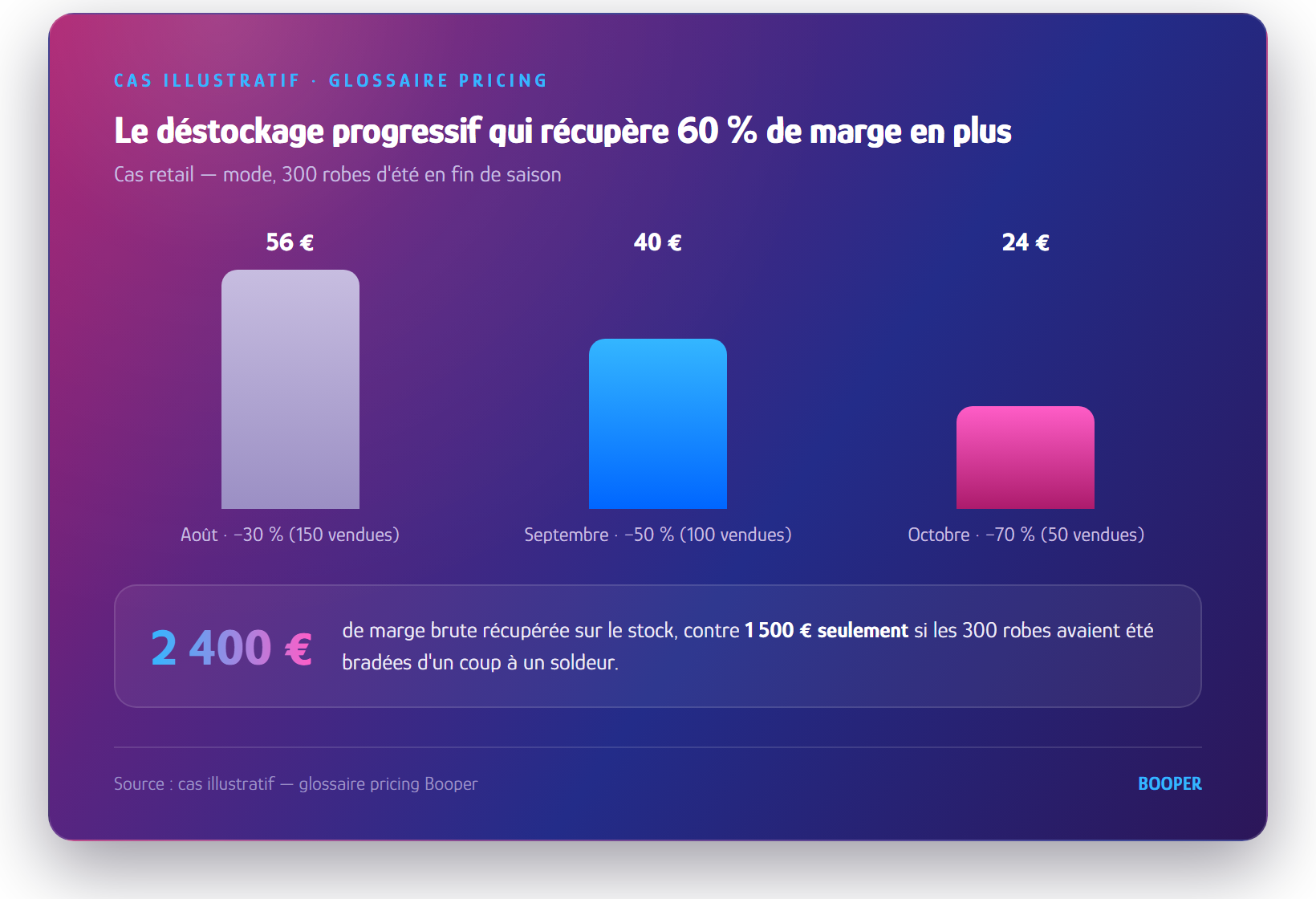
A gradual price reduction yields a gross profit of €2,400 on 300 dresses, compared to €1,500 if they were sold to a discount retailer.
| Bearing | Price | Dresses Sold |
|---|---|---|
| August, -30% | 56 € | 150 |
| September, 50% off | 40 € | 100 |
| October, -70% | 24 € | 50 |
Purchased at €30 each; €11,400 in revenue from the remaining inventory. Illustrative example, Booper pricing glossary.
How can you optimize your markdowns?
By calculating, for each product, the sequence of price levels that maximizes the margin earned above a minimum price.
Measure the remaining inventory
By reference, store, and channel.
Monitor the flow rate
Actual sales pace compared to the time remaining until the end of the season.
Set the minimum price
The threshold below which it's best not to sell.
Calculate the steps
Dates and depths, adjusted based on the observed flow.
Markdown algorithms learn from past seasons to refine these calculations. This is the focus of our markdown and inventory clearance offering, which relies on AI-powered sales forecasting to anticipate remaining inventory. A comprehensive approach:the five key elements of a well-managed markdown strategy.
Clearance sales, markdown, shrinkage: don't confuse them
These terms appear in dashboards, but they do not refer to the same thing or the same levers.
| Concept | What It Is | Lever |
|---|---|---|
| Clearance sale | To dispose of excess or end-of-life stock, by any means necessary | Markdown, private sales, clearance outlets, donations |
| Markdown (trade markdown) | Voluntary and planned price reduction to accelerate sales | Price tiers, schedule, floor price |
| Unknown markdown | Discrepancy between theoretical and actual stock (theft, breakage, errors), unrelated to price | Control, inventories, security |
| Dormant stock | Stock that hasn't been circulating for several months | Priority candidate for clearance |
In an income statement, markdown and markdown both reduce the margin, but only the former is driven by price.
The 3 Most Common Mistakes in Markdown
Differentiating too late, too aggressively from the start, or without a plan reduces profit margins.
- Markdowns too late: Selling at 70% off during the last week destroys profit margins; start earlier, in stages.
- Markdown that's too aggressive from the start: jumping straight to 50% off leaves money on the table if some of the inventory would have sold at 20% off.
- No planning: Markdowns are anticipated at the time of purchase; buy less if you know that part of the inventory will end up on sale.
Frequently Asked Questions
Short answers to the most frequently asked questions about clearance and markdown.
What is clearance sales?
Clearance sales involve quickly selling off excess, seasonal, or end-of-life stock to free up cash and shelf space before the products lose value. In stores, this primarily involves tiered price reductions, known as markdowns, supplemented if necessary by private sales, discount outlets, secondary channels, or donations. A well-planned clearance sale recovers most of the profit margin; a rushed one results in drastically reduced stock prices. This is why clearance sales should be prepared from the point of purchase, with an estimate of remaining stock at the end of the season.
What is markdown?
Markdown, or markdowns, refers to price reductions applied at the end of a season, collection, or product lifecycle to clear remaining stock before it loses value. It is managed in stages: for example, -30%, then -50%, then -70%, depending on the sales rate and the time remaining. Unlike promotions, which aim to drive traffic, markdowns serve an inventory management purpose. The challenge is to find the sequence of price reductions that maximizes the profit margin above a minimum price.
What is the difference between a markdown and a promotion?
The difference between markdown and promotion lies in their objective. Promotions aim to generate traffic and volume for products in normal stock for a limited time, after which the price returns to its usual level. Markdown aims to clear excess or end-of-life stock, and the price reduction is permanent, sometimes even resulting in selling at a loss within legal limits. The two are not measured in the same way: a promotion is judged on incremental sales and cannibalization, while markdown focuses on recovered margin and avoided residual stock.
What is the difference between commercial shrinkage and unknown shrinkage?
Markdown and shrinkage are two different things. Markdown is a deliberate and planned price reduction to clear stock. Shrinkage is an unintentional loss: the difference between the theoretical stock, calculated from receipts and sales, and the actual stock present, due to theft, breakage, receiving errors, or cash register mistakes. Both reduce profit margins, but only markdown can be controlled through pricing; shrinkage can be mitigated through controls, inventory management, and security measures.
Is markdown still cost-effective?
No, markdowns aren't always profitable: each unit is sold at a loss below the purchase cost. However, they are often preferable to other methods, as an unsold product represents a 100% loss of its cost, not to mention storage and space. The goal, therefore, is to maximize the profit margin, not avoid it at all costs. Gradual markdowns, started early, generally yield higher returns than a last-minute clearance sale at a discount store. Profitability is measured over the entire season, not just the last week.
How can we reduce the need for Markdown?
To reduce the need for markdowns, action is taken before the season begins. First, sales forecasts are improved, by SKU and by store, to ensure precise purchasing. Second, restocking is done more frequently in small batches rather than buying everything at once, and new products are tested before bulk purchases. Finally, continuous sales monitoring is essential to react early, through inter-store transfers or initial small markdowns. AI-powered sales forecasting helps anticipate residual stock before it becomes a problem.
How should you handle price reductions during the sales?
During sales periods, markdowns are managed by implementing the planned tiered schedule while adjusting it to actual sales. If stock sells faster than expected, the next tier is delayed or reduced to avoid unnecessary margin losses; if it sells too slowly, it's accelerated to avoid having to rush to clear out remaining stock. Tracking is done by product reference and by store, with stock transfers when one store performs better than another. Dates and announcements of discounts must comply with legal sales regulations.
Key Takeaways
- Markdowns help clear out end-of-cycle inventory; promotions drive traffic.
- Set your price early and in stages, above a minimum price.
- Plan for it from the moment of purchase, based on reliable sales forecasts.
Do you want to stand out without unnecessarily sacrificing your profit margin?
Booper calculates the timing and discount levels that will move your inventory at the best price.
Let's talk about your markdowns →Check out our Markdown and Clearance SaleYou might also be interested in these articles

A markdown is a structural, non-reversible price reduction and should not be confused with a promotion. If not managed properly, it erodes profit margins due to excessive caution or excessive discounting.
Markdowns cost U.S. retailers approximately $300 billion annually, representing nearly 12% of the sector's revenue.
To manage this pricing strategy without triggering a panic reaction at the end of the season, BOOPER's Markdown and Clearance module quantifies the impact of a price reduction scenario before implementing it.

A markdown policy involves two distinct decisions: when to trigger each markdown tier, and by how much. Treating them separately, without a common framework, leads to inconsistencies across stores.
30 to 40 percent of the clothing produced worldwide is sold at a discount or never sold at all (McKinsey). The purpose of BOOPER’s Markdown & Clearance module is to automate this discount schedule and its triggering.

End-of-line inventory and dormant inventory are two forms of the same problem: tied-up value that no one has explicitly decided to address. The latter is more dangerous because it is unforeseen.
Overproduction and unsold inventory result in an estimated loss of between 70 and 140 billion dollars annually worldwide. Identifying this idle inventory before it piles up is the purpose of BOOPER’s Markdown & Inventory Clearance module.