
Structuring a data-driven pricing team:the B2B model

Edouard Calliati
CMO - CRO
February 19, 2026
Key takeaways: building a high-performing pricing team requires adopting a hybrid model that combines central strategy with local agility. This transition replaces intuition with data-driven decisions, orchestrated by expert roles and strict governance.
This proactive management directly transforms financial performance, targeting profitability increases of 100 to 500 basis points.
Are your margins quietly eroding because your pricing decisions still rely on fragile intuitions rather than hard facts? In a merciless B2B environment, the lack of rigorous management exposes your company to avoidable financial losses and weakens your competitive standing.
To reverse this trend and secure your profitability over the long term, you must structure a data-driven pricing team capable of transforming your raw data into a winning strategy. Here, we reveal the precise methodology for defining expert roles, selecting the right tools, and establishing the essential processes to transition your organization from reactive management to undeniable operational excellence.

Structuring a Data-Driven Pricing Team: Steps and Best Practices (B2B)
After witnessing the limitations of manual methods, it has become urgent to establish a rigorous framework to turn your data into a profit driver.
Article Objective
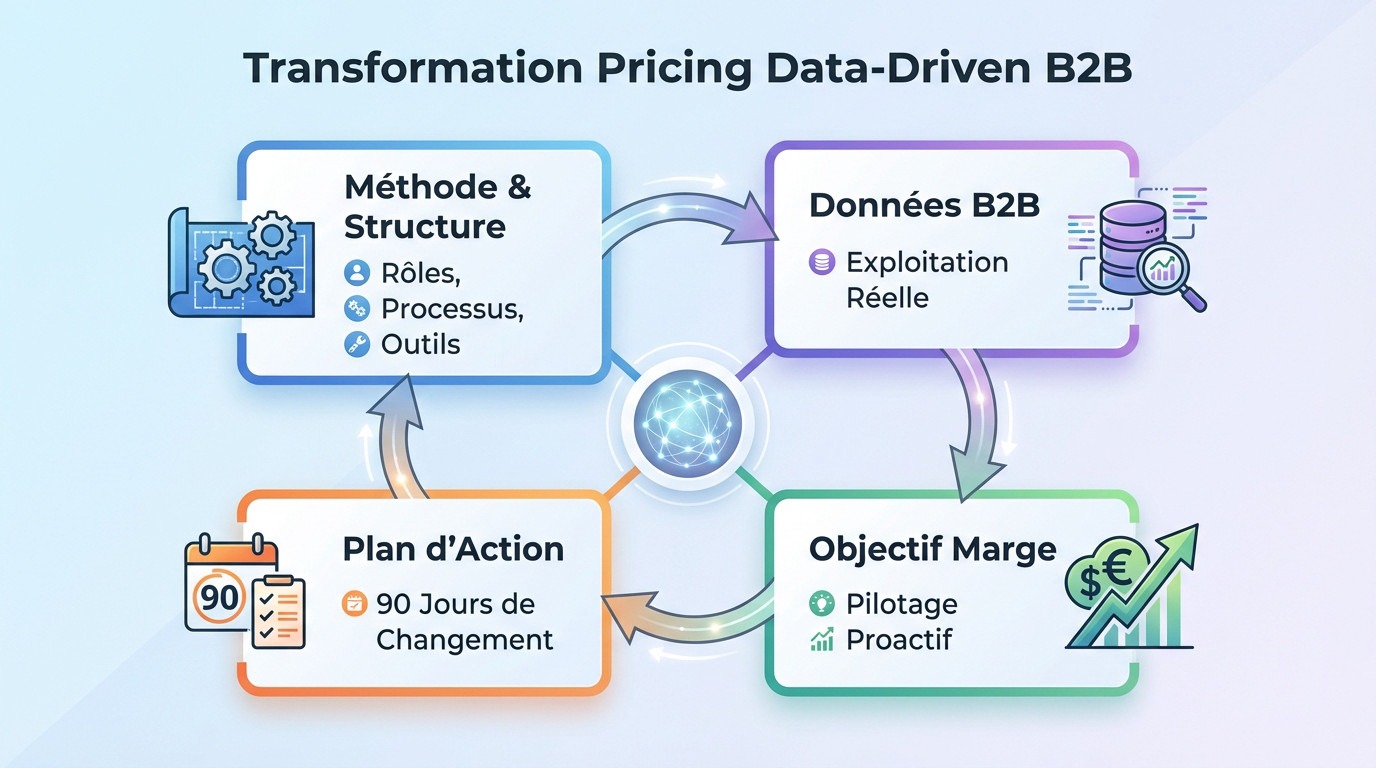
Here is a practical method for building a modern pricing team. We will cover essential roles, rigorous processes, and suitable tools, giving you a structure ready for execution.
This approach is based on leveraging your raw B2B data. The objective is to shift from reactive management to proactive margin control, making your decisions surgical and profitable.
Discover your 90-day action plan. This roadmap guides every step of the transformation.
Why a Data-Driven Pricing Team Changes Everything
Before recruiting, let's understand why the lack of data-driven management weakens your market positions and financial results.
The warning signs of unmanaged pricing
Are you noticing excessive discounts and steadily eroding margins? Sales reps often make decisions independently without clear frameworks or safeguards—a major red flag for your business health.
You may also observe striking pricing inconsistencies among similar clients, leading to legitimate customer frustration and an immediate loss of credibility.
Finally, there is a lack of visibility into the actual impact of pricing. No one really knows where the value leakage originates.
What "Data-Driven" Really Means
Adopting a data-driven approach to structure a pricing team means using objective rules based on transactional history. We no longer guess, we analyze the facts. Decisions thus become traceable and fully justifiable to the customer.
Data serves as the foundation for every pricing adjustment, large or small. It replaces sometimes misleading intuition with indisputable quantified evidence.
However, monitor the quality of the collected data. Without absolute rigor, predictive models remain entirely useless.
Expected Business Benefits
You will observe an immediate improvement in gross margin and better overall commercial discipline. Teams gain decision-making speed during complex negotiations. Segmentation becomes more refined, which helps reduce value leakage on key accounts.
Here are the tangible gains of such a structure:
- Mechanical margin increase.
- Reduction in discount approval time.
- Better revenue predictability.
Choosing the Right Organizational Model
Once the challenges are understood, you must decide where to place the authority threshold within your organization. This is the foundational step to build a high-performing data-driven pricing team.
Centralized Model: Advantages and Limitations
A single team manages prices for the entire group. This guarantees perfect consistency and strong expertise. It is ideal for structures with few countries.
The major risk remains disconnecting from local field realities. Sales teams may perceive this team as a bureaucratic obstacle.
This model requires fluid communication tools. Otherwise, approval delays skyrocket.
Decentralized Model: Advantages and Limitations
Here, each business unit manages its own pricing policy. Responsiveness to the local market is maximized. Experts are close to the end customers.
Beware of the danger of creating data silos. Practices diverge too much and global management becomes impossible.
Strict safeguards are needed to prevent deviations. A shared charter remains essential.
Hybrid Model: The Most Suitable Approach for B2B
The federated model is the ideal compromise for complex enterprises. Headquarters defines the strategy and common tools. Regions execute and adapt according to local specificities. This combines global expertise with operational agility.
Implement this via local pricing referents. They act as a bridge between headquarters and the field, ensuring continuous alignment.
Key Roles in a High-Performing Pricing Team
The chosen model will only work if you recruit the right profiles to embody this new culture.
Head of Pricing: Responsibilities and Skills
This leader defines the strategic vision and aligns objectives with management. They must possess strong leadership. Their role is also political in structuring a data-driven pricing team.
Their ability to translate complex analyses into simple decisions is vital. They validate the major annual pricing orientations.
They are the guarantor of overall profitability, often reporting to the CFO to secure margins.
Pricing Analyst and BI: The Data Engine
This profile handles databases to identify immediate profit opportunities. They create customer segmentation models. Their work fuels daily sales recommendations.
Mastery of BI tools is non-negotiable. They must know how to make raw numbers speak to inform strategy.
They continuously monitor price elasticity. Their analyses concretely guide future commercial campaigns.
Pricing Operations: Flawless Execution
They ensure that prices are correctly injected into the ERP without friction. They manage discount validation workflows. They are the guardian of operational fluidity.
Its role in transactional data quality is central. It corrects anomalies before they skew the analysis.
It trains the sales team on new quoting tools. It acts as the main technical support.
Cross-Departmental Interfaces
Close collaboration with Sales Ops ensures CRM integration. Finance provides the essential profitability framework. Product supplies insights on usage value, while IT guarantees the stability of critical data flows.
To ensure alignment, formalize these exchanges through a clear RACI matrix. Here are the priority touchpoints to monitor:
- Sales Ops: Tool Integration
- Finance: Margin Validation
- Product: Value Positioning
Governance and RACI: Who Decides What?
To avoid friction, it is imperative to clearly define everyone's responsibilities in stone.
Defining Pricing Decision Types
Distinguish between list prices and custom-negotiated rates. Each decision requires a different level of validation. You must clarify these perimeters upfront to structure an effective data-driven pricing team.
Let's examine the management of price corridors by segment. This enables execution to be delegated while maintaining strategic control.
Do not overlook ad-hoc promotional offers. They must also follow a strict, validated process.
Sample RACI Matrix for B2B
Pricing is typically Responsible (R) for the methodology. Sales are Consulted (C) regarding market reality. Finance Approves (A) critical profitability thresholds.
Here is a breakdown of roles to eliminate blind spots within your organization:
An unclear RACI inevitably leads to inertia. Every box must be filled without ambiguity.
Exception Rules and Traceability
Govern exceptions with precise financial thresholds and mandatory justifications. Any exception must be logged in the system for subsequent analysis, which prevents unjustified commercial favoritism. Traceability ensures you understand why a rule was bypassed.
Analyzing exceptions directly feeds into the refinement of future pricing matrices. If everything is an exception, the rule is flawed—a clear sign that your model needs review.
Processes to Standardize (Cadence and Rituals)
A team without rituals quickly loses track of its operational priorities. Yet, this is the foundation for building an effective data-driven pricing team.
Weekly: Operational Alert Monitoring
Every week, the team meets to handle urgent cases without delay. Deals stuck in the validation queue are analyzed. Low-margin alerts are thoroughly scrutinized.
Making quick decisions is vital to unblock the sales team. Agility is key here to avoid losing sales.
Recurring data quality issues are logged. Immediate corrective actions are assigned.
Monthly: Performance Review
Review the past month's performance against established targets and evaluate actual price realization. This is the moment to reallocate resources if necessary to stay on track.
Identify significantly underperforming segments, then discuss the tactical adjustments needed for the upcoming month.
Sharing successes with executive leadership is crucial as it significantly reinforces the team's credibility.
Quarterly: Strategic Update
Review customer segmentation and existing pricing architecture, incorporating shifts in costs and competitive dynamics. This requires a fundamental rethink of your value strategy alongside long-term goal adjustments.
Careful preparation is required for the deployment of new price points for the following quarter. Communication with the sales network is then crucial to ensure rapid adoption.
Essential KPIs to Monitor Pricing Performance
You can only successfully manage what you measure with precision and regularity.
Margin and Price Realization Metrics
Tracking price realization helps reveal the stark gap between target rates and paid prices. Discount leakage highlights the invisible discounts that erode margins. These indicators directly protect your profitability.
Analyze the product mix effect on overall margin. Sometimes, volume masks a degradation in value.
Monitor cost-of-goods trends. Pricing must react swiftly.
Commercial Performance Metrics
Measuring win rate is vital to ensuring prices remain competitive. An excessively high conversion rate often signals underpricing—a classic pitfall. Striking the right balance is essential.
Verify adherence to discount policies across regions to identify specific training requirements.
Correlate price levels with sales volumes. This is the baseline for elasticity analysis.
Financial and Customer Profitability Metrics
Integrating DSO and payment terms into the analysis is non-negotiable. A slow-paying client costs more to service. Net profitability must factor in these hidden costs.
Calculate the "Customer Lifetime Value" to prioritize pricing efforts. A loyal client should not be treated like an opportunistic buyer.
Evaluate the cost-to-serve by segment. Certain accounts are chronically unprofitable.
Executive KPI Dashboard
Synthesize key metrics into a single dashboard to empower a data-driven pricing team. Every KPI must have a clear owner and a defined review frequency. This ensures that data drives concrete actions. Visual clarity drives adoption.
- Price Realization (Monthly, Pricing)
- Win Rate (Weekly, Sales)
- Discount Leakage (Monthly, Finance)
- Customer profitability (Quarterly, Head of Pricing)
Data and Tools: Moving from Excel to Industrialization
Spreadsheets quickly reach their limits as B2B transaction complexity increases.
Essential data sources
Connecting your ERP for historical transactions and your CRM for active opportunities is essential. Your cost data must be up to date. Without these pillars, the analysis remains purely theoretical.
Next, integrate external data, such as market rates or competitor pricing. This allows you to contextualize your actual performance.
Meticulously ensure the integrity of your master data. A flawed catalog skews everything.
Workflow simulations and automation
Use tools capable of simulating the impact of price changes prior to implementation. Automation drastically reduces errors. Finally, workflows accelerate approval processes that are often overly sluggish.
Implement automated alerts for margin erosion. This system should serve as your primary safeguard.
Industrializing the process allows you to handle thousands of rows effortlessly. This delivers a massive time savings.
Team adoption and training
Support change management with regular training sessions for the sales team. Explain the "why" before the "how" to overcome resistance. Interface simplicity is the key to success. An unused tool is a wasted investment.
Communicate early quick wins to prove the value of the approach. Data storytelling helps convince skeptics to structure a data-driven pricing team.
90-Day Deployment Plan
Do not strive for immediate perfection when structuring a data-driven pricing team, but rather follow a structured trajectory to drive lasting results.
Weeks 1–2: Scoping and quick wins
Start by identifying the most glaring margin leakages to take swift action. You must establish a performance baseline to measure future progress. This constitutes your initial diagnostic phase.
Next, engage a small group of enthusiastic sales reps to pilot the initial rules. These ambassadors will champion the project across the rest of the team.
Finally, secure executive buy-in on your objectives. Senior management support is vital.
Weeks 3–6: Governance and initial processes
Formalize the RACI matrix and establish weekly routines without delay. Implement initial discount approval thresholds. The structure begins to take concrete form.
Document processes to ensure organizational longevity. Everything must be transparent for new team members.
Launch the first tracking dashboard. You can now begin driving performance through numbers.
Weeks 7–12: Industrialization and monitoring
Deploy automation tools and train the entire sales force. Closely monitor field adoption and address operational friction. Transition from a project mode to a routine mode. Scaling should be gradual.
Conduct an initial quarterly review to adjust your strategic trajectory. Celebrate the margin gains achieved through this new discipline.
Common mistakes (and how to avoid them)
Many fail by forgetting that pricing is as much about psychology as it is about mathematics.
Too many exceptions, not enough rules
Granting excessive exceptions strips the pricing policy of its substance. If every deal is considered special, you no longer have a strategy. You must learn to say no.
Analyze the root cause of exception requests. They often mask a poor initial segmentation.
Tighten rules progressively to retrain the market. Firmness pays off in the long run.
Unreliable data and ambiguous ownership
Making decisions based on flawed data destroys the sales team's trust. Data ownership must be clearly assigned. Quality is a daily battle.
Invest in database cleaning before launching complex models. Reliable simplicity is better than erroneous complexity.
Audit data flows regularly. An error can spread quickly.
Pricing isolated from field operations
Avoid turning the pricing team into an ivory tower disconnected from commercial realities. Go into the field with the sales reps to understand their negotiation challenges. Alignment between finance and sales is the secret to success. Without buy-in, your pricing grids will remain purely theoretical.
Create regular dialogue forums to adjust rules based on customer feedback. Pricing must serve the business.
To learn more about this subject, consult our comparison of the best retail pricing software.

Building a high-performing pricing team requires adopting a hybrid model that combines central strategy with local agility. This transition replaces intuition with data-driven decisions, orchestrated by expert roles and strict governance.
This proactive management directly transforms financial performance, targeting profitability increases of 100 to 500 basis points.

Key takeaways: building a high-performing pricing team requires adopting a hybrid model that combines central strategy with local agility. This transition replaces intuition with data-driven decisions, orchestrated by expert roles and strict governance. This proactive management directly transforms financial performance, targeting a profitability increase between 100 and 500 basis points.
Key takeaways: building a high-performing pricing team requires adopting a hybrid model that combines central strategy with local agility. This transition replaces intuition with data-driven decisions, orchestrated by expert roles and strict governance.
This proactive management directly transforms financial performance, targeting profitability increases of 100 to 500 basis points.