
Agentic Pricing: The End of Static Pricing in Retail Pricing
.avif)
Fixed-rule dynamic pricing is giving way to autonomous AI agents that make decisions in real time—on both the seller and buyer sides—without waiting for a human approval cycle.
90% of B2B purchases will be handled by purchasing agents by 2028 (Gartner), and 47% of the retail sector has already adopted agent-based AI (NVIDIA): competition between agents is becoming the norm, not the exception.
The real risk is not speed but the lack of safeguards: price floors, price ceilings, and explicit governance are becoming the priority, lest algorithmic collusion—which regulators are already scrutinizing—occur.
A post that’s been circulating widely lately about the rise of agent-based pricing describes a real shift: from fixed-rule dynamic pricing to AI agents that make decisions and negotiate on their own. The observation is accurate, but rarely backed up by statistics.
This article examines this shift, drawing on verifiable sources: what is actually changing, the new balance of power between sales agents and buyers, the already very real regulatory risk, and what a pricing manager needs to do right now.

From Dynamic Pricing to Agentic Pricing
Until now, dynamic pricing has been based on explicit, fixed rules: “If inventory falls below X, raise the price by Y,” “If a competitor lowers their price, match it at -2%.” The system executes quickly, but it doesn’t make decisions: it applies logic set once and for all by a human.Agentic Pricing changes this mechanism by entrusting the decision itself to an agent that continuously monitors demand, procurement costs, elasticity by channel, and competitive behavior, then adjusts the price at the SKU and customer segment level, without waiting for a validation cycle.
Retail and consumer goods organizations have already adopted agent-based AI in their operations, trailing only the telecommunications sector (48%), according to a survey of several hundred industry executives (NVIDIA, State of AI in Retail and CPG 2026).
This shift is not limited to execution speed. It shifts the central question of pricing: we no longer ask ourselves simply “what price to set,” but “how much autonomy to give the agent who will set it, and within what limits.”
| Dimension | Dynamic Pricing (Fixed Rules) | Agentic Pricing (autonomous agent) |
|---|---|---|
| Logic | An explicit rule established in advance by a human and applied exactly as stated. | A decision that is continuously recalculated based on multiple signals. |
| Granularity | Often by category or by group of items. | At the SKU and customer segment levels. |
| Validation | Periodic approval cycle (often monthly or quarterly). | Continuous execution, within limits set in advance. |
Selling Agents vs. Buying Agents
The change doesn't just affect retailers who set their own prices. On the purchasing side, particularly in B2B, autonomous agents are already programmed to maximize purchasing efficiency: comparing offers in real time, testing prices, and identifying inconsistencies in a pricing grid in a matter of seconds. Negotiations no longer take place between two people, but between the seller’s pricing agent and the buyer’s procurement agent.
B2B purchases will be handled by AI-powered procurement agents by 2028, representing approximately $15,000 billion in spending, according to a Gartner forecast released in November 2025 (Digital Commerce 360).
In this head-to-head competition, the factor that protects the margin is no longer the listed price but how it is justified. A buyer optimizes based on the price alone if they have nothing else to compare it to: differentiation through perceived value, bundling, and service terms become the levers that go beyond a pure bot war.
The quarterly cycle becomes a liability
A monthly or quarterly price adjustment is based on the assumption that the market does not change faster than the company’s schedule. This assumption no longer holds true when faced with competitors who react within seconds to a change in cost or availability.
Enterprise applications will incorporate specialized AI agents as early as 2026, up from less than 5% a year earlier, according to a forecast published by Gartner in August 2025 (Gartner).
This is not an argument for eliminating all human validation, but rather for shifting it: instead of validating each price retroactively at a fixed interval, efforts should be directed toward defining the limits within which the agent can make decisions on their own.
The Real Risk: An Uncontrolled Price War
A post that’s been circulating widely lately about the rise of agent-based pricing specifically highlights this risk without providing evidence: without limits, a “bot war” between competing agents could become a self-perpetuating cycle. The mechanism has been well documented by research: independent agents that react to the same market signals in real time can converge toward abnormal price levels—without any explicit coordination having taken place—in a phenomenon known as tacit algorithmic collusion.
Regulatory Oversight
Algorithmic pricing is already under scrutiny
In 2025, the European Commission and the Polish Competition Authority (UOKiK) launched investigations into cases of algorithmic pricing, particularly in the banking and pharmaceutical sectors. In the United States, the agreement reached in November 2025 between the DOJ and RealPage explicitly limits the granularity of pricing recommendations that a single tool can provide to multiple market participants (Wilson Sonsini).
Academic research points to two solutions: agents who make decisions in a decentralized manner rather than based on shared private data, and explicit limits (price floors, price ceilings) set before any deployment rather than added afterward.
What Booper has already built for this rocker
At Booper, agent-based AI isn't a future project—it's how the pricing engine already works, structured around three complementary layers.
Agent-based: execution within business constraints. The agent continuously adjusts prices within predefined limits (minimum margin, product line consistency, benchmark products), never exceeding them.
Generative: well-reasoned recommendations. Each price proposal is accompanied by an explanation of the reasoning behind it—never just an opaque score that you’re expected to accept blindly.
Conversational: a dialogue, not a static table. The pricing manager asks questions and adjusts the system using natural language, rather than reading a static dashboard.
Agent-based, generative, and conversational AI—never a black box
The BOOPER MPS engine combines an executive AI that operates within predefined business boundaries, a generative AI that explains each recommendation, and a conversational layer that allows the pricing manager to interact with the system before making any sensitive decisions. This follows the same logic as the documented safeguard against the risk of algorithmic collusion: limits are set in advance, and there is never complete autonomy without safeguards.
Define your safeguards and your agent-based AI roadmap objectively.
Schedule a meetingWhat to Do Right Now
In light of this shift, the urgent priority is not to adopt a pricing agent overnight, but to lay the groundwork for its operation.
- Set limits before granting autonomy. Price floors, price ceilings, and product line consistency must be in place before an agent makes a decision on their own—never after the fact.
- Rethink the frequency of updates. A quarterly cycle becomes a liability when competitors can react in a matter of seconds.
- Document the reasoning, not just the result. A price recommendation must be transparent so that it can be validated, corrected, and defended if necessary.
- Focus on value-based differentiation. When dealing with buyers who compare only the base price, bundling and perceived service become the true drivers of margin.
- Monitor regulatory risk. The level of detail in recommendations shared among multiple market participants is already under scrutiny by competition authorities.
Agent-based AI does not change the goal of pricing (maintaining margins while remaining competitive); it changes the time scale over which it must be managed.
FAQ
Traditional dynamic pricing applies explicit, fixed rules (“if inventory falls below X, increase the price by Y”) at a scheduled frequency. Agentic Pricing entrusts the decision to an autonomous AI agent that continuously monitors demand, costs, competition, and customer behavior, and adjusts prices at the SKU and customer segment levels without waiting for a human approval cycle. The difference lies not in the speed of execution but in the autonomy of the decision itself.
This is already happening in the B2B sector: Gartner predicts that 90% of B2B purchases will be handled by AI buying agents by 2028, representing approximately $15,000 billion in spending. In the retail and consumer goods sectors, 47% of organizations have already adopted agent-based AI, according to NVIDIA’s 2026 State of AI in Retail and CPG survey. The interaction between a sales agent and a purchasing agent is becoming a common scenario, not a distant prospect.
The risk of tacit algorithmic collusion: independent agents who, without explicitly coordinating, converge toward abnormally high prices simply because they are reacting to the same market signals in real time. The European Commission and the Polish competition authority launched investigations into algorithmic pricing in 2025, and the DOJ’s settlement with RealPage (November 2025) explicitly limited the granularity of price recommendations that an algorithm can provide to multiple players in the same market.
The question has shifted: it is no longer “how often” but “with what ongoing safeguards.” Gartner predicts that 40% of enterprise applications will incorporate specialized agents by 2026, up from less than 5% a year earlier. A quarterly or monthly review cycle becomes a liability when faced with competing agents that respond in a matter of seconds; the real issue to address first is that of the limits (price floors and ceilings) imposed on the agent, not the review schedule.
Booper combines three layers of AI under explicit governance: an agent-based AI that executes decisions within predefined business constraints (minimum margin, product line consistency), a generative AI that produces well-reasoned recommendations rather than opaque scores, and a conversational AI that allows the pricing manager to interact with the system rather than read a static dashboard. No sensitive decisions are implemented as a "black box."
The risk is real if agents are deployed without explicit limits: without a price floor or price ceiling, two competing agents can drive each other’s prices down within a few reaction cycles. The solution, as documented by academic research and regulators, is to establish safeguards early on (price floors, price ceilings, and decentralized decision-making rather than decisions based on shared private data) and to differentiate based on perceived value and bundling rather than solely on the listed price.
Sources
NVIDIA, State of AI in Retail and CPG 2026 · Gartner via Digital Commerce 360, AI agents will account for $15 trillion in B2B purchases by 2028 · Gartner, 40% of enterprise apps will feature task-specific AI agents by 2026 · Wilson Sonsini, 2026 Antitrust Year in Preview: Algorithmic Pricing. Last updated: September 25, 2026.

Fixed-rule dynamic pricing is giving way to autonomous AI agents that make decisions in real time—on both the seller and buyer sides—without waiting for a human approval cycle.
90% of B2B purchases will be handled by purchasing agents by 2028 (Gartner), and 47% of the retail sector has already adopted agent-based AI (NVIDIA): competition between agents is becoming the norm, not the exception.
The real risk is not speed but the lack of safeguards: price floors, price ceilings, and explicit governance are becoming the priority, lest algorithmic collusion—which regulators are already scrutinizing—occur.
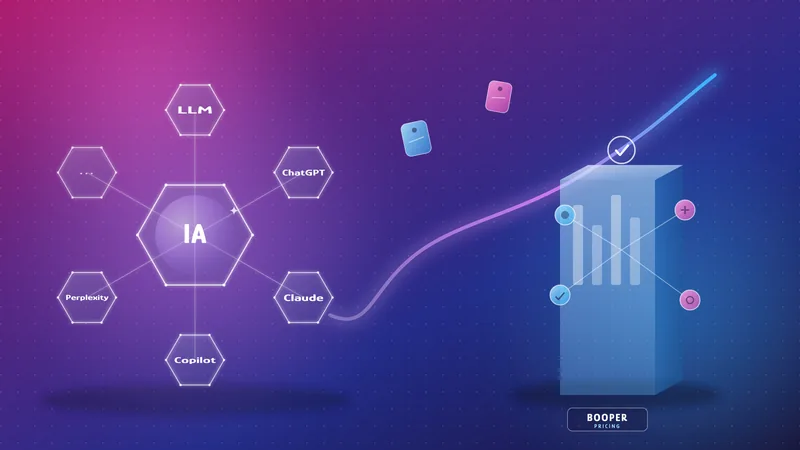
It has become increasingly common to compare two implementations of the same general-purpose language model before deciding which one to use to drive pricing; but the real question isn’t which one to choose, but where to position each one.
A general-purpose LLM lacks four key components required for pricing decisions: access to real-world data, explicit business rules, impact simulation, and explainable governance—these are the responsibilities of a specialized solution, not the LLM alone.
Generative AI projects that combine in-house expertise with that of a specialized partner have a significantly higher success rate than those developed solely in-house: 67% versus 22%.

Auditing a rule verifies that a calculation was executed correctly. Explaining a decision reconstructs the data, the expected demand, elasticity, cannibalization, the rules applied, and margin-volume trade-offs. According to Sage & IDC, 71% of financial executives would reject an AI tool that is 99% accurate if it cannot explain its answer.