
General-purpose AI vs. specialized pricing solution: Why it's not a choice
.avif)
It has become increasingly common to compare two implementations of the same general-purpose language model before deciding which one to use to drive pricing; but the real question isn’t which one to choose, but where to position each one.
A general-purpose LLM lacks four key components required for pricing decisions: access to real-world data, explicit business rules, impact simulation, and explainable governance—these are the responsibilities of a specialized solution, not the LLM alone.
Generative AI projects that combine in-house expertise with that of a specialized partner have a significantly higher success rate than those developed solely in-house: 67% versus 22%.
Comparing two implementations of the same general-purpose language model before deciding which one to use to drive pricing has become standard practice among large retail groups. Structurally speaking, this is also the wrong question: the real issue isn’t choosing between general-purpose AI and a specialized pricing solution, but determining where to deploy each one.
This report explains why the two are complementary and sets the framework for combining them rather than pitting them against each other.
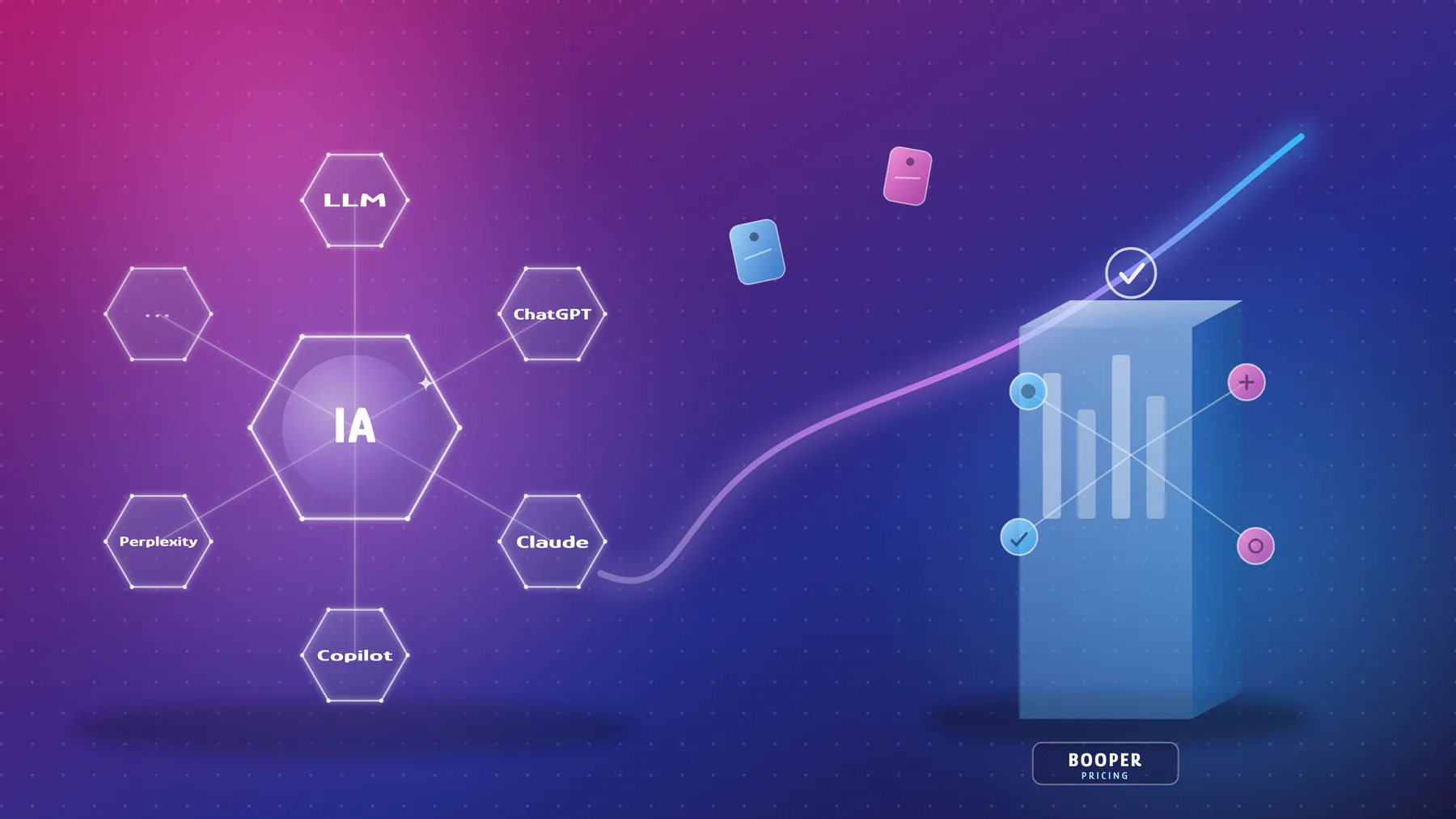
A Misframed Dilemma
In recent weeks, several retail contacts have described a similar situation to us. Internally, two teams are each developing their own version of the same general-purpose language model, before comparing them to decide which one will be selected for pricing. The clearest example comes from a major retail group: two competing implementations of the same Gemini model, built by two separate teams at the parent company, are now being weighed against each other to determine which one will be used to drive pricing decisions.
On paper, the approach appears rigorous: benchmarking, measuring, and selecting the best implementation. However, it is based on an assumption that warrants scrutiny even before the comparison begins: that the question to be decided is which of the two implementations will determine the price, rather than what each—whether general-purpose or specialized—should actually contribute to the decision-making process.
This is not an isolated case. As major retail groups expand their internal AI initiatives, the question of whether to use general-purpose AI or a dedicated solution is becoming increasingly pressing in the area of pricing—one of the functions where a poorly informed recommendation immediately impacts margins or price perception. As we’ll see, the right answer is almost never just one of the two options on its own.
What an Internal Bake-Off Really Measures
A comparison between two implementations of the same language model generally measures three things: the quality of the prompt, the configuration of the context provided to the model, and sometimes fine-tuning on a proprietary dataset. These are real, measurable differences that justify a decision between the two teams.
But these differences all stem from the same underlying principle. Both implementations remain a model trained to predict the most plausible sequence of words, not to reason based on a product catalog, price elasticity, or a minimum margin constraint. The comparison distinguishes between two variants of the same tool, without ever verifying whether that tool, within its category, was the right choice for this specific problem.
Our feature article, “Why Generative AI Gets Prices Wrong, ” explains this mechanism in depth: a general-purpose language model doesn’t verify anything—it makes predictions. When it comes to a price—a specific, time-stamped piece of data—this structural limitation does not disappear simply because we’ve chosen the better of the two tested implementations. This does not mean that the general-purpose LLM is useless, but rather that it should not be the sole basis for the final decision.
What a general-purpose LLM Lacks Structurally
Regardless of the team that built it or the prompt used, a general-purpose language model lacks four key components that are essential for any retail pricing decision:
Data: connection to actual prices. Without a link to a product database and up-to-date competitive data, the model makes predictions based on its training data, not on the actual conditions in the store.
Rules: explicit domain-specific constraints. Minimum margin, product line consistency, flagship products: a general-purpose LLM is unaware of any of these rules unless they are restated to it with every query, and there is no guarantee that it will follow them.
Impact: Pre-deployment simulation. A language model does not test the effect of a price on sales or inventory before recommending it. It generates text; it does not simulate anything.
Governance: Explainability and Auditing. A price recommendation must remain justifiable in hindsight. A general-purpose LLM produces plausible reasoning, but rarely an actionable audit.
These four building blocks are not arguments against general-purpose AI: they are the conditions that are currently lacking for it to be able, on its own, to confidently determine a price. Above all, they define what a specialized solution must provide alongside it—not in its place.
The True Cost of General-Purpose AI Left to Its Own Devices
Entrusting this type of decision-making to two internal teams—without ever questioning the role that a general-purpose LLM should play—comes at a cost that far exceeds the time spent on the benchmark. Each team mobilizes data scientists, infrastructure resources, and several months of development work, only to produce a result that, by design, remains a variant of the same general-purpose model—left to its own devices, without the missing building blocks.
Generative AI projects in companies have no measurable impact on the income statement, according to a study based on 52 interviews with executives, 153 respondents, and an analysis of 300 deployments (MIT NANDA, *The GenAI Divide: State of AI in Business 2025*).
This figure does not suggest that generative AI is generally ineffective. It highlights a problem with the approach: the majority of internal projects remain poorly defined and poorly integrated into existing workflows, with no business objective established before development begins—exactly the risk involved in a bake-off between two in-house implementations that lack a common business specification.
Generative AI projects in enterprises will be abandoned after the proof of concept by the end of 2025, due to insufficient data quality, spiraling costs, or poorly defined business value (Gartner, July 2024).
Having two teams develop two in-house implementations in parallel doubles the risk of abandonment—not just the budget already committed. If the bake-off selects one of the two, the effort invested in the other will have yielded no pricing decision—and the winning implementation will still be left to deal with the four missing building blocks.
Why Combining Is a Game-Changer
The same MIT report offers a lesson that can be directly applied to pricing: successful generative AI projects are not those that bet everything on one approach—whether general-purpose or specialized—but those that combine both.
This is the success rate for generative AI projects that combine internal expertise with that of a specialized partner, compared to just 22% for projects developed solely by internal IT teams (MIT NANDA, *The GenAI Divide: State of AI in Business 2025*).
A specialized pricing solution is neither an enhanced language model nor a competitor to a general-purpose LLM. It is a different category of tool, built from the ground up around the four building blocks that are structurally missing from a general-purpose LLM (connected data, business rules, simulation, and governance), and operated by teams whose expertise lies in retail pricing. The general-purpose LLM still has its place alongside it: to explore a scenario, draft a trading recommendation, or summarize in natural language what the specialized solution has just simulated—as long as it is not the one determining the final price.
Companies that do not yet use AI in their pricing cite a lack of expertise or internal resources as the main obstacle, according to a survey of more than 2,200 executives in 28 countries and 39 industries (Simon-Kucher, Global Pricing Study 2025).
This is exactly the gap that a specialized partner working alongside existing systems fills: the pricing expertise that two IT teams—no matter how skilled they may be in language models—generally do not have available in-house. The general-purpose AI they already master does not disappear; it simply takes on a different role.
With all four building blocks in place, general-purpose AI is a welcome addition
The BOOPER MPS optimization engine combines GENIUS Price for business rules, filters, and simulations; GENIUS Link for competitive matching via NLP; and GENIUS Predict for sales forecasting and price elasticity—all connected to the retailer’s data via Data Loader. Each recommendation remains explainable and verifiable by a pricing team; it is never deployed as a “black box” based on an isolated model—leaving the team free to use the general-purpose AI of its choice to explore the results or draft a summary.
General-purpose AI vs. a dedicated solution: Spend 30 minutes with our teams to determine the right division of roles for your product catalog.
Schedule a meetingThe Comparison: To Each Their Own Role
When presented in a table, the four building blocks and their operational implications reveal not so much a clear winner as a division of roles.
| Dimension | General LLM | Specialized Pricing Solution |
|---|---|---|
| Actual price data | To be connected and maintained by the user, outside the template. | Native, connected from the moment of deployment. |
| Business rules | Reformulated with each request; compliance not guaranteed. | Integrated, versioned, and controlled. |
| Impact Simulation | Not included by default; to be developed separately. | Integrated prior to any deployment. |
| Explainability & Auditing | Plausible reasoning, rarely traceable. | A well-founded and historically grounded recommendation. |
| Required Team | Generalist data scientists, on an ongoing basis. | Pricing team, quick onboarding. |
| Time to value | Several months, uncertain (30% abandoned during the POC). | Weeks, as part of a pilot rollout. |
| Most Helpful Role | Explore, write, and summarize in natural language. | Determine, simulate, and justify the final price. |
A framework for assigning roles
The relevant question is not “which of the two to choose,” but “where one’s role begins and the other’s ends.” Four specific questions help frame this issue before any technical comparison is made.
- Is your data already integrated and reliable? Sales history, price elasticity, up-to-date competitor prices: without this foundation, no model—whether general-purpose or specialized—will produce reliable recommendations.
- Where can general-purpose AI really help you? Exploring hypotheses, drafting a decision memo, summarizing results in natural language: identify these use cases without ever letting it set the final price.
- Should pricing decisions remain explainable and auditable? For a single introductory price, a plausible explanation is sometimes sufficient. For a national pricing policy, however, every recommendation must be justifiable in hindsight—that is the role of a specialized solution, not a general-purpose LLM.
- Do you have a specialized solution for filling in the missing pieces? Connected data, business rules, simulation, governance: once this foundation is in place, the general-purpose AI that your teams already know how to use can safely build on it.
Pitfalls to Avoid When Combining the Two
- Compare only the quality of the generated text. Never its impact on a pricing decision tested on the actual catalog.
- Contrast general-purpose AI with a dedicated solution, rather than defining precisely where each one comes into play in the decision-making process.
- Do not include governance and explainability in the selection criteria, only to discover them upon deployment.
- Ignoring maintenance costs after the proof of concept. Yet this is the phase in which the greatest number of projects are abandoned.
- Let the general-purpose LLM make the final decision. Just to make things easier, without ever linking it to the business rules and governance frameworks that would guide it.
The choice isn't between general-purpose AI and a specialized pricing solution. It lies in the division of roles: general-purpose AI handles exploration, drafting, and synthesis; the specialized solution handles the decision itself, connected to data, business rules, simulation, and governance. Discuss your specific situation with our teams via our MPS page , Booper's modular pricing solution.
FAQ
No: that’s the wrong question. The most successful AI projects aren’t the ones that rely entirely on one approach or the other, but rather those that combine in-house expertise (including the use of a general-purpose LLM for exploring, drafting, and summarizing) with a specialized solution to drive the pricing decision itself, along with the connected data, business rules, simulation, and governance that this requires.
A general-purpose LLM generates plausible text based on its training data, with no guaranteed connection to up-to-date data or explicit business rules. A specialized pricing solution combines demand modeling, versioned business rules (minimum margin, product line consistency), pre-deployment impact simulation, and explainable governance—all continuously connected to the retailer’s real-time data. The two do not play the same role: one explores and formulates, while the other decides and proves.
By reserving general-purpose AI for the tasks at which it excels—exploring hypotheses, drafting, and summarizing results in natural language—and leaving the actual pricing decision to a specialized solution that handles connected data, business rules, impact simulation, and governance. Projects that combine in-house expertise with that of a specialized partner have a significantly higher success rate than those developed solely in-house.
According to a 2025 MIT NANDA study, 95% of generative AI projects in companies have no measurable impact on the bottom line. The cause is generally not the quality of the model, but rather the approach: poorly defined business objectives prior to development, insufficient integration with existing workflows, and a lack of domain expertise to guide the project—often because the project was conceived as a replacement rather than a complement.
Technically, yes—through a custom-built integration—but this connection is not part of the model itself: it must be built, maintained, and secured separately, just like the business rules and the simulation layer. A specialized pricing solution natively integrates these components, making it the foundation on which a general-purpose LLM can then build, rather than having to rebuild everything from scratch on its own.
We avoid the main factors for failure identified by studies: a poorly defined business objective, unreliable data, and business rules that are reformulated for each query rather than integrated natively. By bringing specialized pricing expertise into the internal technical team from the outset, this approach achieves a significantly higher success rate than isolated development, while still leaving the door open for the use of general-purpose AI for exploration and drafting tasks.
Sources
MIT NANDA, *The GenAI Divide: State of AI in Business 2025* · Gartner, July 2024 · Simon-Kucher, *Global Pricing Study 2025*. Last updated: September 23, 2026.

The key takeaway: An AI-generated price recommendation without an explanation falls on deaf ears with pricing teams, who refuse to apply a score they don't understand.
Explainability and auditability are two distinct requirements: the former justifies a recommendation at the time it is proposed, while the latter makes it possible to trace who approved what, when, and why—even several months later. A key finding: Explainability is identified as a key AI risk by a large majority of executives, but very few organizations are actually taking steps to address it.

Fixed-rule dynamic pricing is giving way to autonomous AI agents that make decisions in real time—on both the seller and buyer sides—without waiting for a human approval cycle.
90% of B2B purchases will be handled by purchasing agents by 2028 (Gartner), and 47% of the retail sector has already adopted agent-based AI (NVIDIA): competition between agents is becoming the norm, not the exception.
The real risk is not speed but the lack of safeguards: price floors, price ceilings, and explicit governance are becoming the priority, lest algorithmic collusion—which regulators are already scrutinizing—occur.

It has become increasingly common to compare two implementations of the same general-purpose language model before deciding which one to use to drive pricing; but the real question isn’t which one to choose, but where to position each one.
A general-purpose LLM lacks four key components required for pricing decisions: access to real-world data, explicit business rules, impact simulation, and explainable governance—these are the responsibilities of a specialized solution, not the LLM alone.
Generative AI projects that combine in-house expertise with that of a specialized partner have a significantly higher success rate than those developed solely in-house: 67% versus 22%.