
Retail Price Optimization: The Complete Guide (Methods, AI, ROI)
.avif)
Price optimization involves determining, for each product, the price that maximizes a defined business objective (margin, volume, market share, price image) within operational constraints. It is not about finding the highest price; rather, it is about finding the best balance among often conflicting objectives.
A retail optimization engine combines three layers: demand modeling, constrained optimization, and human oversight of sensitive trade-offs. None of these three is sufficient on its own.
Assuming a constant product mix and strategy, rigorous optimization generally yields an additional 0.5 to 1.5 percentage points in gross margin, with a return on investment achieved in less than 12 months.
“Price optimization” is one of the most common search terms related to retail pricing, and yet none of our resources cover it comprehensively: our glossary provides a brief definition, and several articles address specific aspects of it (elasticity, AI, governance).
This guide fills that gap: what price optimization really is, what it isn't, how an optimization engine works, the methods available, and what you can realistically expect in terms of profit margins and ROI.

What is price optimization?
Price optimization involves determining, for each product SKU, the price that maximizes a defined business objective—such as margin, volume, market share, or price image— while adhering to a set of operational constraints, including minimum margin, product line consistency, competitive rules, and desired positioning. It is not about finding the highest or lowest possible price; rather, it is about finding the best balance between often conflicting objectives. Modern optimization combines AI-driven modeling (elasticity, forecasting) with explicit business rules—never one without the other.
What Price Optimization Is Not
There are three common misunderstandings that come up regularly and should be clarified right from the start:
- This isn't dynamic pricing. Changing a price several times a day isn't optimization if no objective is explicitly maximized under constraints; it's automation of frequency, not decision-making.
- This isn't just a matter of competitive pricing. Matching a competitor's price is a policy, not an optimization strategy: it ignores the specific price elasticity of the benchmark product and can erode margins on products that are not very price-sensitive.
- This is not a blanket price increase. A well-executed optimization adjusts prices in both directions—upward and downward—depending on what each product can actually support.
Why It Has Become a Must-Have in Retail
A product lineup consisting of several thousand SKUs—which is updated several times per season—can no longer be reviewed manually, SKU by SKU, without dedicating an entire team to the task and without ensuring consistency in decisions across different reviewers. It is this operational limit that has driven the expansion of optimization—long reserved for a few large accounts—to the entire retail sector.
This is the percentage of organizations that plan to adoptgenerative or agent-based AI in pricing within the next 1 to 3 years, compared with just 10 to 30 percent today, according to a survey conducted in November 2025 among more than 400 pricing executives (McKinsey, Agentic AI in Pricing Survey).
This shift is not simply a result of a passing technological trend; it addresses a concrete scalability issue. The available data (sales history, elasticity, competitor reports) has also become significantly more up-to-date and granular in recent years, making it possible to perform calculations that few retailers could carry out manually a decade ago.
How Does a Price Optimization Engine Work?
Behind the phrase “the price that maximizes the objective subject to constraints,” a retail optimization engine is organized into three distinct and complementary layers.
Layer 1: Demand modeling. Price elasticity, sales history, seasonality, and competitive data (AI matching) are used to generate a benchmark estimate.
Layer 2: Constrained optimization. The engine tests thousands to hundreds of thousands of combinations to find the best compromise without violating the specified constraints.
Layer 3: Governance and explainability. The most sensitive decisions are still validated by a human before deployment: each recommendation remains explainable—it is clear which factors it is based on and why.
None of these three layers functions on its own. Brilliant modeling without governance produces recommendations that are mathematically correct but operationally unacceptable; strict governance without reliable modeling amounts to validating approximations. Our feature “AI That Decides, AI That Executes” details exactly where to draw the line between what the engine can decide on its own and what must be escalated to a human decision-maker, and our feature “Machine Learning and Price Elasticity” explains how these models are trained and validated.
A concrete example with figures
A clothing retailer is optimizing the prices of its fall collection, which includes 1,200 items. The goal is to maximize the total margin, while ensuring that sales volume does not decline by more than 3 percent—a constraint that was explicitly set before the calculation began, not an adjustment made after the fact.
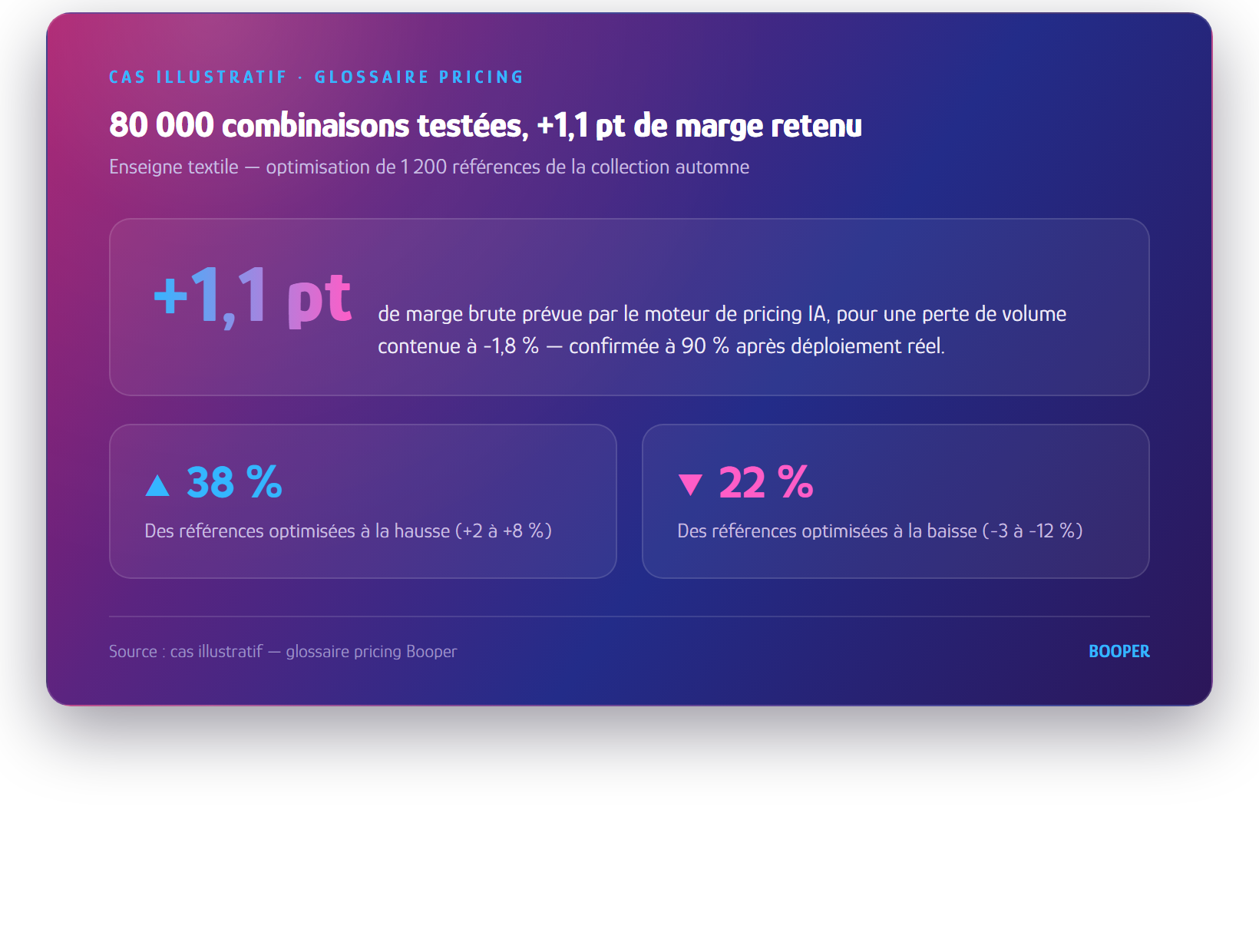
gross margin projected by the simulation for a volume loss limited to -1.8%. The actual 8-week rollout confirmed this forecast to 90% accuracy, using an algorithm that tested 80,000 price combinations.
The engine tests 80,000 combinations and identifies the optimal solution: 38% of prices are adjusted upward (by +2 to +8%), 22% are adjusted downward (by -3 to -12%), and 40% remain unchanged. It is this distribution in both directions—never a uniform increase—that distinguishes true optimization from a simple price hike.
Price Optimization Methods: An Overview
Not all pricing methods are equally effective when dealing with a broad and ever-changing product assortment. Here are the four most common approaches in retail—and their limitations.
| Method | Logic | Required information | Main limitation |
|---|---|---|---|
| Cost-plus | Cost of goods sold + fixed target margin, applied uniformly. | Purchase costs. | It completely ignores demand and competition. |
| Competitive alignment | Price set at a target spread relative to the competitor being tracked. | Competitor price surveys. | Follows the competitor's strategy; ignores its own elasticity. |
| Perceived value | A price based on what the customer is willing to pay for the perceived benefit. | Customer surveys, price tests. | It is costly to measure across an entire product line. |
| AI & Elasticity | Models actual demand using a reference model and optimizes it subject to constraints. | Sales history, price elasticity, competition, business constraints. | Requires reliable data and governance to ensure accountability. |
In practice, these methods rarely overlap in their pure form: most established retailers combine a cost-plus model (with a non-negotiable minimum margin), a competitive framework (positioning constraints), and AI-driven optimization that makes decisions within this framework, rather than choosing a single approach for the entire catalog.
Price Optimization vs. Related Concepts
Pricing terminology often overlaps in business communications and specifications. Four clarifications can help avoid the most common misunderstandings.
vs. dynamic pricing. Dynamic pricing adjusts the frequency of price changes; optimization adjusts the decision itself. A price may change several times a day without solving any constrained objective.
vs. competitive intelligence. Competitive intelligence provides information on where competitors are positioned. Optimization determines what price to set based on this information and other constraints.
vs. price management. Price management handles existing data: distribution, exceptions, and workflow. Optimization calculates what the price should be even before it is published.
Revenue management. A concept inherited from the hospitality and transportation industries, designed for fixed and perishable capacity (a seat, a room). It can be partially applied, but rarely as-is, to a permanent retail product lineup.
The Role of AI and Its Limitations
AI didn't invent price optimization: elasticity models have existed for decades in microeconomics. What AI has changed is the ability to apply them to an entire product lineup, in real time, using up-to-date data. But this computational power doesn't eliminate the need for the same safeguards as any other pricing decision.
Companies that do not yet use AI in their pricing cite a lack of expertise or internal resources as the main obstacle, according to a survey of more than 2,200 executives in 28 countries and 39 industries (Simon-Kucher, Global Pricing Study 2025).
This figure highlights the true limitation of AI in pricing: it’s not that the technology is lacking, but rather the ability to deploy it with the business expertise needed to set the right constraints and interpret the right results. AI without pricing expertise merely replicates and amplifies the same errors as a poorly configured spreadsheet—only faster and across more products.
Explicit business rules, AI that executes them
The BOOPER MPS optimization engine combines GENIUS Price for business rules, filters, and simulations; GENIUS Link for competitive matching using NLP; and GENIUS Predict for sales forecasting and elasticity. Before each decision is made, it simulates the impact on sales and inventory—not just on margin. Every recommendation remains explainable and verifiable; it is never deployed as a “black box.”
How much untapped profit potential lies within your product lineup? It only takes 30 minutes to objectively assess your catalog’s potential for optimization.
Schedule a meetingImplement price optimization
Operational price optimization is a step-by-step process; it is never a "big bang" change affecting the entire catalog on the first day.
- Define the objective. Margin, volume, market share, price-image, or an explicit trade-off between several of these. Without a clear objective, no decision-making mechanism can make a call.
- Set the constraints. Minimum margin, product line consistency, key performance indicators (KPIs), maximum acceptable competitive position: these are the non-negotiable safeguards that must be established before performing the calculation.
- Ensure data reliability. Sales history, price elasticity, and up-to-date competitive data. A powerful algorithm based on unreliable data will only produce unreliable recommendations.
- Test the initiative in a pilot category. Measure actual results before expanding: most retailers roll out initiatives over a period of 6 to 18 months, never all at once.
- Govern continuously. Ensure human oversight of sensitive decisions and regularly review objectives and constraints as the market evolves.
Common pitfalls
- Optimize for a single objective. Maximizing unit margin without considering the impact on volume, brand image, or product line consistency merely shifts the problem rather than solving it.
- Overburdening the engine. Piling on too many safeguards until there is no room left to maneuver: optimization then drops to zero without anyone noticing.
- Deploy in black-box mode. Without human validation, mathematically correct recommendations may be operationally unacceptable in the field.
- Confusing optimization with price increases. Optimization that never lowers prices is not true optimization—it is a price hike in disguise, with all the reputational risks that entails.
- Ignore flagship products. Optimizing a KVI just like any other product—without taking its visibility into account—damages the price image even if the overall margin increases.
Pricing optimization is never a one-time project: it is a dynamic system that remains relevant as long as its objectives, constraints, and data are reviewed as the market evolves.
FAQ
Price optimization involves determining, for each SKU, the price that maximizes a defined business objective (margin, volume, market share, price image) while adhering to operational constraints (minimum margin, product line consistency, competitive positioning). It has become important because a product assortment consisting of several thousand SKUs can no longer be managed manually on a SKU-by-SKU basis: without changing the catalog or the strategy, rigorous optimization typically yields an additional 0.5 to 1.5 percentage points in margin.
Rule-based software applies fixed, explicit logic (“price = cost + 30%” or “aligned at -2% of competitor A’s price”): predictable, but unable to balance multiple conflicting objectives. AI-powered optimization software models demand (elasticity) and tests a large number of price combinations to find the best compromise between these objectives, within the same business constraints. In practice, the two are combined: the rules set the boundaries, and the AI seeks the optimal solution within that framework.
Assuming a constant product mix and strategy, rigorous optimization generally yields an additional 0.5 to 1.5 percentage points in gross margin, with a return on investment typically achieved in less than 12 months. The exact figure depends on the size of the product mix, the recency of the available data, and the scope of deployment selected at the outset (pilot category or the entire catalog).
The process consists of four steps: precisely defining the objective to be maximized (margin, volume, price-image, or a trade-off among them); establishing non-negotiable constraints (minimum margin, product line consistency, competitive positioning); ensure the reliability of the input data (sales history, elasticity, competitive data), and then pilot the optimization on a test category before gradually extending it to the entire product assortment over a period of 6 to 18 months.
Yes, provided that the optimization is constrained by volume and not just by unit margin. A properly configured engine simulates the projected impact on sales prior to any rollout and can be set to not exceed a maximum acceptable loss in volume. In a documented Booper case study, an optimization of 1,200 SKUs resulted in a +1.1 percentage point increase in gross margin, with volume loss limited to -1.8%, a result confirmed with 90% accuracy following actual deployment.
The main risk is treating each SKU in isolation and losing the consistency perceived by the customer: price increases that are too noticeable on benchmark products (KVI) damage the price image, even if the overall margin improves. This risk is mitigated by incorporating product line consistency and “key product” status as explicit constraints within the pricing engine—never as an after-the-fact adjustment—and by maintaining human oversight for the most sensitive trade-offs.
Start with a limited and reversible scope—a pilot category rather than the entire catalog—with the objectives and constraints of the existing sales strategy defined at the outset, rather than added later. The initial recommendations are manually validated before deployment, which allows for verification of their consistency with the current pricing policy before expanding the scope.
Demand-based optimization relies on the price elasticity specific to each SKU (how demand responds to a price change) to maximize a business objective. Competition-based optimization sets the price relative to the prices observed among monitored competitors. The two are not mutually exclusive: robust retail optimization combines price elasticity as a decision driver and competitive positioning as a constraint or input signal, rather than choosing one at the expense of the other.
Sources
McKinsey, B2B Pricing: Navigating the Next Phase of the AI Revolution · Simon-Kucher, Global Pricing Study 2025. Last updated: September 22, 2026.

Price optimization involves determining, for each product, the price that maximizes a defined business objective (margin, volume, market share, price image) within operational constraints. It is not about finding the highest price; rather, it is about finding the best balance among often conflicting objectives.
A retail optimization engine combines three layers: demand modeling, constrained optimization, and human oversight of sensitive trade-offs. None of these three is sufficient on its own.
Assuming a constant product mix and strategy, rigorous optimization generally yields an additional 0.5 to 1.5 percentage points in gross margin, with a return on investment achieved in less than 12 months.

Setting a selling price is based on three key factors (costs, demand, and competition), but in retail, the constraints lie elsewhere: a legal price floor (SRP+10 for food products through April 15, 2028), up to 40,000 SKUs in a hypermarket, and an operating profit margin of about 8% for every 1% change in price. Price setting becomes a managed process, with rules and safeguards, rather than an isolated calculation.
Pricefx, Competera, and Revionics are not aimed at the same buyer: a modular, multi-sector suite; advanced competitive intelligence; and pricing at a very large scale. Therefore, there is no single alternative, but rather an alternative tailored to the retailer’s scale and actual needs.
For a French retailer, three criteria carry more weight than the list of features: the size of the network, the scope of services actually expected (market monitoring, comprehensive optimization, promotions, and markdowns), and business support.
None of these three publishers publishes a price list; prices are available upon request.