>
>
Article
Data-driven B2C pricing: Maximize your margins and profits
.avif)
Edouard Calliati
Director of Marketing and Business Development
Given the current volatility, B2C pricing can no longer rely on intuition but requires a data-driven strategy. This analytical rigor enables real-time price adjustments to maximize profitability without sacrificing volume. A successful transition to this model offers profit growth potential of up to 9%.
Setting your prices blindly exposes your profitability to a silent erosion, as intuition alone is no longer enough to counter today’s market volatility and your competitors’ aggressive strategies. To stop this loss of value, switching to data-driven B2C pricing allows you to mathematically align your prices with actual demand and maximize your margins without damaging your brand image. This method will guide you step by step to identify key financial KPIs, conduct rigorous tests, and deploy automation tools that will radically transform your sales performance.
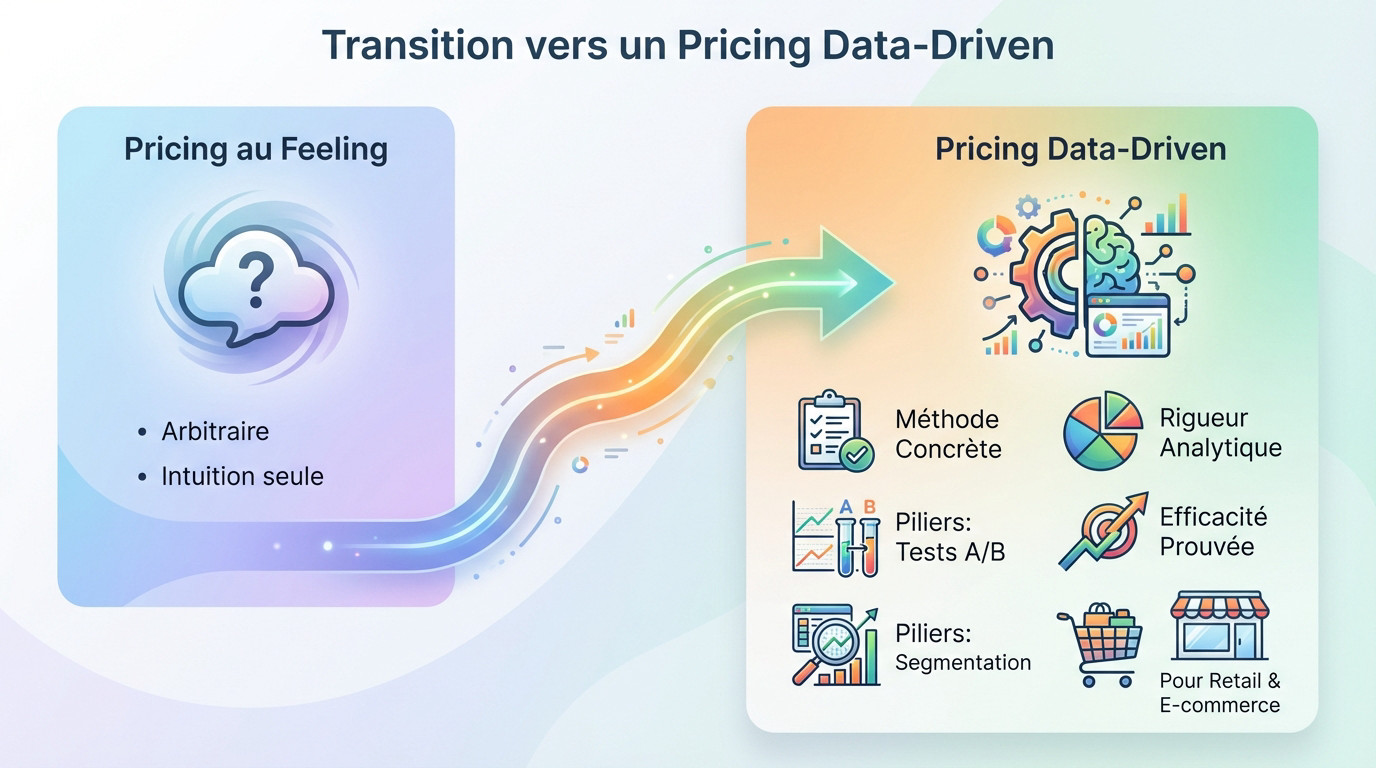
B2C Pricing: Moving from "gut-feel" Pricing to a Data-Driven Approach
Let's be honest: given the volatility of the market, intuition alone isn't enough anymore. Pricing based on a "gut feeling" now sacrifices your margin in the face of agile competition.
Purpose of the article
We’ll walk you through a practical method for structuring your pricing. It’s time to move away from guesswork and adopt a rigorous, analytical approach.
You’ll learn about the essential pillars—from segmentation to testing—that form the core of profitable, data-driven B2C pricing.
This approach applies to both retail and e-commerce. Results are guaranteed.

Why "gut-feel" pricing no longer works in B2C
Let's see why traditional methods are now threatening your profitability.
Promotions, competition, seasonality: complexity is on the rise
Competitors, inventory, inflation: the variables are skyrocketing. No human mind can handle this market complexity without technological assistance.
The hidden cost: margin erosion and pricing inconsistencies
An unnecessarily low price undermines value. These inconsistencies drive customers away and accelerate margin erosion.
The difference between “data” and “over-optimization”
Data-driven B2C pricing doesn't replace common sense. The algorithm makes suggestions, but your human judgment always has the final say.
The essential data for managing B2C pricing
To find your way out of the fog, you need the right analytical tools.
Internal data: sales, margin, average order value, conversion rate, returns, inventory, costs
Compile six months of transaction history, including the cost per unit. These metrics, combined with the return rate, reveal the true health of your offering.
External data: competition, trends, inflation, seasonality
Don't copy your competitors, but make sure you're in the right price range. Factor in inflation and market trends to stay relevant.
Data quality: avoiding biases (promotions, outliers, data gaps)
Be careful of data gaps that distort elasticity. Remove outliers, as data quality is key to your success in data-driven B2C pricing.
Define a pricing strategy before optimizing
Once you have the figures, decide on your pricing strategy.
Positioning: premium, mainstream, budget
Pick a side. You can’t be both the cheapest and the highest quality at the same time in data-driven B2C pricing. Align your price with your value proposition: that’s your strategic positioning.
Pricing strategy: loss leaders vs. high-margin products
Identify your traffic-driving "power products" and accept lower margins on them. Then make up for it with profitable accessories. That’s a solid pricing strategy.
Price ranges and rules (min/max) to ensure consistency
Set limits to avoid a "price cliff" compared to competitors. Automate these limits using strict management rules. The goal? To maintain overall consistency without unjustified discrepancies.
B2C Segmentation: The Foundation of Data-Driven Pricing
To succeed with data-driven B2C pricing, segmentation is your best tool.
Segmentation by category (A/B/C, bestsellers, long tail)
Focus on the 20% of products that generate 80% of revenue. Automate the rest through effective product segmentation.
Segmentation by channel (website, marketplace, retail, ads)
Adjust your prices based on commission rates, as sales through marketplaces cost more. Monitor your margin by channel to protect your net profits.
Customer segmentation (new vs. repeat customers, promotional sensitivity)
Don't sell your products at a discount to customers who are willing to pay top dollar. Assess their price sensitivity so you can reward loyalty without eroding your profit margin.
Testing without putting yourself at risk: the experimental method
Theory is useful, but only real-world testing can validate it.
A/B Price Testing: When and How to Use It
For data-driven B2C pricing, test two prices on similar segments. Monitor conversion rates. A/B testing should be subtle so as not to frustrate customers.
Pilot studies and holdouts: measuring the actual impact
Isolate a category and compare it to an unchanged control group. This eliminates seasonal biases to validate the actual impact.
Measuring cannibalization and the promotional effect
A product promotion shouldn't cannibalize your profitable sales. Monitor cannibalization and calculate the actual uplift to protect your margins.
The Most Effective B2C Pricing Strategies (with Examples)
Let’s move on to some concrete data-driven B2C pricing strategies.
Psychological pricing and thresholds (9.99, 49.90…)
Breaking through a psychological barrier can cause demand to plummet. Use prices ending in 9 to maximize the perceived impact.
Bundles, packs, cross-selling: sell more without lowering prices
Bundling products increases their perceived value. This allows you to boost the average order value without lowering individual prices.
Targeted promotions: segment, timing, channel (avoid promotion addiction)
Avoid permanent sales. Focus on limited-time offers to maintain healthy promotional momentum.
- Maintaining the margin
- Customer Reactivation
- Inventory Management
Shipping and “total price”: impact on conversion rates and average order value
Shipping is crucial. Adjust your free shipping threshold to cover shipping costs and boost conversion rates.
Standardization: Rules, Alerts, and Workflows
Alerts: margin below threshold, excessive promotion, at-risk inventory
Set up automatic notifications for critical issues. Don’t wait until the end of the month to discover a loss in profit margin. By then, it’s too late.
Respond immediately to deviations. Use reliable management alerts.
Workflows: validations, exceptions, promotional schedule
Determine who approves each price change. Avoid unauthorized changes.
Centralize the sales calendar. A rigorous approval process prevents errors. The team stays on the same page.
Traceability: Staying in Control as Things Scale
Track every change to analyze its impact. Understand why performance has dropped or risen. This is data-driven B2C pricing.
Review your rules regularly. Traceability ensures complete control.
Key Performance Indicators (KPIs) to Monitor for B2C Pricing
Drive your decisions with data. Here are the essential metrics for data-driven B2C pricing.
Profit: margin, contribution, price realization
Track "price realization." The contribution margin ensures the actual profitability of each sale.
Growth: conversion rate, average order value (AOV), volume
Balance volume and AOV to protect your market share.
Promotion: promotional rate, uplift, cannibalization
The uplift must cover the cost. Focus on promotional effectiveness so as not to erode your profit margin.
Inventory: sell-through, stockout, overstock
Adjust prices based on inventory levels. Monitor inventory turnover to avoid stockouts.
Quality: Returns, Cancellations
Keep an eye on the return rate. A price that’s too low often attracts fickle customers.
30 days to transition from “gut-feel” pricing to data-driven pricing
Follow this step-by-step action plan.
Week 1: Baseline + Goals + Quick Wins
Assess the current situation and set clear goals. Address obvious inconsistencies to achieve quick wins.
Week 2: Data + Segmentation
Separate your "Power Products" from the long tail. Clean up your data to ensure the reliability of your analyses.
Week 3: Tests and Rules (Corridors)
Run A/B tests and set price ranges. These strategic price ranges help protect your margins.
Week 4: Alerts + Processes + Monitoring
Automate reporting and train your teams. This industrial management system ensures a data-driven transition to B2C pricing.
1. Active alerts
2. Defined roles
3. Shared Dashboard
Common mistakes (and how to avoid them)
Finally, avoid these common pitfalls that have tripped up many experts.
Too many promotions: addiction and margin erosion
Constant promotions erode perceived value: customers now only wait for sales. It's a vicious cycle.
Protect your brand—break free from promotional addiction.
Focus on revenue rather than profit margin
Going for volume's sake is risky. Revenue doesn't pay the bills— profit does.
Prioritize net profit to ensure your operational profitability.
Ignoring brand image and multichannel consistency
Different prices on Amazon and your website frustrate customers. Maintain a consistent pricing strategy across all platforms.
Manage perceptions through strict pricing consistency.
Frequently Asked Questions
Here are the key answers to clear up any remaining doubts you may have.
Articles similar

Building a high-performing pricing team requires adopting a hybrid model that combines centralized strategy with local agility. This transition replaces intuition with data-driven decisions, guided by specialized roles and strict governance.
This proactive management directly improves financial performance, enabling companies to aim for an increase in profitability of between 100 and 500 basis points.

In response to the radical price transparency of 2026, the retail sector is adopting automated management. This strategy protects margins against inflation by ensuring immediate responsiveness across all channels.
A high-performance tool guarantees a return on investment in less than six months, making pricing a cornerstone of net profitability.

Product matching is the foundation of competitive monitoring because it prevents the comparison of non-equivalent products. Reliable product matching safeguards margins by basing repricing on real-time, multi-source data.
Key finding: According to the Diamart study, 50% of French retailers still consider this challenge to be unresolved.