Competitive monitoring in retail: How can we improve the accuracy of product matching?
.avif)
Edouard Calliati
Director of Marketing and Business Development
March 15, 2026
Product matching is the foundation of competitive monitoring because it prevents the comparison of non-equivalent products. Reliable product matching safeguards margins by basing repricing on real-time, multi-source data.
Key finding: According to the Diamart study, 50% of French retailers still consider this challenge to be unresolved.
Are you losing market share and net profit every day because of a flawed retail product matching system that mistakenly compares non-equivalent items?
This article outlines a comprehensive operational methodology for identifying specific variants, avoiding marketplace pitfalls, and building a robust data repository to manage your pricing strategy with absolute mathematical precision.
By following our checklist and reliability KPIs, you’ll secure your price positioning, reduce your manual workload by 40%, and maximize your profits through a high-performance multi-signal trust scoring system.

Why product matching is the critical point of competitive monitoring
Comparing apples and oranges makes data collection pointless; the quality of your retail product matching competitive intelligence is the foundation of your strategy.
In fact, without specific information, you're flying blind.
The cost of a fixed match (margin, image-price, distorted decisions)
Poor pricing leads to unnecessary price cuts. This erodes your net margin for no good reason. Customers also lose confidence in the consistency of your pricing.
Your repricing algorithms are based on inaccurate data. Your price positioning is suffering because you’re benchmarking against non-identical products. This is a strategic mistake.
Strategic decisions become risky. In short, you’re running your business based on skewed numbers and a completely distorted view.
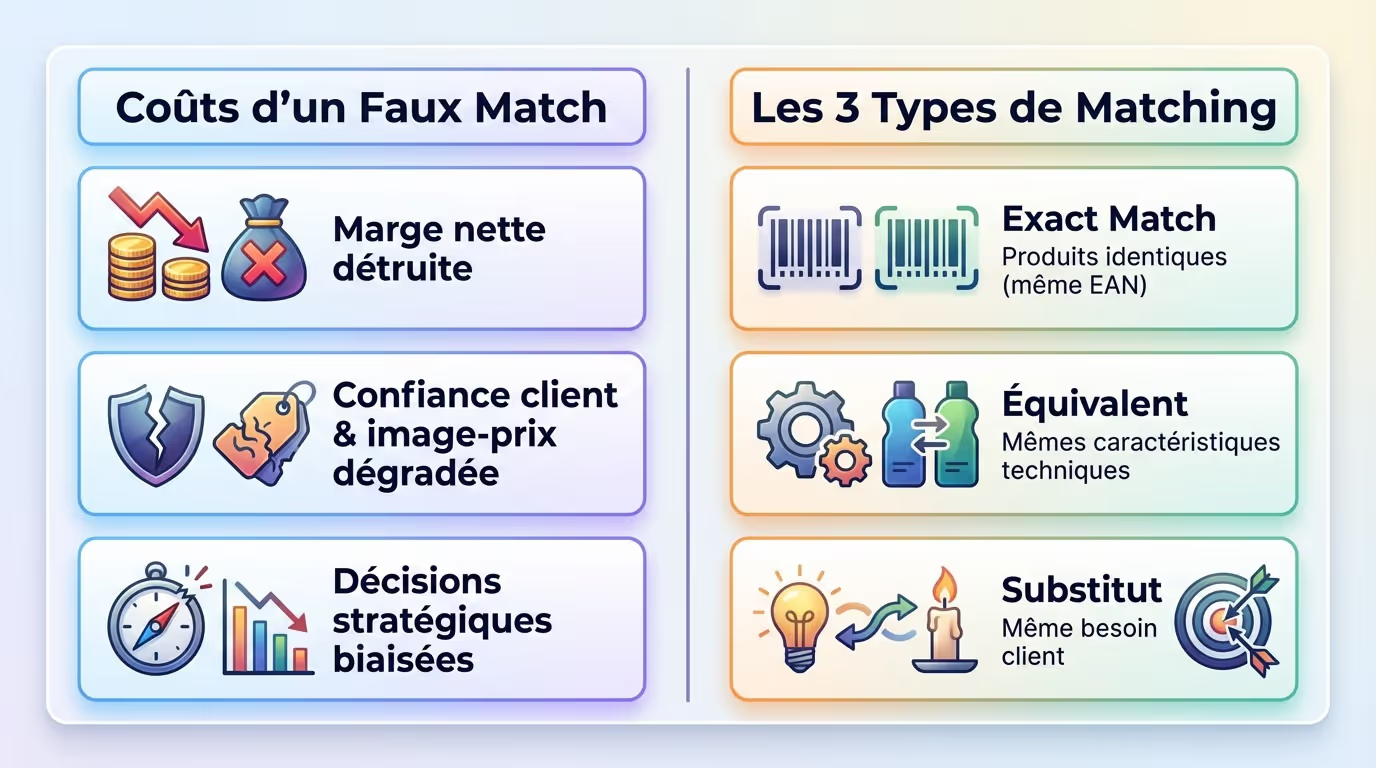
The three cases to distinguish: exact match / equivalent / substitute
- Exact Match: same EAN.
- Equivalent: similar characteristics.
- Alternative: same customer need.
An exact match refers to products that are exactly the same and have the same EAN. This is the basis of monitoring. We then compare the same barcode and the same brand.
These equivalents share similar technical specifications.
Substitutes meet the same customer need without being technically identical.
Distinguishing between these levels helps prevent sudden misalignments. This safeguards your operating margins on a day-to-day basis.
The number one causes of matching errors (and how to spot them)
But where do these errors that plague your reports come from?
Here are the common pitfalls your scraping tools encounter every day when monitoring retail product matching for competitive analysis.
Variants (size, color, capacity, vintage)
A size 42 shoe doesn't always cost the same as a size 38. Rare colors often cost more online. The system must isolate each specific attribute.
A wine vintage completely changes the price point. Never confuse a 1TB hard drive with a 2TB model.
Detail is your best ally. Always check the competitor’s detailed spec sheet.
Packs, bundles, and sets (x2, x3, "+ free")
Packages of two items skew the listed unit price. A free item drastically changes the perceived value. You need to be able to spot these phrases in the headlines.
The bundle makes it difficult to determine the actual list price. Your tool needs to extract the exact quantity to compare offers.
A pack is not a single unit. Pay close attention to quantity keywords.
Units & formats (kg vs g, L vs ml, “per piece”)
Standardizing units is a major technical challenge. A price per kilogram is different from a price per item. Conversion errors are very common and costly.
Always compare like with like. A 50-ml travel size is not the same as a standard 200-ml size.
Convert everything to a common unit of measurement. That’s the only way to get a reliable score.
Beware of data pollution
Inaccurate unit conversions (kg vs. g) and ghost stock (out-of-stock items) leading to margin-eroding repricing errors.
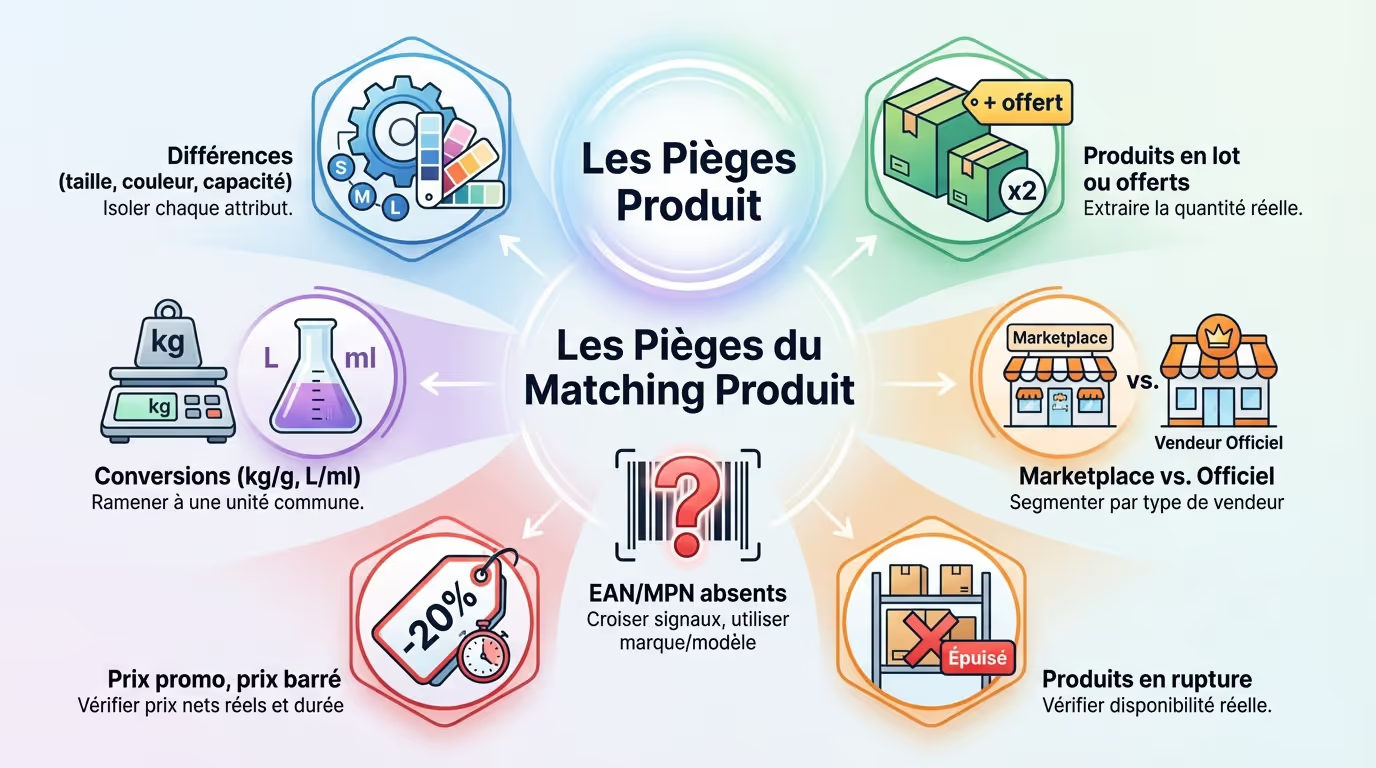
Incomplete references (missing EAN, missing MPN)
Without an EAN, matching becomes a risky statistical guess. The MPN helps, but sometimes it cannot be found on websites. In this case, several weak signals must be cross-referenced.
Vague titles often hide specific references. Use the brand and model to make up for it.
Missing code increases the risk of errors. Human oversight then becomes essential.
Marketplace vs. official seller (quality, price, conditions)
Third-party sellers sometimes offer rock-bottom prices without actually having the items in stock. Their product listings are often less detailed than the official ones. Don't confuse direct sales with the marketplace.
Shipping costs vary greatly from one seller to another. The warranty may also differ depending on the source of the offer.
Segment your data by seller type. This is crucial for your pricing strategy.
Promotions & crossed-out prices (mechanics and timing)
A limited-time promotion shouldn't dictate your annual strategy. Cart promo codes aren't immediately visible. Make sure to clearly identify the actual net prices.
The crossed-out price is sometimes misleading on certain websites. Always calculate the actual discount percentage.
Keep an eye on how long the offers last. A promotion that ends tomorrow isn't a threat.
Stock/availability (shortages that skew the analysis)
An aggressive price on a product that’s out of stock is a red flag. Matching that price is a major strategic mistake for your profit margins. Your monitoring system must verify actual availability.
Inventory levels directly influence competitive pressure. A competitor with no inventory is no longer a threat.
Filter out unavailable products. They skew your overall performance metrics.
Operational methodology for improving matching reliability (step by step)
To succeed in retail product matching competitive monitoring, you need to follow a strict methodology. Here’s how to turn your raw data into smart pricing decisions.
6-step matching method
1. Defining the scope
2. Golden Record Structure
3. Multi-signal matching
4. Confidence scoring
5. Quality control
6. Correction loop
Step 1: Define the scope (categories, KVIs, competitors, channels)
Don't upload your entire catalog all at once. Prioritize your best-selling items—your top-performing products. Also, select your most direct competitors to ensure your listings remain highly relevant.
Identify the channels you should prioritize. The web and brick-and-mortar stores operate by completely different rules.
A clearly defined scope ensures quality. Above all, don’t spread yourself too thin—it’s a trap.
Step 2: Structure product data (golden record)
Create a clean and comprehensive master database. Each product must have its key attributes: EAN, brand, and model. This is what’s known as your golden record.
Clean up your own data before looking elsewhere. The quality of your internal data always determines the success of external matching.
A robust data model is the foundation. Without it, your entire system will quickly collapse.
Step 3: Multi-signal matching (EAN/MPN + attributes + title)
Don’t rely solely on the barcode. Cross-check the titles, images, and technical specifications. This multi-signal approach drastically reduces scanning errors.
Use text similarity algorithms for titles. Also compare actual dimensions and weights.
The more indicators you have, the more reliable it is. The EAN is really just a starting point.
Step 4: Confidence scoring (A/B/C) + decision thresholds
Assign a reliability rating to each match. An A rating indicates certainty, a B rating requires verification, and a C rating indicates uncertainty. Automate only the A ratings.
Set clear decision thresholds for your teams. Never take any risks on low scores.
Scoring protects your margins. It finally adds some nuance to the system, you see?
Step 5: Quality control (sampling + audits)
Regularly review a sample of your automated matches. Manually verify the matches to detect any technical issues. This is essential groundwork.
Involve the category managers in this review. They have a thorough understanding of their products and all their specific features.
The human eye remains the final arbiter. The audit ensures the long-term viability of the overall system.
Step 6: Correction loop (rules, exceptions, learning)
Continuous refinement improves your results. Identify weaknesses so you can act quickly. Here are the key steps to stabilize your technical foundation:
- Record detected errors
- Create specific exclusion rules
- Force manual matches
- Update the thesaurus
- Adjust the weights of attributes in the algorithm
Every corrected error should feed into the algorithm. Create exception rules for recurring special cases. The system must learn from its own past mistakes.
Exact match vs. similar match: what pricing decision rules should be applied?
Once you’ve established your retail product matching competitive monitoring, what should you do? The strategy differs radically depending on whether the product is a clone or just a close variant.
When to align (exact match) and when not to align
When it comes to exact matches, price matching is often the norm. Customers use their smartphones to compare EAN or MPN codes between online and in-store prices. But don’t sacrifice your profitability.
Don't list your product if the competitor is out of stock. Also, avoid unreliable marketplace sellers.
Alignment should be carefully considered. It is not an automatic requirement.
Manage equivalents (substitutes) without compromising margins
For similar products, use an A/B/C confidence rating. Don’t try to match a substitute perfectly. Highlight your own strengths, such as customer service or warranty coverage.
The customer accepts a price difference for a different brand. Follow an error-proofing checklist for data validation.
Maintain your margins on exclusive products. Substitutes offer more flexibility.
Case study: KVI vs. long tail
KVIs require absolute precision to avoid false matches. For long-tail keywords, be more flexible. Tailor your matching efforts to the actual financial stakes.
Checklist for avoiding false matches (to be applied before adjusting the price)
Before clicking "Submit" for a new price, run your data through this security checklist designed for retail product matching and competitive monitoring.
Attributes checklist (brand, model, size, unit, etc.)
Check the exact make and model. Do the size and capacity really match? In short, even a small discrepancy in the unit can throw off your entire final margin calculation.
Don’t overlook any technical details. A single letter in a product code can refer to a completely different product. Be careful.
Checklist for offers (seller, delivery, returns, warranty)
Who is the actual seller behind the listing? Is shipping included in the listed price? Compare return policies and warranties.
An offer that doesn't include free shipping isn't comparable. The service is included in the price.
Promotional checklist (coupon, bundle, crossed-out price)
Is there a hidden promo code on the page? Is the offer part of a bundle deal? Does the crossed-out price reflect actual market conditions?
Unravel the complex promotional tactics. They often hide the actual selling price.
Marketplace checklist (seller, condition, fees)
Identify exactly who is selling what by reviewing this key data to ensure you don’t target the wrong audience:
- Third-party seller name
- Seller reliability rating
- Product condition (new or used)
- Country of shipment
- Possible customs duties
Is the product really new? A refurbished item cannot be used as a basis for comparison. Overseas sellers often have hidden fees.
The marketplace is a jungle. Don't hesitate to filter out suspicious listings.
KPIs & dashboards: measuring monitoring reliability
You can only effectively manage what you measure. Use these metrics to monitor the quality of your competitive intelligence.
Key figures: The market for data-driven retail technologies is projected to reach $25 billion by 2029, with an annual growth rate of 24%.
Matching quality (precision, recall, false match rate)
Precision measures the proportion of true matches generated. Recall indicates whether you have found all possible links. Aim for a minimal false match rate.
These technical indicators are your tool's thermometer. Monitor their progress after each software update to ensure reliability.
A good score reassures the teams. It validates pricing decisions.
Coverage (share of matched catalog, KVIs covered)
How much of your product catalog is actually being monitored? Your strategic products must be 100% covered. Identify the blind spots where you’re flying by the seat of your pants.
Expanding coverage should not compromise accuracy. It’s a delicate balance to strike to ensure the effectiveness of your retail product matching competitive monitoring.
Always prioritize your best-selling items. Achieving full coverage is often a pipe dream.
Data freshness (update interval, inactive page rate)
Price data becomes outdated very quickly. What is the average time between two updates? Monitor the percentage of pages returning errors.
Timeliness is key to responsiveness. A price from yesterday is already old news for your business.
Business impact (margin, competitiveness, image-price)
Monitoring should improve your overall profit margin. Track changes in your competitiveness across your key segments. Price perception is built over time through consistency.
If your profits are falling, take a closer look at your matching strategy. Data should be used to drive overall financial performance.

Recommended process: who validates what (governance)
Technology isn't everything. Effective governance defines the responsibilities needed to turn data into concrete action.
Roles (pricing manager, category manager, data/IT)
The pricing manager oversees the overall strategy for retail product matching and competitive monitoring . The category manager contributes specialized product expertise. The IT team ensures the technical reliability of incoming data feeds.

Everyone must know exactly what their responsibilities are. Collaboration prevents silos and mistakes.
In short, communication is the glue that holds the process together. Make sure to clearly define roles from the start.
Escalation rules (A automatic / B review / C block)
Automate price changes for high confidence scores. Schedule a manual review for ambiguous cases. Block any action if there is too much uncertainty.
This escalation system ensures the security of your operations. It saves time without compromising margin control.
Better safe than sorry. Don’t let AI make decisions on its own.
Review frequency (daily, weekly, monthly)
KVIs require daily monitoring. A weekly review is sufficient for the rest of the catalog. Conduct a monthly quality audit of the entire system.
Adjust your pace to market volatility. Consistency leads to operational excellence.
The 5 Priority Actions to Improve Reliability in 30 Days
Finally, here is the roadmap we recommend. This plan will completely transform your price positioning.
- Review the top 100 bestsellers.
- Clean the EAN codes.
- Set A/B/C scoring thresholds.
- Isolate marketplace listings.
- Introduce a weekly review.
Start small, but aim for perfection with your KVIs. You earn your teams’ trust through tangible results. Don’t try to go fully automated right away.
Data quality is an ongoing challenge. Stay alert to changes made by your competitors. Your agility will make the difference in the long run.
Reliable product matching turns your competitive intelligence into a profit driver by combining scoring and audits to optimize your retail product matching monitoring.
Take action now to protect your margins and manage your prices with surgical precision.
Your future profitability depends on the accuracy of your current data.
Frequently Asked Questions
Articles similar

Building a high-performing pricing team requires adopting a hybrid model that combines centralized strategy with local agility. This transition replaces intuition with data-driven decisions, guided by specialized roles and strict governance.
This proactive management directly improves financial performance, enabling companies to aim for an increase in profitability of between 100 and 500 basis points.

In response to the radical price transparency of 2026, the retail sector is adopting automated management. This strategy protects margins against inflation by ensuring immediate responsiveness across all channels.
A high-performance tool guarantees a return on investment in less than six months, making pricing a cornerstone of net profitability.
Product matching is the foundation of competitive monitoring because it prevents the comparison of non-equivalent products. Reliable product matching safeguards margins by basing repricing on real-time, multi-source data.
Key finding: According to the Diamart study, 50% of French retailers still consider this challenge to be unresolved.