Best retail pricing software in 2026:comparison + selection criteria

Fabrice Decroo
Director of Consulting
March 12, 2026
In response to the radical price transparency of 2026, the retail sector is adopting automated management. This strategy protects margins against inflation by ensuring immediate responsiveness across all channels.
A high-performance tool guarantees a return on investment in less than six months, making pricing a cornerstone of net profitability.
If you experience a sudden drop in conversion rates because your competitors are adjusting their prices in real time, you need to equip yourself with the best retail pricing software of 2026 to stay competitive.
This detailed comparison analyzes specialized platforms capable of predicting price elasticity and managing your omnichannel inventory to turn every piece of raw data into immediate, tangible profit.
Discover how these tools automate your specific business rules while ensuring complete strategic control over your brand image and delivering a measurable return on investment in less than six months.
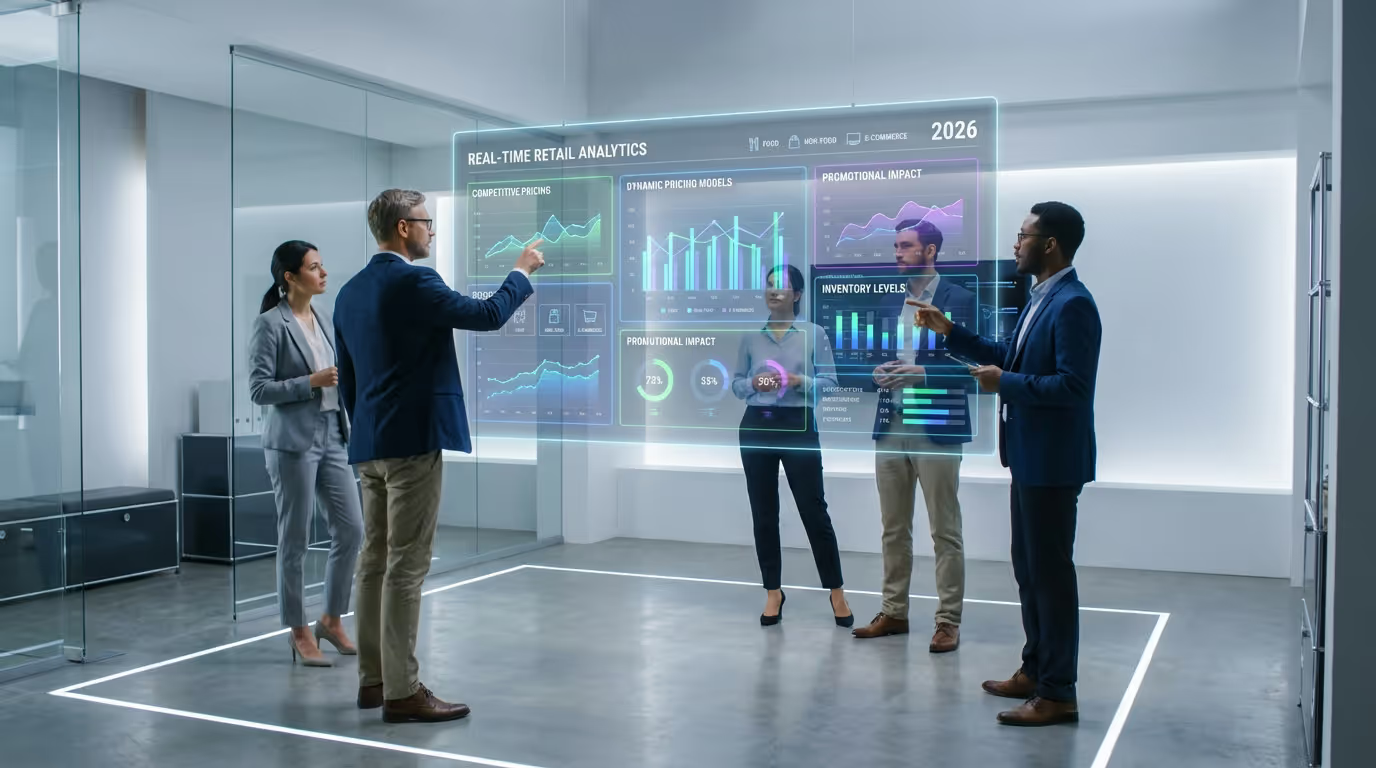
Why retailers are investing in pricing software in 2026
After years of trial and error, the retail sector will shift to data-driven management in 2026 to counter volatility, which has become the norm.
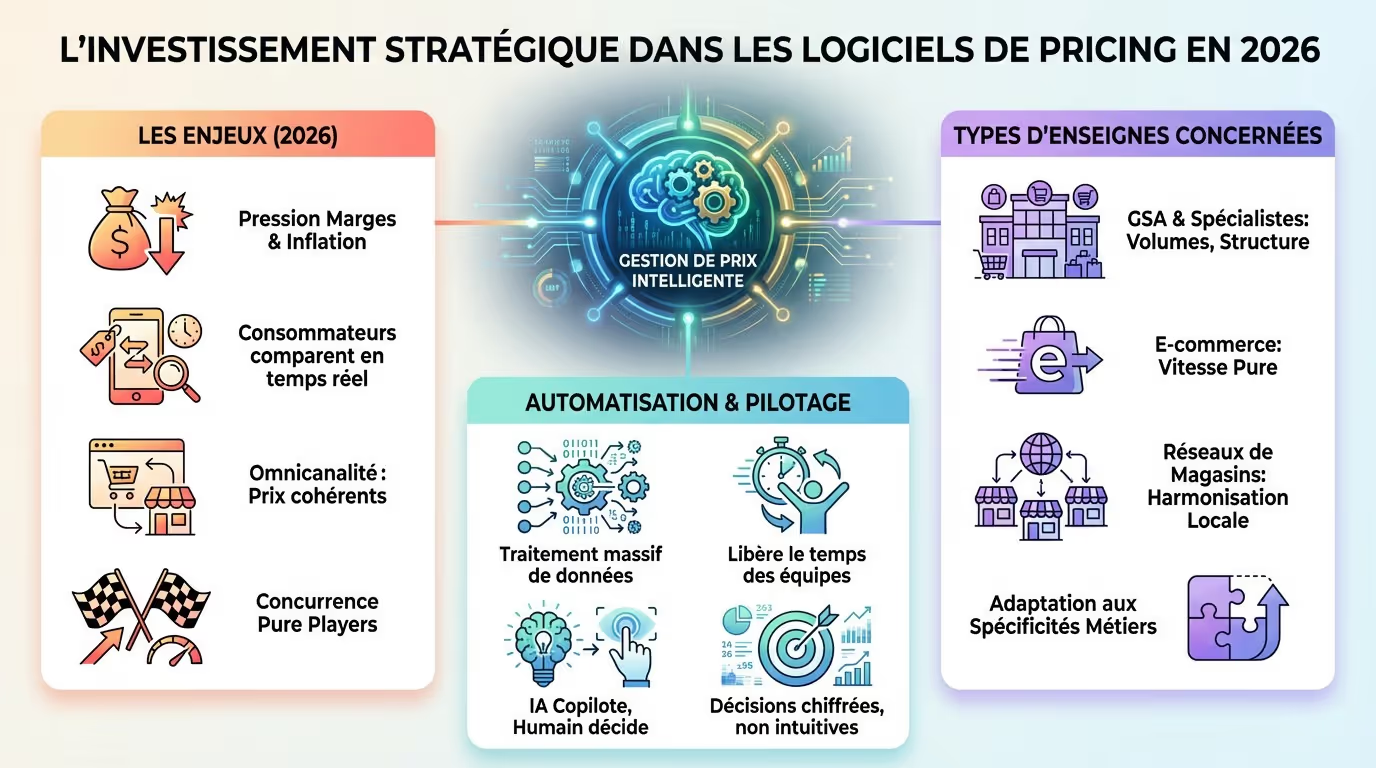
The challenges: margins, inflation, competition, omnichannel
In 2026, inflation at 2.4% is eating into your margins. Your customers are comparing prices down to the last penny on their phones before checking out. This puts constant pressure on your profitability.
Omnichannel retailing demands absolute consistency. Different prices online and in physical stores undermine customer trust.
Competition from pure-players is fierce. They force companies to respond almost immediately in order to survive.
Automation vs. control: what tools really change
The best retail pricing software of 2026 processes vast amounts of data to free up time for teams. It separates automated execution from human strategy. This results in a significant boost in efficiency.
The algorithm suggests relevant changes. However, the business team always has the final say on the final prices.
We’re moving away from vague intuition. The decision is finally quantified and precise.
For what types of retailers (supermarkets, specialists, e-commerce, chains)?
Large retailers and specialty stores handle massive volumes of products. E-commerce prioritizes speed above all else. Retail chains focus primarily on local standardization. Each type of business requires a solid technological foundation to manage its assets.
Each format has its own constraints. BOOPER adapts to these specific business requirements seamlessly. The ultimate goal remains the overall performance of your sales network.
The 10 essential criteria for choosing pricing software
To find the best retail pricing software for 2026, you need to carefully examine these ten technical and functional pillars.
1) Price positioning & alignment rules (KVI, gaps, index)
Managing KPIs requires surgical precision. The tool must track metrics against competitors while monitoring the strategic gaps that drive customers away.
Alignment rules automate this monitoring. They ensure that your price image never deviates, regardless of fluctuations in the local and digital market.
2) Price elasticity & margin optimization (markdown/promotion/regular)
Calculating price elasticity is no longer optional. The software predicts how a price increase will affect your sales volume, serving as the lifeblood of your overall profitability.
It handles all types of pricing. From regular shelf stock to aggressive end-of-season markdowns, every penny is carefully considered.
3) Competitive data: collection, frequency, reliability
Data scraping must be clean and up-to-date. Outdated data leads to ill-informed and costly decisions. The frequency of data collection should align with the pace of your actual sales.
Product matching is the foundation. Comparing identical references without error remains the absolute basis of the pricing profession today.
4) AI & forecasting: demand, cannibalization, seasonality
Predictive models forecast crowd movements. AI detects spikes in demand and seasonal trends to help you avoid selling off your inventory unnecessarily.
Beware of cannibalization. Lowering the price of one item should not kill sales of neighboring products. The algorithm must consider the entire shelf.
5) Simulation / “what-if” scenarios (prior to deployment)
Testing before implementation is a game-changer. We simulate a new strategy to assess its theoretical impact on margins, thereby limiting actual financial risks.
It serves as a safety net for decision-makers. We validate assumptions with concrete data rather than relying on intuition, which can often be misleading.
6) Management of promotions and mechanics (2+1, lots, crossed-out prices)
The system must be able to handle complex mechanics. Bundles, 2+1 or immediate discounts, everything must run smoothly. The current promotional fatigue requires extremely precise targeting.
The profitability of operations remains the ultimate judge. Every euro invested in a promotion must prove its immediate or deferred accounting value.
7) Governance & workflows (rights, validations, traceability)
Control is the key word. Who modifies what? The system tracks every click and every rate change to ensure complete internal transparency.
Approval workflows simplify life. Managers approve sensitive transactions in the blink of an eye, without wasting time on unnecessary email exchanges.
8) IS integration (ERP/POS/PIM/e-commerce/BI)
The tool doesn't operate in isolation. It constantly communicates with your ERP and PIM systems. Data flows must move seamlessly without any technical friction.
The price reduction is the final step. The new price must be updated immediately at the checkout or on your website to ensure consistency across all platforms.
9) Deployment & time-to-value (implementation, change management)
The speed of implementation often determines success. A project that drags on for two years often ends up on the back burner. We aim for tangible results within a few months.
People remain at the heart of the process. Your teams need to get comfortable with the interface so that their efforts can truly make a difference in day-to-day operations.
10) ROI & KPIs (margin, volume, revenue, price image, availability)
Success is measured by the bottom line. We track gross margin growth and revenue growth. Perceived value for money has become a key indicator.
Don't forget about availability. A perfect price on an empty shelf is a wasted opportunity. Inventory and price are two sides of the same coin.
2026 comparison: what types of pricing tools are available?
The market has evolved into several segments, each addressing distinct challenges.
Pricing analytics (diagnosis + recommendations)
These tools analyze historical data to identify margin leaks. They pinpoint exactly where money is being lost. This is the first step toward understanding your strategy.
The tool suggests corrections without applying them. You retain control over every final decision.
Great for beginners. It's perfect for setting up a data workflow without automating everything all at once.
Pricing optimization (algorithm/AI + business constraints)
Advanced algorithms analyze elasticity and inventory levels to determine the optimal price. Price management becomes highly precise. Precision finally replaces intuition and spreadsheets.
The system takes your business requirements into account. We strictly adhere to minimum margins and suggested retail prices.
This is the core of BOOPER's expertise. We combine computing power with business rules to deliver results.
Competitive pricing / price monitoring
This company continuously monitors competitors' prices online. It alerts you in the event of a significant price drop. You no longer have to be at the mercy of the market.
Responsiveness is key. We quickly match our competitors' promotions to stay in the game.
Beware of price wars. Blindly matching prices can destroy your brand’s value.
Promotion & markdown optimization
These solutions calculate the right discount to clear out inventory. This prevents waste at the end of the product's life cycle. Profitability is maintained.
We're planning the highlights of the year. The promotional calendar is becoming more streamlined and visible.
Very useful in the fashion industry. Short production cycles require a high degree of precision that humans alone can no longer guarantee.
End-to-end pricing suite (from diagnosis to deployment)
These platforms cover the entire product lifecycle. Everything is centralized in a single interface. Management becomes comprehensive.
Cross-departmental collaboration is improving. Teams are finally able to rely on a single, reliable source of data to make decisions.
This is the target vision. It leads to greater consistency and operational efficiency in the long term.
2026 Selection: examples of tools and "when to choose them"
The final decision depends on your data maturity and your immediate operational priorities.
Tools focused on pricing optimization (ideal margin/volume)
These solutions are designed for high-volume retailers. They help you find the best retail pricing software for 2026 to increase margins on thousands of SKUs.
Here, AI balances volume and net profitability. It’s a precise process.
This is where BOOPER comes in. We help make these complex decisions.
Competitive intelligence tools (ideal for monitoring the competition)
In competitive markets, staying informed is crucial. If your customers are comparing everything, get real-time alerts about your competitors’ moves so you can stay in the game.
Automating data collection frees up your teams. It saves valuable time on data entry.
Useful for e-commerce. The battle is won or lost on immediate visibility.
Promotion/markdown-oriented tools (ideal for retail with deep discounts)
The apparel and fresh food sectors require strict management of markdowns. The goal is to clear inventory without sacrificing profit margins, using high-performance algorithms.
Optimizing sales is easy. We adjust the discount based on remaining inventory.
Reducing unsold inventory is essential. It is a major economic challenge for 2026.
Data and forecasting tools (advanced management ideal)
Expert systems provide detailed models of customer behavior. Demand forecasting becomes the cornerstone of a pricing strategy that anticipates rather than merely reacts.
Integrating external data is a game-changer. Weather conditions affect your seasonal sales.
Planning ahead leads to better inventory management. Price becomes a key factor in logistics.
And when to favor a customized/supported approach
Standard tools sometimes fall short when it comes to your business processes. When off-the-shelf software limits your performance, expert guidance becomes essential.
Building a competitive advantage takes boldness. Develop algorithms tailored to your brand.
BOOPER offers this advice. We build solutions that are tailored to your needs.
Comparison Chart
Here is a summary to help you determine which solution best fits your actual needs.
Recommended columns
This summary allows you to compare the strengths and weaknesses of each approach to find the best retail pricing software for 2026. It serves as a guide for your upcoming RFP. You’ll get a clear picture at a glance.
It is worth noting that the complexity of integration varies depending on the scope of the project. The benefits are proportional to the effort expended. Your choice will depend primarily on your internal resources.
How to deploy pricing software without disrupting operations
The tool is only half the solution; the other half lies in the deployment method.
Step 1: Framing (objectives, categories, rules)
You can’t change everything all at once. Identify your pilot product lines and set specific margin goals. This approach prevents you from spreading your efforts too thin.
Set firm price limits. These safeguards protect your brand image on a daily basis.
Get your team on board. Everyone needs to understand the direction we’re heading in to ensure a smooth transition.
Step 2: Data quality + product repositories
Clean up your databases. Without clean data, AI will produce costly errors. It’s the most thankless task, but it remains the foundation of your future pricing performance.
Verify product matches. Your products must align perfectly with those of your identified competitors.
Automate data flows. Ensure that data flows smoothly between the ERP system and the tool.
Step 3: Pilot program in one area (category/region)
Test the system under real-world conditions on a specific region or category. Fine-tune the algorithms without throwing the whole operation into disarray. This cautious approach pays off during the final global rollout.
Take a close look at the initial indicators. Compare the pilot store’s figures with those of the rest of the chain.
Fix the remaining bugs. The pilot project serves as a testing ground for resolving the final technical issues encountered.
Step 4: Industrialization + monitoring + team training
Take your entire catalog to the next level. Keep a close watch to block any suspicious algorithmic deviations. Vigilance now replaces pure intuition in your decision-making.
Train your category managers. They need to master the interface so they can regain control of their strategic levers.
Highlight the margin gains. These tangible successes bring teams together around this new standard.
Common mistakes (and how to avoid them)
Many projects fail for human or organizational reasons rather than technical ones.
Choosing a tool that is "too powerful" without data/resources
Wanting the best retail pricing software in 2026 doesn’t mean buying a Formula 1 car just to drive around town. Your tool should match your current processing capacity.
Do you have the analysts to run the system? Take an honest look at your internal resources before making a decision.
A well-managed solution is better than a complicated mess. Start simple to ensure success.
Do not define business rules (safeguards)
Maintaining strategic control is vital. AI can generate absurd prices if not given clear boundaries. Business rules protect your brand image.
Set specific limits. For example, you can set maximum daily price fluctuations.
Trust but verify. People remain the guarantors of the overall consistency of your offering.
Forget about business UX (validation, exceptions, workflows)
Think about the end users. If the interface is too complicated, no one will use it. The tool should make life easier for teams, not unnecessarily complicate it.
Handling exceptions. It must be possible to manually override a price in case of an emergency or unforeseen circumstance.
BOOPER focuses on simplicity. Our screens are designed for field staff.
Measuring ROI solely on revenue (instead of margin + price image)
Focus on the right metrics. Generating revenue while losing money is a classic trap. Net margin is the only true measure of success.
Keep an eye on your brand image. Don’t ruin customer perception for the sake of immediate short-term gains.
Analyzing customer loyalty. Effective pricing builds a lasting and healthy relationship with your audience.
Which tool will be "the best" in 2026?
Ultimately, the answer isn't found in a list of features, but in how well it aligns with your core values.
The best = the one that aligns with your objectives + your IT constraints + your organization
Choosing the best retail pricing software for 2026 isn’t just a matter of following trends. The ideal solution integrates seamlessly into your IT infrastructure. Above all, it must speak the language of your customers.
Plan ahead. Your needs are bound to change. Your solution must be able to scale with your data volume without ever experiencing technical slowdowns.
BOOPER favors a pragmatic approach. We focus on real price performance rather than theoretical promises. Decision support remains our priority.
Final mini-checklist (5 questions before making a decision)
Don’t sign anything without pressing the service provider for details. Data and infrastructure are the lifeblood of the operation. Make sure these critical points are in order before committing.
- Can the tool handle my margin requirements by category?
- How long does it typically take to integrate with my current ERP system?
- Does AI explain its decisions, or is it a black box?
- What level of personal support is included in the contract?
- Can I test the solution on a limited scale before committing to it?
A demo is worth a thousand brochures. Contact us for an audit. Now is the time to take concrete action.
Articles similar

Building a high-performing pricing team requires adopting a hybrid model that combines centralized strategy with local agility. This transition replaces intuition with data-driven decisions, guided by specialized roles and strict governance.
This proactive management directly improves financial performance, enabling companies to aim for an increase in profitability of between 100 and 500 basis points.

In response to the radical price transparency of 2026, the retail sector is adopting automated management. This strategy protects margins against inflation by ensuring immediate responsiveness across all channels.
A high-performance tool guarantees a return on investment in less than six months, making pricing a cornerstone of net profitability.

Product matching is the foundation of competitive monitoring because it prevents the comparison of non-equivalent products. Reliable product matching safeguards margins by basing repricing on real-time, multi-source data.
Key finding: According to the Diamart study, 50% of French retailers still consider this challenge to be unresolved.