
BRAND RATE
Definition
The markup rate refers to the ratio of the markup to the pre-tax selling price, expressed as a percentage. It is the standard metric used in France in retail and distribution to manage the profitability of a sale—as distinct from the gross margin, which expresses the same margin relative to the purchase cost rather than the selling price.
Why it matters
- Avoid confusing gross margin and markup: a 30% markup rate and a 30% gross margin rate do not represent the same level of profitability—the corresponding gross margin rate is always higher (42.9% for a 30% markup rate).
- Directly controlling the selling price: Calculated based on the listed price rather than the cost, the markup makes setting a target price easier to understand.
- Standard practice in the French retail sector: Virtually all retailers manage their profitability targets based on brand margins rather than gross margins.
Real-world example
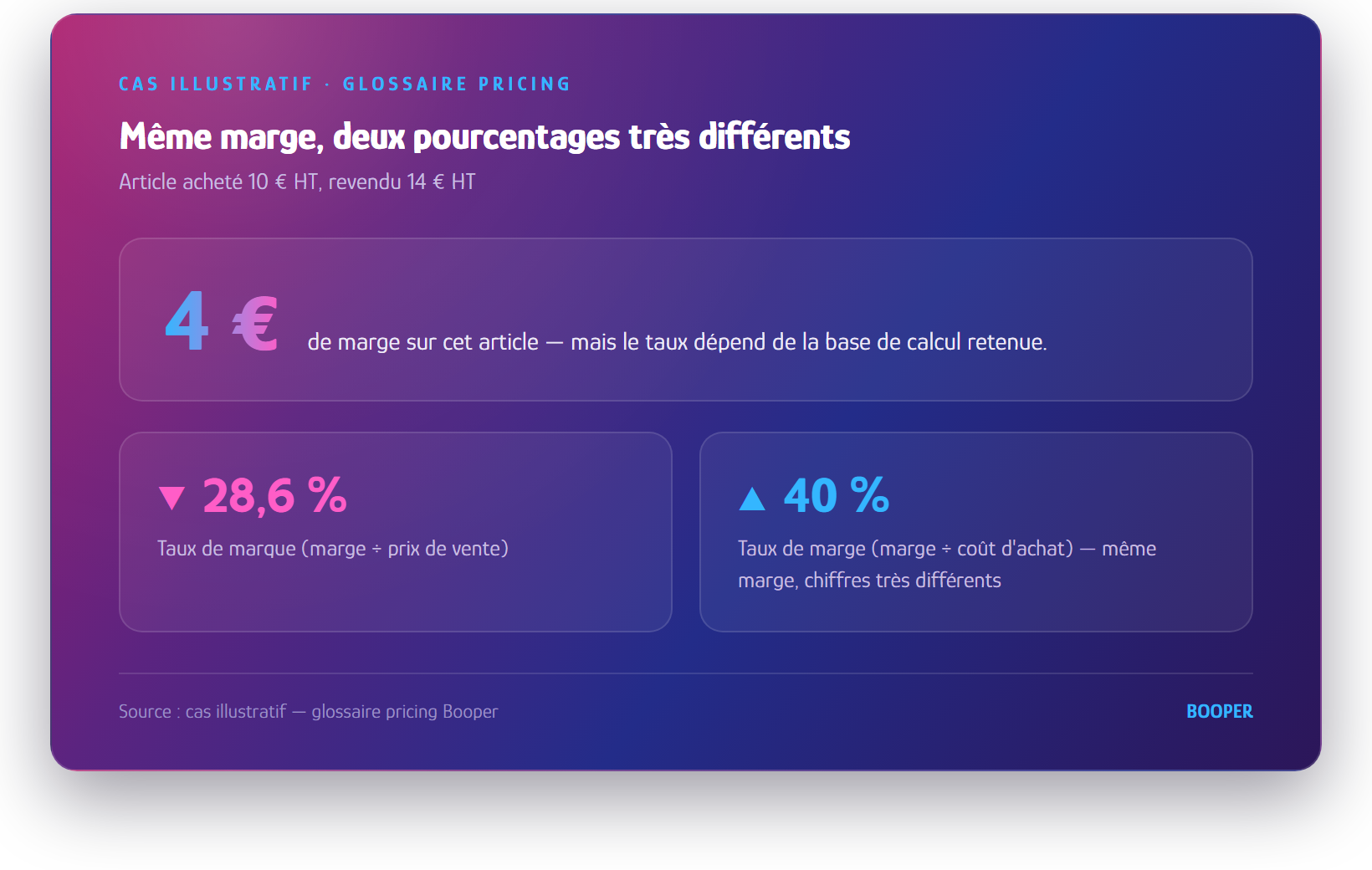
An item is purchased for €10 (excluding tax) and resold for €14 (excluding tax). The sales margin is €4
. The markup rate is 4 / 14 = 28.6%
The profit margin rate (calculated based on the purchase cost) is 4 / 10 = 40%
For the same profit in euros, the two rates yield very different percentages—confusing the two leads to underestimating or overestimating the actual profitability of a category.
How to calculate it
Markup (%) = (Selling price, excluding tax − Purchase cost, excluding tax) ÷ Selling price, excluding tax × 100
To calculate the selling price based on a target markup rate: Selling price (excluding tax) = Purchase cost (excluding tax) ÷ (1 − Target markup rate)
. This should not be confused with the multiplier (Selling price (excluding tax) ÷ Purchase cost (excluding tax)), which is a third way of expressing the same margin.
Common pitfalls
- Confusing the brand rate with the margin rate in a report, which distorts comparisons between categories or with industry benchmarks expressed differently.
- Set a single target markup rate for the entire product line without taking into account the different strategies for key performance indicators (KPIs), loss leaders, and regular stock.
- Manage solely based on percentages without referring back to the margin in absolute terms, which masks significant volume discrepancies between SKUs.
FAQ
The markup rate expresses the margin as a percentage of the selling price excluding tax, while the margin rate expresses it as a percentage of the purchase cost excluding tax. For the same margin in euros, the margin rate is always higher than the markup rate.
Margin rate = Markup rate / (1 − Markup rate). For example, a markup rate of 25% corresponds to a margin rate of 33.3%.
This varies greatly by industry (45 to 60% in the textile and cosmetics sectors, and 20 to 30% in the general food sector)—the relevant benchmark is the average rate for a company’s own category, not a universal figure.
You might also be interested in these articles

Maintaining a high price protects the unit margin but slows sales; marking down quickly speeds up sales but erodes the margin. The right balance is calculated, not guessed.
The total annual cost of holding inventory—including capital, storage, and obsolescence—averages 20 to 30 percent of its value.

An effective pricing strategy relies on a rigorous segmentation between image products (KVI) and margin drivers to maximize profitability. By balancing perceived value and competitive data, this approach can increase EBITDA by up to 15%. This strategy then translates into a concrete pricing policy that is applied on a daily basis. Clear governance and automated rules ensure consistent execution despite market fluctuations.

An effective pricing strategy relies on rigorous segmentation between key value items (KVIs) and margin drivers. To protect profitability, retailers must move away from blind competitive matching by establishing strict governance and pricing corridors. Data-driven management using cleansed data allows companies to restore their price image and margins in just 30 days.