
Pricing policy: definition, types and examples
On this page
Are your pricing policies documented and enforced?
Schedule a meetingLearn about our pricing strategy consulting servicesPricing policy is the structured set of rules that guide a company's pricing decisions: objectives (margin, volume, price image, customer acquisition), type of policy adopted (low price, promotional, pricing alignment, premium), arbitration rules, validation processes, and performance indicators. Without it, pricing decisions become erratic.
The Essentials in 6 Questions
A policy document that governs all pricing decisions.
Sales, marketing, procurement, finance, pricing.
Comprehensive review every 18 to 24 months; annual updates.
In all daily arbitrage decisions and pricing tools.
Ensure consistency and speed up decision-making.
Assessment, collaborative development, concise writing, and guided implementation.
The main types of pricing policy
Five main families of pricing policy coexist in retail; a brand often combines several depending on its categories.
| Type of policy | Principle | Example of use |
|---|---|---|
| Permanently low prices | Low prices all year round, few promotions. | Hard discount, basic necessities. |
| Promotional Policy | Higher reference prices, frequent and visible promotions. | Large retailers, key sales periods. |
| Competitive alignment | Target gap relative to selected competitors. | KVI, products that are frequently compared. |
| Premium or value | Price based on perceived value rather than market value. | Strong brands, differentiated products. |
| Differentiated prices | Prices vary depending on the area, channel or customer segment. | Multi-format networks, drive-through, e-commerce. |
These types can be combined: strict alignment with KVIs , value proposition based on differentiating products, and occasional introductory pricing to generate traffic. To determine which to choose for each category, see our guide to selecting your retail pricing strategy .
Pricing policy or pricing strategy: what's the difference?
The strategy chooses the method of setting prices; the policy determines who decides, according to what rules, and how to control it.
Pricing strategy answers the question, "How do we calculate our prices?" (cost, value, competition, demand). Pricing policy translates this into operational rules: target variances, minimum margin requirements, validation thresholds, and permitted exceptions. In the marketing mix, pricing policy is one of the four core corporate policies, along with product, distribution, and communication policies. It is only valuable if it remains aligned with management objectives, which is ensured by strategic alignment .
Why Establish a Pricing Policy?
Because a written framework quickly resolves common trade-offs and endures through changes in personnel.
- Provide a common framework for all teams that influence or are affected by pricing decisions.
- Ensure consistency over time, despite changes in staff.
- Speed up decision-making on routine cases so we can focus on the real exceptions.
Real-world example: 40% less arbitration time
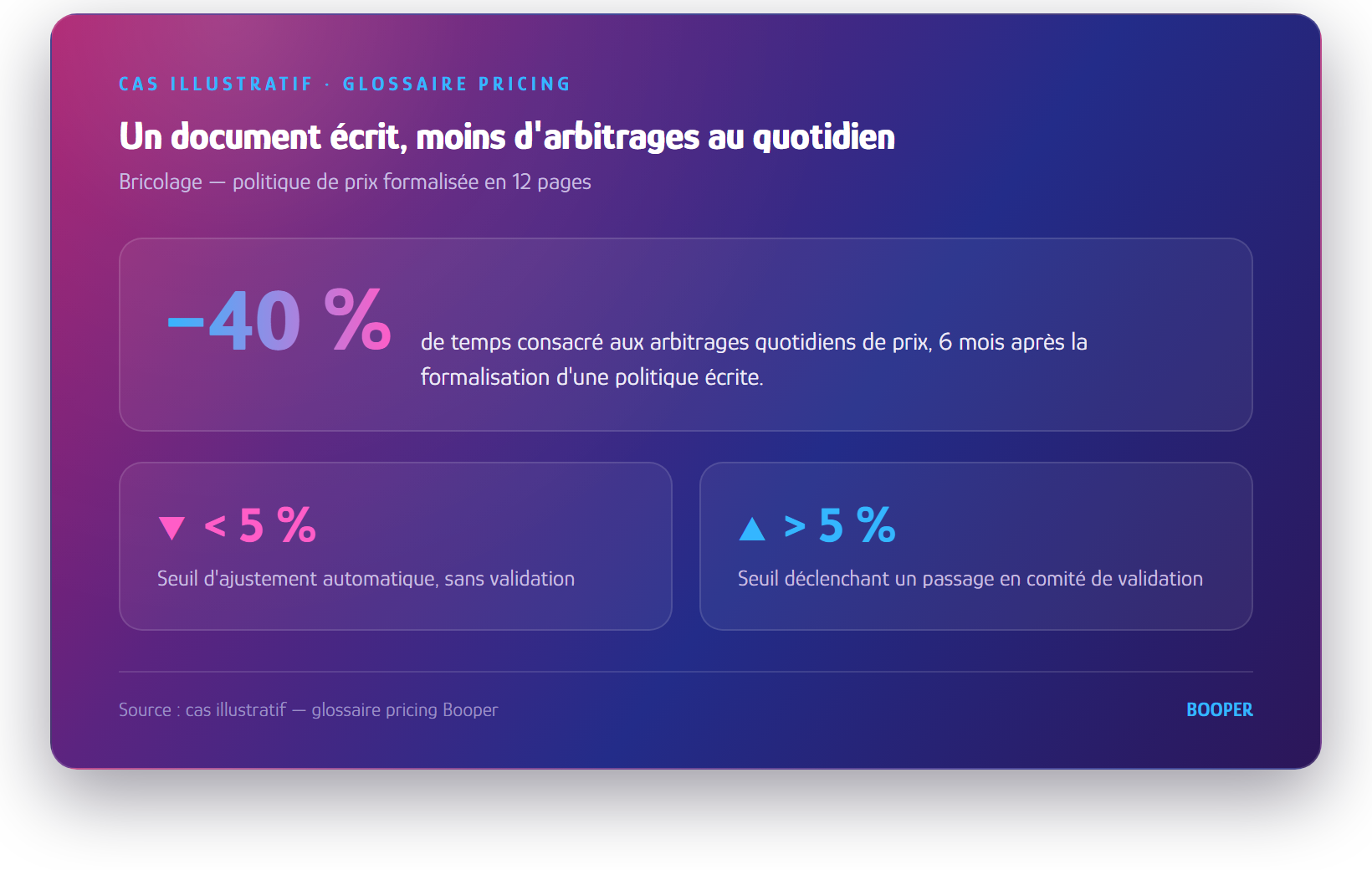
By establishing clear thresholds, a home improvement retailer reduced the time spent on day-to-day decision-making by 40% in six months.
| Rule | Contents |
|---|---|
| Target Positioning | Competitive on the KVI, with added value on the rest. |
| Competitive Advantage | Strict alignment with the KVIs, up to +5% elsewhere. |
| Floor margin | Between 18% and 35%, depending on the category. |
| Validation | Adjustments of less than 5% are automatic; those above that threshold are decided by the committee. |
A 12-page document, following years of case-by-case decisions.
How do you develop a pricing policy?
Four steps, working with the relevant departments and extending all the way down to the tools.
Assess the Current Situation
Current Status, Discrepancies Between Theory and Practice.
Build Together
Including sales, marketing, finance, and procurement.
Write concisely and in a way that inspires action
Easy to read and understand in an hour.
Deploy and equip
Training, communication, integration into pricing tools .
This is the focus of our pricing strategy consulting ; our change management support ensures adoption by teams. To ensure the rules remain effective over time, see the governance of a pricing policy .
The 3 Common Mistakes in Pricing Strategy
A text that is too abstract, written without any practical experience, or never updated.
- Drafting a policy that is too abstract, without any practical operational guidelines.
- Building without the field teams, which slows down adoption.
- Do not update: This document will become obsolete in 18 to 24 months.
See also : Common Pricing Strategy Mistakes.
Frequently Asked Questions
Short answers to the most frequently asked questions about pricing policy.
What is a pricing policy?
Pricing policy is the structured set of rules and principles that guide a company's pricing decisions: strategic objectives, type of policy chosen, rules for arbitrating between conflicting objectives, validation processes and performance indicators.
What are the different types of pricing policy?
The main strategies are a policy of permanently low prices, promotional policies, matching competitors' prices, a premium policy based on perceived value, and differentiated pricing by area, channel, or segment. A retailer typically combines these strategies according to its product categories.
Are pricing policy and tariff policy the same thing?
Yes, the two expressions are synonymous. "Pricing policy" is more commonly used in B2B and for services, while "pricing policy" is used in retail and marketing.
What is the difference between pricing policy and pricing strategy?
Pricing strategy is the choice of pricing method (cost, value, competition, demand). Pricing policy translates this into concrete rules: target variances, minimum margins, validation thresholds, and exceptions.
How to choose your pricing policy?
By combining three criteria per category: the category's role (traffic, margin, image), its life cycle, and the retailer's competitive position. A single policy for the entire catalog is rarely the right answer.
How long should a pricing policy be?
Usually between 10 and 25 pages: long enough to provide concrete rules, yet short enough for a newcomer to get the hang of it in an hour.
Who is responsible for approving the pricing policy?
The Executive Committee or senior management, following joint planning with the sales, finance, marketing, and purchasing departments.
How often should you review it?
A comprehensive review every 18 to 24 months, partial updates each year, and a special review in the event of a major development (acquisition, repositioning, crisis).
Key Takeaways
- Fixed pricing policy objectives, type of policy, trade-offs, validation and indicators .
- Five main types are combined according to the categories: low price, promotional, alignment, premium, differentiated.
- It is co-constructed , written in short sections and revised every 18 to 24 months.
Would you like to establish a clear pricing policy for the entire company?
Booper translates your pricing policy into rules that are automatically applied in the field.
Let's talk about your pricing policy →Learn about our pricing strategy consulting servicesYou might also be interested in these articles

The right question is not "which pricing policy to adopt" but "which policy, for which subset of the catalog, and why?" Three factors are sufficient to build the decision framework: the category and its elasticity, the product life cycle, and the retailer's competitive position.

Most pricing policies fail not so much because of poor design as because of a lack of active governance. Organizations that frame their automated decisions with dedicated governance are 3.4 times more effective (Gartner, 2025), but only 28% of organizations explicitly assign this responsibility to a senior executive (McKinsey). People must steer, automation must execute—never the other way around.
Establishing this governance framework, roles, exemption log, and review schedule is the focus of BOOPER's Operational Pricing Consulting module.

72% of prices are exactly the same between the website and physical stores at major multichannel retailers (American Economic Review, 2017), so the widespread price discrepancy is not justified. What is justified: a common policy (rules, objectives, protected KPIs) broken down into grids targeted at formats with genuinely different costs or uses, with curbside pickup (32% of French households) and the online marketplace at the top of the list.