
Bundling (group selling): definition, examples and prices
On this page
Are your bundle sales more profitable than individual sales?
Schedule a meetingLearn about our pricing strategy consulting servicesBundle pricing (or group pricing) involves selling several products or services together at a single price lower than the sum of their individual prices . This increases the average order value, sells slow-moving items, and enhances the perceived value of the offer.
The Essentials in 6 Questions
A set of products sold for less than the sum of their individual prices.
Pricing, marketing, and e-commerce teams.
Product launches, sales campaigns, inventory clearance.
Retail, e-commerce, beauty, electronics, SaaS, telecommunications.
Increase the average order value and move slow-moving inventory.
Complementary products, calibrated discount, overall margin validated.
Why Sell in Bulk?
Because a bundle encourages customers to buy more than they intended by making the savings obvious, while also promoting products that don't sell well on their own.
- Increase the average basket size : the customer buys more than planned to take advantage of the savings.
- Sell off slow-moving inventory without lowering the unit price.
- Building loyalty: A well-designed bundle delivers a more complete experience than a standalone product.
Similar to cross-selling, bundling makes the combination systematic and visible in the price.
Real-life example: a beauty gift set for €69 instead of €87
Sold at a 21% discount compared to the individual products, the gift set generates a 1.8-times higher average order value and sells three items instead of one.
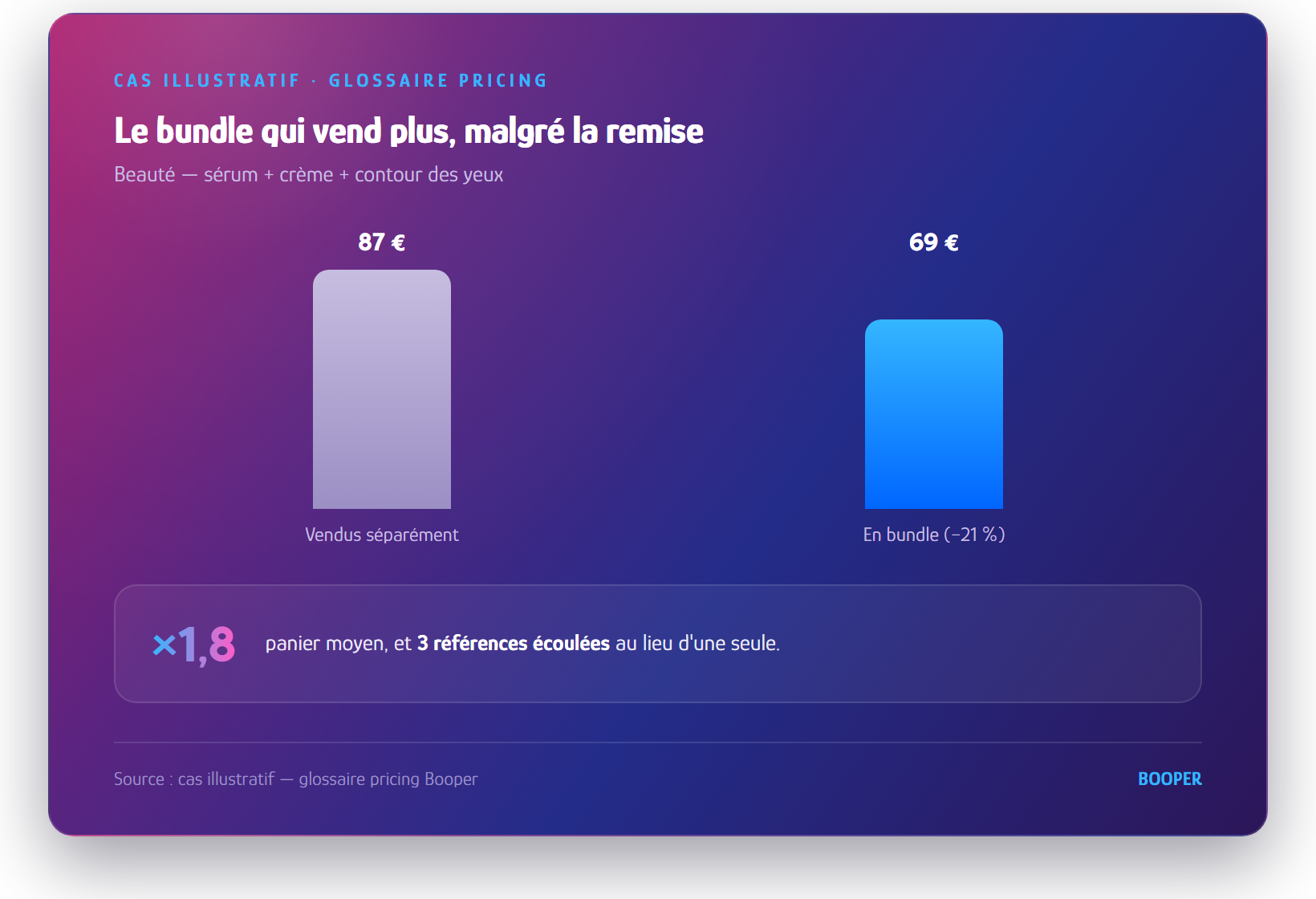
Serum for €39, cream for €29, and eye cream for €19: €87 total, offered as a set for €69. Despite the discount, the overall contribution margin is higher than that of a single-item purchase.
How do you build a profitable bundle?
In four steps: products designed to be used together, a tailored discount, an approved margin, and a test.
Choose complementary products
Identified through shopping cart analysis: items that customers already buy together.
Calibrate the discount
Visible enough to trigger the purchase of the lot, without destroying the margin.
Confirm the overall margin
And make sure the bundle doesn't cannibalize sales of the more profitable individual items.
Test and Stage
Displayed savings, total reference price: presentation matters just as much as price.
Our promotions management system simulates the margin for each bundle before it goes on the shelf; its role in the offering is defined in consultation with our pricing strategy consultants. See also our overview of the 5 pricing strategies in retail.
The 3 mistakes to avoid when bundling
Unrelated products, a prize package that's too appealing, or a lack of staging.
- Bundling non-complementary products: Customers don't see the value in it.
- Cannibalizing unit sales: An overly attractive bundle replaces individual sales with higher margins.
- Neglecting visual appeal: without any visible design elements or styling, the bundle goes unnoticed.
Frequently Asked Questions
Short answers to the most frequently asked questions about bundling.
What is bundling?
Bundle pricing involves selling several products or services together in a single package at a price lower than the sum of their individual prices. It's also known as group buying or bundled offers. Its purpose is to increase the average order value, sell items that don't sell well individually, and enhance the perceived value of the offer. For example, a set of three skincare products sold for €69 instead of €87 separately. A well-designed bundle improves overall profit margins; a poorly executed one cannibalizes more profitable individual sales.
Bundling, group sale, bundled offer: what's the difference?
Bundling, group selling, and bundled offers all refer to the same business practice: offering several products together at a single price. "Bundling" is the English term, used in marketing and pricing; "vente groupée" and "offre groupée" are the common French expressions. A distinction is made between pure bundling, where products are sold only as a bundle, and mixed bundling, where they are also available separately. Cross-selling , which suggests a complementary product without a discount on the bundle, is a related practice.
How do you set the price of a bundle?
To set the price of a bundle, we start with the sum of the unit prices and apply a discount significant enough to encourage the purchase of the bundle without destroying the profit margin. We verify three points: the bundle's contribution margin must remain higher than that of the individual sales it replaces; the discount must be consistent with the perceived value for the customer; and the bundle must not cannibalize the most profitable individual sales. In practice, the discount is often within a moderate range, which is tested on a limited sample before being rolled out more broadly.
What are the risks of bundling?
Bundled products present three main risks. They can reduce profit margins if the discount on the bundle isn't offset by increased volume. They can cannibalize individual sales when customers who would have bought a single product at full price opt for the discounted bundle. Finally, they can create the impression of an artificial discount if the advertised reference price has never actually been charged, a practice regulated by consumer law. Hence the importance of simulating the impact of a bundle on the category's profit margin before launching it.
How do you measure the performance of a bundle?
The performance of a bundle is measured by the overall margin generated, not just its own sales. We track changes in average order value, the attachment rate between the products in the bundle, the volume sold in bundles and individually, and the category's contribution margin before and after the launch. A bundle that sells well but reduces the category's margin because it replaces full-price individual sales is a false success. Comparisons are made over equivalent periods, taking into account seasonal and promotional effects.
Key Takeaways
- The bundle is sold at a lower price than the sum of the individual products.
- It increases the average order value and clears out slow-moving inventory.
- Its overall margin is simulated prior to launch to prevent cannibalization.
Would you like to create profitable bundle offers?
Booper calculates the margin for each bundle before putting it on the shelf.
Let's talk about your bundle deals →Learn about our pricing strategy consulting servicesYou might also be interested in these articles
The success of a retail pricing strategy relies on moving away from outdated spreadsheets in favor of (semi-)automated execution driven by AI. This technological pivot allows retailers to delicately balance profitability with commercial attractiveness.
This is essential for building customer loyalty, given that 62% of shoppers are willing to switch retailers for a better price.

Strategic pricing defines long-term positioning to maximize profitability and price image, unlike daily operational adjustments. This framework structures range architecture and governance to prevent gut-feeling decisions. In retail, 62% of buyers prioritize price, making this compass essential for protecting margins against competition.

Segmenting an offering into several price tiers makes it possible to target different customer profiles without pitting them against each other, provided that each tier corresponds to a real difference in perceived value—not just a difference in price. If done poorly, segmentation cannibalizes the entry-level price and erodes margins rather than expanding the market.