
Cross-selling: Selling More Through Complementary Products
On this page
Are your cross-sells really profitable?
Schedule a meetingLearn about our operational pricing consulting servicesCross-selling involves offering a customer a product that complements the one they are purchasing—a product from a different category but with a related use (batteries with a toy, a laptop sleeve with a computer). The goal is to increase the total value of the shopping cart, not the price of a single item.
The Essentials in 6 Questions
Offer a complementary product with the main purchase.
E-commerce, merchandising, pricing, and sales teams.
During thepurchaseprocess: product page, shopping cart, checkout.
Both online (" frequently bought together ") and in-store.
Increase the average order value without acquiring new customers.
Real-world usage models, driven by retention rates and margins.
Why Cross-Selling Increases Basket Profitability
Because it builds on a previously expressed intent to purchase in order to sell products that are often more profitable.
- Increase average order value without acquiring new customers, by leveraging existing purchase intent.
- Promote secondary or higher-margin products that, on their own, would not generate traffic.
- Enhance the perceived relevance of the brand when the associations align with actual usage.
Unlikeup-selling, the goal here is not to sell a higher-end version of the same product, but to expand the shopping cart.
Real-life example: a lawn mower and its accessories
With 30% of shoppers adding an accessory, the average cart value for this category increases by about €8 per order.
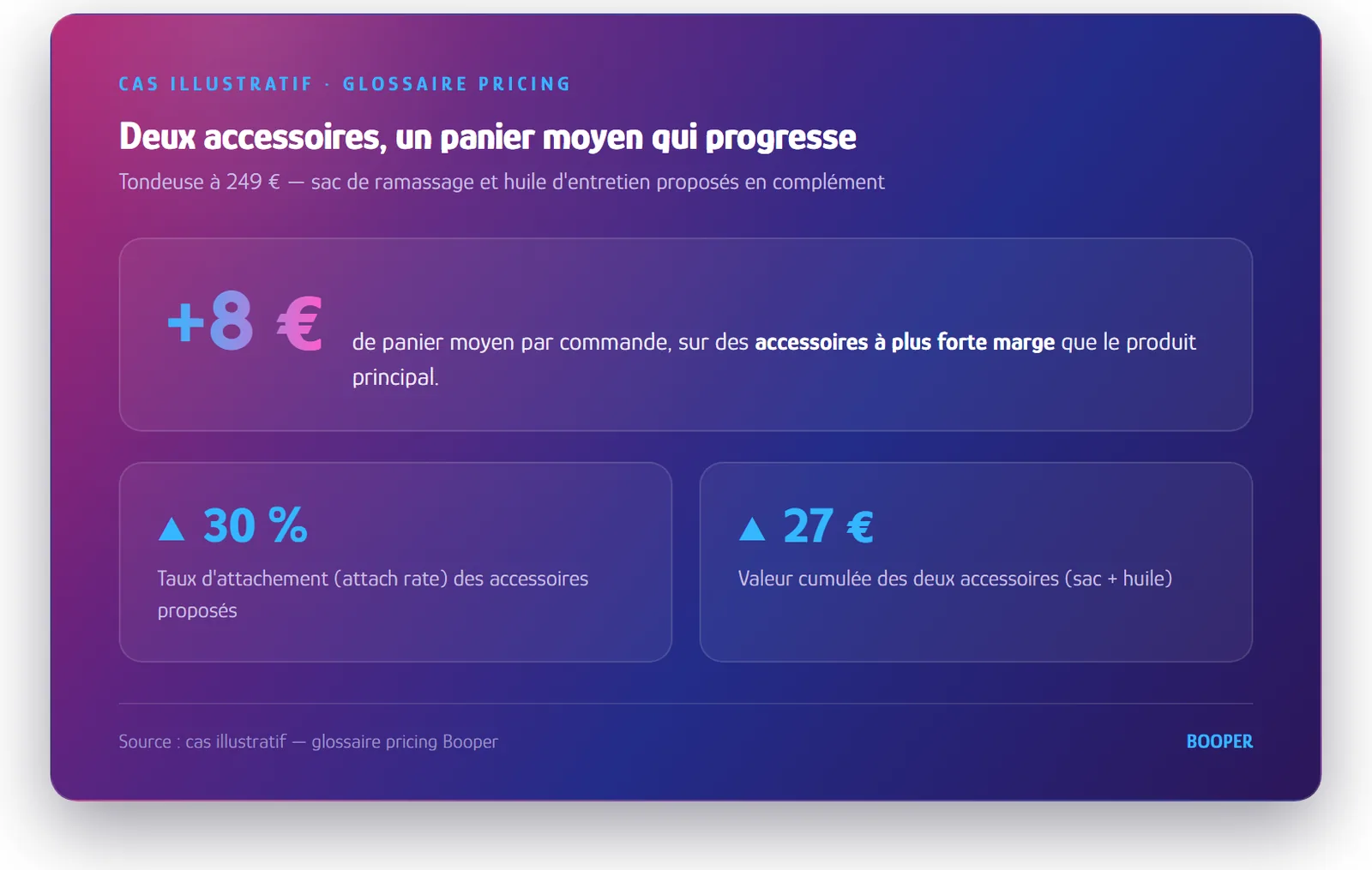
A customer buys a lawn mower online for €249. The website offers a compatible grass catcher bag for €19 and maintenance oil for €8. These accessories generally have a higher profit margin than the lawn mower itself.
How do you measure cross-selling?
Based on the retention rate and the net impact on the transaction margin, not just on revenue.
| Indicator | What it measures |
|---|---|
| Retention Rate | The percentage of main transactions accompanied by at least one complementary product. |
| Contribution to the average shopping cart | The additional revenue generated by related sales. |
| Transaction Margin | The net effect of the merger on overall profitability. |
Online, recommendation engines automate the identification of relevant product combinations. To assess the actual margin for each combination, see our price optimization software; to structure this process with your teams, see our operational pricing consulting services.
The 3 Most Common Mistakes in Cross-Selling
Unrelated, excessive, or unprofitable organizations end up costing more than they bring in.
- Associations that are too generic, with no real practical connection to the main product.
- Too many offers, to the point of complicating the buying process and causing the main sale to fall through.
- Ignoring the actual profit margin on complementary products by prioritizing volume over profitability.
Frequently Asked Questions
Short answers to the most frequently asked questions about cross-selling.
What is cross-selling?
Cross-selling involves offering a customer a product that complements the one they are purchasing, in order to increase the total value of the shopping cart rather than the unit price of a single item.
What is the difference between cross-selling and upselling?
The two terms are generally synonymous in French: “vente additionnelle” refers to the offer of a complementary product alongside the main purchase, which corresponds to cross-selling.
Does cross-selling work in every industry?
It is particularly effective when there are obvious usage combinations (accessories, consumables, maintenance). It is more difficult to implement for one-off purchases that do not naturally complement each other.
How can you measure the effectiveness of a cross-selling strategy?
Through the cross-selling rate (the percentage of orders containing at least one complementary product) and its net effect on the transaction margin.
How do you choose which products to cross-sell?
By focusing on actual purchases rather than on common assumptions. An analysis of shopping carts reveals frequent product pairings, some of which are counterintuitive. Two precautions: exclude obvious pairings that customers already make on their own—which do not generate any additional revenue—and verify that the paired product is not a substitute for the one being purchased.
Should we put a cross-selling batch on hold?
Not always. A discount is justified when it triggers a purchase that otherwise would not have occurred. It erodes profit margins when applied to a bundle that the customer would have purchased anyway. The test is the same as for any promotion: measure the actual incremental sales against a control group, not the volume sold as a bundle.
What is the difference between cross-selling and bundling?
Cross-selling offers a second product that the customer is free to add or not, with each product retaining its own price. A bundle combines several products into a single offer, typically at a total price lower than the sum of the individual prices. The former expands the shopping cart without altering the pricing structure, while the latter creates a new price point to manage.
Key Takeaways
- Cross-selling involves selling a complementary product, while up-selling involves selling a higher-end version.
- It is determined by the attachment rate and the transaction margin.
- Associations should be based on actual usage, without complicating the process.
Do you want to boost cross-selling without compromising your price image?
Booper identifies product combinations that maximize average order value and profit margin.
Let's talk about your average cart value →Learn about our operational pricing consulting servicesYou might also be interested in these articles

An effective pricing strategy relies on a rigorous segmentation between image products (KVI) and margin drivers to maximize profitability. By balancing perceived value and competitive data, this approach can increase EBITDA by up to 15%. This strategy is then translated into a concrete pricing policy applied on a daily basis. Clear governance and automated rules ensure consistent execution despite market fluctuations. Building and equipping this strategy from start to finish is the purpose of BOOPER’s Pricing Strategy Development module.

Retail promotion management must rely on rigorous data analysis to ensure profitability. By mastering uplift and cannibalization, retailers can transform a high-risk lever into a tool for healthy growth. Precise monitoring is vital, as six out of ten promotions today prove to be unprofitable.
The purpose of BOOPER’s Promotions Management module is to automate this process rather than calculate it manually: to simulate uplift and cannibalization before launching a campaign, not after.

Maintaining a high price protects the unit margin but slows sales; slashing prices quickly speeds up sales but erodes the margin. The right balance is a matter of calculation, not guesswork.
The total annual cost of holding inventory (capital, storage, obsolescence) averages 20 to 30 percent of its value. The purpose of BOOPER’s Markdown & Inventory Clearance module is to quantify this trade-off between margin and sales on a per-SKU basis.