
Promotional pricing: 7 strategies for 2026

Retail promotion management must rely on rigorous data analysis to ensure profitability. By mastering uplift and cannibalization, retailers can transform a high-risk lever into a tool for healthy growth. Precise monitoring is vital, as six out of ten promotions today prove to be unprofitable.
The purpose of BOOPER’s Promotions Management module is to automate this process rather than calculate it manually: to simulate uplift and cannibalization before launching a campaign, not after.
Are your promotional campaigns silently draining your gross margin instead of generating healthy, robust, and truly measurable growth? Between the invisible cannibalization of items and the erosion of perceived value, dumping inventory without a scientific approach has become a serious financial risk that this article helps you eradicate through seven data-driven strategies.
Discover how to master uplift and operationalize these tactics using artificial intelligence to anticipate competitor reactions while securing market share with surgical precision and sustainably optimized profitability.

Promotional Pricing in Retail: Why Running Promotions Is No Longer Enough
Promotions are no longer simply a tool for driving sales volume but a major risk to profitability if they are not data-driven.
The impact of promotions on fast-moving consumer goods (FMCG) sales has reached a 20-year high in France: 21.9% of FMCG-CPG turnover is now generated through promotions (NielsenIQ, 2025 report).
This ratio has a name: the promotional rate, the key indicator for tracking a retailer's promotional intensity.
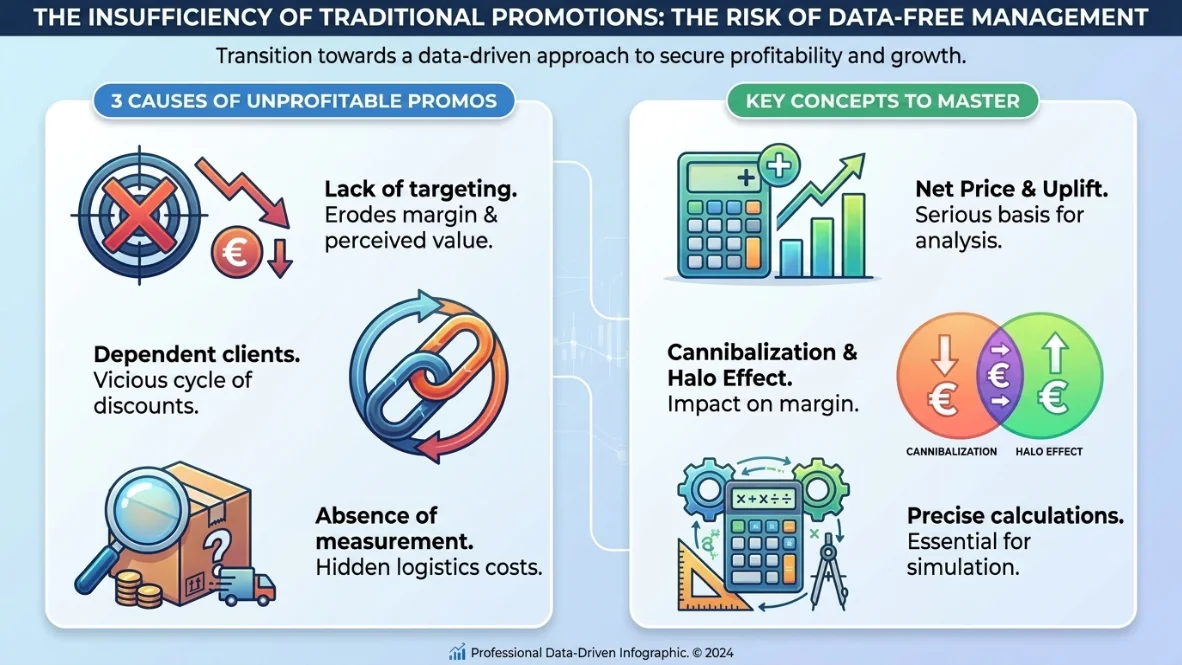
The 3 classic causes of unprofitable promotions
Unstrategic discounting destroys perceived value. A lack of targeting causes a severe erosion of your gross margin—a fatal mistake for your market positioning.
Your customers get used to permanent discounts. This creates a vicious cycle that is hard for the brand to break, as shoppers systematically wait for the next markdown.
Hidden logistics costs are often overlooked. Failing to measure the actual long-term impact skews your results.
30% to 40% of retail promotions are inefficient or unprofitable, in addition to fatiguing shoppers with an excess of irrelevant offers (Boston Consulting Group, 2023).
Net price, uplift, cannibalization: key concepts to master
Net price and uplift measure the actual incremental sales surplus. These indicators form the basis of any serious analysis and allow you to assess commercial performance.
Key Definitions
Uplift: incremental sales volume generated by a promotion. Cannibalization: loss of sales on a product due to the promotion of a similar item.
Cannibalization and the halo effect directly impact overall margins. They are two sides of the same coin.
Without these foundations, simulation is impossible. Precision in your calculations is paramount.
The minimum data required to manage data-driven promotions
Moving from intuition to science first requires cleaning and centralizing your data assets.
Sales, net price, costs, inventory, availability
Collect your transactional data: volumes, net prices, and procurement costs. Without them, calculating your actual post-discount margin becomes an impossible mission.
Critical Data
Data must be updated daily. Key variables: procurement cost, real-time inventory, and historical performance by channel (web vs. store).
Monitor your stock levels in real time. Launching a promotion on an out-of-stock product is entirely pointless.
Data must remain fresh. Daily updates are the minimum standard.
Promo history + calendar + channels
Analyze your past performance by channel. Web and in-store channels behave differently, requiring adjustments for each touchpoint.
Integrate seasonality and events. Your calendar often dictates the intensity of the promotional pressure required.
Competition & product matching (if product matching)
Monitor market prices. Product matching allows you to compare identical items to stay competitive against rivals.
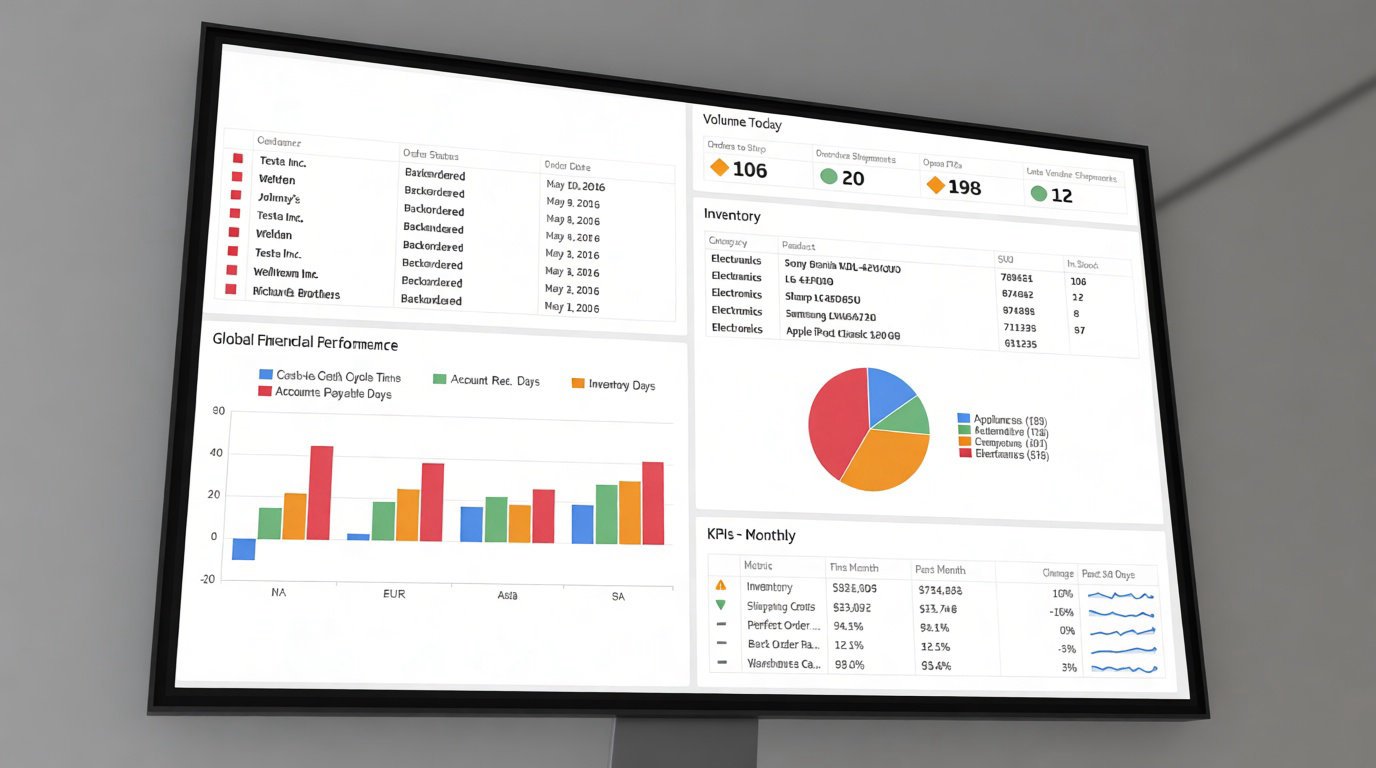
Adjust your aggressiveness based on these data points. However, avoid blindly following every competitor price drop.
Strategy #1: KVI protection (price image) with corridors
The primary rule is to protect your traffic-driving products—those that define your positioning in the customer's eyes.
Objective
Preserve attractiveness on your key items. Prevent customers from perceiving your brand as too expensive.
Stabilize actual in-store traffic for your data-driven promotional pricing strategies. This is the cornerstone of this tactical approach.
Implementation (rules)
Define precise price corridors relative to the market leader. Apply automated discounts as soon as the gap becomes excessive. Monitor direct competitors' prices daily without fail.
Automate variance alerts. Reactivity is paramount here.
Guardrails
Set an absolute price floor. Never sell at a loss, even to match an aggressive competitor. Protect the minimum gross margin for every targeted SKU. This is non-negotiable.
KPIs
Monitor price index and sales volume. Verify that market share in KVI is increasing . Analyze the penetration rate of key items.
Example
An entry-level carton of milk. Align within 2% of the local discounter to build trust. This helps validate the low-price perception. Simple and effective.
Strategy #2: Stock-driven promotions (excess inventory clearance)
When warehouses overflow, promotions become an inventory management tool to free up cash flow.
Objective
Liquidate end-of-line items rapidly. Drastically reduce storage costs that unnecessarily tie up your precious operational cash flow.

Clear shelves to make room for new arrivals. Above all, it is a matter of assortment freshness.
Implementation
As part of an effective promotional pricing strategy, use progressive discounts based on the age of the inventory. The longer a product sits on the shelf, the greater the discount.
Target stores with the highest levels of unsold stock. Local granularity is a winning strategy.
Guardrails
Strictly limit duration to prevent habituation. Never turn your department into a permanent clearance zone that would devalue your brand image.
KPIs
Track the sell-through rate daily. Measure the rotation speed of the specific inventory targeted by the campaign to adjust your prices in real time.
Example
Fan clearance at the end of August. A -40% discount is applied to avoid carrying this bulky inventory throughout the upcoming winter.
Strategy #3: Segment-driven promotions (Customer targeting)
Rather than broadcasting to everyone, leverage CRM data to personalize the promotional effort.
Objective
Rewarding the loyalty of top-tier customers remains a priority. You want to increase the lifetime value of each segment.
Reactivating dormant customers is also possible. A targeted offer can trigger an immediate repurchase.
Implementation (with CRM data)
Segment your buyers by purchase frequency and average basket value. Send personalized coupons via the app or email. It is that simple.
Test exclusive offers for your members. The sense of exclusivity enhances overall engagement. It is truly effective.
Safeguards (Fairness / Cannibalization)
Verify that regular customers would not have purchased without a promotion. Avoid subsidizing purchases that were already planned. Do not squander your margin.
KPIs
Track coupon redemption rates. Measure the incremental revenue generated by the specific targeted segment. This is the only metric that matters.
Example
A -15% "birthday" offer sent via SMS. It specifically targets customers who haven't made a purchase in three months. Timing is everything for success.

Strategy #4: Basket-building (Bundles / Cross-sell)
The idea here isn't to sell at lower prices, but to increase sales at each checkout through smart promotional pricing.
Objective
Mechanically boost the average order value (AOV). Drive the discovery of complementary product categories throughout the shopping journey right away.

Improve transaction profitability. Service costs are covered effortlessly.
Implementation (Bundle, 3-for-2, basket discount)
Assemble coherent bundles, for instance, a device and its accessories. Apply an immediate discount on the second item, the cheapest in the cart. This is a powerful mechanism.
Intelligently utilize free shipping thresholds. This tactic naturally drives your customers to add impulsive items.
Safeguards (Margin mix)
Closely monitor the weighted margin of the complete bundle. Strictly avoid associating two low-margin products in the same promotional bundle to limit cannibalization. This is vital.
KPIs
Analyze the evolution of the number of items per basket. Scrupulously track the penetration rate of loss leaders to validate the relevance of the offer. Do not overlook any indicator.
Example
Launch a "Buy 2, Get the 3rd Free" operation on your consumables. The customer then doubles their initially planned purchase volume, thereby securing your market share. Inventory clears out quickly.
Strategy #5: Competitive response (Controlled tactic)
Do not let your rivals clear out your shelves with aggressive offers without reacting intelligently.
Objective
The goal is to defend your local market share. You must put a definitive stop to customer churn toward direct competitors.

Demonstrate that you remain competitive. This represents an active defensive stance.
Implementation (thresholds + duration)
Deploy temporary price cuts on matched items. Strictly limit the operation to the duration of the competing promotion. Never exceed this specific timeframe.
Communicate this alignment locally. Display clear in-store signposting.
Guardrails (price floor / KVI)
Avoid the trap of aligning your entire catalog. Target only high-visibility products. Monitor your price floors closely to prevent selling at a loss.
KPIs
Monitor your promotional share of voice and traffic. Checkout volume must remain stable. Verify that overall margin does not collapse.
Example
A competitor launches a 20% discount on diapers. You immediately reply with an identical offer for 48 hours. This neutralizes the competitor's advantage without unnecessarily discounting your inventory.
Strategy #6: Test & Learn (A/B testing / holdout groups)
Stop guessing your product elasticity and start measuring it scientifically.
Objective
The objective is to determine the ideal discount by category. The goal is to see whether the customer truly reacts to the price point.
This allows you to halt margin erosion. Future pricing rules become significantly more precise.
Simple implementation (category management)
Isolate a test group of stores and another to serve as a control. Activate the promotion exclusively on the first group.

Analyze the metrics after two weeks of testing. The performance gap between the two zones reveals the net uplift.
Guardrails (volumes, seasonality)
Prioritize neutral periods for your experiments. The holiday season distorts purchasing behavior and renders data unusable.
KPIs
Observe the uplift differential between your two groups. Accurately calculate the cost of sacrificed margin versus the actual gain.
Example
Test a 10% discount versus 20% on coffee. It is frequently observed that a small markdown is entirely sufficient.
Strategy #7: Calendar-driven (promotional planning + forecasting)
Early planning synchronizes purchasing, logistics, and marketing for maximum impact.
Objective
Anticipating seasonal demand spikes remains a priority. Ensure product availability during major high-traffic periods.
Smooth out warehouse operational activity. This is a formidable efficiency driver for your internal teams.
Black Friday and the year-end holidays alone account for 22% of annual e-commerce product sales in France: a peak that leaves no room for improvisation regarding inventory and forecasting (Fevad, 2025 report).
Implementation (calendar, forecasting, inventory allocation)
Building an annual commercial calendar requires absolute rigor. Leveraging predictive models is highly beneficial. Estimating required volumes by region prevents geographical allocation errors.
Reserve inventory with suppliers. Securing product availability is vital for success.
KPIs
Sales forecast accuracy. Measure stockout rates during promotional events. Analyze variances between actual sales and initial estimates to make adjustments.
Example
Black Friday preparation starts six months in advance. Volumes and discounts are validated with partner brands. This helps lock in logistical capacities without friction.

How to operationalize: the end-to-end promotional process
A sound strategy is worthless without rigorous execution and clear approval workflows.
1) Brief (objective + scope + constraints)
Frame each operation with precise targets. List the targeted products, including start and end dates. This clarity prevents costly operational drift.
Identify minimum margin constraints. Never launch anything without these clear boundaries to protect your profits.
2) Simulation (uplift vs. margin vs. cannibalization)
Run data-driven scenarios before approval. Estimate the impact on substitute product sales on shelves. Anticipating cannibalization often preserves overall profitability.
Calculate the operation's break-even point. How many units must be sold to remain profitable despite the discount?
3) Validation (thresholds, exceptions, channels)
Submit the plan to category managers. Approve exceptions for specific stores or websites.
Lock prices in the back-office. This is the point of no return.
4) Execution (in-store / e-commerce / marketplaces)
Deploy price tags and web banners. Maintain pricing consistency across all active marketplaces.

Verify actual shelf displays. Field execution must align with headquarters.
5) Live monitoring (anomalies, inventory, variances)
Monitor sales in real-time. Detect early stockouts to quickly recalibrate strategy.
Correct pricing errors immediately. Every minute counts for margin preservation.
6) Post-mortem (insights & rules)
Analyze final results against the brief. Note what worked and identify any failures.
Update business rules. Improvement must be continuous and documented.
Comparative matrix: which strategy to choose based on your objective?
Selling at a loss without thinking it through will drain your cash flow. To manage your promotional pricing effectively, each discount should serve a *specific purpose*. Here’s a summary to help you make decisions based on your current business priorities.
Promotional Approaches Summary
| Strategy | Main Objective | Key Data | Critical KPI | Major Risk |
|---|---|---|---|---|
| KVI Protection | Price image | Competitor Prices | Price Index | Price War |
| Stock-driven | Sell-through | Stock Levels | Turnover Rate | Sacrificed Margin |
| Segment-driven | Customer Loyalty | Customer Profiles | Retention Rate | Complexity |
| Basket-building | AOV Uplift | Purchase History | Average Basket | Low Value |
| Competitive Response | Market Share | Real-time Monitoring | Conversion Rate | Margins |
| Test and Learn | Elasticity | A/B Data | Price Elasticity | Confusion |
| Category Calendar | Seasonality | Sales History | Revenue Growth | Stockouts |
Checklist: Before Launching a Promo (Error Prevention)
Before hitting the "publish" button, run your campaign through these essential checkpoints.
Mandatory Checkpoints
Launching a promotional pricing campaign without a safety net is like playing with fire. One promotion set up incorrectly in the ERP system, and your margin vanishes. Here are the safeguards you need to put in place to protect your profits.
- Verification of available stock and pending deliveries.
- Validation of the net price after discount against the loss-leader pricing threshold.
- Price consistency across the website, mobile app, and physical stores.
- Accurate configuration of activation dates and times in the ERP.
- Up-to-date product matching to monitor competitor reactions.
- Availability of marketing assets (banners, shelf tags).
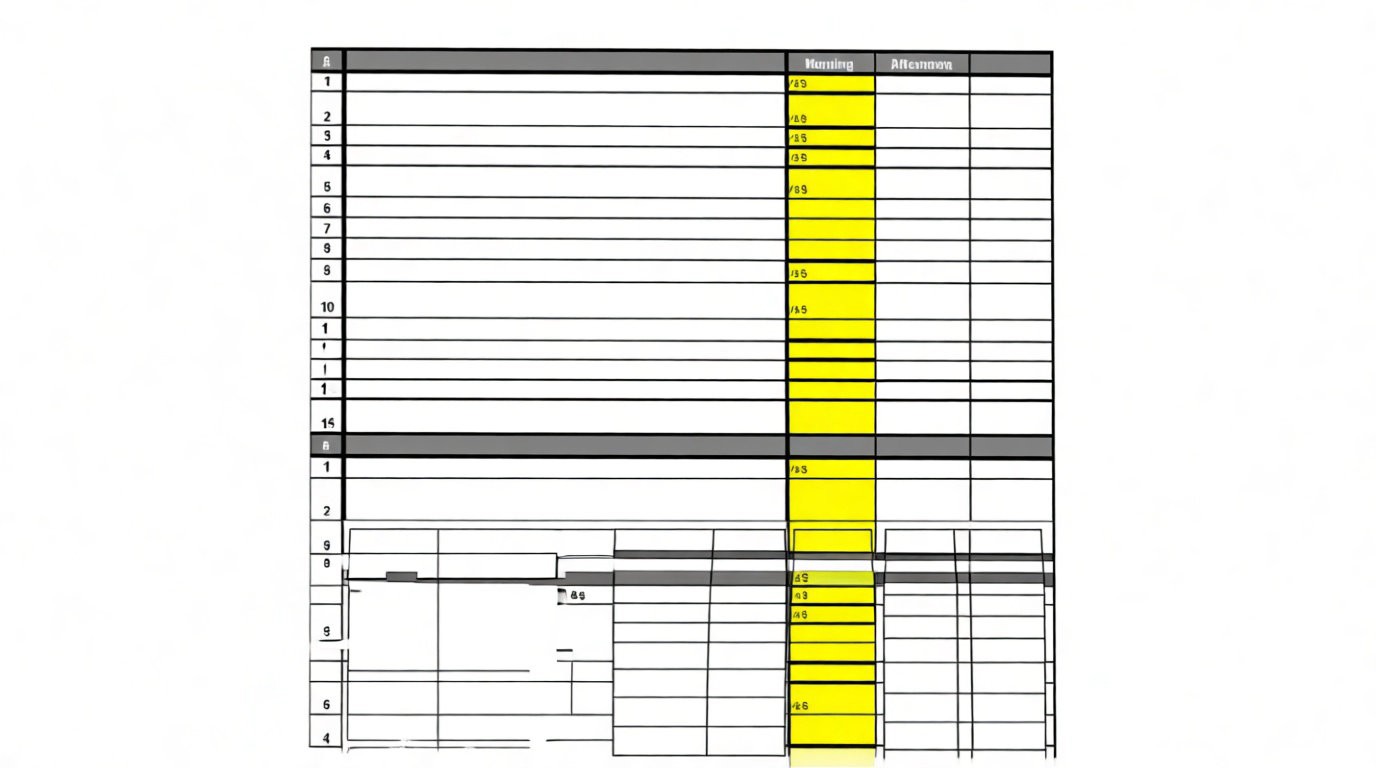
1. Stock check
2. Net price vs loss threshold
3. Omnichannel price consistency
4. ERP scheduling
5. Competitor matching
6. Marketing assets readiness
Conclusion: Fewer Promos, Higher Profitability
In summary, the future of retail lies not in across-the-board discounting, but in the surgical precision of every invested euro. Raw data and testing transform your markdowns, and promotions finally become a driver of healthy growth once again.

Adopt a progressive pricing approach. Test a tactic on a single category first, measuring actual gains before rolling it out across your entire catalog. This is how you sustainably protect your gross margin against profit erosion.
Software never replaces your business expertise. Technology supports you, but the final decision remains in your hands. Be bold in your testing while always maintaining the necessary caution.
Using data to drive your promotional pricing strategy transforms every discount into a precise tool for boosting profitability. By leveraging AI to simulate revenue uplift, you protect your margins and regain control of your performance right now. Don’t let intuition undermine your value any longer: analytical excellence is the engine of your future growth.
FAQ
Measuring the true effectiveness of a promotion involves comparing sales during the promotional period to a stable baseline, then subtracting the cost of the discount, logistics expenses, and the cannibalization effect on similar products. Sales volume alone says nothing about the profitability of the promotion.
This is precisely what the industry figures reveal: promotions now account for 21.9% of FMCG-FLS revenue in France (NielsenIQ, 2025 Year-End Report), a record high, while 30% to 40% of campaigns remain unprofitable or ineffective once all costs are factored in (BCG, 2023). The 6-step process detailed above—from the brief to the simulation and then to the post-mortem—is designed precisely to objectively evaluate this metric rather than guess at it.
For a retailer, this rigorous approach to measurement directly affects the annual gross margin: without it, every promotional campaign becomes a gamble rather than a growth driver guided by the right metrics.
Uplift refers to the volume of incremental sales generated by a promotion—that is, the units sold in addition to what would have been sold at the regular price during the same period. It is calculated as the difference between sales observed during the promotion and the product’s historical baseline.
In a data-driven approach, uplift is never considered in isolation: it must be weighed against the cannibalization caused by substitute products and the halo effect, as well as the cost of the discount, to determine the actual incremental margin. The “test & learn” strategy presented in the article—which involves a test group of stores and a control (holdout) group—is specifically designed to isolate this net uplift from any confounding factors.
Confusing gross volume with actual uplift is one of the most costly mistakes in promotional management: it leads to the continuation of strategies that subsidize purchases that would have occurred anyway, at the expense of the retailer's profitability.
Cannibalization occurs when a promotion for one item causes sales of a similar product in the same department to drop: this does not create value, but is simply a shift in sales volume within the category. It can be observed by comparing the sales trends of the promoted product and its direct substitutes over the duration of the promotion.
In practical terms, if Product A increases in sales while Product B decreases by the same amount, the category’s overall margin may appear stable on the surface, or even decline once the discount is applied—this is the very principle behind bundling and basket-building discussed in the article, where the key challenge is precisely to monitor the margin mix of the bundle, a trade-off similar to that between margin and sales volume, to avoid pairing two already vulnerable SKUs.
Without this systematic control, a retailer can show an increase in volume on its shelf while losing net margin category by category, which permanently distorts the management of promotional profitability.
The optimal discount level depends on each product’s specificprice elasticity, which must be measured precisely using benchmarks: the goal is to identify the minimum threshold that generates sufficient volume to offset the loss in unit margin, without spending a single euro more than necessary.
The “test & learn” method described in the article involves comparing different discount levels—for example, a 10% discount versus a 20% discount on the same product category—between a test group of stores and a control group. Experience often shows that a more modest discount is sufficient to achieve the desired uplift, thereby avoiding unnecessary margin sacrifice.
This testing methodology directly safeguards profitability: every discount point granted beyond the necessary threshold is a lost margin point with no additional commercial benefit for the retailer.
Protectinga retailer’s price-image starts with protecting its KVI (price-image products): these traffic-driving items must remain consistently aligned with tight price ranges relative to competitors, rather than being sold off at bargain prices on an ad hoc basis.
Conversely, leaving a flagship item on display with a crossed-out price for too long accustoms customers to a discounted price and makes a return to the regular price risky for the brand’s reputation. The logic outlined in the article is to reserve promotions for occasional, targeted use—such as stock-driven or segment-driven promotions—while maintaining a competitive base price on the most visible products at the front of the shelf.
This approach prevents the habit-forming effect that causes customers to systematically postpone their purchases while waiting for the next discount—a vicious cycle that erodes the brand's perceived value over the long term.
Consistent omnichannel pricing management relies on a centralized pricing platform that simultaneously displays the same offer and net price on the website, the mobile app, and in physical stores.
This requires real-time synchronization of data flows across channels: inventory levels, prices, and activation dates. This is one of the checkpoints explicitly listed in the article’s error-prevention checklist, alongside ERP configuration and product matching consistency—even a delay of just a few hours across channels is enough to create confusion and undermine customer trust.
This omnichannel consistency has become a competitive necessity: a customer who notices a price discrepancy between the app and the store will question the brand’s reliability across all its touchpoints, far beyond the specific product in question.
A holdout test involves intentionally excluding a group of stores or a customer segment from the promotional offer in order to have a control group that is not exposed to the discount.
By comparing sales in the test group with those in the holdout group over the same period, we isolatethe net uplift that can actually be attributed to the promotion, free from seasonal or cyclical variations that affect both groups equally. The article recommends choosing neutral periods for these tests, as the holiday season distorts purchasing behavior and renders the results unusable.
This is the most reliable method for turning a marketing intuition into a business rule validated by pricing simulations—one that can be reused to calibrate future campaigns without repeating the same approximations.
While a promotion is underway, three metrics must be monitored continuously: the sell-through rate, the current gross margin after discounts, and the out-of-stock levels for the relevant SKUs.
This real-time monitoring—described in the article as the fifth step in the “end-to-end” promotional process—makes it possible to detect price anomalies or early stockouts and correct them before the end of the campaign, rather than waiting for the final results. Every minute that a discrepancy goes uncorrected directly impacts the campaign’s profit margin.
This real-time monitoring is what distinguishes data-driven promotional management from mere passive execution: it transforms the promotion into a managed process with actionable checkpoints, rather than a fixed gamble at launch.
To learn more, check out our comparison of the best pricing software for 2026.

Reversibility is negotiated before the contract is signed, never after. Once the contract is signed and the system is live, the balance of power has completely shifted. Four assets are at stake: your raw data, your rule set, your trading history, and your competitive matching. Only the first is generally covered by contracts.
The gap between perception and reality is well documented: 89% of executives believe they can switch suppliers in less than a month, but among those who have tried, 58% report that the effort failed or took much longer than expected (Zapier, 2026). The goal isn’t to leave, but to have the option to do so: that’s what maintains a healthy supplier relationship throughout the contract term.

Pricing decisions account for only a small portion of the workweek in most organizations. The rest is divided among preparation, coordination, formatting, and justification. This time is not wasted: justifying a price to a buyer is real work. The problem is that it takes the place of what creates value.
The measurement is based on a reconstructed typical week, not on self-reported estimates: the difference between the two is often a factor of two. The correction then follows a specific order: eliminate, then automate, then delegate. Automating a useless task is tantamount to making it permanent.

The accumulation of rules is a cumulative process, not an isolated incident: it grows with every legitimate decision made in isolation, even though no single decision is open to criticism. Five forms predominate: the exception that has become permanent; the seasonal rule that is never suspended; rules that contradict one another; the orphaned rule whose author has left; and the redundant rule.
The cost isn't what you might think: before it eats into profit margins, debt erodes trust. A team that no longer understands why the system suggests a certain price will stop following it. The solution is a consistent routine rather than a major cleanup effort every three years: a quarterly portfolio review, four questions per rule, and an expiration date set at the time of creation.