
Competitive product matching: make price comparisons more reliable

Product matching or linking is the foundation of competitive monitoring, as it prevents the comparison of non-equivalent products. Reliable matching safeguards margins by basing repricing on actual, multi-signal data.
Key finding: According to the Diamart study, 50% of French retailers still consider this challenge to be unresolved.
These similarity algorithms rely heavily on natural language processing (NLP) to match the descriptions of different products.
Are you losing market share and net margin daily due to flawed competitive monitoring that mistakenly compares non-equivalent items?
This article outlines a comprehensive operational methodology to isolate specific variants, bypass marketplace traps, and structure a robust data repository to drive your pricing positioning with absolute mathematical precision.
By following our checklist and KPIs, you will secure your price image, reduce manual workload by 40%, and optimize profits through a high-performing multi-signal confidence scoring system.

Why product matching is the critical bottleneck in competitive monitoring
Comparing apples and oranges makes data collection pointless; the quality of data-driven competitive pricing and product matching is the foundation of your strategy.
In fact, without precision, you are flying blind.
50% of French retailers still consider product matching to be an unresolved challenge (Diamart study).
The true cost of mismatching (margin erosion, damaged price image, skewed decisions)
Poor matching leads to unnecessary price cuts, eroding your net margin for no valid reason. Customers also lose trust in your pricing consistency.
Your repricing algorithms rely on flawed data. Your brand image degrades because you are aligning with non-identical products. This is a strategic mistake.
Strategic decisions become risky. In short, you are driving your business with biased figures and a completely distorted vision.
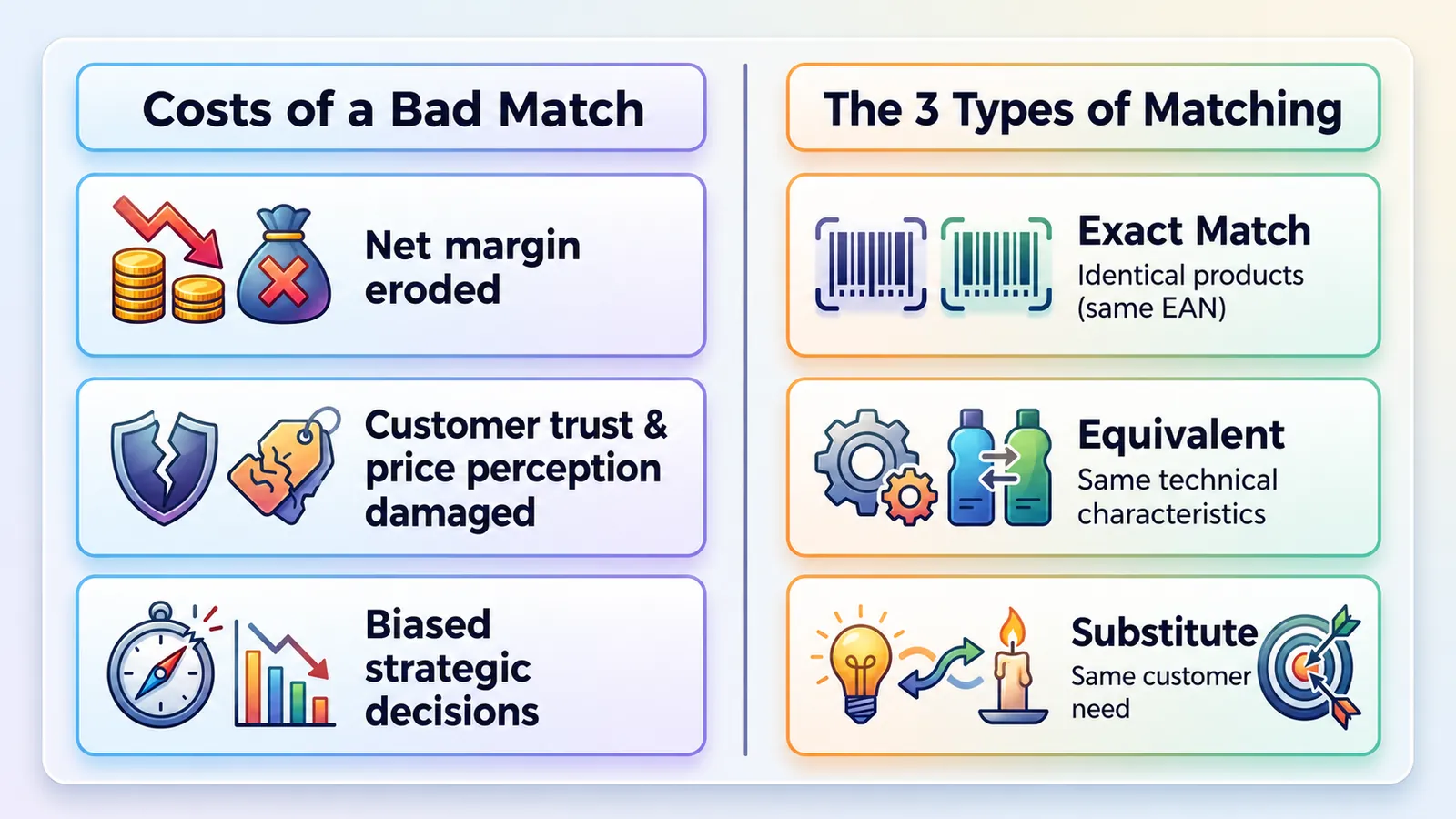
The 3 cases to distinguish: exact match / equivalent / substitute
- Exact Match : same EAN.
- Equivalent : similar specifications.
- Substitute : same customer need.
Exact matches involve strictly identical products with the same EAN. This is the foundation of monitoring, comparing the exact same barcode and brand.
Equivalents share closely aligned technical specifications.
Substitutes address the same customer need without being technically identical.
Distinguishing between these levels prevents drastic alignment errors, safeguarding your operational margins on a daily basis.
Reliable matching is essential for an accurate analysis of competitors' prices: without it, any measured discrepancy may simply be a false discrepancy.
The #1 causes of matching errors (and how to spot them)
But where do these errors that pollute your reports actually come from?
Here are the classic pitfalls your scraping tools encounter every day during retail competitive monitoring and product matching.
Variants (size, color, capacity, vintage)
A size 42 shoe does not always carry the same price as a size 38. Rare colors often cost more on the web. The system must isolate each specific attribute.
A wine vintage changes the entire pricing positioning. Never confuse a 1TB hard drive with a 2TB model.
Granularity is your best ally. Always verify the competitor's detailed product datasheet.
Packs, bundles, and lots (x2, x3, “buy one get one free”)
Bundles of two items distort the displayed unit price. A complimentary product radically alters the perceived value. You must be able to detect these mentions in titles.
Bundles create confusion regarding the actual face value. Your tool must extract the exact quantity to compare offers accurately.
A pack is not a single unit. Pay close attention to quantity keywords.
Units & formats (kg vs g, L vs ml, “per piece”)
Unit normalization is a major technical challenge. A price per kilogram differs from a price per piece. Conversion errors are very frequent and costly.
Always compare apples to apples. A 50ml travel size is not a standard 200ml format.
Convert everything to a common reference unit. It is the only way to obtain reliable scoring.
Beware of data contamination
Inaccurate unit conversions (kg vs g) and ghost stock (out-of-stock items) leading to margin-killing repricing errors.
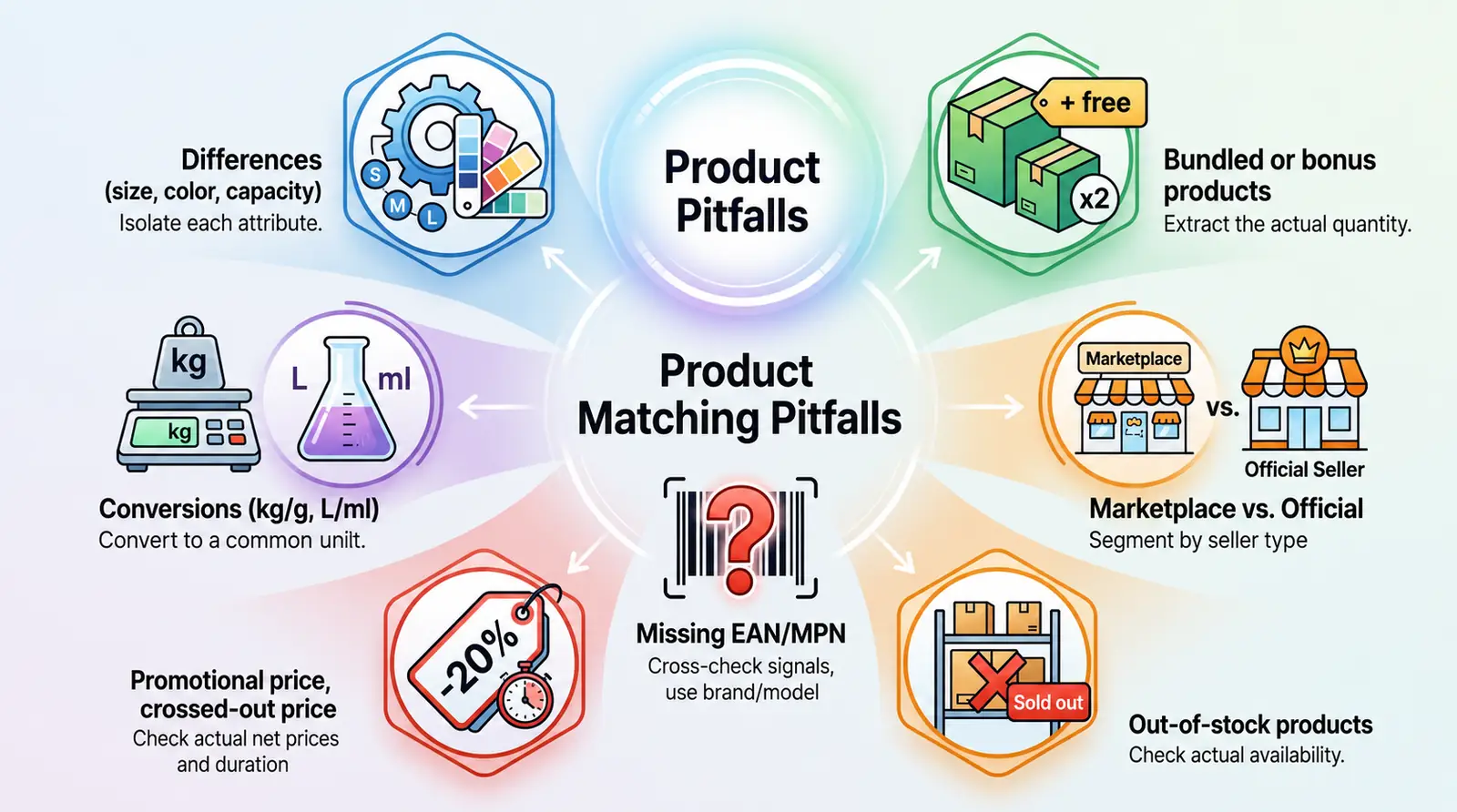
Incomplete references (missing EAN, absent MPN)
Without an EAN, matching turns into a risky statistical guessing game. The MPN helps but is sometimes missing from websites, requiring the cross-referencing of multiple weak signals.
Vague titles often conceal precise references. Use the brand and model to compensate.
A missing code increases the risk of error, making human oversight essential.
Marketplace vs official seller (quality, price, conditions)
Third-party sellers occasionally undercut prices without actual stock. Their product listings are frequently less detailed than official ones. Do not conflate direct supply with marketplace offers.
Shipping costs vary significantly between vendors. Warranties may also differ depending on the source of the offer.
Segment your data by seller type. This is vital for your price perception.
Promos & struck-through pricing (mechanics and timing)
A flash promotion should not dictate your annual strategy. Cart promotional codes are often invisible at first glance. Accurately identify actual net prices.
Strikethrough prices can sometimes be artificial among certain online players. Always calculate the true discount percentage.
Monitor the duration of offers. A promotion ending tomorrow does not constitute a threat.
Stock / availability (out-of-stock items skewing the analysis)
An aggressive price on an out-of-stock product is a decoy. Matching it represents a major strategic error for your margins. Your monitoring must verify actual product availability.
Stock levels directly influence competitive pressure. A depleted competitor is no longer a dangerous rival.
Filter out unavailable products. They skew your overall performance indicators.
The out-of-stock rate stood at an average of 5% at the start of 2023 for fast-moving consumer goods—enough to regularly distort monitoring that does not filter out unavailable items (LSA–NielsenIQ Barometer).
Operational methodology to make matching reliable (step-by-step)
To successfully execute your retail competitive monitoring and product matching, you must follow a strict methodology. Here is how to transform your raw data into intelligent pricing decisions.
6-step matching methodology
1. Scope definition
2. Golden Record structure
3. Multi-signal matching
4. Confidence scoring
5. Quality control
6. Correction loop
Step 1: define the scope (categories, KVIs, competitors, channels)
Do not match your entire catalog all at once. Prioritize your best-selling items, your KVIs (Key Value Items). Also, select your most direct competitors to remain truly relevant.
Define the channels to monitor as a priority. The web and physical stores operate under completely different rules.
A well-defined scope guarantees quality. Avoid unnecessary dispersion, as it is a common trap.
Step 2: structure product data (golden record)
Create a clean and comprehensive reference base. Every product must possess its key attributes: EAN, brand, model. This constitutes your golden record.
Clean your own data before looking elsewhere. Internal data quality always dictates the success of external matching.
A healthy repository is the foundation. Without it, your entire system will quickly collapse.
Case of multi-brand and multi-collection groups (fashion, specialty)
A fashion brand that manages multiple collections and product lines increases the risk of false positives. A single SKU may be available in multiple colors, materials, or seasonal editions, with price points that vary significantly from one line to another.
The Golden Record must therefore include the brand and the collection as top-level attributes, not merely as metadata. Two jackets that look similar but come from different lines cannot be compared in the same way when pitted against the competition.
You should also segment your monitoring scope by brand rather than by generic category: relevant competitors and price sensitivity thresholds often vary from product line to product line.
Step 3: multi-signal matching (EAN/MPN + attributes + title)
Do not rely solely on the barcode. Cross-reference titles, images, and technical specifications. This multi-signal approach drastically reduces matching errors.
Use text similarity algorithms for titles. Also, compare actual dimensions and weights.
The more signals you have, the higher the certainty. The EAN is merely a starting point.
Step 4: confidence scoring (A/B/C) + decision thresholds
Assign a reliability score to each match. Score A represents certainty, score B requires verification, and score C is uncertain. Automate matching exclusively for score A.
Establish clear decision thresholds for your teams. Never take risks with low-confidence scores.
Scoring protects your margins. Ultimately, it brings necessary nuance to the system.
Step 5: quality control (sampling + audits)
Regularly audit a sample of your automated matches. Manually verify correspondences to detect technical drift. This is an essential foundational task.
Involve category managers in this review. They have an expert understanding of their products and all associated specifications.
The human eye remains the final arbiter. Auditing ensures the long-term reliability of the overall system.
Step 6: correction loop (rules, exceptions, learning)
Continuous correction refines your results. Identify vulnerabilities to act swiftly. Here are the key levers to stabilize your technical database:
- Log detected errors
- Create specific exclusion rules
- Force manual matches
- Update synonym dictionary
- Adjust attribute weights in the algorithm
Every corrected error must feed the algorithm. Create exception rules for recurring edge cases. The system must learn from its past mistakes.
Exact match vs. similar match: what pricing decision rules apply?
Once retail competitive monitoring and product matching are established, how should you proceed? Strategy differs fundamentally depending on whether the product is an exact clone or a mere substitute.
When to match (exact match) and when not to match
For exact matches, price alignment is often the norm. Customers compare EANs or MPNs on their smartphones between web and in-store. However, never sacrifice your profitability.
Do not align if the competitor is out of stock. Also, disregard unreliable marketplace vendors.
Alignment must be strategic. It is not an automatic obligation.
Manage equivalences (substitutes) without compromising margin
For similar products, use an A/B/C confidence scoring model. Do not seek perfect parity with a substitute. Highlight your own value propositions, such as service or warranty.
Customers accept price variances for different brands. Follow an error-prevention checklist for data validation.
Maintain your margins on exclusives. Substitutes offer greater flexibility.
Case study: KVI vs. long tail
| Product type | Price sensitivity | Matching rule | Recommended action |
|---|---|---|---|
| KVI (Top sellers) | High | Exact | Strict matching |
| Niche products (Long tail) | Low | Broad | Margin preserved |
| Seasonal products | High | Exact/Broad | Dynamic matching |
KVIs require absolute precision to avoid false matches. On the long tail, adopt a more flexible approach. Scale your matching efforts according to the actual financial stakes.
Anti-false-match checklist (to apply before taking pricing action)
Before clicking "validate" for a new price, run your data through this security checklist dedicated to retail competitive monitoring and product matching.
Attributes checklist (brand, model, size, unit…)
Scrutinize the exact brand and model. Do the size or capacity truly correspond? In short, a minor discrepancy in the unit of measure alters your final margin calculation entirely.
Do not overlook any technical detail. A single character in a reference can denote a completely different product. Exercise vigilance.
Offers checklist (seller, delivery, returns, warranty)
Who is the actual vendor behind the offer? Are shipping costs included in the displayed price? Compare return policies and warranties.
An offer without free shipping is not comparable. Service is an integral component of the price.
Promo checklist (coupon, bundle, struck-through price)
Is there a hidden promo code on the page? Is the offer tied to a bundle purchase? Does the strikethrough price reflect market reality?
Uncover complex promotional mechanics, as they often mask the actual selling price.
Marketplace checklist (seller, condition, fees)
Precisely identify who is selling what by verifying these essential data points to ensure target accuracy:
- Third-party seller name
- Seller reliability score
- Product condition (new or used)
- Shipping country
- Potential customs duties
Is the product genuinely new? Refurbished items cannot serve as a benchmark. International sellers often incur hidden fees.
The marketplace is a jungle. Do not hesitate to filter out questionable offers.
KPIs & dashboards: measuring monitoring reliability
You can only manage what you measure. Track these key performance indicators to oversee the quality of your competitive intelligence.
Key figures: The retail data technology market will reach $25 billion by 2029, with an annual growth rate of 24%.
Matching quality (precision, recall, false match rate)
Precision measures the proportion of valid matches generated. Recall indicates whether you have identified all potential links. Aim for a minimal false match rate.
These technical indicators act as the thermometer for your tool. Track their evolution after each software update to maintain reliability.
A strong score instills confidence across teams and legitimizes pricing decisions.
Coverage (matched catalogue share, covered KVIs)
What share of your catalogue is actively monitored? Your strategic products must be fully covered. Identify blind spots where you operate without visibility.
Increasing coverage must not compromise precision. This is a delicate balance to maintain in order to secure your retail product matching competitive monitoring.
Always prioritize your best sellers. Total coverage is frequently a mirage.
Data freshness (update latency, inactive page rate)
Pricing data degrades rapidly. What is the average frequency between data extractions? Monitor the rate of error pages.
Freshness is the key to responsiveness. Yesterday's price is already outdated news for your business.
Business impact (margin, competitiveness, price image)
Monitoring must improve your overall margin. Measure the evolution of your competitiveness across key segments. Price image is built through consistency over time.
If your profits are dropping, question your matching. Data must serve core financial performance.
Recommended process: who validates what (governance)
Technology is not a silver bullet. Robust governance defines responsibilities to translate data into actionable execution.
Roles (pricing manager, category manager, data/IT)
The pricing manager orchestrates the overall strategy of retail competitive monitoring and product matching. The category manager brings deep product expertise, while the IT team ensures the technical reliability of incoming data feeds.
Everyone must understand their exact scope of responsibility. Collaboration prevents silos and errors.
In short, communication remains the foundation of the process. Clarify roles clearly from the start.
Escalation rules (A automated / B reviewed / C blocked)
Automate price updates for high-confidence scores. Implement manual reviews for ambiguous cases, and halt any action if uncertainty is too high.
This escalation system secures your operations. It saves time without sacrificing margin control.
Better safe than sorry. Do not let AI make decisions autonomously.
Review frequency (daily, weekly, monthly)
KVIs require daily monitoring, whereas a weekly review suffices for the rest of the catalog. Conduct monthly quality audits across the entire system.
Adapt your pace to market volatility. Consistency drives operational excellence.
The 5 priority actions to ensure data reliability within 30 days
Finally, here is our recommended roadmap. This plan transforms your price image entirely.
- Audit the top 100 best sellers.
- Cleanse EAN codes.
- Define A/B/C scoring thresholds.
- Isolate marketplace offers.
- Establish a weekly review.
Start small but aim for perfection on your KVIs. Team trust is built through tangible results. Do not rush into full automation.
Data quality is an ongoing battle. Stay vigilant against competitor shifts. Your agility will make the long-term difference.
Reliable product matching transforms your market intelligence into a profit driver by combining scoring and audits to optimize retail competitive monitoring and product matching.
Take action now to protect your margins and execute pricing with surgical precision.
Your future profitability is built on the rigor of your current data.
See also: Building a Comprehensive Price Monitoring System.
FAQ
Product matching consists of mapping catalog references to equivalent or identical products sold by competitors. It enables reliable price comparison without mistakenly comparing products that are not truly comparable.
In retail, this is a key component of competitive monitoring. Without accurate price matching, pricing decisions can be skewed, posing a direct risk to margins, price perception, and competitiveness.
Competitive monitoring is only valuable if the compared products are genuinely equivalent. Comparing a reference item with the wrong product can lead a retailer to lower prices unnecessarily, align with a non-comparable offer, or misinterpret market gaps.
Reliable matching helps ensure accurate repricing decisions, protect margins, and maintain a consistent price image. It transforms competitive intelligence into a powerful pricing management tool.
An exact match refers to two strictly identical products, often sharing the same EAN, model, and specifications. This is the most reliable case for direct price comparison and potential price alignment.
An equivalent product has similar characteristics but is not exactly the same. A substitute meets the same customer need without being technically comparable. These distinctions are important because the pricing decision rule should vary depending on the degree of product similarity.
The most frequent errors stem from product variants: size, color, capacity, vintage, format, or packaging. A two-pack, a 1 TB version instead of 2 TB, or a 50 ml format instead of 200 ml can completely distort the comparison.
Marketplaces also add complexity: third-party sellers, shipping costs, varying warranties, uncertain inventory, and refurbished products. These factors must be filtered out to avoid false matches and poor pricing decisions.
The first step is to define the scope: priority categories, KVIs (Key Value Items), competitors to monitor, and channels to analyze. Next, a clean product reference database—often called a golden record—must be built, containing essential attributes such as EAN, brand, model, and technical specifications.
The matching process must then cross-reference multiple data points: EAN, MPN, title, attributes, images, and technical data. At BOOPER, this cross-referencing is automated using NLP through the GENIUS Link module, which assigns an A/B/C confidence score to each product. The more consistent the data points are, the higher the confidence score. Uncertain matches must be flagged for human review.
Confidence scoring is used to rank product matches based on their reliability. An A score can be considered reliable and suitable for automation. A B score must be reviewed or validated by a human. A C score should generally be blocked or excluded from automatic repricing.
This logic prevents algorithms from making pricing decisions on dubious matches. It secures margins while saving time on the most reliable cases.
Packs, bundles, and sets must be standardized before comparison. A set of two products cannot be compared directly with a single unit. The price must therefore be converted to a common unit: price per piece, per kilogram, per liter, or an equivalent unit.
Mechanics such as 'x2', 'x3', '+ free item', coupons, or crossed-out prices must also be detected. Without this normalization, monitoring risks comparing different offers and generating erroneous pricing decisions.
The priority KPIs are matching accuracy, false-match rate, recall, catalog coverage, and KVI coverage. Strategic products must be monitored as a priority, since an error involving these SKUs can have a significant impact on price reputation.
Data freshness, update latency, inactive page rates, and actual business impact—such as margin, competitiveness, and positioning consistency—must also be tracked. A good dashboard should connect technical indicators to pricing decisions.
When the EAN is missing or differs (private label, formats, lots), the matching process relies on other indicators, such as the manufacturer’s part number, attributes (brand, size, variant), and product description—which is analyzed using natural language processing to identify the same product under two different names. Each match is assigned a confidence score. Only high scores are processed automatically; ambiguous cases are reviewed by a human. Finally, prices are converted to a common unit (kilogram, liter, piece) before being compared.

Seven criteria distinguish a competitor pricing monitoring tool that simply generates a table of price differences from one that actually drives decisions: coverage, recency, product matching, alerts, governance, integration, and compliance. The listed cost is only part of the total cost: manual reclassification, maintenance of in-house development, and the opportunity cost of a poorly informed decision often outweigh the subscription fee.

A comprehensive competitor pricing monitoring system is built on five inseparable components: data collection, matching, alerts, reporting, and governance; if even one of these components is missing, the system becomes ineffective. The retail sector revises its prices more frequently than any other (ranging from monthly to daily, depending on the category), which requires a system capable of keeping pace.

Many organizations receive a report on competitor price differences every morning, but few have a genuine strategy. The difference lies in three questions that must be asked before implementing the system: Why collect this data? What exactly should be tracked? And what decisions should be made once a price difference is identified?
Key point: Key value items (KVI) —the products whose prices customers remember—typically account for 15 to 25 percent of a category’s sales. Focusing monitoring efforts on this small core group is more cost-effective than trying to track everything with the same intensity.