
Excel is no longer enough to manage its pricing

The true cost of Excel isn't formula errors, but rather the portion of the catalog that no one reviews, and the plausible errors that correct themselves silently. The limit is reached when the number of decisions exceeds the team's available time, not when a certain number of rows is reached.
It is possible to transition directly from Excel to a hybrid AI system—without an intermediate step involving rules—if management supports the decision and a test confirms its viability. The migration begins with existing files, and Excel retains its role for ad hoc analysis, not as a repository.
Excel has published the prices for most retailers, and it remains unbeatable for one-off analysis. But it doesn't offer anything else: items the team doesn't have time to open still show yesterday's price.
This article explains where the line is drawn, why the most costly mistake is the one that seems right, and how to close the spreadsheet without losing track of your work.

Excel or a pricing tool: where is the line drawn?
A pricing tool calculates, simulates, and monitors prices across an entire catalog based on rules, sales history, and competitor prices. Excel actually does one part of this very well: the calculation.
It does not perform pre-publication simulations, rule checks, or decision logging. As long as the catalog is short and stable, this isn't a problem.
For a few hundred entries, a well-maintained spreadsheet is all you need. It’s flexible, everyone knows how to use it, and it’s still unbeatable for ad-hoc analysis.
The limit isn't the number of lines. It occurs when the number of decisions that need to be made exceeds the team's available time: suppliers, stores, channels, promotions, and competitors to monitor.
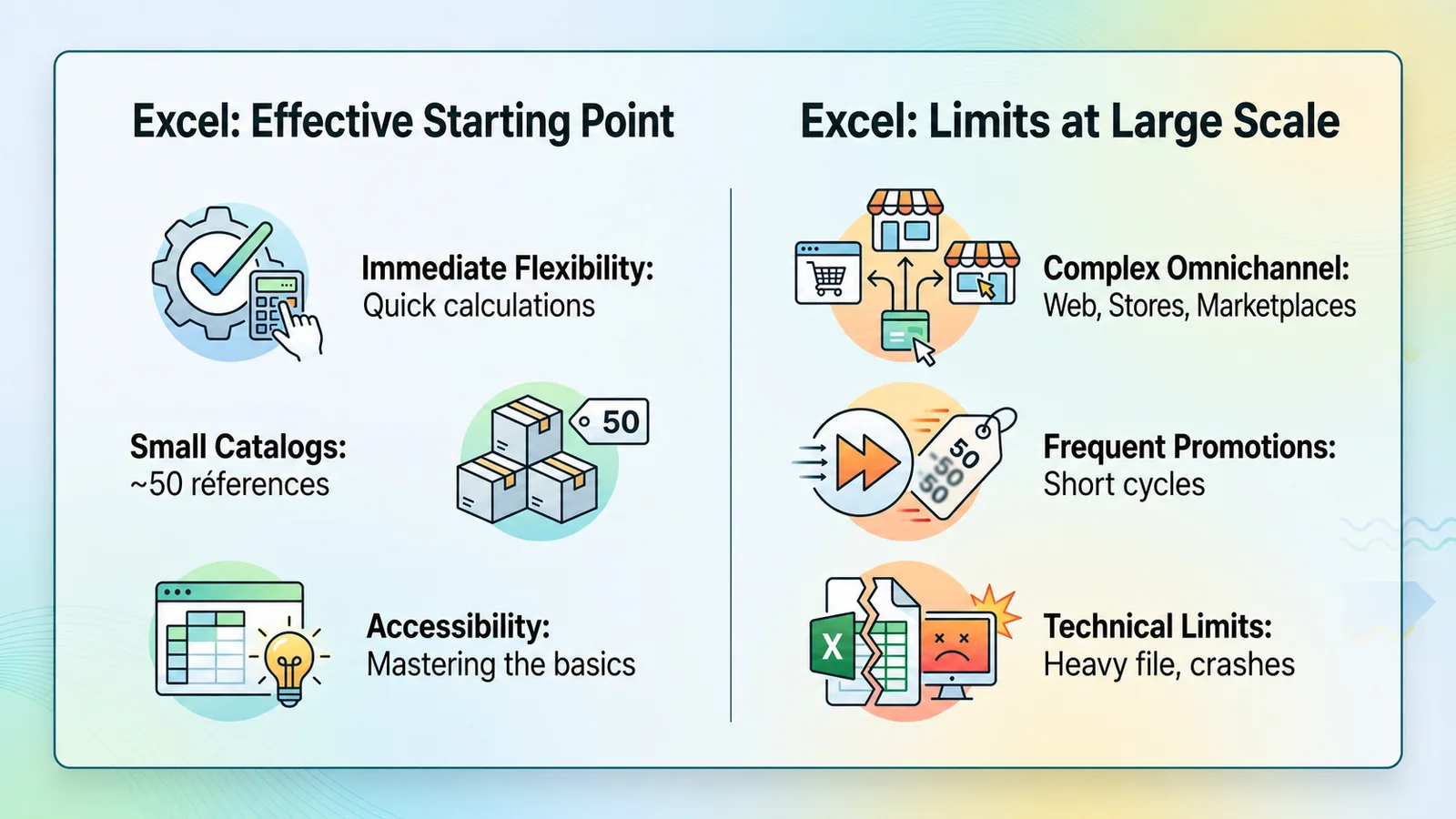
The True Cost of Excel: References That No One Ever Checks
After more than ten years of pricing projects, we’ve come to this conclusion: the real cost of Excel isn’t formula errors. It’s the portion of the catalog that no one has time to review.
A spreadsheet doesn't offer anything. It waits for you to open it. Anything that isn't open keeps yesterday's price.
A catalog of 15,000 items. Two people on the pricing team, each of whom spends a day and a half a week analyzing prices; the rest of their time is spent on promotions, data files, and meetings.
At 120 thoroughly reviewed items per day, that comes to 360 per week, or about 4,700 per quarter. That’s less than 30% of the catalog—and in reality, even less: it’s the same loss leaders that come back every week.
The other benchmarks retain their historical coefficients. No one decided this, no one notices it, and that's where the margin is lost.
That's why the profits from a tool rarely come from loss leaders, which are already closely monitored. They come from the back end of the catalog, left at a rate that no one has reviewed in months.
A dangerous mistake is one that seems right
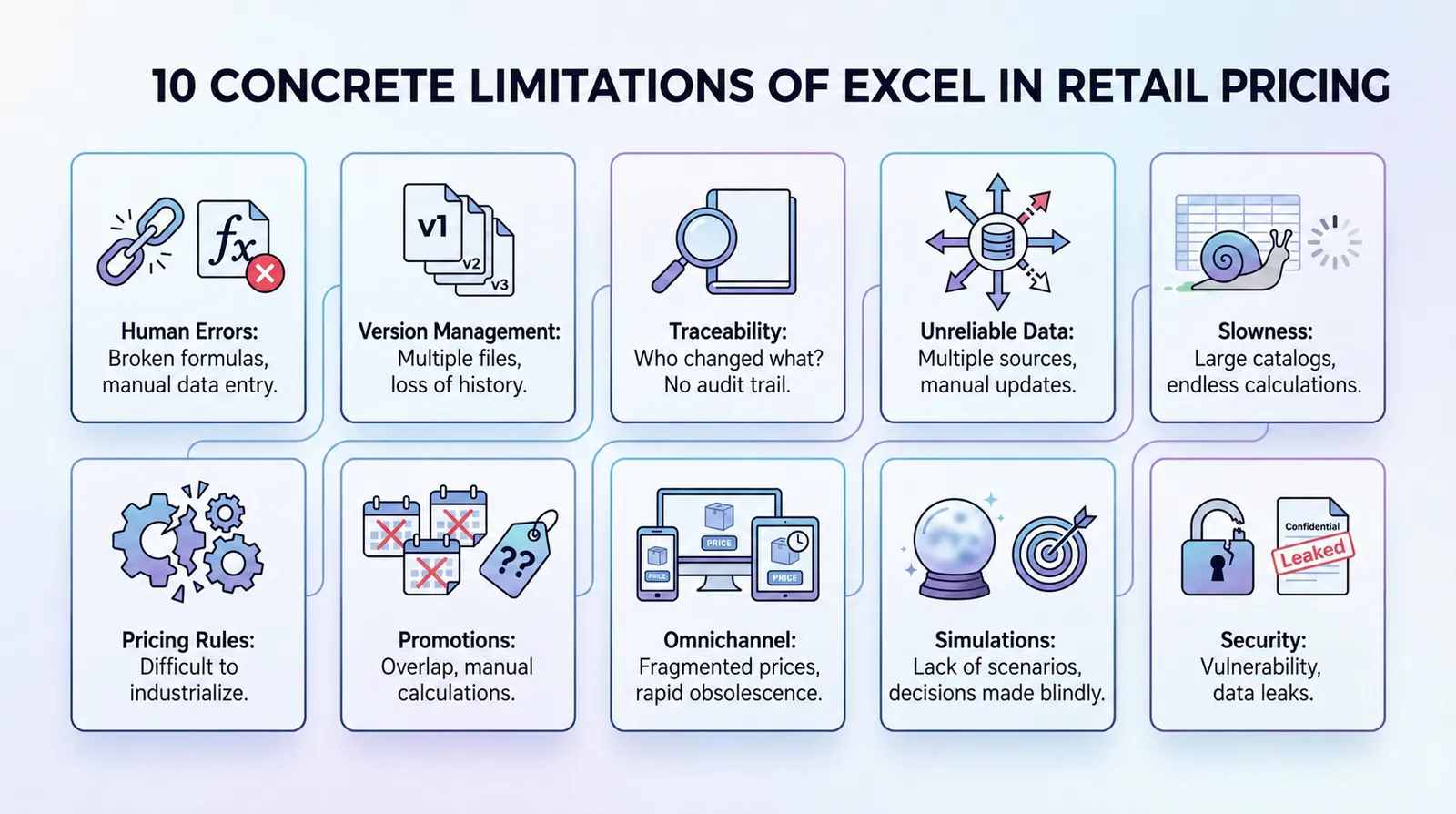
A misplaced comma or a negative margin is immediately obvious. What costs money is when the purchase price is updated in the ERP system but not in the file, or when the wrong version is sent to the store.
These kinds of errors are plausible. They pass all visual inspections and remain on the shelves for weeks.
Operational teams encounter a spreadsheet error every week; 22% encounter one every day. And 2 out of 5 incidents are corrected without ever being reported to management.
(DOSS, survey of 1,003 professionals, May 2026)
The second figure is the most telling for a pricing manager: errors are corrected quietly. Management never sees how much the spreadsheet has cost, so they don't see any reason to change it.
Four Signs That Your Spreadsheet Has Reached Its Limit
First sign: Pricing rules are embedded in formulas that only one person knows how to interpret. If that person leaves or goes on leave, the pricing policy comes to a standstill.
Second sign: we’re no longer pretending. A price cut is decided without estimating its impact on sales volume and profit margin, simply because there isn’t enough time to run the numbers.
Third sign: No one knows which version was sent to the store or uploaded to the website. Fourth: Promotions and the reference price for the last 30 days are managed manually, with the associated risk of incorrect pricing.
If you’re also tracking competitors’ prices in the same file, the threshold is reached sooner—that’s the subject of our article on Excel’s limitations when monitoring competitors’ prices.
| What Matters | Excel | Pricing Tool |
|---|---|---|
| Percentage of the catalog that has actually been revised | The one the team has time to handle | The entire catalog; the team handles the exceptions |
| Impact of a price prior to publication | Estimate it roughly or not at all | Simulation of sales, margin, and inventory |
| Pricing Rules | In formulas and in a person's mind | Written down, legible, and applied to each calculation |
| Record of Decisions | File versions in emails | Log: Who decided what, when, and why |
| Plausible error | Go unnoticed | Stopped by a floor or an alert |
How can you replace Excel for price management without losing control?
By replacing the file with a platform whose rules remain transparent to your teams—not a black box.
Four features make all the difference: rules that can be configured without a developer, a pre-publication simulation, human validation of sensitive prices, and retained Excel exports.
Here's how BOOPER works: The AI suggests a price, your rules set the parameters, and a manager approves it.
Pricemoov, Optimix, and PricingHUB also offer a rules engine combined with recommendations; the difference lies in how each price is explained and in the ability to get started using existing data.
Is it necessary to use a rule-based tool before moving on to AI?
The most common path consists of four steps: Excel, followed by a rule-based tool (if this condition is met, then that price), followed by a hybrid AI that makes recommendations within the framework of the rules, and finally, partial automation.
Our position: Following the rules is not mandatory. A team can move directly from Excel to a hybrid AI solution, provided that management supports the decision and a pilot test on a limited scale demonstrates its effectiveness.
What can't be skipped is mastery. Successful teams stay on top of the rules and approve proposals: no one switches from a spreadsheet to autopilot.
Spreadsheets remain by far the most common starting point: duringa Pricing Club webinar in April 2026, half of the participants who responded to the survey were still managing their pricing in Excel.
Migrating Without Breaking Everything: Three Principles
First, start with the existing files. POS exports, pricing, and catalog: that’s what separates a project launched in a few weeks from one delayed by a year due to a lack of a connector.
Second, don't wait for perfect data. A broken product catalog needs to be restored first; the rest will become more reliable as you go along, starting with the products that drive sales.
Three: Start small, then scale up. One category, one quarter, a clear measure of margin and price positioning: Results speak louder than a transformation plan.
The project workflow—from scoping to rollout—is detailed in our article on implementing a pricing tool.
Booper's Data Loader imports point-of-sale exports, pricing, and the catalog as-is, with no connector required to get started. Excel becomes the entry point for the project, not an obstacle.
Each proposed price is simulated before publication (sales, margin, inventory) and governed by your rules: minimum price, maximum price, target price, and variations from one retail location to another, with an alert when a local price goes outside these limits.
Teams supported by Booper have seen profit margins increase by 0.5 to 3 points in just a few months and a 70 to 90 percent reduction in the time spent preparing prices (Hugues Lafitte, Informations Entreprise, September 15, 2026).
What Excel Becomes After Migration
Excel isn't going away. It's going back to what it does best: one-off analysis, exporting data, and answering that question you ask yourself on a Tuesday afternoon.
It loses only one function: that of a price reference. As soon as a file begins circulating again as the basis for decision-making, parallel versions reappear—and with them, silent errors.
Companies improved their 2024 margins primarily through pricing, compared with 38% through volume. Price is the primary driver of margins: it is what a fragile spreadsheet exposes.
(Simon-Kucher, Global Pricing Study, 2025)
It would be a mistake to measure return on investment based solely on revenue: rising revenue can mask a declining margin. We look at the margin, the portion of the catalog that is actually managed, and the time freed up for the team.
See also in this feature
- Selecting and Implementing a Pricing Tool: From Identifying the Need to Going Live
- Changing Pricing Tools Without Repeating Past Mistakes: The Assessment
- Developing an In-House Pricing Tool: The True Cost of a Build
- Pricing POC: What Data Should You Prepare to Ensure Reliable Results?
FAQ
Answers to the most frequently asked questions before closing the spreadsheet.
Yes, as long as the catalog is short and stable, and the team has time to review each price. The threshold isn't a specific number of lines; it's the point at which the decisions that need to be made exceed the time available.
Because the team can only review a small portion of the catalog, and plausible errors go unnoticed. According to DOSS (May 2026), 53% of teams encounter a spreadsheet error every week.
There is no universal threshold. Consider the number of SKUs, stores, and the frequency of price changes: when the number of decisions exceeds what the team can handle, part of the catalog remains at its historical price.
By choosing a platform where the rules remain clear and can be modified by your teams, with a preview feature before publication and human approval.
BOOPER gets started with your sales data and pricing: the AI makes suggestions, your rules provide guidance, and a manager approves them.
It's not mandatory. The direct transition from Excel to a hybrid AI works when management is committed to the project and a pilot test on a limited scale demonstrates its effectiveness. However, a thorough understanding of the rules remains essential.
BI shows what has happened: it's a thermometer. Pricing software proposes and controls tomorrow's prices, and can catch an error before it reaches the checkout: it's a thermostat. The two are complementary.
A solution that uses your existing files as a starting point—without requiring a complete overhaul of your information system—and that first automates the tasks Excel handles poorly: decision-making, simulation, and alerts.
A solution that builds on the point-of-sale exports, pricing, and catalog you already have. This is what sets apart a project that can be launched in a few weeks from one that’s delayed by a year. Check out our price optimization software.
Yes, for ad hoc analysis and exports. It just shouldn't be used as a price reference anymore: as soon as a file starts circulating again as the basis for decision-making, parallel versions and silent errors will reappear.
Through profit margins, not just revenue, and through the portion of the catalog that’s actually managed. The time saved for the team also counts. You can find the details in our article on the ROI of a pricing solution.
Sources: DOSS, Spreadsheet Errors, May 14, 2026 (1,003 operations professionals, United States); Simon-Kucher, Global Pricing Study 2025; live poll, Club du Pricing webinar, April 9, 2026. Example with figures: illustrative case, without customer data. Updated: October 2026.

A franchisor cannot impose a minimum resale price: doing so is punishable by law; the franchisor may only recommend a price or set a maximum. A franchisee’s margin is therefore governed by a documented target, defined by network segment and applied uniformly across each segment.
The best indicator of this governance is not adherence to the suggested retail price, but the rate of compliance with it by segment. A suggested retail price that franchisees in a given area do not follow often signals a poorly set price, not a lack of discipline.

Optimix merged with Maxxing in July 2025, and PricingHUB was acquired by Akeneo in June 2026. For their customers, the question of the independence of the pricing roadmap has become a legitimate concern.
What sets a query apart in France isn't the processing speed: it's the native support for French rules, pricing by store or by zone, the validation process, and testing with your own data.

A promotion should not be launched in stores without knowing what impact it will have, how it will shift sales to neighboring products or over time, and what it will cost in terms of profit margin. The sales base determines everything else: if it is undervalued, it makes any promotion profitable.
The best way to choose between two scenarios isn't based on uplift, but on the cost per unit actually earned. Under the Egalim cap, the discount depth becomes a budget to be allocated among operations, and each scenario must be able to be replayed and explained.