
Branch and franchisee: Two pricing strategies under one brand

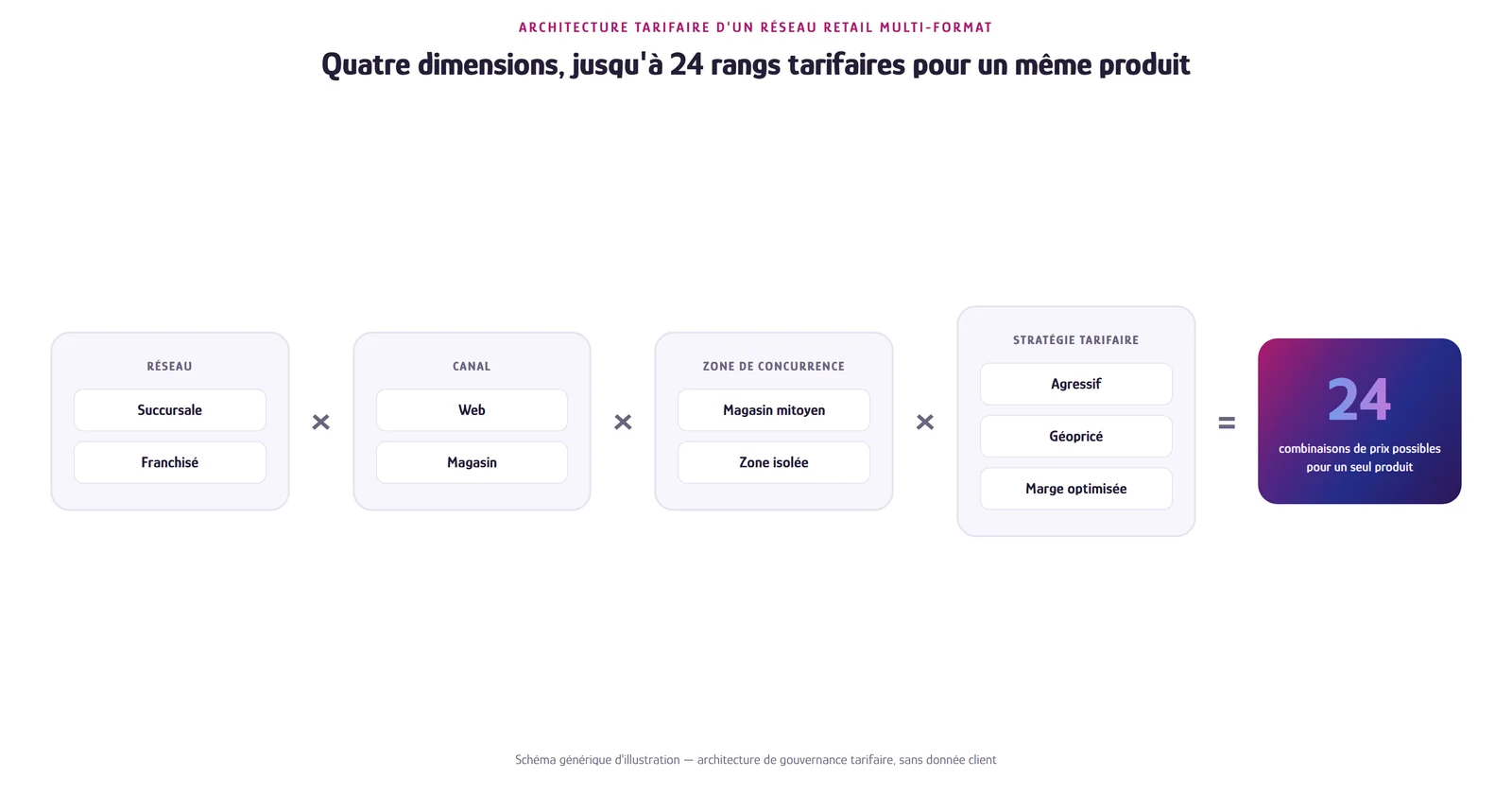
A franchisor cannot impose a resale price: the law prohibits it from doing so; it can only recommend a price or set a maximum. A franchisee’s margin is therefore governed by a documented target, defined by network segment rather than on a store-by-store basis, and applied uniformly to all retail locations within the same segment. Three tiers are usually sufficient: aggressive pricing online, geopricing in-store, and an optimized margin for the franchisee.
The same brand, the same product, and yet two legitimate ways to set the markup: one for a company-owned store, and one for a franchisee-owned store that negotiates its own markup.
To ignore this discrepancy is to treat the network as a homogeneous entity, which it is not. To document it is to transform a recurring source of friction into a stable, enforceable, and defensible rule.

Short answer: Two margin approaches, one method
In a mixed network, a company-owned store’s margin is an internal target set and adjusted by the corporate brand. A franchisee’s margin, on the other hand, reflects the profitability of an independent business owner, who negotiates it. Both are legitimate, and a one-size-fits-all rule ultimately serves neither well.
The answer is not to make decisions on a case-by-case basis, but to establish a rule for each network segment—one that is documented and applied consistently across all retail locations within that segment. That is what transforms a recurring source of friction into a defensible policy.
A mixed network is not a homogeneous network
Viewed from headquarters, a retail network often appears as a single thread: price, margin, brand. Viewed from the field, however, it consists of two distinct groups. On one hand, there are company-owned stores, where margin is an internal objective. On the other, there are stores operated by franchisees—independent entrepreneurs who have invested their own capital and negotiate their margins just as any retailer negotiates their profitability.
franchised retail locations in France in 2025, up 2.9% year-over-year, spread across 2,035 networks
(French Franchise Federation, Key Indicators 2025)
Managing the profit margin of such a group using a single set of rules amounts to ignoring the fact that half the network—and sometimes more—does not respond to the same economic incentives as the other half. A branch manager implements a policy. A franchisee adapts it each month based on his or her own income statement.
What a franchisor can—and cannot—require regarding pricing
Before we even discuss the tool itself, there is a legal reality that underpins the entire issue—and one that is all too often discovered too late: under French law, a franchisor cannot impose a resale price on its franchisee. Imposed prices, such as minimum prices, are prohibited by competition law, which applies in full to franchise agreements.
prices set by a franchisor for its franchisee: by law, the franchisee retains full and complete freedom to set its resale prices
(Commercial Code, Book IV, analysis by the Commission for the Review of Commercial Practices)
What the law does allow, however, is for a franchisor to recommend prices or set maximum prices with the explicit goal of ensuring price consistency and maintaining brand image across the network, provided that the contract explicitly states in writing that the franchisee retains control over the final decision.
It is this legal detail that changes everything when it comes to conceptualizing a target such as the “optimized margin.” It is not—and cannot be—an order. It is a documented target, accompanied by a clear justification (local competition, operating costs, brand image), which the franchisee is able to understand, discuss, and ultimately follow because the economic benefit is demonstrated, not decreed. The distinction between this and exceptions or waivers to a pricing policy is governed in the same way.
Three tiers, one consistent brand identity
In a mixed multichannel network, three pricing strategies are generally sufficient to cover most situations, provided they are never confused with one another.
| Bearing | Where it applies | What it protects | Who's driving it? |
|---|---|---|---|
| Aggressive | Web channel, national comparison | Perceived Competitiveness in the Online Market | Headquarters, across all brands in the network |
| Geopriced | Store, depending on the level of local competition | Real competitiveness relative to the closest competitor | Automatic Rule by Catchment Area |
| Optimized Margin | Franchise store, negotiated rent | The franchisee's profitability, without going overboard | A documented policy, discussed with the franchisee |
To put it this way: the three tiers are not three price levels ordered from lowest to highest. They are three answers to three different questions: how much to cut to stay competitive online, how much to adjust to remain credible against the local competitor, and how much to preserve so that the franchisee continues to invest in their store. Consistency between online and in-store, on the other hand, depends on price differences across channels.
A documented policy, not a one-time negotiation
The most common instinct when faced with this complexity is to handle it on a case-by-case basis: a franchisee calls, a manager makes an adjustment, and the exception becomes the unofficial norm. This works when there are five franchisees. When there are fifty, this instinct becomes the main source of inconsistency within the network—and the primary cause of complaints when a franchisee compares their situation to that of a colleague.
The right architecture reverses the logic: a target margin level is defined once—by network segment and by competitive zone—and this rule then applies equally to every franchisee in that segment. Exceptions become rare, documented, and justifiable, rather than being the default. This is the same discipline described in retail pricing.
It also provides the best protection for the franchisor itself: if a franchisee ever challenges their rate tier, or if a regulatory agency investigates the network’s pricing policy, a written rule that is applied consistently can be defended. A history of verbal adjustments cannot.
The Four Criteria That Ensure Sustainable Governance
- Segment by network, not by store: the rule is defined at the segment level (branch or franchisee, adjacent or isolated area), never on a store-by-store basis; otherwise, it becomes a disguised negotiation.
- Justify a target, not an order: the sales target must remain a documented goal that the franchisee can understand and discuss—never a price imposed from above. The law requires it, and so does the business relationship.
- Document the same calculation for everyone: two franchisees in the same segment must be able to compare their pay tiers and find that they are based on exactly the same method, with no variation from one manager to another.
- Monitor deviations and catch them before they escalate: a price that deviates from the norm for its segment must be identified before a complaint or audit, not after.
Expand Without Straining the Franchisee-Franchisor Relationship
- Map out the actual segments: cross-reference the network, channel, and competitive landscape before setting any margin rules.
- Set the rules with—not for—the franchisees: a threshold that is perceived as having been negotiated will hold up over time, while one that is perceived as having been imposed will be circumvented as soon as the opportunity arises.
- Automate the application, not the decision: once a rule is established, its application to each price must be automatic and consistent. The decision remains a human one; the execution does not.
- Rethinking the fixed-interval rule: a fixed threshold eventually becomes disconnected from local competitive realities.
Mistakes That Undermine Trust in the Network
- Treat the optimized margin as a fixed price. Aside from the legal risk, this is the surest way to alienate a retail chain that has invested its own money in its stores.
- Allow the rate to vary from one manager to another. Two franchisees in the same segment using two different calculations are bound to disagree as soon as they discuss it with each other.
- Combining company-owned stores and franchisees into a single margin rule. Two cost structures, two levels of autonomy: a single rule ultimately fails to serve either of them well.
- Never settle for the status quo. A margin optimized for the competitive landscape of two years ago becomes a hidden disadvantage.
Here are five questions to help you assess the state of your governance: Is your pricing structure documented, or is it decided over the phone? Do two franchisees in the same segment receive the same price calculation? Is a discrepancy visible before a complaint is filed? Do your guidelines distinguish between company-owned stores and franchisees? When was the last time you revised your pricing tiers? The use of key performance indicators is detailed in “Measuring Your Price Image,” and the specifics by business activity are covered in “Pricing by Sector.”
FAQ
Recurring questions about margin governance in a hybrid network.
We need a tool capable of two things: setting a margin target for each network segment, and letting each retail location make its own decisions, while making any deviation visible. BOOPER MPS manages target price rules—including minimum and maximum limits—that vary from one retail location to another, with an alert when a local price goes outside those limits. The modular platform defines this scope.
No. Under French law, fixed prices and minimum prices are prohibited by competition law, which applies in full to franchise agreements. A franchisor may, however, recommend prices or set maximum prices to ensure pricing consistency, provided that the agreement specifies that the franchisee retains control over the final decision.
These aren't two levels; they're two different approaches. In a company-owned store, the margin is an internal target that the company sets and adjusts. For a franchisee, it's the profitability of an entrepreneur who has invested their own capital and makes decisions each month based on their income statement. A one-size-fits-all rule ultimately fails both.
By defining the rule on a segment-by-segment basis—never store by store—we consider the network (company-owned or franchised), the channel (online or in-store), and the competitive zone (adjacent or isolated), and then apply the same calculation method to all retail locations within a given segment. Exceptions once again become rare and justifiable, rather than the unofficial norm.
By building it with them rather than for them, and by documenting the process. A price point that is perceived as having been negotiated will hold up over time, while one perceived as having been imposed will be circumvented. The rationale is just as important as the number itself: local competition, operating costs, brand image. Two franchisees in the same segment must arrive at exactly the same calculation.
Rarely. The level of competition is not the same in a densely populated area as in an isolated one, and a single price means sacrificing profit margins in one area or competitiveness in the other. That is the whole point of geopricing, which should be distinguished from the pricing tier negotiated with a franchisee.
Sources
- French Franchise Federation, “Key Indicators 2025,” franchise-fff.com
- Commercial Code, Book IV, “On Price Freedom and Competition,” legifrance.gouv.fr, and analysis by the Commission for the Review of Commercial Practices, economie.gouv.fr

Optimix merged with Maxxing in July 2025, and PricingHUB was acquired by Akeneo in June 2026. In less than a year, two of the three software providers most frequently used by French retailers underwent changes in ownership, raising the question of alternatives for their customers.
This comparison evaluates Optimix XPA, PricingHUB, Mercio, Yieldigo, and BOOPER based on what truly sets a pricing solution apart in France: native support for French regulations, pricing by store or by zone, the approval process before a price changes at the register, and roadmap independence.

A franchisor cannot impose a resale price: the law prohibits it from doing so; it can only recommend a price or set a maximum. A franchisee’s margin is therefore governed by a documented target, defined by network segment rather than on a store-by-store basis, and applied uniformly to all retail locations within the same segment. Three tiers are usually sufficient: aggressive pricing online, geopricing in-store, and an optimized margin for the franchisee.

A manufacturer that raises its list price does not set the price on the shelf. Between the negotiated list price and the displayed price lie the retailer, its markup, and its promotions. What is measured is the price elasticity of each product, retailer by retailer.