
Markup rate: definition, formula and calculation
On this page
Does your reporting confuse brand rate and margin rate?
Schedule a meetingLearn about our pricing analysisThe markup rate is the percentage margin calculated based on the pre-tax selling price: (pre-tax selling price − pre-tax cost of goods sold) ÷ pre-tax selling price. It differs from the gross margin, which is calculated based on the cost of goods sold. It is the standard profitability metric in the French retail sector.
The Essentials in 6 Questions
The portion of the selling price (excluding tax ) that constitutes the distributor's gross margin.
Pricing teams, management accounting teams, and category managers.
For every price setting and in all profitability reports.
By reference number, category, and brand.
Manage profitability based on the listed price, without confusing it with the profit margin.
Margin ÷ selling price (excluding tax) × 100.
Brand Rate vs. Margin Rate: Why the Distinction Matters
For the same margin in euros, the two rates yield very different percentages: confusing them distorts any assessment of profitability.
- Avoid margin/brand confusion : a brand rate of 30% corresponds to a margin rate of 42.9%, which is always higher.
- Directly control the selling price: Calculated based on the listed price, the markup makes setting a target price easier to understand.
- Standard practice in the French retail sector: Virtually all retailers set their profitability targets as a percentage of sales.
A Practical Example of Calculating the Brand Rate
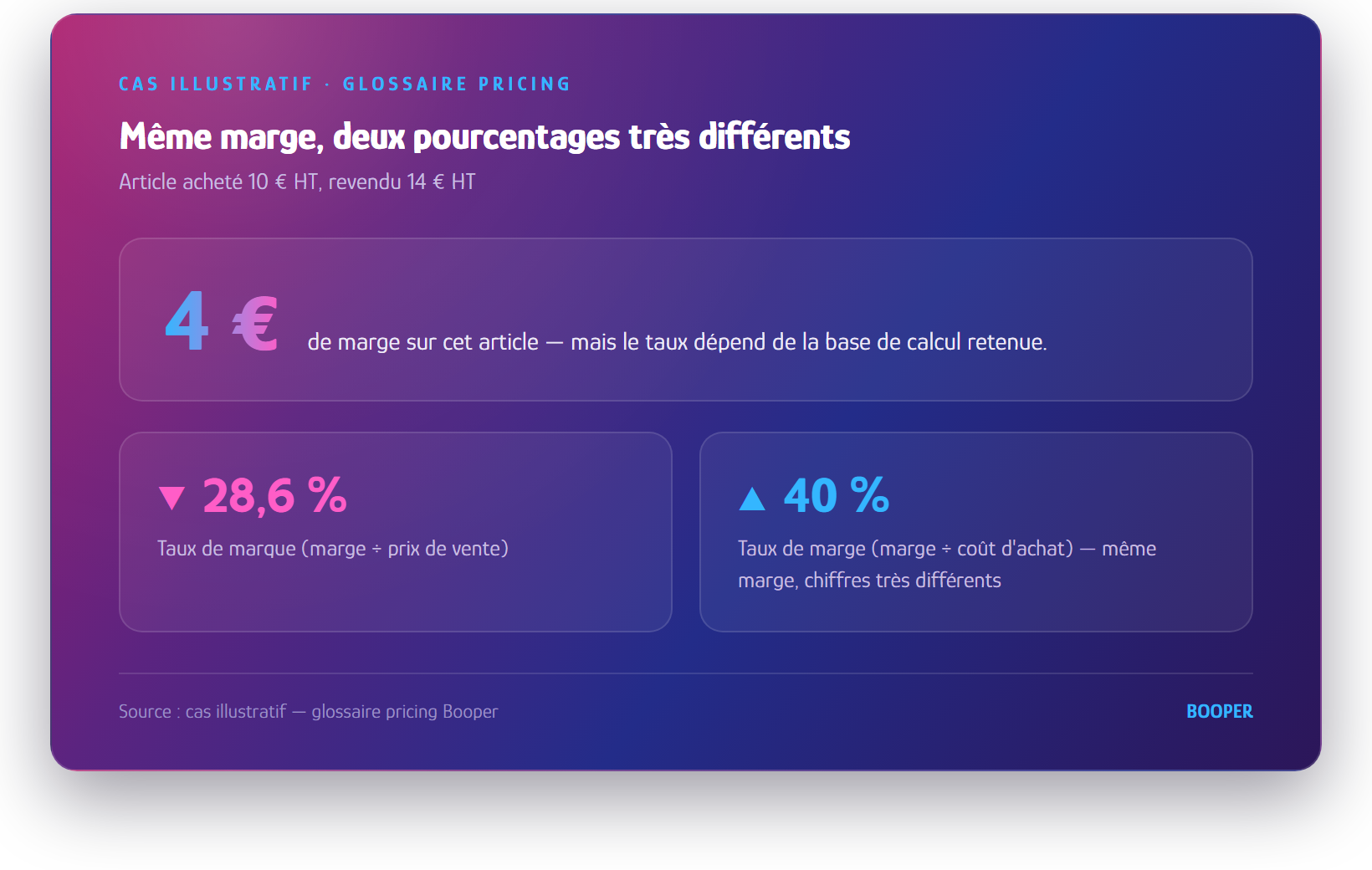
An item purchased for €10 (excluding tax) and resold for €14 (excluding tax) has a markup rate of 28.6% and a profit margin of 40%.
sales margin: €14 (excluding tax) − €10 (excluding tax).
brand rating: 4 ÷ 14.
margin rate: 4 ÷ 10.
Confusing the two leads to underestimating or overestimating the actual profitability of a category.
Formula and calculation of the markup rate
Two formulas are all you need: one calculates the rate, and the other determines the selling price based on a target rate.
| Need | Formula |
|---|---|
| Measuring Brand Awareness | (Selling price excluding tax − Purchase cost excluding tax) ÷ Selling price excluding tax × 100 |
| Setting a Price Based on a Target Rate | Selling price (excluding tax) = Purchase cost (excluding tax) ÷ (1 − Target markup rate) |
| Switch to the margin rate | Margin Rate = Mark Rate ÷ (1 − Mark Rate) |
Not to be confused with the multiplier (selling price excluding tax ÷ purchase cost excluding tax), a third way of expressing the same margin. The markup is one of the key pricing KPIs for profitability that are monitored as a priority. To measure it precisely by category and identify the SKUs that are eroding it, see our pricing analysis; to align teams on these concepts, see our pricing training.
The 3 Common Mistakes with the Markup Rate
Confusion between concepts, focusing on a single target, and overlooking the value margin are the classic pitfalls.
- Confusing brand rates with margin rates in a report, which skews comparisons between categories or against benchmarks.
- Set a single target rate for the entire product line, without distinguishing between KVI, loss leaders, and stock items.
- Manage based solely on percentages, without referring to the margin in absolute terms, which masks volume differences between SKUs.
Frequently Asked Questions
Short answers to the most frequently asked questions about the brand rate.
What is the brand rate?
The markup rate is the percentage of profit margin calculated on the selling price excluding tax: (selling price excluding tax − purchase cost excluding tax) ÷ selling price excluding tax × 100. It indicates the portion of the displayed price that goes to the retailer once the merchandise has been paid for. It is the benchmark indicator for French retailers, because teams typically base their calculations on the shelf price. A product sold for €20 excluding tax and purchased for €13 excluding tax thus has a markup rate of 35%. This should not be confused with the gross margin rate calculated on the cost, nor with the profit margin in euros.
What is the formula for the markup rate?
Markup rate = (selling price excluding VAT − purchase cost excluding VAT) ÷ selling price excluding VAT × 100. Example: a product bought for €10 excluding VAT and sold for €14 excluding VAT generates a margin of €4, i.e., a markup rate of 4 ÷ 14 = 28.6%. To find the selling price from a target rate: selling price excluding VAT = purchase cost excluding VAT ÷ (1 − markup rate).
What is the difference between the brand rate and the margin rate?
The difference between markup rate and margin rate lies in the calculation method: markup rate relates the margin to the selling price excluding VAT, while margin rate relates it to the purchase cost excluding VAT. For the same margin in euros, the margin rate is therefore always higher. For example: purchased for €10 excluding VAT, sold for €14 excluding VAT, a product generates a margin of €4, representing a 28.6% markup rate but a 40% margin rate. Comparing a target markup rate to a result based on margin rate distorts the entire assessment of a category's profitability.
How do you convert a brand rate to a margin rate?
To convert from a markup rate to a margin rate, the following formula is used: margin rate = markup rate ÷ (1 − markup rate). A markup rate of 25% thus corresponds to a margin rate of 33.3% (0.25 ÷ 0.75), and a markup rate of 40% to a margin rate of 66.7%. Conversely, markup rate = margin rate ÷ (1 + margin rate). These conversions are primarily used to harmonize reports that combine the two concepts, for example, between purchasing, which focuses on cost, and pricing, which focuses on the selling price.
What profit margin should you aim for in retail?
The target brand conversion rate in retail depends primarily on the category: fast-moving consumer goods (FMCG) are managed with much lower rates than textiles, beauty products, or home furnishings, where volumes are lower. The right benchmark is therefore not a general average but the historical performance of your own category and its direct competitors. Differentiated targets are then set: a lower rate for loss leaders that convey a price image , and a higher rate for core products, always keeping a close eye on profit margins in euros.
Key Takeaways
- Markup rate = margin ÷ selling price (excluding tax ); margin rate = margin ÷ purchase cost (excluding tax).
- For the same margin, the margin rate is always higher than the markup rate.
- Set targets by category and also track the profit margin in value terms.
Would you like to track your brand rating without any calculation errors?
Booper continuously calculates your brand rate and simulates the impact of each pricing decision.
Let's talk about your profit margins →Learn about our pricing analysisYou might also be interested in these articles

Maintaining a high price protects the unit margin but slows sales; slashing prices quickly speeds up sales but erodes the margin. The right balance is a matter of calculation, not guesswork.
The total annual cost of holding inventory (capital, storage, obsolescence) averages 20 to 30 percent of its value. The purpose of BOOPER’s Markdown & Clearance module is to quantify this trade-off between margin and sales on a per-SKU basis.

An effective pricing strategy relies on a rigorous segmentation between image products (KVI) and margin drivers to maximize profitability. By balancing perceived value and competitive data, this approach can increase EBITDA by up to 15%. This strategy is then translated into a concrete pricing policy applied on a daily basis. Clear governance and automated rules ensure consistent execution despite market fluctuations. Building and equipping this strategy from start to finish is the purpose of BOOPER’s Pricing Strategy Development module.

An effective pricing strategy relies on rigorous segmentation between key value items (KVIs) and margin drivers. To protect profitability, retailers must move away from blind competitive matching by establishing strict governance and pricing corridors. Data-driven management using cleansed data allows companies to restore their price image and margins in just 30 days.