5 Common Mistakes Pricing Teams Make When Dealing with AI (and how to avoid them)
.avif)
Edouard Calliati
Director of Marketing and Business Development
To put it simply: artificial intelligence should never dictate pricing strategy. Its implementation requires the establishment of rigorous safeguards—such as price corridors and human validation—to protect financial margins. This combination of computational power and expert oversight transforms raw data into sustainable profitability without the risk of algorithmic drift.
Are your margins quietly eroding due to poorly managed automation? AI pricing errors now pose an invisible threat to business profitability, often turning this technological tool into a source of uncontrolled risks. We precisely identify the five major strategic flaws—from data quality to the lack of human oversight—so you can correct course immediately. This expert content provides you with the methodological safeguards and validation protocols needed to regain control. Secure your pricing strategy and turn these technical challenges into a driver of sustainable financial performance.

Purpose of the article
Artificial intelligence is no longer an optional extra; it’s a tool that must be mastered to avoid eroding profit margins.
Purpose of the article
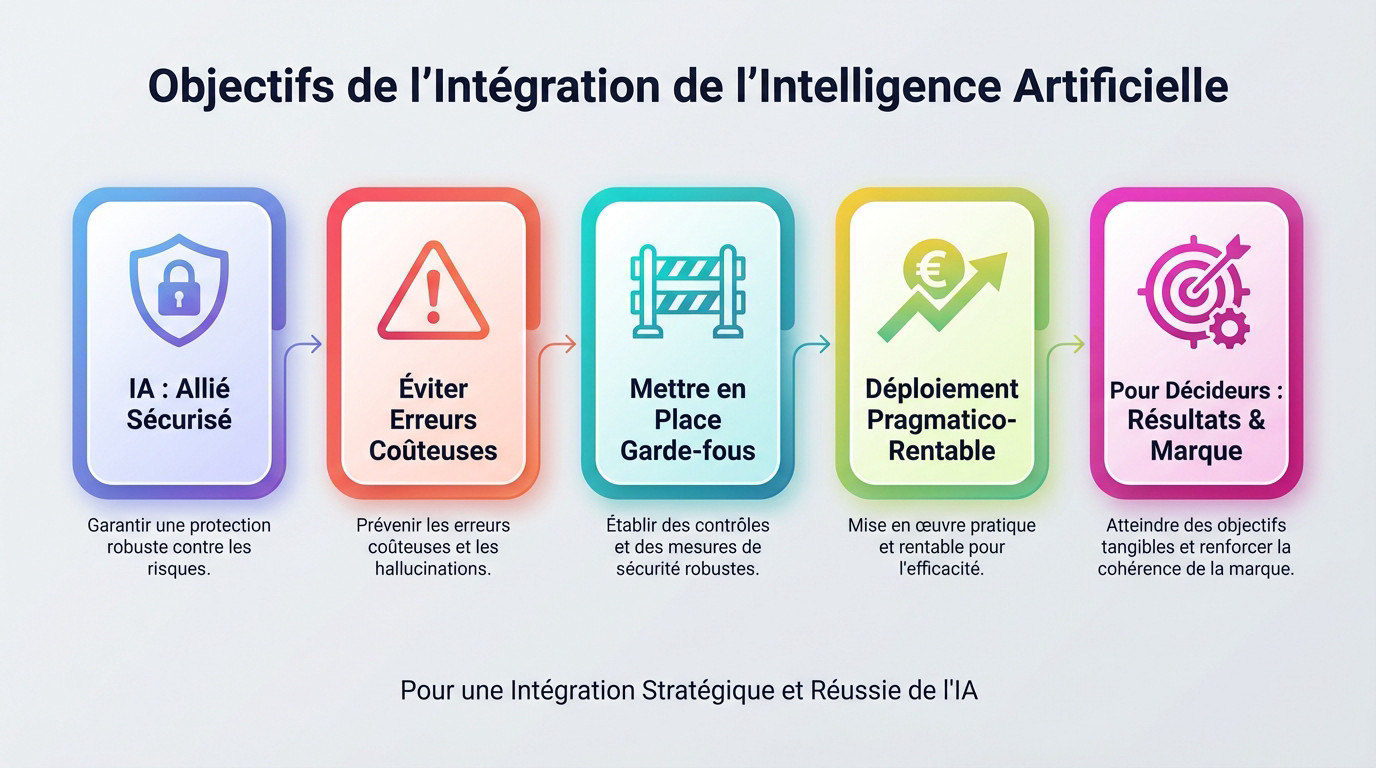
This guide is designed to help you turn AI into a reliable ally for your organization. We’ll help you avoid common AI pricing mistakes and costly miscalculations that undermine value.
We present a method for establishing concrete and actionable safeguards. The goal is to move from theory to a pragmatic and cost-effective implementation as quickly as possible.
This article is intended for decision-makers who demand immediate financial results without ever compromising their brand consistency.
AI and Pricing: What AI Does Well (and What It Won't Do for You)

Before jumping in, it’s important to distinguish between the machine’s superpowers and the responsibilities that remain purely human, in order to avoid AI pricing errors.
What AI Actually Improves
AI excels at detecting weak signals and synthesizing large datasets. It simulates complex scenarios in record time to inform decision-making.
It automates repetitive tasks. This frees up time for strategic analysis.
What AI Can't Replace
Pure strategy and political maneuvering remain the exclusive domain of humans. AI also cannot handle the subtleties of business relationships or overall corporate governance.
The long-term vision is human. Machines lack business intuition.
Requirements for reliable use
Without its own data and clear guidelines, the tool becomes dangerous. Strict validation processes must be established to oversee each algorithmic recommendation before it is implemented.
Data quality is the foundation. There are no shortcuts to success.
Mistake #1 — Confusing AI with pricing strategy

The first mistake is to believe that the tool determines the direction, when in fact it is merely a driver. This is one of the most common AI pricing errors.
Symptoms: opportunistic decisions, lack of goals, lack of segmentation
Price changes are often observed that lack any overarching logic. The absence of clear segmentation leads to erratic pricing that confuses loyal customers and partners.
Management is based on visual assessment. There are no specific targets.
Risks: inconsistency, loss of profit margin, price war
The danger is accidentally triggering a destructive price war. Price inconsistencies across sales channels ultimately erode gross margins irreversibly.
The brand's reputation suffers. Customers lose confidence.
How to avoid: targets, segmentation, discount policies, price corridors
Set minimum and maximum price ranges to guide the algorithm. Establish a strict discount policy and segment your customers based on their actual value rather than their volume.
A human must validate the thresholds. The strategy dictates the tool.
Mistake #2 — Using incomplete, dirty, or ungoverned data

If you feed the AI junk data, don’t be surprised if it gives you toxic advice for your business.
Symptoms: inconsistent recommendations, unstable results
The recommendations vary wildly for no apparent reason. There are glaring inconsistencies between similar products, indicating that the source data is contaminated by data entry errors.
The models lose all stability. The predictions become unusable.
Risks: poor pricing, loss of team confidence
A poor price can drive away your best customers. Worse still, your sales teams may reject the tool altogether if they consider its pricing to be unreasonable.
The rollout comes to a sudden halt. The investment is completely lost.
How to avoid: data readiness, data dictionary, ownership, quality
Create a data dictionary to standardize definitions. Appoint quality assurance leads and ensure that data flows are regularly audited before feeding them into your models.
Mistake #3 — Over-automating without safeguards (“runaway” pricing)
Full automation is a dangerous fantasy that can turn your catalog into an algorithmic battlefield.
Symptoms: too frequent changes, uncontrolled exceptions
Prices fluctuate several times a day without any market justification. These AI-driven pricing errors generate a growing number of exceptions in an opaque manner, making it impossible for management to assess sales performance.
The system is stuck in a loop. No one understands the fluctuations.
Risks: brand image, pricing, margins, customer experience, operational chaos
Customers feel cheated by excessive volatility. This creates internal chaos, with salespeople spending their time justifying prices they don't even understand themselves.
The margin is quietly disappearing. The shopping experience is deteriorating.
How to avoid: min/max ranges, thresholds, exception rules, validations
Set strict limits that the AI must never cross. Set up automatic alerts whenever a recommendation strays from the norm, requiring immediate human approval.
Use simple rulers to frame the machine. Here are the supports you need to install:
- Tight price ranges.
- Automatic alert thresholds.
- Human verification is required for large accounts.
Keep the final say. The machine suggests, the human decides.
Mistake #4 — Treating a recommendation as a decision (without assessing its impact)
Blindly following what the AI says is like driving with your eyes closed on a mountain road. It’s one of the most dangerous mistakes in AI pricing.
Symptoms: no testing, no monitoring, no rollback
The new prices are being rolled out on a massive scale without any prior testing. There is no procedure in place to quickly reverse the changes if sales figures suddenly take a nosedive.
We're sailing without a map. Unfortunately, the actual impact remains unknown.
Risks: Hidden Negative Effects (Volume, Churn, Margin)
You could lose sales volume without realizing it right away. The churn rate could skyrocket if the AI misjudges your customers' price sensitivity.
Financial damage often goes unnoticed. By the time it becomes apparent, it’s already too late.
How to avoid: A/B testing or pilot studies, monitoring KPIs, review committee
Always test on a small scale before rolling out the changes. Convene a weekly review committee to analyze key performance indicators and adjust the models based on feedback from the field.
Caution is the key to profitability. Always take things one step at a time.
Mistake #5 — Overlooking risks (privacy, compliance, competition, bias)
AI is not a lawless zone; ignoring these threats is one of the worst mistakes in AI pricing.
Symptoms: sharing of sensitive data, uncontrolled access
Confidential data ends up in open models. Access to tools is not restricted: anyone can modify strategic margins.
Safety is being neglected. It's dangerous.
Risks: data breaches, non-compliance, biased decisions
A data breach undermines your competitive advantage. Biased algorithms expose you to heavy penalties for illegal price discrimination.
Your reputation is on the line. Fines are lurking.
How to prevent this: access control, anonymization, audit trail, usage policies
Traceability of decisions is a lifeline for your pricing strategy when dealing with regulators.
Anonymize the data. Implement a comprehensive audit trail to track every price change and ensure compliance.
Secure your expertise. Technical rigor prevents disasters.
Essential safeguards for AI-powered pricing
To ensure peace of mind and avoid costly AI pricing errors, your system must incorporate native, tamper-proof security measures.
Price corridors, discount rules, multi-level approvals
Price corridors contain the algorithm's deviations. Require human approval for any out-of-range discounts to prevent margin erosion. It's your safety net.
The framework remains rigid. The AI operates solely within these strict boundaries.
Audit trail: who decided what and why
Every price change requires a permanent digital record. Always document the reason behind each decision so you can analyze your future successes or failures. You can’t manage what you don’t know.
Your history becomes your greatest asset. Never underestimate the power of logs.
Monitoring: margin, discount leakage, win rate, churn, perceived price
Track discount leakage to stop the drain on your profits. Analyze the win rate in real time to adjust the sensitivity of your models to sudden market reactions.
The data never lies. Keep your eyes on this dashboard.
Safe and useful AI use cases for a pricing team
There’s no need to revolutionize everything all at once; start with quick wins that don’t involve any major risks.
Summary and organization: policies, arguments, rules
Use AI to draft your pricing policies and sales pitches. It organizes your internal guidelines in a consistent manner, making it easier for all sales teams to adopt them.
It saves a tremendous amount of time. It makes things much clearer.
Anomaly detection: unusual discounts, inconsistent prices
The algorithm instantly detects unusual discounts. It identifies inconsistent prices in your catalog, allowing you to correct AI-driven pricing errors before they impact your annual financial results.
It's an effective safety net. Mistakes are quickly corrected.
Simulation: margin/volume impact, scenarios, sensitivity
Simulate the impact of a price increase on your overall sales volume. Test different sensitivity scenarios to anticipate competitors’ reactions and protect your net margins.
Plan for the future without risk. Simulation is a powerful tool.
Workflows: Speed Up Approvals Without Losing Control
Automate the special offer approval process. AI filters out simple requests and forwards only complex cases to experts, thereby accelerating the company’s sales responsiveness.
Business moves faster. Control remains complete.
30-Day Rollout Plan (Simple and Realistic)
Here’s a practical, four-step weekly plan to transform your pricing strategy and avoid common AI pricing mistakes.
Week 1: Choose 1 use case, define the baseline and KPIs
Start by identifying a single priority pricing issue. Establish your current baseline based on historical performance. Select key performance indicators to measure the immediate financial impact.
Avoid spreading yourself too thin. A clear vision ensures success.
Week 2: Securing Data and Rules (Guardrails)
Filter the data specifically required for this use case. Set up technical safeguards to prevent any inconsistent price quotes. Enforce strict rules to mitigate major financial risks.
Secure your system now. Security comes first.
Week 3: Pilot program on a limited scale + adjustments
Launch the pilot program on a limited range of products. Analyze daily results to identify anomalies. Adjust the algorithm’s parameters based on real-world feedback.
Learn by moving quickly. Agility determines the project's viability.
Week 4: Formalize processes, training, go/no-go decision
Document each step to ensure the process is reproducible. Train your teams on the new pricing tools. Approve the full rollout only based on solid, quantifiable evidence.
Make the change in methodology official. The implementation will then proceed smoothly.
"Ready for AI in Pricing" Checklist
Before pressing the button, make sure you’ve checked all the boxes on this checklist to ensure your margins are secure.
Data, rules, governance, adoption, monitoring
Your historical data must be completely reliable to feed the algorithm. We establish strict business rules to govern every automated decision. Governance clarifies who approves the final prices.
The buy-in of the sales teams ensures the success of the field rollout. Robust monitoring immediately detects margin anomalies. Use this table to assess your level of operational readiness.
Don’t skip any steps to avoid AI pricing errors. A thorough checklist helps prevent unexpected operational issues.
Frequently Asked Questions
Articles similar

Building a high-performing pricing team requires adopting a hybrid model that combines centralized strategy with local agility. This transition replaces intuition with data-driven decisions, guided by specialized roles and strict governance.
This proactive management directly improves financial performance, enabling companies to aim for an increase in profitability of between 100 and 500 basis points.

In response to the radical price transparency of 2026, the retail sector is adopting automated management. This strategy protects margins against inflation by ensuring immediate responsiveness across all channels.
A high-performance tool guarantees a return on investment in less than six months, making pricing a cornerstone of net profitability.

Product matching is the foundation of competitive monitoring because it prevents the comparison of non-equivalent products. Reliable product matching safeguards margins by basing repricing on real-time, multi-source data.
Key finding: According to the Diamart study, 50% of French retailers still consider this challenge to be unresolved.