Pricing workflow alerts: large-scale management
.avif)
Edouard Calliati
Director of Marketing and Business Development
To cut to the chase: standardizing pricing through automated alerts and structured workflows is the only effective defense against margin erosion during growth phases. This approach safeguards profitability by detecting anomalies in real time while accelerating strategic decision-making, thereby transforming pricing management into a true competitive advantage. Request a Booper demo
Is it acceptable to watch your margins erode silently day by day because your teams, overwhelmed by the volume of data, can no longer manually monitor thousands of complex transactions? To put a permanent stop to this erosion of value, structuring your business around pricing alert workflows is the only way to align maximum sales responsiveness with rigorous protection of your financial gains. Here, we reveal the essential governance rules and concrete automation scenarios to instantly detect costly anomalies while accelerating your strategic decisions at scale.

Pricing Alerts & Workflows: When Pricing Can Be Managed at Scale
The transition from manual management to an automated system that incorporates pricing alerts and workflows is the only way to stay afloat in the face of the explosion of transactional data.

Purpose of the article
Here’s a straightforward approach to streamlining your pricing process. We’ll explore how to identify risks before they become costly. The goal isto make smarter, faster business decisions.
Your top priority remains ensuring profit margins. You must also ensure full traceability of approvals.
That's the principle of scale control. You're finally back in control.
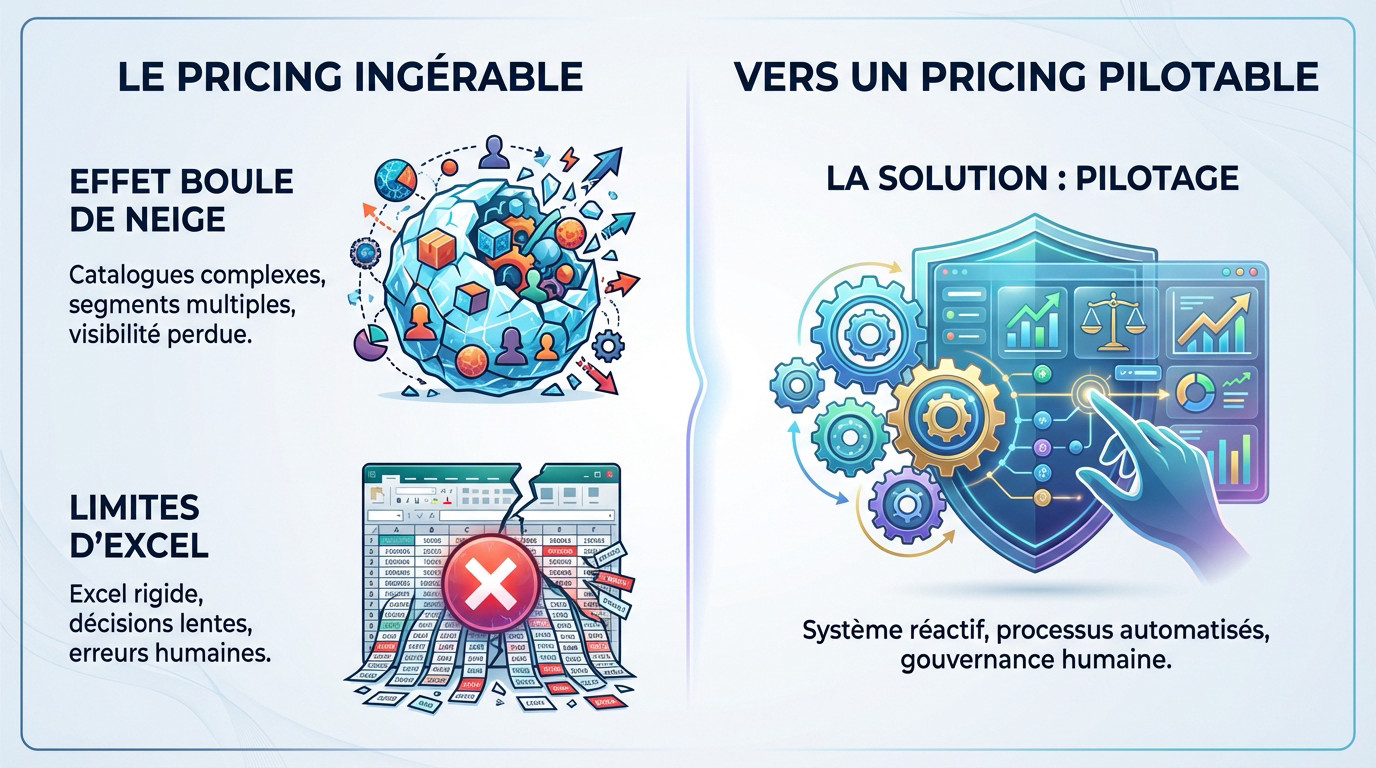
Why pricing becomes "unmanageable" as the business scales
Before looking for solutions, let’s understand why your current methods are failing under the pressure of growth.
More products, more segments, more exceptions: the snowball effect
Your catalog is growing, and chaos is quietly taking hold. With thousands of items, data entry errors are no longer isolated incidents but inevitable statistics. It’s a matter of math—and it’s unavoidable.
Add to that the growing number of specific customer segments. Every approved exception becomes a rule that’s impossible to follow.
The result? You lose sight of the big picture. The noise drowns out the signals.
The limitations of Excel and “case-by-case” decisions
Let's be honest, your spreadsheets have become a dangerous mess. Excel doesn't warn you in real time when a margin collapses. It's a hopelessly static tool.
Your teams are also burning out from having to approve every quote manually. Making decisions on a case-by-case basis slows down the entire business.
The risk of human error skyrockets. A simple copy-and-paste can be costly.
The real challenge: moving from ad-hoc pricing to a managed pricing strategy
Flexible pricing isn't a luxury—it's an essential, responsive system. You need solid safeguards to protect your brand strategy. It's a matter of survival.
Craftsmanship doesn't scale. Industrialization requires pricing alerts, workflows, and automated processes.
That's where governance comes in. Control must remain firmly in human hands.
Alerts vs. Workflows: Simple Definitions
To effectively manage your margins, you must first distinguish between the raw signal and the organized response.
A pricing alert = an actionable signal (not just a report)
An alert should promptimmediate action. It’s not a dashboard you check once a month. It’s a wake-up call demanding an immediate fix.
A single alert is worthless. Without specific market data or competitive context, you’re flying blind.
Too many signals drown out the information. The relevance of the signal is your only ally.
A workflow = a decision-making process (approval, deadlines, escalation)
The workflow organizes the human response. It strictly defines who approves what and by when. It is the backbone of the process that turns chaos into order.
Some complex deals require management intervention. Escalation management helps prevent business deadlocks.
Tools such as Azure Logic Appsmake it possible to automate these business validation workflows.
From Signal to Decision: The 5-Step Framework
The cycle is set in stone: detection, qualification, routing, decision-making, and archiving. Each step must flow seamlessly. Speed of execution becomes a decisive competitive advantage here.
- Signal detection
- Business Impact Analysis
- Hierarchical validation
- Implementing the change
- Stock Report
The loop must be closed. Real learning comes only from post-mortem analysis.
Pricing alerts to set up first
Don’t try to monitor everything at once. To make your pricing alert workflows truly effective, focus only on the signals that directly impact your bottom line.
Margin Below Threshold Alert (product / customer / deal)
This is the ultimate survival alert. It must trigger immediately as soon as a transaction falls below a defined profitability threshold, whether we’re talking about gross or net margin. You can’t let a poorly negotiated deal destroy your value.
Note that this threshold varies by category: a loss leader can meet lower standards than a premium product.
Discount leakage alert
Salespeople are sometimes too eager to close a deal quickly. This alert automatically flags any deviations from the official pricing schedule to stop the silent erosion of prices. It’s the only way to regain control over pricing discipline.
Next, assess whether these discounts are justified by actual volume or whether they are simply a costly negotiating habit.
Price outside the range alert / Catalog inconsistency
A premium product priced lower than an entry-level model? This happens more often than you might think, especially with a barrage of promotions. A price gap alert is essential for maintaining the logical consistency of your product lineup in the eyes of the market.
Carefully compare the relative prices across different formats. Customers should never feel shortchanged by a glaring inconsistency.
Ensure your technical branding is on point: an illogical pricing structure instantly damages your brand image.
Cost Increase Alert (Materials, Logistics, Services)
If your costs rise, your prices must automatically follow suit. This alert creates the vital link between procurement and pricing, ensuring you don’t simply absorb inflation without taking action. Ignoring this signal is tantamount to giving your margin away to the market.
Be sure to factor in logistics costs, which often skyrocket without you even noticing. With large volumes, every penny spent on shipping counts.
Act quickly to protect your profit margin, because in this area, time is of the essence.
Competition alert (significant gap) – if applicable
Keep an eye out for sudden deviations from market trends. If a competitor slashes prices aggressively, you need to know about it right away so you can make a decision—but never blindly copy them. Your added value often justifies a price difference.
It is important to distinguish between temporary promotions and fundamental strategic changes.The analysis must be thorough and context-sensitive to avoid unnecessary panic.
Use tools to automate this tedious monitoring. You can Request a demo of Booper to centralize these alerts.
Anomaly alerts (prices set to 0, outliers, data entry errors)
Data entry errors are real time bombs. A price listed as zero or a misplaced decimal point can ruin a day’s revenue. This alert acts as an essential technical safety net.
Clean your data regularly, as the quality of your data pipeline determines the reliability of your entire system.
Stock/capacity alert (if it affects pricing strategy)
Too much inventory? Lower the price strategically to move it. Running low on stock? Raise the price to curb demand and protect your margin. This is basic yield management, but it’s a very powerful tool for boosting profitability.
The goal is to align sales and the supply chain in real time. Pricing then becomes a tool for managing inventory flows.
You should absolutely avoid running promotions on products that are out of stock. It’s disastrous for the customer experience and trust.
How to set effective thresholds (without overwhelming the teams)
Adjusting the sliders is an art that requires precision to avoid alert fatigue.
The 4 criteria: impact / frequency / possible action / owner
Every alert must pass a rigorous test. If no action can be taken, the alert is useless. If no one is held accountable, it will be ignored. Next, assess the actual financial impact: don’t sound the alarm over three euros. Finally, clearly designate a person in charge. Individual accountability prevents collective inertia.
Dynamic thresholds vs. fixed thresholds (when to use which)
Fixed thresholds are simple but inflexible. Dynamic thresholds, on the other hand, adapt to seasonal trends or costs; choose the right approach based on the maturity of your data. Use percentages for small volumes, but opt for absolute values for large deals. Above all, test your thresholds using historical data. Avoid surprises when you launch.
Prioritize: P1 / P2 / P3 (critical, important, informational)
Not everything is urgent. P1s block the sale or require immediate action. P3s are simply trend indicators.
Filtering notifications by role is crucial. The director sees only P1 notifications.
Standard Workflows: Who Approves What, and How to Keep Things Moving Quickly
Once the alert is triggered, the workflow takes over to turn the intention into action.
Discount Workflow: Thresholds, Justification, Escalation
Set strict spending limits for sales representatives. If spending exceeds 10%, a written justification is required to prevent any overspending. If spending exceeds 20%, the manager must personally approve it.
Automate the sending of requests to streamline pricing alerts and workflows. The fewer emails there are, the faster the process runs.
Keeping track of rejections helps uslearn. It helps train teams on true value.
"Strategic Deal" Workflow: Quick and Traceable Decisions
For key accounts, establish a streamlined decision-making process. Bring together pricing, finance, and sales for a 15-minute meeting to ensure full alignment. Traceability is essential here for auditing purposes.
Use collaborative tools to speed up your work. Microsoft Copilot Studio can help create agents for these workflows.
Documenting exceptions safeguards the future. Don’t leave any gaps in your records.
Price Increase Workflow: Simulation, Approval, Communication
Before raising prices, always simulate the impact on sales volume. Have the new pricing approved by the marketing team in advance. Then prepare the messaging for customers.
Coordinating the rollout across all channels prevents confusion. An omnichannel approach does not allow for price discrepancies.
It is essential to monitor the market's reaction. Make adjustments if the attrition is too high.
Contract and Key Account Workflow Exceptions
Framework agreements often have specific and strict rules. The workflow must ensure strict compliance with existing commitments. Avoid conflicting promises between departments.
Notifying clients of contract expiration dates is a game-changer. Anticipating renegotiations boosts profit margins.
Centralizing legal documents streamlines access. Pricing and legal matters are closely linked.
Governance & RACI: Ensuring Sound Decision-Making
Without clear governance rules, your workflows will eventually get bogged down in endless discussions.
RACI matrix (Pricing / Sales / Finance / Management / Product)
Pricing sets the rules of the game, while Sales puts them into practice on the ground. Finance, for its part, ensures overall profitability. This trio must work together to ensure alignment, without blurring the lines between their roles.
Be careful not to involve too many people in the decision-making process. Too many opinions slow down the process and create completely unnecessary bottlenecks.
Management? They stay out of day-to-day operations. We only call on them for exceptional circumstances.
Exceptions: Documentation, Logging, Auditing
An undocumented exception constitutes a major governance failure. Always document the rationale behind the decision; this record will be your best ally during the next financial or regulatory audit.
Notice how often these exceptions occur. If an exception occurs too frequently, it means the general rule is outdated: change it.
Choose an immutable audit log. This radical transparency builds internal trust.
Frequency: weekly monitoring, monthly review, quarterly strategy
Management requires a disciplined approach. Monitor pricing workflow alerts weekly, review thresholds monthly, and adjust your strategic course quarterly to stay in step with the market.
Above all, don’t confuse operational matters with strategic ones. Every meeting should have its own specific objective; otherwise, we’re just wasting time.
Involve stakeholders from the very beginning. A pricing culture isn’t something that can be imposed; it’s something we build together.
3 real-world scenarios (from alert to decision)
Let’s now see how these theoretical concepts translate into practical terms in the day-to-day operations of a business.
Case 1: Excessive discount on a deal (alert + approval)
A sales representative offers a 30% discount to close the deal. A P1 alert is triggered immediately. The manager receives a notification on their mobile phone for review.
The manager gives the go-ahead after seeing the future potential. The deal is sealed in an hour.
The margin has been maintained. The process went off without a hitch.
Case 2: Rising costs (alert + simulation + decision)
The price of steel has risen by 15%. The margin alert notifies the pricing manager. He simulates a 5% price increase in the catalog.
The simulation shows that the margin remains stable. The decision is made by the executive committee.
The new rates are being pushed. The company isn't losing money.
Case 3: Catalog inconsistency (alert + correction + verification)
Due to an error, the 10-pack is cheaper than the single item. The corridor alert flags the anomaly. The data manager corrects the price in two clicks.
An automatic check verifies the accuracy. The website is updated instantly.
The brand image is protected. Customers are not confused.
Measuring effectiveness: Key Performance Indicators (KPIs)
What isn't measured doesn't improve, especially when it comes to pricing performance.
Category: Policy compliance rate, discount leakage
Keep a close eye on how well you’re following your own rules. How many sales actually fall outside the guidelines? Discount leakage measures the money left on the table unnecessarily.
Reducing this leakage rate by 1% often boosts profits. It’s a pure profit driver.
We need to identify the underperformers. Training must be targeted.
Performance: margin, price realization, product mix
Price realization compares the target price to the actual price received. It shows how effective your strategy really is. The product mix also affects the overall margin.
Analyze these KPIs by region or by team. Disparities often reveal opportunities.
Aim for continuous improvement. Pricing is a marathon.
Operations: validation time, number of exceptions, backlog
A slow workflow kills business. Measure the average time it takes to approve an exception. If it takes too long, simplify your processes or tools.
Keep an eye on the number of pending cases. A backlog is a sign of being overwhelmed.
Optimize for fluidity. Agility is your greatest asset.
How a pricing tool helps you scale up (without losing control)
Humans have their limits; technology is there to push those limits while staying on course with our strategic goals.
Centralize alerts, workflows, and audit trails
A dedicated tool brings together pricing alerts, workflows, and data all in one place. No more lost emails or corrupted Excel files. You get a 360-degree view of your decisions.
The audit trail ensures regulatory compliance. Every click is recorded and time-stamped.
See Azure Logic Apps Pricing to understand the integration pricing models.
Simulate and make decisions faster (scenarios)
Stop guessing—test your hypotheses. With the right tool, you can see the impact of a price increase in just a few seconds. Arbitrage becomes a science, not just a hunch.
Compare several scenarios side by side. Choose the one that best meets your primary objective.
Reducing decision-making uncertainty is a game-changer. It boosts team confidence.
Collaborate on pricing, sales, and finance
Break down the barriers between departments. Everyone works with the same data, in real time. Collaboration becomes natural and constructive, free from the usual conflicts.
Share shared dashboards. Alignment with objectives happens instantly.
Save time in meetings. We discuss solutions, not numbers.
30-Day Implementation Plan (Checklist)
Don't aim for instant perfection; take a pragmatic, iterative approach.
Week 1: Select 5 priority alerts + owners + baseline
Identify the most glaring margin leaks in your current data. Assign a single point of contact for each type of alert to ensure action is taken. Establish a baseline to measure the future effectiveness of your pricing alert workflows.
Keep it simple to start with. Too much complexity right from the start discourages teams and stifles adoption.
It is essential to verify the quality of the source data. Without a solid foundation, nothing holds up.
Week 2: Define thresholds, workflows, and RACI
Set strict thresholds for triggering alerts. Map out the approval workflows on paper before attempting to automate them in the tool. Assign specific roles to each relevant employee to avoid any ambiguity.
It is essential to communicate the new rules to field teams. Explain the economic rationale behind them to gain their genuine buy-in.
It’s important to anticipate resistance to change. Be open to feedback—even the most critical comments, even the most critical ones.
Week 3: Pilot program on a limited scale
Test the system on a single pilot product category to minimize risk. Monitor the initial alerts and observe how users actually respond to the notifications. Adjust the sensitivity settings to eliminate unnecessary noise.
Gather unfiltered feedback from the field. Your sales reps are your best testers for gauging how the process actually works.
Fix routing bugs immediately. Ensuring the smooth flow of information is the top priority.
Week 4: Phased rollout + monitoring
Roll out the validated strategy across the entire product catalog. Closely monitor performance KPIs to ensure that profitability is on track. Celebrate early wins, such as a deal saved or a margin protected.
Schedule a final training session for those who are behind. Make sure everyone is fully proficient with the tool.
Switch to continuous improvement mode starting at the end of the month. The project never really stops.
Common mistakes (and how to avoid them)
Let's face it: most projects fail because of minor execution issues. Learn from others' mistakes to avoid these costly pitfalls in your pricing alert workflows.
Too many alerts = overload
If everything is a priority, nothing really is. Teams will inevitably end up ignoring notifications if they come pouring in nonstop. Filter them drastically to keep only the essentials: an alert must require immediate action.
For P3-level information, use daily summaries. Don't overload inboxes with unnecessary noise.
It is mandatory to review thresholds regularly. Adapt to on-the-ground realities and market trends.
No owner = alerts ignored
An alert sent to a general mailing list ("sales@...") will never be taken seriously. Each report must be sent directly to the inbox of a specific person who is personally responsible for resolving the issue.
Incorporate alert management into individual performance goals. What gets measured gets done; the rest gets overlooked.
It’s essential to have substitutes lined up for vacation time. Pricing never stops, not even in August.
Cumbersome workflows = a barrier to business growth
If it takes three days to approve a discount, the customer will go to a competitor. Your processes should support sales, not hinder them. Find the right balance between financial control and speed of execution.
Delegating authority whenever possible makes all the difference. Trust saves valuable time every day.
Automate simple validations using the CPQ. Reserve human judgment for complex cases.
No measurement = no learning
Without analyzing the results, you’ll never know whether your alerts are helpful or harmful. See how many times an alert led to an actual price change or a margin adjustment.
Eliminate unnecessary alerts. Keep the system streamlined to maintain agility.
Share your successes with management. Demonstrate the system’s tangible financial value.
Frequently Asked Questions
Let’s wrap up with an overview of the most frequently asked questions to address any remaining concerns you may have.
Articles similar

Building a high-performing pricing team requires adopting a hybrid model that combines centralized strategy with local agility. This transition replaces intuition with data-driven decisions, guided by specialized roles and strict governance.
This proactive management directly improves financial performance, enabling companies to aim for an increase in profitability of between 100 and 500 basis points.

In response to the radical price transparency of 2026, the retail sector is adopting automated management. This strategy protects margins against inflation by ensuring immediate responsiveness across all channels.
A high-performance tool guarantees a return on investment in less than six months, making pricing a cornerstone of net profitability.

Product matching is the foundation of competitive monitoring because it prevents the comparison of non-equivalent products. Reliable product matching safeguards margins by basing repricing on real-time, multi-source data.
Key finding: According to the Diamart study, 50% of French retailers still consider this challenge to be unresolved.