The 7 Most Common Mistakes in pricing strategies

Edouard Calliati
CMO - CRO
June 9, 2026
An effective pricing strategy relies on a rigorous segmentation between image-building products (KVI) and margin-generating products. To protect profitability, companies must move away from blind competitive alignment by implementing strict governance and price corridors. Management based on cleaned data can restore price-image and margins in just 30 days.
Summary of the article:
Setting a price without prior analysis exposes your company to direct losses, because profitability cannot rely solely on sales volume. Companies often end up sacrificing their margins simply by following the competition or due to a lack of reliable data. Many companies make strategic pricing mistakes that erode their profitability without them even realizing it right away.
This article breaks down the seven most common pitfalls in retail and e-commerce to help you regain control of your pricing.

Why Do Most Pricing Strategies Fail?
Strategic pricing mistakes, such as blindly following the competition or relying on biased data, erode margins. Rigorous KPI-based segmentation and strict governance can restore price positioning and profitability within 30 days. However, everything hinges on the delicate balance between volume and profitability.
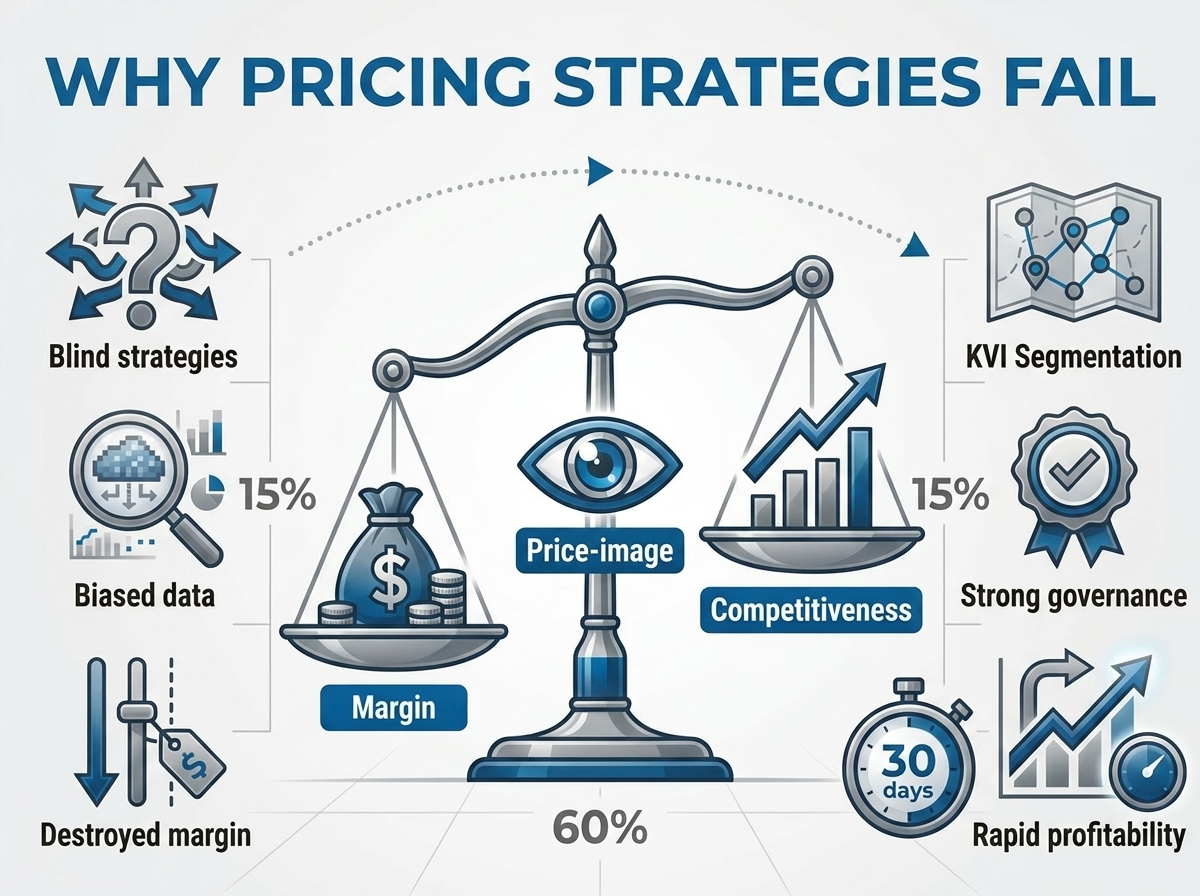
Pricing = margin arbitrage / competitiveness / price-image
Pricing isn't just a price tag. It's a matter of survival. You have to balance immediate profitability with your customers' perceptions.
Every penny directly affects your sales volume. One misstep in positioning, and your entire business could be at risk.
It’s a constant balancing act. A true feat of strategic maneuvering.
Without a framework, data, and governance, we are at the mercy of events
Without clear guidelines, your teams are left to wing it. You end up reacting to competitors without thinking things through. Data then becomes nothing more than noise.
Governance ensures that every decision is properly vetted. Without it, chaos will reign on your shelves—both physical and digital.
Trading requires reliable tools. Otherwise, you ’re simply at the mercy of the market.
Mistake #1: Confusing pricing strategy with tactics
Now that we’ve established the overall context, let’s turn our attention to the first problem: the lack of a long-term vision in favor of addressing immediate needs.
Symptoms
Prices are changed every morning for no apparent reason. The sales team decides on its own what discounts to offer at the end of the month.
One promotion follows another just to fill the gaps. We no longer know why we're lowering prices.
Impacts
Margins are eroding without warning. Customers are losing their bearings in the face of unstable prices. The brand’s image takes a serious hit. Ultimately, perceived value collapses completely, causing a impact on suboptimal profitability.
Corrections (frame, lines, segmentation)
Set clear annual goals. Distinguish between those who set the framework and those who implement it. Segment your product lines to adjust pricing strategies.
Set firm boundaries. It’s your only protection.
Key performance indicators to monitor
Monitorchanges in gross margin by category. Ensure that recommended retail prices are being followed.
Analyze the price dispersion. It's a strong signal.
Mistake #2: Focusing entirely on the competition (price war)
But tactics aren't the only pitfall; many fall into the trap of dangerous imitation when faced with competition.
Why does this happen?
The fear of losing market share is paralyzing executives. People believe that price is the only factor in making a choice. This is an intellectually lazy solution.
We follow others without knowing their inventory levels. It's often a purely emotional reaction based on an outdated market price.
When it is legitimate (rare)
Pricing should be aligned only for products that are highly comparable. This is the case for the market’s best-sellers.
Stay away from these products. Stick to your own course.
How to install handrails and guardrails
Set minimum and maximum price limits. Never sell below your cost price, even to follow a market leader. Set up automated alerts in your system.
Prevent sharp declines. Preserve your perceived value.
KPIs (KVI index, margin, gaps)
Track your competitiveness score for key products. Measure the price gap between you and your three main competitors.
Keep an eye on the remaining margin. It must not drop below the threshold.
Mistake #3: Poor product segmentation (KPI / margin / long tail)
To avoid stocking the same items everywhere, you need to understand the role each item plays in your product lineup.
Why is this the foundation?
Not all of your products are equally price-sensitive. Some attract customers, while others generate profit. Without making this distinction, you ’re needlessly selling your best products at a discount.
Treating the entire catalog the same way is a fatal mistake. It’s the surest way to lose money. See the correlation between value and price.
A simple segmentation method
Identify your KVI—those well-known products whose prices are memorized. Next, prioritize the margin drivers with low price elasticity. Finally, set aside the long tail for more flexible pricing. This structure effectively protects your overall profitability.
Review this ranking every quarter. Trends change quickly.
KPIs (KVI coverage, margin contribution, mix)
Analyze the contribution of key performance indicators (KPIs) to your revenue. Make sure that the margins on other products offset this.
Keep an eye on your product mix. Avoid over-reliance on a single product.
Mistake #4: Making decisions based on biased data (net prices, stockouts, matching)
Even the best segmentation will fail if the data it is based on is incorrect or incomplete.
Net price vs. listed price (sales/coupons)
The marked-down price isn't the price you actually pay. If you don't account for coupons or loyalty discounts, you'll get a distorted view of the market. You might think you're paying too much when you're actually not.
Include shipping costs. They really make a difference.
Breaks and outliers
A low price on a product that’s out of stock doesn’t count. Exclude this data so it doesn’t skew your analysis.
Clean up your price files. Data entry errors do happen.
False positive in competitive matching
Comparing a six-pack to a single unit is absurd. The specifications must be strictly matched.
Check the EAN codes. That's the foundation of the business.
KPIs (error rate, matching reliability)
Measure the percentage of products without a reliable match. Track the number of outlier price alerts.
Audit your data sources. Quality is key here.
Mistake #5: Promotions and markdowns that aren't aligned with the strategy
Using proprietary data allows for better management of promotions, which can often erode value if left unchecked.
Promotional ROI vs. Cannibalization
A successful promotion shouldn't just boost sales volume. Nor should it hurt sales of your full-price products. Always calculate the actual net profit after the discount.
Customers often wait for a sale before making a purchase. It’s a vicious cycle that needs to be broken.
Promotion depth, frequency, schedule
Too many promotions kill the promotion. Space out your promotions to maintain a sense of urgency.
Vary the size of your discounts. Don't be predictable.
Markdown-driven inventory
Lower prices only to clear out unsold inventory. Markdowns should be used as a tool for inventory management.
Plan ahead for the end of the season. Don't wait until you're backed into a corner.
KPIs (promotional ROI, uplift, sell-through)
Measure the increase in sales. Compare it to the cost of the operation.
Keep track of your sales rate. It’s vital for your inventory.
Mistake #6: Omnichannel inconsistencies (store/web/marketplaces)
Price management becomes even more complicated when companies expand their sales channels without an overall strategy.
Strict parity vs. controlled parity
Showing two different prices for the same item frustrates customers. However, the costs of selling on a marketplace sometimes justify price adjustments. Find the right balance so you don’t come across as dishonest.
Clearly explain the differences in services. Be completely transparent abouthow pricing is adjusted on marketplaceswill protect your online reputation.
SI latency & per-channel rules
Your systems must communicate in real time. A price updated online must also be updated in-store. Latency leads to unnecessary and costly disputes at the checkout.
Automate price feeds. Avoid multiple manual entries.
KPIs (channel discrepancies, update delays)
Count the number of SKUs with different prices. Measure how long it takes for a change to take effect.
Keep an eye on customer feedback. They see everything.
Mistake #7: Lack of governance and KPIs (no oversight)
Finally, no strategy can succeed without a team to implement it and performance metrics.
Who Decides What (Pricing Alert Workflows)
Pricing shouldn't be the sole responsibility of a single person. Define who proposes, who approves, and who implements changes. A clear workflow helps prevent impulsive and risky mistakes.
Involve the finance and marketing teams. This is a team effort.
Thresholds, validations, logs
Keep a record of every price change. Require human approval for any price reduction of more than 15%.
Secure your software access. Restrict editing permissions.
Rituals: Weekly Tactical / Monthly Strategic
Bring the teams together every week to adjust prices. Schedule a more in-depth monthly review of the overall strategy.
Never skip these appointments. Consistency pays off.
KPIs (performance, issues, time-to-market)
Check how quickly decisions are implemented. That’s how responsive you are.
Keep an eye on the error rate. The lower it is, the better.
Summary table: error → impact → fix → KPI
To help you get a clearer picture, here is a concise summary of the key points to watch out for to ensure your profitability.
Summary of pricing errors
Without a clear picture of your actual margins, you ’re flying blind. Getting back on track simply requires careful management of your operational data to avoid these costly pitfalls.
Checklist: 10-Point Quick Audit (Can Be Completed in 30 Minutes)
Take action now with this quick audit to assess your current pricing maturity.
Is your strategy sound?
Do you really have your pricing under control? Even a small glitch can undermine your profitability. Take thirty minutes to compare your actual situation with these ten critical points. If you check fewer than seven boxes, your strategy has flaws that are eroding your margins.
- An updated list of KVI is available.
- Existence of price ranges (min/max).
- Data pricing cleaned.
- Process for approving sales discounts.
- Weekly tracking of profit margins by category.
- Consistent pricing across online and in-store channels.
- Systematic analysis of the ROI of promotions.
- Use ofreliable competitive intelligence tools.
- Clear distinction between list price and net price.
- Joint governance between Finance and Sales.
This quick assessment helps you identify your weak spots. By addressing these areas, you can regain control of your pricing strategy and protect your business model from competition in the long term.
Quick Wins: Improve Your Pricing Strategy in 30 Days
You don't have to change everything all at once; a few quick wins are enough to get things back on track.
30 days: segmentation + KPIs + dashboards + safeguards
Identify your 50 best-selling products. These are your top KPIs. Align them closely with market trends to immediately reassure your customers.
Identify products with high margins and low competition. Discreetly raise their prices by 2%. This small adjustment will boost your profitability without causing any friction.
Set up a simple dashboard to track these changes. Don't overcomplicate the tools at first.
Train your teams on the new rules. Internal communication is the key to success.
Conclusion and Outlook
Pricing is a demanding but rewarding discipline. Avoiding these seven mistakes will already put you ahead of your competitors. Data and governance are your best allies. Finally, stay agile so you can make regular adjustments.
Don’t let your profit margins slip away out of habit. Take control of your pricing today. The success of your retail business really depends on it.
Would you like to conduct a more in-depth review of your strategy? Contact our experts for a personalized assessment. Together, let’s optimize your performance for the long term.
To address your pricing strategy mistakes, you need to prioritize your KPIs, clean up your data, and establish strict governance. By striking the right balance between margin and price perception today, you’ll safeguard your future profitability against the competition. Take back control of your pricing to turn every penny into a driver of sustainable growth.
Frequently Asked Questions
To understand the process, please review our project pricing methodology.

Building a high-performing pricing team requires adopting a hybrid model that combines centralized strategy with local agility. This transition replaces intuition with data-driven decisions, guided by specialized roles and strict governance.
This proactive management directly improves financial performance, enabling companies to aim for an increase in profitability of between 100 and 500 basis points.

Facing a sudden drop in conversion rates because your competitors are adjusting their prices in real time means you need to equip yourself with the best data-driven retail pricing strategy tool for 2026 to stay competitive. Price transparency in 2026: Retailers are automating pricing to protect their margins against inflation, improve omnichannel responsiveness, and generate a quick ROI.
Discover how these tools automate your specific business rules while ensuring complete strategic control over your brand image and delivering a measurable return on investment in less than six months.
This detailed comparison analyzes specialized platforms capable of predicting price elasticity and managing your omnichannel inventory to turn every piece of raw data into immediate, tangible profit.

Product matching is the foundation of competitive monitoring because it prevents the comparison of non-equivalent products. Reliable matching safeguards margins by basing repricing on real-time, multi-source data.
Key finding: According to the Diamart study, 50% of French retailers still consider this challenge to be unresolved.