Why Excel Is No Longer Enough to Manage a Pricing Strategy (and what to replace it with)?
.avif)
Edouard Calliati
Director of Marketing and Business Development
March 13, 2026
Key takeaway: Excel hampers retail performance by optimizing only 10% to 30% of catalogs. Switching to a dedicated solution automates decision-making and safeguards margins in the face of market complexity.
This shift is crucial because 24% of retailers were still using spreadsheets in 2023, leaving themselves vulnerable to critical manual errors.
Does your retail pricing strategy in Excel still rely on fragile spreadsheets where a simple copy-and-paste error can directly threaten the profitability of your stores? While 24% of retailers are still stuck using limited spreadsheets that handle only 30% of their SKUs, this article examines the risks of suboptimal performance and offers practical solutions to finally manage your entire product portfolio.
Discover how to move away from these risky manual methods and adopt an automated platform that can secure your profits while simulating price elasticity scenarios with surgical precision to stay one step ahead of every strategic move your competitors make.

Excel: great for getting started... but not for scaling a pricing strategy
Excel has long been the mainstay of retail pricing. But faced with today's demand for responsiveness, this long-standing tool is finally showing its limitations.
Key figures
- 24% of retailers still use Excel.
- Manual control: 10% to 30% of the catalog.
What Excel does well (one-off analyses, quick wins)
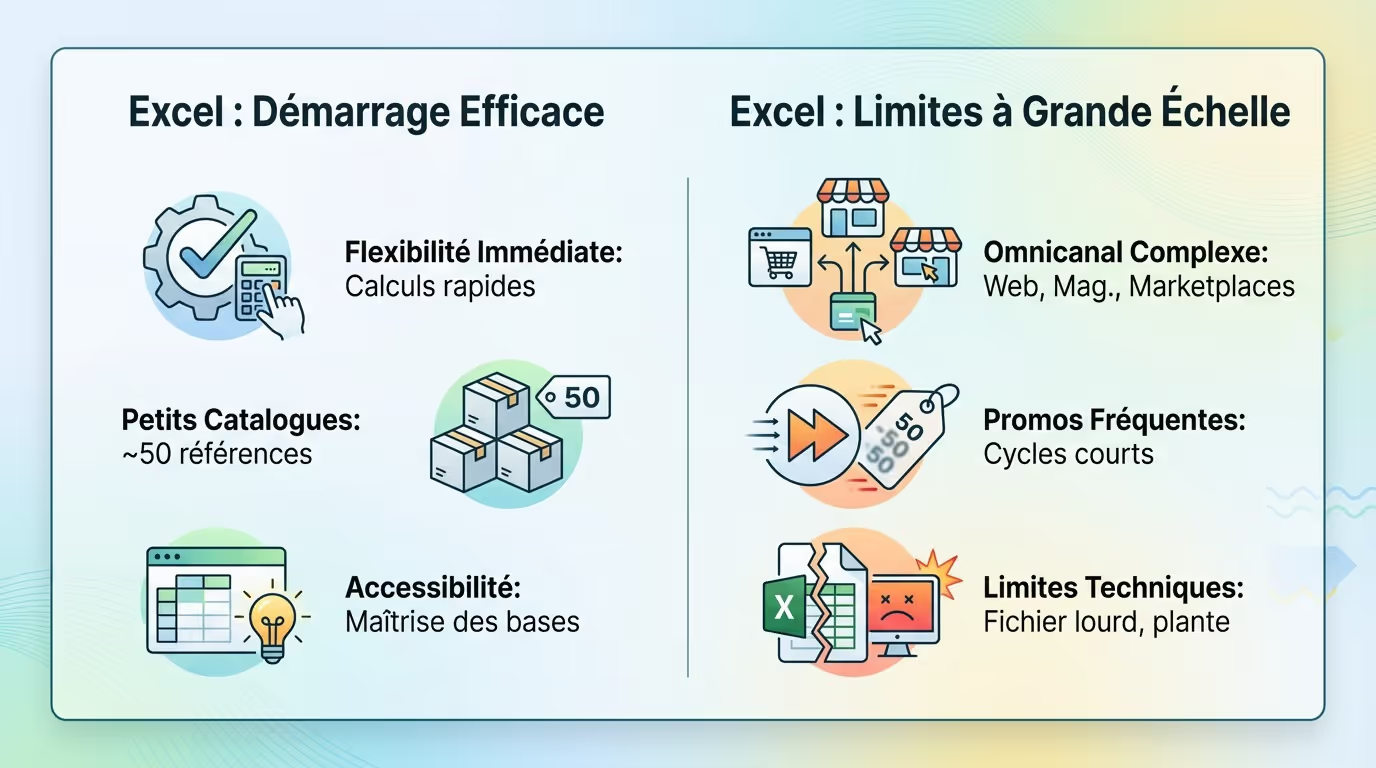
Its immediate flexibility remains a major asset for quick calculations. It is the perfect tool for evaluating gross margin on the fly without any complicated setup.
For small catalogs, Excel is sufficient. Fifty references can be managed very easily with a few macros and a little discipline.
Accessibility is its strong point. Everyone owns and is proficient in this software.
The tipping point: when volumes, channels, and promotions explode
Omnichannel makes everything more complex. Synchronizing prices between the website, stores, and marketplaces quickly becomes a logistical nightmare that is impossible to manage manually.
Promotions are multiplying. Product life cycles are shortening, requiring constant price updates.
The technical limit is approaching. The file becomes heavier, slows down, and eventually crashes.
Did you know that 24% of retailers still rely on spreadsheets to manage their pricing in 2023? It's a risky bet. By sticking with this model, you're only processing 10% to 30% of your SKUs. You're losing money without even knowing it. Here's why your Excel retail pricing is becoming your worst enemy.
Technical alert
An Excel file has a 4 GB limit. Formulas become indecipherable after three adjustments, and the loss of a macro expert paralyzes your business strategy.
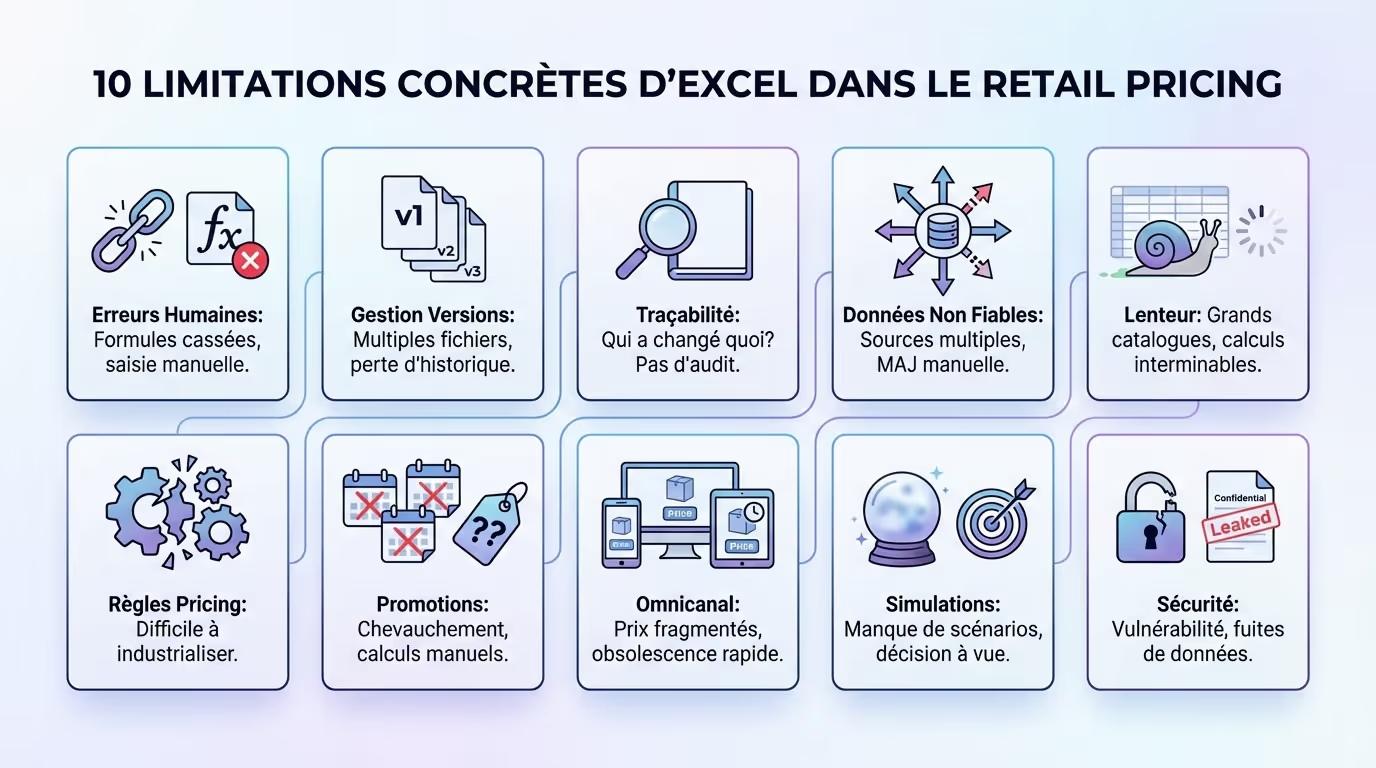
The 10 concrete limitations of Excel in retail pricing
But beyond mere volume, it is the very reliability of your decisions that is at stake due to structural flaws.
Human errors & formulas (copy/paste, broken references)
Entering a price manually exposes you to costly mistakes. One misplaced decimal point or extra zero and your margin instantly evaporates. This is a constant risk to your overall profitability.
Broken links are time bombs. A broken link to an external tab silently skews your calculations.
Version management
Mailboxes are overflowing with files with questionable names. Your teams often work on different documents without even realizing it. It's total chaos for internal coordination.
We end up losing track of the decisions that have been made. No one knows which version was actually sent to stores.
Lack of traceability & auditing (who changed what?)
Changes to your spreadsheets remain anonymous. It is impossible to know who lowered the margin on this specific category. This prevents pricing teams from being held accountable.
The history of changes remains a complete mystery. Change logs are non-existent in a traditional locally stored file.
Unreliable data (multiple sources, manual updates)
Importing external data often turns into a technical nightmare. Competitor prices often arrive too late or are poorly formatted. You end up working with information that is already outdated or incorrect.
The absence of a single source of truth creates tension. Each department has its own figures and analyses.
Slow performance with large catalogs and histories
Opening a file with 100,000 lines takes several minutes. Every filter change becomes a challenge for the processor. You end up losing pure productivity. The machine quickly becomes overloaded and blocks all your daily work without warning.
Employees avoid complex analyses. They fear a permanent crash of the software.
Impossible to industrialize pricing rules
Rigid formulas limit your commercial creativity. Coding complex business rules requires macro skills that are too rare. You remain stuck with overly basic calculation schemes.
Scaling up is a complete illusion. A rule defined for one country is difficult to replicate elsewhere.
Why change?
- Data flow automation
- Artificial Intelligence and Machine Learning
- Ultra-fast What-If scripting
- Transparency of decisions (Clear Box)
Excel risks
- Undetected input errors
- 70% sub-optimization of the catalog
- Hidden costs of manual handling
- Dependence on a single macro expert
Poorly managed promotions and discounted prices
Overlapping offers become unmanageable in a spreadsheet. Excel does not handle promotional calendars that overlap over a period of time very well. Display errors in stores quickly multiply.
Calculating the reference price is a nightmare. Complying with legal display requirements becomes an exhausting manual headache.
Omnichannel/marketplaces: biased comparison
Analyzing price fragmentation requires capabilities that are not available here. Marketplace commissions are not always included in the net calculation. Your actual margins are therefore completely distorted.
The spreadsheet can't keep up with Amazon's robots. Real-time competition leaves you behind.
Your price is already obsolete. The file registration is too late.
No robust simulation (margin/volume scenarios)
It is impossible to test the impact of an overall price reduction. It is impossible to accurately predict the market's reaction. You are moving forward without any insight into your future results.
Advanced mathematical models do not run correctly. Price elasticity remains an inaccessible theoretical concept for you.
We are navigating by sight. The financial risk is immense.
Security & governance (rights, validation, workflow)
The vulnerability of the file is a danger to the company. Anyone can accidentally delete a vital column. There is no serious locking mechanism to protect your sensitive data.
Getting a price approved by your boss is a laborious process. Email approval workflows slow down your entire sales response time.
A file can be easily copied. Data leakage is inevitable.
Excel vs. Pricing Tool
The business risks of managing prices using Excel
These technical limitations are not just annoying, they have a direct impact on your profitability and brand image, especially when you rely on manual retail pricing in Excel.
Loss of margin (biased decisions)
The erosion of your profits often remains invisible. A forgotten change in supplier costs is enough to destroy your profitability. Your net margin evaporates without anyone really noticing.
You are mistakenly maintaining prices that are too low. Blindly aligning yourself with a competitor who is out of stock is costly.
Image-price degradation (poor kvi alignments)
Promotional products require surgical precision. A mistake on a KVI is immediately obvious to customers. It's the quickest way to appear out of touch with the local market.
The inconsistency between the shelves sows doubt. Consumers do not understand these unjustified discrepancies and therefore feel cheated by the store.
Trust collapses abruptly. Rebuilding a solid reputation will take years.
Internal conflicts (category vs. commerce vs. finance)
The war of numbers paralyzes your meetings. Each team defends its own dashboard, cobbled together in isolation. Consensus becomes impossible in the face of contradictory data.
Frustration is eating away at the departments. No one is taking responsibility for an erroneous formula that distorts the overall results.
Wasted time (repetitive tasks)
The hidden cost of maintenance is enormous. Your experts waste 80% of their time cleaning up corrupted files. It's a waste of talent, plain and simple.
Strategic thinking goes out the window. Due to lack of time, you are at the mercy of the market instead of actually steering it.
Turnover is accelerating. The best candidates are shunning these uninteresting manual tasks.
What to replace Excel with: 4 approaches (from the simplest to the most comprehensive)
Fortunately, there is a path to maturity that will allow you to move away from Excel without traumatizing your teams.
Option 1: Excel + BI (Power BI / Looker / Tableau) for reporting
This is the hybrid stage. We keep using Excel for data entry, but we view the data in a professional tool. This is reassuring when starting out.
The advantage is visual. Price and margin trends finally become clear.
The limitation? The source data remains fragile.
Option 2: Data pipeline + warehouse + BI (making data reliable)
We move on to technical centralization. Connect the ERP and concurrent flows in a clean database. Everything becomes reliable.
Automation takes over. Data is updated without human intervention.
It is the essential foundation.
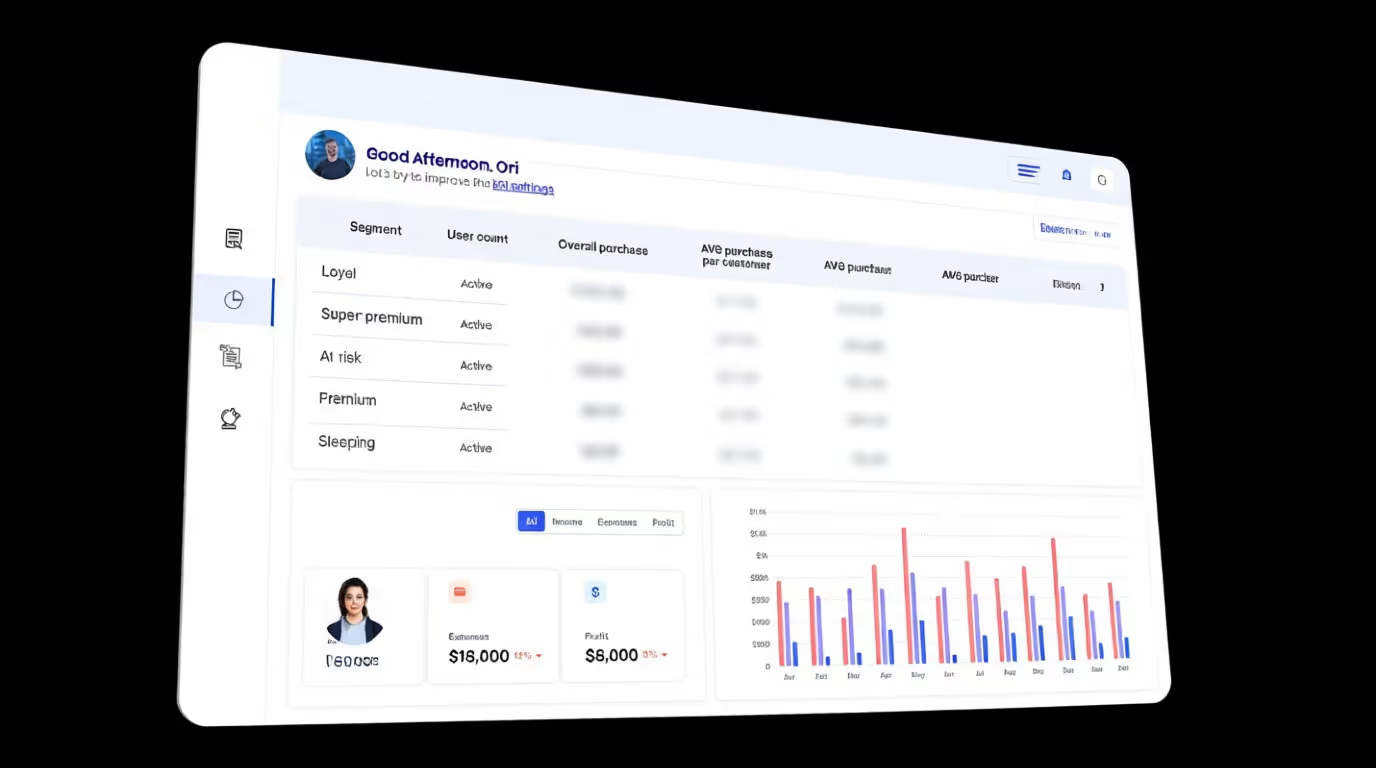
Option 3: Pricing analytics tool (analysis, dashboards, recommendations)
Make way for business intelligence. The tool suggests price changes based on your rules. No more manual calculations.
The pricer validates intelligent proposals. It no longer processes raw data.
We save time on exceptions.
Option 4: Pricing platform (rules + optimization + promotions + markdowns)
Here is the complete, integrated solution. It manages the entire product lifecycle, from launch to final markdown. Algorithms maximize margins in real time based on inventory levels. It is the ultimate cockpit for the modern retailer.
AI refines sales forecasts based on price and inventory.
The "essential" features of a true retail pricing tool
If you decide to take the plunge, here are the software components you absolutely must insist on.
KVI (Key Value Items)
Products that most influence consumers' perception of a retailer's price competitiveness.
Competitive monitoring + reliable matching
To steer the ship, you need to see clearly. Your solution must centralize market data in real time. Here are the points to watch:
- Crawl frequency
- Matching quality (EAN, attributes)
- Marketplace management
- Price alerts
Without precise matching, your comparisons are worthless. This is the basis of any sound decision.
KVI management / positioning / image-price
Segmentation-based management changes your entire daily routine. You don't treat a star product like just another item on the shelf. That's vital.
The tool monitors your price indices. It ensures that you remain within the positioning range defined by your strategy.
Consistency becomes automatic. The price image is automatically protected.
Scenario simulation (margin, volume, elasticity)
Sandbox mode is your best ally. Test the impact of a VAT increase or a promotion before confirming.
The tool estimates the likely sales volume for each price point. It uses price elasticity to predict future results.
We validate with evidence. Gain peace of mind.
Governance (workflows, validation, logs)
No more chaos with shared files. Approval workflows secure your actions. A significant price must be validated by a manager.
The complete history remains accessible. Every action is tracked, time-stamped, and assigned to a specific user for full auditing.
Integrations (ERP/PIM, e-commerce, POS, marketplaces)
The ecosystem must be connected to be truly effective. The tool communicates with your inventory management system and your website. Outgoing flows are smooth to avoid display delays. An isolated solution quickly becomes just another Excel spreadsheet.
Technical flexibility via APIs allows for adaptation. Future sales channels can be managed without having to reinstall everything. It's sustainable.
How to migrate without breaking anything: a 5-step method
Don’t throw away your spreadsheets just yet; the transition needs to be seamless to be successful.
Step 1: Map your Excel files and actual uses
Find the ghost files lying around on desktops. Make a precise list of regular users and vital formulas. These isolated spreadsheets often hide the true logic behind your current retail pricing Excel file.
Assess the technical complexity. Each product family has its own constraints that must be understood before switching everything to a new system.
Step 2: Define KPIs and rules (KVI, thresholds, safeguards)
Put your pricing strategy down in black and white. Get the management rules out of your employees' heads. Putting it in writing avoids risky interpretations when configuring settings in the future.
Lock the safety limits. Determine the minimum margins below which the system must never fall by mistake during automatic calculations.
Anticipate automation. Clear instructions ensure smooth configuration of the target software.
Step 3: Ensure data reliability (golden record + sources)
Clean up your databases without mercy. Eliminate unnecessary duplicates and check every EAN code. A clean import is the only guarantee that you won't import IT chaos.
Designate the sources of truth. Decide once and for all which software holds the actual and definitive purchase price to avoid conflicts.
Ensure overall quality. Corrupted data renders any pricing tool completely useless.
Step 4: Deploy a pilot on a category
Isolate a representative test perimeter. Choose a complex product family for which you have a good understanding of volumes. This laboratory allows you to validate the relevance of calculations in real-world conditions.
Adjust the initial parameters. Use these initial concrete results to refine your algorithms and specific management rules.
Step 5: Industrialize (process + governance + automation)
Extend the solution to your entire offering. Guide teams toward new validation processes. Delete obsolete files to eliminate duplicate work. This is where we finally gain real agility.
Communicate early financial successes. Highlight immediate margin gains. This strengthens employee buy-in to the change and proves the value of the project.
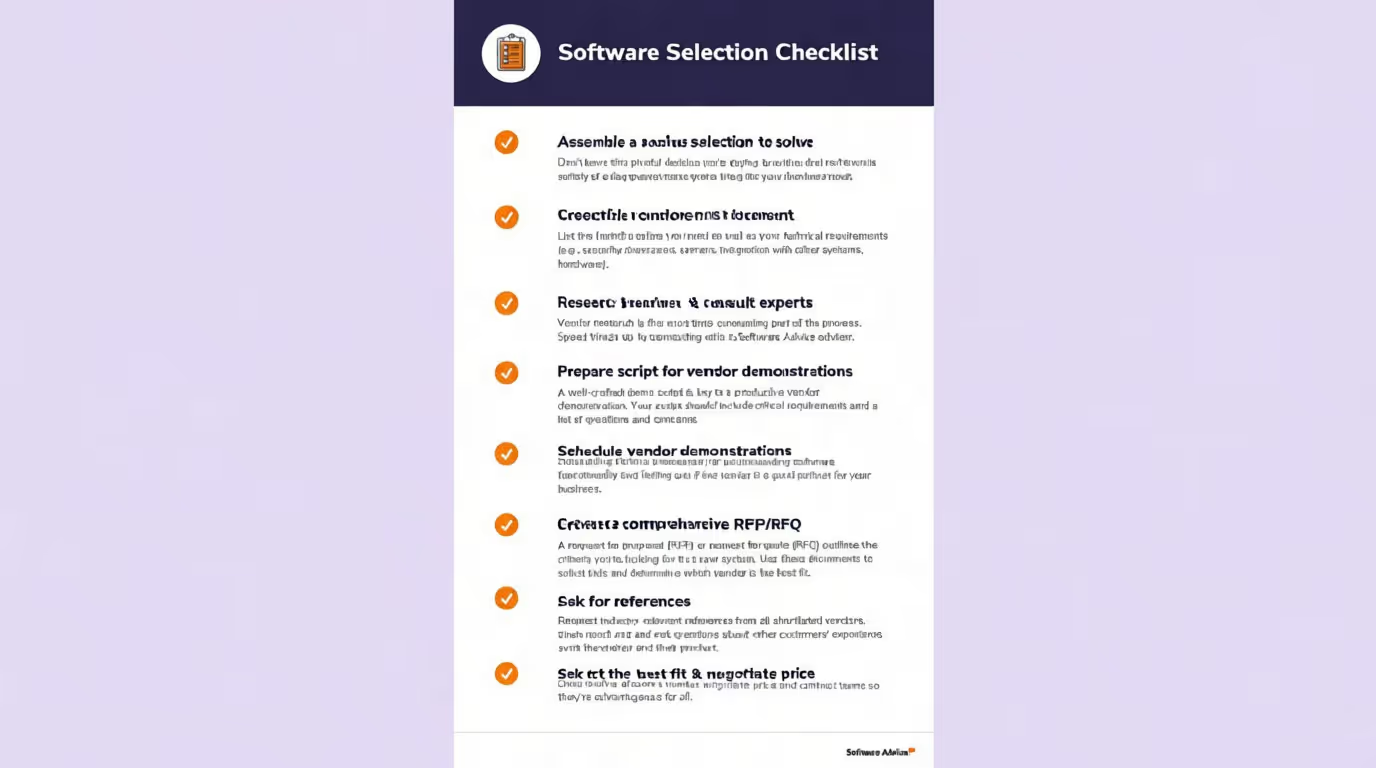
Checklist (10 criteria) for selecting the right solution
The market is full of tools, but not all of them are equally suited to the specific needs of retail.
Retail coverage, integration, scalability, governance...
To manage your prices seamlessly, make sure your catalog has these specific technical capabilities:
- Multi-currency capability
- Management of psychological rounding
- Scalability (millions of SKUs)
- Ergonomic and fluid interface
Ensure that the tool understands your business constraints, not just the math. The reality on the ground always takes precedence.
Test the responsiveness of technical support. A bug on a Saturday can be very costly.
Total cost (tool + data + maintenance)
Carefully analyze the billing model proposed by the publisher. Be aware of hidden costs related to the massive volume of data processed or the number of users connected simultaneously.
Calculate the expected ROI. The tool must quickly pay for itself through increased gross margin.
Team adoption (UX, training, support)
Prioritize ease of use. If the interface is too complex, pricers will quietly revert to Excel. Plan for robust training to support the cultural shift. The tool is only a means to an end; people remain in control.
Involve end users from the outset. Their buy-in is key.
Listen to feedback from the field. Adjust the tool according to their needs.
Conclusion: Excel remains a support tool, not the pricing cockpit.
Finally, keep Excel for your drafts, but give your business the engine it deserves.
Spreadsheets have served the retail industry well for years. But now, the frenetic pace of modern commerce no longer tolerates DIY solutions. Your margins evaporate at the slightest copy-paste error. Switching to a professional system is no longer optional.
Bring out your best minds from the depths of their gray cells. Give them the space to drive strategy and analyze trends. That's exactly where you'll outpace your competitors.
- Data centralization
- Rule automation
- Scenario simulation
- Process safety
While Excel has served you well in the past, its inflexibility now threatens your margins and your ability to respond quickly to competition. To optimize your retail pricing strategy, automation is becoming a vital lever for growth. Adopt a dedicated tool to transform your data into profits and steer the future with surgical precision.
Frequently Asked Questions
Here are the answers to the questions you still have before taking the plunge.
Articles similar

Building a high-performing pricing team requires adopting a hybrid model that combines centralized strategy with local agility. This transition replaces intuition with data-driven decisions, guided by specialized roles and strict governance.
This proactive management directly improves financial performance, enabling companies to aim for an increase in profitability of between 100 and 500 basis points.

In response to the radical price transparency of 2026, the retail sector is adopting automated management. This strategy protects margins against inflation by ensuring immediate responsiveness across all channels.
A high-performance tool guarantees a return on investment in less than six months, making pricing a cornerstone of net profitability.

Product matching is the foundation of competitive monitoring because it prevents the comparison of non-equivalent products. Reliable product matching safeguards margins by basing repricing on real-time, multi-source data.
Key finding: According to the Diamart study, 50% of French retailers still consider this challenge to be unresolved.