Pricing KPIs: key metrics to track

Edouard Calliati
CMO - CRO
June 2, 2026
Effective pricing management relies on a constant balance between profit margins, competitiveness, and price perception. By monitoring five key indicator categories, you can safeguard your profitability while remaining competitive. A mere 1% increase in price realization can boost operating profit by 6.4%, turning your pricing strategy into a major driver of growth.
A 1% improvement in your price realization can boost your operating profit by 6.4%. In a retail market where every penny counts, raw data is your best ally for turning your prices into drivers of immediate growth.
However, managing your business based solely on revenue is like driving in a fog without realizing your margins are evaporating. This article breaks down the essential pricing KPIs needed to build an effective decision-making dashboard and safeguard your profitability.

Why Pricing KPIs Are Essential (and Why “Just One KPI” Isn’t Enough)
Pricing management is based on a dashboard comprising five categories of metrics: margin, competitiveness, price-image, execution, and promotions. A 1% improvement in price realization boosts operating profit by 6.4%, making the trade-off between volume and profitability critical.
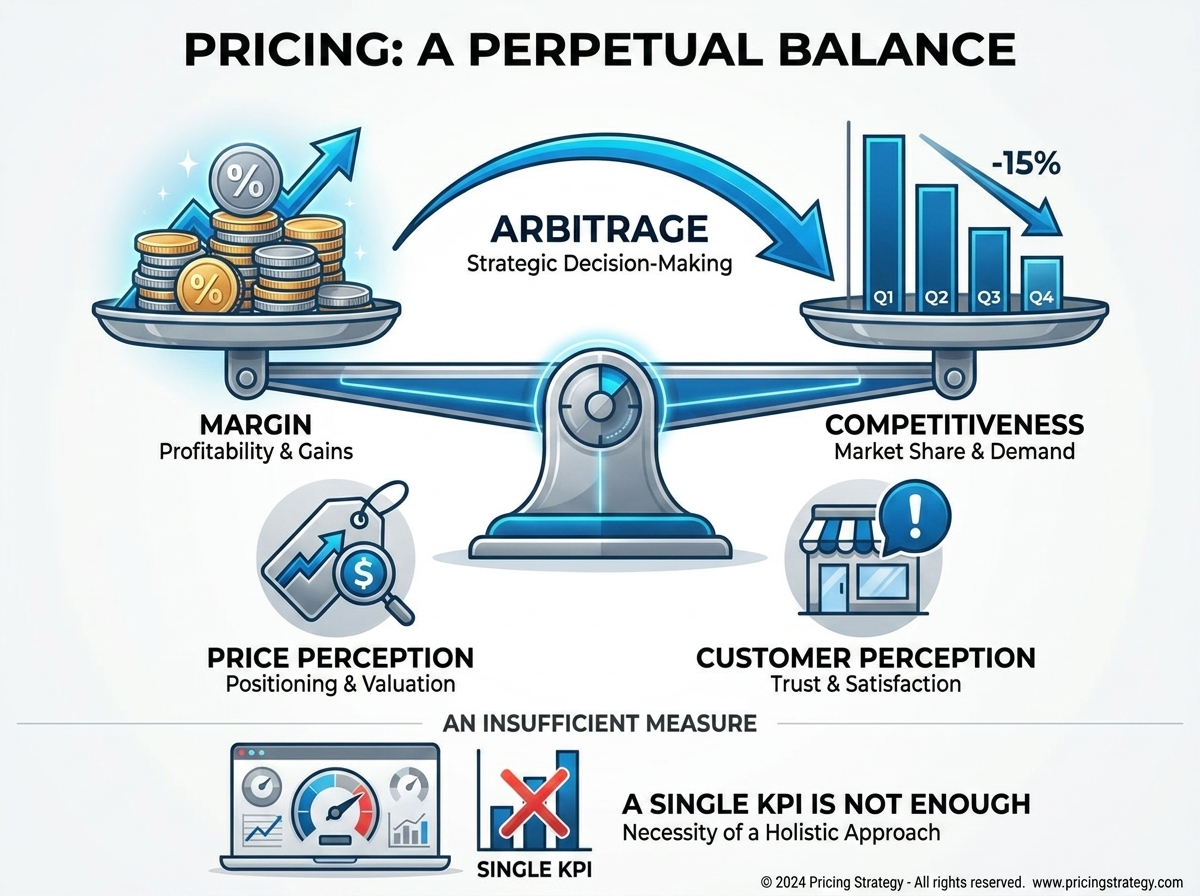
Thinking that a single number can sum up your business health is a risky bet. In reality, the key lies in striking a balance between these conflicting forces.
Pricing = margin arbitrage / competitiveness / price-image
Setting a price isn't a one-time decision. It's a constant balancing act between protecting your margins and staying competitive against aggressive retail competitors. You can't ignore the competition.
Price perception also comes into play. Setting the price too high for a flagship product (KVI) undermines the customer’s overall perception. It’s a matter of trust.
Management therefore requires a 360-degree view. You can’t just look at a single figure. It’s essential.
Common mistakes: managing based on financial statements or intuition
Many retailers focus solely on revenue. This is a dangerous trap. You can sell a lot while still losing money on every transaction. It’s simple math.
A gut feeling about the "right price" is no substitute for data. Without precise pricing KPIs, decisions become purely emotional and risky. We end up flying by the seat of our pants, without a compass.
Operating without a clear strategy often leads to unnecessary price wars. Profitability suffers as a result. We need to change our approach.
The 5 categories of pricing KPIs (the dashboard)
To avoid these pitfalls, you need to structure your dashboard around complementary pillars that cover the entire product lifecycle.
Profit Margin KPIs
This category measures the financial health of your sales. It includes gross margin and contribution margin. It is the key to ensuring the business’s survival.
- Gross margin
- Net margin
- Discount rate granted
Competitiveness KPIs (competition)
Here, we look at how your prices compare to the market. The price index is the key tool. It helps you determine whether you are perceived as expensive or affordable.
We track the average gap to the leaders. This helps us adjust our positioning.
Price-image KPIs (KVI + consistency)
The price image is based on the items that customers compare most often (KVI). It is important to ensure price consistency across different sizes or product lines to avoid losing customers.
An illogical price erodes trust. Price sensitivity varies greatly depending on the product category.
Performance KPIs (quality and reliability)
A strategy is nothing without flawless execution. This pillar identifies labeling errors or delays in updating prices. It ensures that the price displayed is correct.
Common errors ruin the customer experience. They also skew your overall performance analytics.
Promotions & Markdown KPIs (Actual ROI)
Sales and promotions have a significant impact on profitability. It is important to measure the increase in sales volume they generate. Did the discount really create additional value for the retailer?
Poor management can lead to impact of unstructured discounts on your bottom line.
Margin KPIs: Driving Profitability Without Sacrificing Volume
Let’s take a closer look at the first pillar—the one that ensures every sale actually contributes to your profits.
Gross margin (% and €) + mix effect
Gross margin remains the key indicator. It should be monitored both in absolute terms and as a percentage. Be mindful of the mix effect, which can mask declines in profitability.
If you sell more low-margin products, your overall profit will drop—even if your revenue is growing.
Always analyze margins by category. This reveals the true drivers of growth.
Net margin / contribution (if available)
The contribution margin includes variable costs such as logistics. In e-commerce, this is essential for determining whether a shipment is profitable. Never overlook these hidden costs when making your calculations.
If the price is too low, delivery can result in a loss. This is a major risk in the marketplace.
Average price / average basket size (by channel)
The average basket size indicates whether your cross-selling strategies are working. In-store, the goal is often to increase the number of items purchased per customer. The average price per item complements this approach.
A price increase can lead to a decline in sales volume. But it can also increase the total purchase amount.
Competitiveness KPIs: Measuring Market Position vs. Competitors
Once you've secured your profit margin, you need to make sure your prices aren't driving customers away to the competition.
Price index (overall and KVI)
The price index compares your pricing to a base of 100. If your index is 105, you are 5% more expensive than the market. This is a fundamental retail pricing indicator.
Focus this metric on your best-selling products. That’s where the competition is fiercest.
An overall index can mask disparities. Break it down by product category.
Average price gap + dispersion
The average gap shows the actual price difference in euros compared to your competitors. The spread, on the other hand, indicates whether your prices are consistent or all over the place. Avoid large, unjustified gaps.
Too much scattered messaging dilutes your brand message. Stay true to your brand promise.
Competitive coverage (percentage of the compared catalog) + matching reliability
You can't compare everything. The coverage rate indicates what percentage of your offering is "matched" by the competition. A 70% rate is often a good target.
Accurate product matching is crucial. Comparing different products can completely skew your decisions and your margins.
Automate this monitoring process using tools. Manual tracking is too slow.
Price-Image KPIs: Managing Customer Perception
Beyond the raw numbers, pricing is a matter of psychology and the overall perception of the brand.
KVI Index + KVI “in-zone” share
KVI (Key Value Items) are products whose prices are memorized by customers. You must be flawless when it comes to these items. Being "on target" means staying within an acceptable price range.
Losing out on the KVI products ruins your price image—even if the rest of the catalog is very competitive.
Identify your 500 key products. Keep a close eye on them.
Product line consistency (price tiers, psychological price points)
Price points should be logical. A family-size package should be cheaper per pound than a smaller one. Also, use price endings like .99 or .95, as they reassure shoppers.
An inconsistency in the product range causes confusion. As a result, customers end up not buying anything.
Omnichannel price discrepancies (store vs. web vs. marketplace)
Customers are everywhere. They don’t understand why a product costs more in-store than on your website. Managing these price discrepancies helps prevent frustration and complaints at the register.
Consistency strengthens the brand. It also simplifies inventory and returns management.
Performance KPIs: Avoiding Mistakes That Undermines Management
Even the best strategy will fail if it isn't implemented properly on the ground or on-site.
Rate of price outliers
"Outliers" are abnormal prices, often caused by data entry errors. A product listed at €1 instead of €100 can end up costing a lot. Check for these anomalies daily to minimize the damage.
Set up automatic alerts. This allows you to make adjustments before the first sale.
Labeling error rate / channel synchronization (if measurable)
In-store, the price tag must match the price at the register. Frequent discrepancies erode customer trust and can result in legal penalties. Price synchronization across channels must be nearly instantaneous.
Conduct regular shelf audits. This is the only way to verify the actual situation on the ground.
Price update latency (time-to-market)
How long does it take to respond to a competitor's price drop? In e-commerce, every hour counts. If your response time is too long, you’ll lose sales and visibility on price comparison sites.
Agility is a competitive advantage. It enables companies to meet demand at the right time.
Competition false matching rate (if monitoring)
If your tool compares a 6-pack to a single item, your decisions will be inaccurate. Monitor the quality of the data provided by your suppliers. Poor matching leads to unjustified price reductions.
Clean up your internal and external pricing databases regularly. Accuracy is more important than quantity.
KPI for Promotions & Markdowns: Measuring True ROI
Promotions are powerful tools, but they can also destroy value if not managed properly.
Uplift (volume gain) vs. cannibalization
Uplift measures the increase in sales during the promotion. But be careful of cannibalization: if you sell fewer products at full price, the actual gain may be zero or negative.
Analyze customer behavior. Are they buying only because it's on sale?
The goal is toattract new customers. No discounts for regulars.
Promotional ROI (incremental margin)
The key promotional KPI calculates the additional profit generated after paying the discount. It is the ultimate metric for validating a sales campaign. Don’t just look at sales volume.
A successful promotion must cover its own costs. It must also generate a net profit.
Promotion depth / promotion frequency
Offering too many promotions can get customers used to not paying full price. Be mindful of how often you run promotions so as not to devalue your brand. The size of the discount should remain exceptional.
However, customers' likelihood of switching brands depends heavily on price sensitivity.
Markdown efficiency (sell-through, inventory turnover)
Markdowns are used to clear out slow-moving inventory. Their effectiveness is measured by the rate at which the inventory sells out relative to the discount offered. The goal is to make room for new products.
Better a big discount early than a small one too late. Inventory is expensive.
Table: KPI → simplified formula → frequency → alert
Managing a strategy without specific metrics is like driving in a fog. Here’s a practical guide to help you organize your dashboard and know when to take action if things start to go off track.
(summary table)
This dashboard provides an immediate, actionable overview for management. Monitor these thresholds to protect your margins. A quick response can often prevent lasting damage to your market position.
KPIs by role: Who monitors what?
Not everyone needs the same level of detail. Pricing governance depends on each person's responsibility.
Pricing Manager
He ensures overall consistency. He monitors price indices and execution anomalies on a daily basis. His goal isto optimize the calculation rules to maximize performance.
He also analyzes price performance metrics to adjust strategies. He is the one calling the shots.
Category Manager
He focuses on his product line. His priorities are gross margin and product mix. He uses KPIs to negotiate with suppliers and validate his promotions.
He must balance sales volume and profitability within his department. He is a subject matter expert.
Management / Finance
Management wants a big-picture view. It looks at the overall net margin and changes in the brand’s price image. These indicators are used to validate major strategic directions strategicdirections of the company.
They are primarily interested in the bottom line and growth. Pricing is a financial lever.
Set up a pricing KPI dashboard (method)
Building an effective dashboard requires a systematic approach to avoid getting buried under a mountain of useless numbers.
Choosing KPIs (fewer but better)
Don’t try to track everything at once. Start by selecting two metrics from each category. A dashboard that’s too complex will eventually stop being used by operational teams.
Prioritize the KPIs that have the greatest impact on your profit. Simplicity is key.
Define data sources (net price, costs, inventory, competition)
The quality of your dashboard depends on your data. Connect your net price feeds, purchase costs, and inventory in real time. Add price data from your direct competitors.
Accurate data prevents false pricing alerts. This is the foundation of any serious analysis.
Set thresholds/alerts and review procedures
A number without context is useless. Set critical alert thresholds. Establish routines: daily reviews of anomalies, weekly reviews for tactics, and monthly reviews for overall strategy.
Rituals foster a data-driven culture. They force people to make decisions.
Scale up (logs, governance, continuous improvement)
Automate the collection and calculation of your pricing metrics. Keep a record of changes to understand the impact of your past decisions. That’s how you ’ll make progress over the long term.
- Dashboard Checklist: Reliable Sources
- Email alerts
- Price History
Common mistakes (and how to avoid them)
Even with the best tools, certain common pitfalls can cloud your judgment and lead you to make poor decisions.
Manage solely through the Board of Directors
This is the most common mistake. Revenue can increase even as margins plummet. Always look at the net profit generated after each sales transaction or price reduction.
Volume isn't everything. Profitability must remain your top priority.
Do not isolate the promotional effect
Promotions artificially boost sales. If you don’t isolate them, your shelf price analyses will be skewed. You may end up believing that a regular price is performing well when it actually isn’t.
Make sure to keep your day-to-day business separate from your promotional activities. This is essential for clarity.
Relying on an ill-matched competition
Comparing apples to oranges is a recipe for disaster. Poor price matching will cause you to lower your prices unnecessarily or miss out on opportunities to raise them. Check your most strategic products manually.
External data is often messy. Take the time to clean it up before taking action.
Forget about cross-channel consistency
Having different prices online and in-store for no good reason frustrates customers. It also makes it harder for you to assess your performance. Maintain a clear policy to protect your brand image.
Omnichannel retailing requires strict pricing discipline. It calls for high-performance synchronization tools.
Conclusion: Pricing is a data-driven field
Setting prices without metrics is like driving in the fog. A well-organized dashboard allows you to react quickly while protecting your profitability. This is a major strategic advantage.
A 1% improvement makes all the difference. According to price realization analyses, this marginal gain significantly boosts profits. Precision pays off immediately.
Don’t get stuck in your ways. Continuously test, measure, and adjust your prices. It’s the only way to stay competitive in a rapidly changing retail landscape.
Mastering your pricing KPIs is the only way to strike a balance between margin and competitiveness. By automating the tracking of your price index and promotional profitability, you secure your future profits. Take action now to turn your data into a driver of immediate and sustainable growth.
Frequently Asked Questions
To understand the process, please review our project pricing methodology.

Building a high-performing pricing team requires adopting a hybrid model that combines centralized strategy with local agility. This transition replaces intuition with data-driven decisions, guided by specialized roles and strict governance.
This proactive management directly improves financial performance, enabling companies to aim for an increase in profitability of between 100 and 500 basis points.

Facing a sudden drop in conversion rates because your competitors are adjusting their prices in real time means you need to equip yourself with the best data-driven retail pricing strategy tool for 2026 to stay competitive. Price transparency in 2026: Retailers are automating pricing to protect their margins against inflation, improve omnichannel responsiveness, and generate a quick ROI.
Discover how these tools automate your specific business rules while ensuring complete strategic control over your brand image and delivering a measurable return on investment in less than six months.
This detailed comparison analyzes specialized platforms capable of predicting price elasticity and managing your omnichannel inventory to turn every piece of raw data into immediate, tangible profit.

Product matching is the foundation of competitive monitoring because it prevents the comparison of non-equivalent products. Reliable matching safeguards margins by basing repricing on real-time, multi-source data.
Key finding: According to the Diamart study, 50% of French retailers still consider this challenge to be unresolved.