How to measure A retailer’s brand image?

Edouard Calliati
CMO - CRO
June 4, 2026
Price perception is a subjective view shaped by a brand’s key products (KVI), not by an overall statistical average. For the reader, mastering this lever makes it possible to build customer loyalty without sacrificing overall profitability. A key point? Just 2% of a brand’s products account for 80% of its price perception.
A retailer may be mathematically cheaper than its competitors yet still be perceived as expensive by its customers. This discrepancy often stems from poor management of high-turnover items, as consumers tend to remember only a few benchmark prices when judging an entire store.
To effectively manage your profitability without compromising your appeal, it is essential to accurately measure your retail pricing strategy. We will explore how to identify your strategic products and which metrics to track to align your actual pricing with market perceptions.

Price-image: A Simple Definition (and Why It’s Different from Competitiveness)
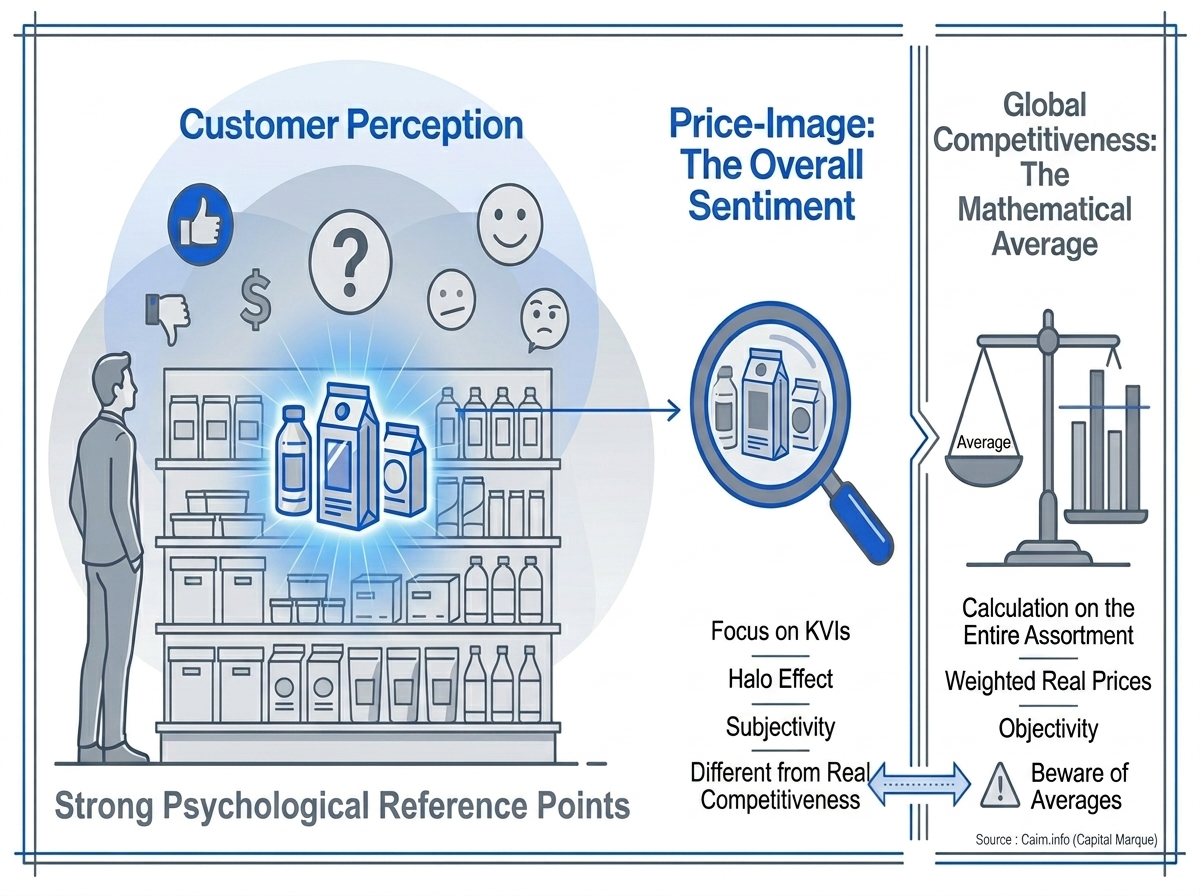
Price perception is customers’ subjective view of a retailer’s prices, which is shaped by its key products (KVI). It differs from actual competitiveness because it is based on strong psychological anchors.
This distinction is key because it explains why a retailer can be perceived as expensive even though most of the items in its catalog are priced low.
Price image = customer perception, based on a few visible products
Price perception is an overall impression. Customers use only a few reference prices—often those of the most visible products—to judge an entire store.
This image is multifaceted. It is linked to access and service to build brand equity of a retailer.
It is a complex structure.
Overall competitiveness ≠ price-image (be careful with averages)
We must not confuse the mathematical average of prices with perception. A retailer may be cheaper on average but appear expensive when it comes to its flagship products.
Broad metrics are dangerous. They often mask critical drop-offs on the pages your customers visit most frequently.
Why brand image hinges on Key Value Items (KVIs)
Once we’ve distinguished between perception and reality, we need to take a closer look at the products that drive sales on the shelves.
What is a KVI?
Key Value Items are products that are purchased frequently and for which consumers have a strong price memory. Milk and bottled water are typical examples of such items for consumers.
These items serve as a guide for customers. If they are considered too expensive, shoppers will perceive the entire store as overpriced.
How to Select a KVI Basket (Simple Method)
The selection process is based on an analysis of sales volume and market penetration. It is necessary to cross-reference checkout data with the brand awareness of national brands. Entry-level products remain a priority.
Here are the criteria for identifying your best-selling products:
- Sales volume (top 20%)
- Purchase frequency
- Promotional visibility
- Price sensitivity tested
Weighting: Why Not All Products Count Equally
The use of weighting factors is essential to reflect reality. When making a calculation, a liter of milk carries much more weight in the customer’s mind than a specialized toothbrush.
Without this weighting, your price index remains mathematically accurate but commercially inaccurate. Customer perception does not follow a simple arithmetic mean.
Endogenous and exogenous pricing data must be validated before measurement (otherwise the results will be biased)
Identifying the right products is one thing, but collecting clean data is another—and a much more technical one at that.
Net price vs. listed price (sales, coupons, bundles)
Beware of the "list price" trap. Instant promotions and loyalty discounts alter the actual price at the register. These tactics make all the difference for the customer.
Compare what the customer actually pays. Ignoring promotional tactics completely skews the price-image analysis. The net price remains the only reliable metric for your assessment.
Availability / Out of stock (prices not comparable)
Out-of-stock items undermine the validity of your analysis. A very low price on an unavailable product does not help your pricing strategy; it frustrates the customer. It’s a broken promise.
Exclude out-of-stock products from index calculations to maintain consistency. A product that is out of stock no longer affects the perception of actual in-store competitiveness.
Omnichannel: brick-and-mortar stores, e-commerce, marketplaces
Price differences between online and in-store are common. Customers now check prices on their smartphones while standing in front of the shelves. Price transparency is no longer an issue.
Collect feedback across all touchpoints simultaneously. This is essential for understanding how your customers perceive your brand, regardless of the sales channel used.
Step by step: an 8-step method for measuring price-image
To put theory into practice, here is the step-by-step guide to follow for your dashboard.
Set target (overall / category / area)
Determine the scope of the study. Do you want to measure retail price positioning at the national level, or that of a specific retail location compared to its neighbor? The accuracy of the results depends on this initial choice.
Determine whether the issue affects the entire store or a strategic category, such as fresh produce. A local perspective often provides a more accurate picture of actual consumer habits.
Build the KVI basket (+ categories)
Group products into logical categories. Each category must have its own standout products in terms of image and price to be representative. These Key Value Items (KVIs) shape the overall perception.
Be sure to include national brands and private labels to cater to all customer segments. The shopping basket must reflect typical weekly consumption to be credible.
Select competitors and channels
Identify who is really influencing your customers. It’s not always the one closest to them geographically, but often the one most active online. Price competition is now being fought on multiple fronts.
List the e-commerce sites and pickup locations to monitor daily to stay on top of things. Competitor price tracking should include marketplaces to provide a comprehensive view of the market.
Reliable product matching (EAN/MPN/attributes)
Ensure that we are comparing apples to apples. Using the EAN code is the foundation, but attributes (weight, size) are essential for products without a unique code. Incorrect matching renders the entire study invalid.
Please note that automated matching must be reviewed by subject matter experts on a regular basis. Without this reliability, your retail price data will be completely skewed by technical errors.
Calculate KPIs (index, gaps, dispersion)
Turning raw data into meaningful metrics. The 100 Price Index remains the benchmark for gauging your position relative to the market. It is the essential barometer of your market positioning.
Analyze price dispersion. Excessively large price discrepancies on certain products can undermine your efforts across the rest of the shopping cart. The retail price index must remain consistent.
Set alert thresholds (corridors)
Determine tolerance zones. If your KVI index exceeds 102, immediate corrective action must be taken. These limits protect your pricing strategy in the public eye.
These price ranges allow us to avoid reacting to every minor, non-strategic fluctuation. This helps us avoid a price war that is both exhausting and detrimental to our profit margin.
Governance (who approves what)
Clearly define responsibilities. Should the category manager approve every price reduction, or does the system operate autonomously? A robust decision-making structure ensures the necessary responsiveness.
Smooth governance prevents delays that give competitors an advantage. The approval process must be streamlined to ensure that price changes are reflected in real time.
Link to pricing and promotions management
Integrate these measures into the overall sales strategy. The price-image strategy should guide the promotional calendar to maximize impact. Promotions directly influence the value perceived by the customer.
Use this data to balance immediate profit margins with long-term price strategy. Management must align financial objectives with a sustainable pricing strategy.
Essential KPIs for Price Image (Table)
To manage effectively, you need a handful ofprecise metrics rather than a mountain of numbers.
KVI Price Index (Overall & by Category)
This is the key indicator of your perceived competitiveness. It compares your weighted basket to that of the benchmark market. To ensure the calculation remains realistic, it must include the net price.
Tracking by category allows usto pinpoint exactly where image quality is degrading. This prevents local issues from being obscured by a misleading overall average.
Average Price Gap + Dispersion
Measuring the percentage gap between your prices and those of the market leader allows youto adjust your positioning. The dispersion shows whether your prices are consistent or erratic across your entire product range.
Too many outliers create harmful confusion among end consumers. Unreasonable prices erode trust and undermine the perceived integrity of your pricing.
KVI coverage + data freshness
It is essential to check what percentage of your strategic portfolio is actually matched. Low coverage makes the index unreliable and skews your pricing decisions.
Freshness is key. A price recorded ten days ago is already outdated in retail. Data must be nearly real-time to be actionable.
Matching quality (false matches)
Monitoring the mismatch rate helps prevent strategic errors. A false match can lead you to mistakenly believe that your prices are too high compared to the competition.
Regularly auditing product links helps maintain trust in your reports. Without reliable matching, your analyses are nothing more than risky guesses.
Product Line Consistency & Psychological Pricing
Maintaining consistent pricing across different sizes helps customers understand the pricing structure. The price per liter should not be higher for larger sizes. Psychological pricing also plays a major role.
An inconsistent pricing structure immediately raises doubts about the fairness of the prices. Consumers need logical guidelines to feel confident about their purchasing decisions.
Omnichannel gaps
It has become essential to systematically compare prices in-store versus at the drive-through. Loyal customers who shop across different channels often expect consistent pricing.
Unjustified price discrepancies undermine transparency and overall customer loyalty. Maintaining price consistency ensures a seamless customer experience free of unpleasant surprises.
Table: KPI → simplified formula → frequency → alert
Here is a practical guide to help you structure your internal reporting without any frills.
Key performance indicators
This table summarizes the key metrics for responsive and accurate pricing governance. It enables the measurement of retail pricing performance with analytical rigor.
Practical examples (3 short case studies)
Theory is always refined through real-world experience, whether you're a generalist or a pure web professional.
GSA: Protecting price image across 30–100 KVI
A hypermarket monitors its 50 best-selling products. It matches the prices of its nearest local competitor down to the cent. This strict policy prevents any loss of customers.
This strategy sacrifices profit margins on these items to drive foot traffic to the store. It is a necessary investment to boost customer traffic.
The result is an immediate increase in the perception of "good deals. " The overall price image improves automatically.
Expert: Analyzing KVI vs. Margin Drivers
A home improvement retailer is slashing prices on its top-selling drills. However, it maintains high profit margins on accessories. Its pricing strategy remains aggressive for highly visible loss leaders.
Customers come in for the visible promotion and fill their carts with items that are less price-sensitive. This helps maintain the overall profit margin.
E-commerce/marketplaces: price parity + exceptions
An online-only retailer uses algorithms to adjust its prices every hour. Its primary goal is to secure the "Buy Box" on e-commerce platforms. Responsiveness is the key to success here.
Automated monitoring allows you to detect aggressive price cuts by competitors in real time. This ensures consistent competitiveness without the need for constant human intervention.
Common Mistakes (and How to Fix Them)
Many retailers are fighting the wrong battle by trying to keep track of everything without a clear strategy. Here are the pitfalls to avoid.
Comparing without reliable matching
Relying on vague product names leads to massive pricing errors. A 6-pack is not a 12-pack. This confusion completely undermines the credibility of your analyses.
Solution: Automate matching using EAN codes and manually verify exceptions. This is the only way to ensure an accurate comparison between your products and those of your competitors.
Use a "catalog" average instead of a KVI basket
Bury your key products among 20,000 SKUs, and your catalog will lose all meaning. Customers don’t see everything. Their attention is focused on just a few standout items.
Focus your efforts on the 2% of products that account for 80% of revenue. These Key Value Items (KVI) determine your retail price strategy.
Ignore promotions/net price
Forgetting that the competitor is offering 50% off the second item skews your perspective. The price you pay is the only reality. Calculations based on list prices are often misleading.
Include promotional details in your statements to ensure accuracy. Customers, however, always calculate their actual savings at the checkout.
Forget omnichannel
Thinking you’re protected by the store’s physical walls is an illusion. Customers compare everything, everywhere, all the time. The smartphone has become the go-to shopping assistant on the sales floor.
Keep an eye on the online prices of your direct competitors, even for your in-store sales. Price perception now plays out across all touchpoints simultaneously.
Measuring without thresholds or governance
Having data without taking action is a waste of time. Who decides to lower the price when the alarm goes off? Without a clear process, your reports will go unheeded.
Establish streamlined decision-making processes to stay ahead of the competition. Responsive governance transforms raw data into a real and immediate competitive advantage.
Checklist: Implementing price-image tracking
To make sure you don't miss a thing, here is your operational roadmap for launching your monitoring project.
KVI Checklist
Identify your strategic products by analyzing your sales volumes alongside their media exposure. This forms the basis of your brand perception.
- Top-selling by volume
- Items in the flyer
- Category leaders
- Budget-friendly products
Data & Competition Checklist
Target your direct competitors and verify the reliability of your sources. Without your own data, your analysis will be worthless.
- List of direct competitors
- Target URLs
- Reading frequency
- Matching method
Dashboard Checklist & Routines
Set up your management tools and organize decision-making processes. Data must be quickly translated into concrete action.
- KPI Dashboard
- Alert thresholds
- Weekly Pricing Committee
- Pricing Alert Workflows Validation
Conclusion: Managing Your Price Image for Long-Term Success
Controlling how your prices are perceived is the most powerful way to build customer loyalty without undermining your profitability.
Identifying your KPIs and ensuring flawless product matching is essential. Measuring retail pricing is no longer an option but an absolute strategic necessity. This allows you to focus your pricing efforts where customers actually notice them.
Take action by establishing clear governance and alert thresholds. A powerful monitoring tool transforms raw data streams into straightforward operational decisions. This is the key to maintaining control over your positioning.
Finally, integrate these insights into your dynamic strategic pricing and promotions. This will help you maximize your results while strengthening the consistency of your omnichannel offering. Reliable data remains your best ally for success.
Mastering your KPIs and ensuring reliable data matching are the cornerstones of accurately measuring your retail price positioning. Take action now on these strategic levers to turn your metrics into sustainable profitability. Manage your price perception today to dominate your market tomorrow.
Frequently Asked Questions
To understand the process, please review our project pricing methodology.

Building a high-performing pricing team requires adopting a hybrid model that combines centralized strategy with local agility. This transition replaces intuition with data-driven decisions, guided by specialized roles and strict governance.
This proactive management directly improves financial performance, enabling companies to aim for an increase in profitability of between 100 and 500 basis points.

Facing a sudden drop in conversion rates because your competitors are adjusting their prices in real time means you need to equip yourself with the best data-driven retail pricing strategy tool for 2026 to stay competitive. Price transparency in 2026: Retailers are automating pricing to protect their margins against inflation, improve omnichannel responsiveness, and generate a quick ROI.
Discover how these tools automate your specific business rules while ensuring complete strategic control over your brand image and delivering a measurable return on investment in less than six months.
This detailed comparison analyzes specialized platforms capable of predicting price elasticity and managing your omnichannel inventory to turn every piece of raw data into immediate, tangible profit.

Product matching is the foundation of competitive monitoring because it prevents the comparison of non-equivalent products. Reliable matching safeguards margins by basing repricing on real-time, multi-source data.
Key finding: According to the Diamart study, 50% of French retailers still consider this challenge to be unresolved.