Switch from Excel to a pricing solution

Fabrice Decroo
Director of Consulting
May 26, 2026
Migrating from Excel to a dedicated platform safeguards your profit margins by eliminating the 10% rate of manual data entry errors. This transition automates pricing workflows and centralizes ERP/PIM data, ensuring essential omnichannel consistency. A methodical 8-step migration process helps optimize profitability and enables you to respond to competition in real time.
A simple Excel file generates an average of 10% data entry errors and hampers your omnichannel responsiveness. When faced with massive data flows, this spreadsheet becomes a bottleneck that directly threatens your net margins and your pricing reputation.
Maintaining consistent pricing across the web and in-store requires a level of agility that can only be achieved with a dedicated tool. To replace Excel-based pricing without disrupting your operations, we break down the key steps of a successful migration, from data auditing to deployment of a pricing tool with centralized governance.

Excel: useful at first, risky as you scale
Managing prices in Excel results in a 10% data entry error rate and hinders omnichannel operations. A dedicated platform automates workflows, safeguards margins through price corridors , and centralizes ERP/PIM data—which is essential for detecting the first signals of endogenous and exogenous pricing of operational friction.
But how can you tell if your file has become a ticking time bomb?
Signs That Excel Is Holding You Back (7 Symptoms)
Files quickly become overloaded, and macros break without warning. The lack of a version history makes it impossible to conduct a reliable audit. Collaboration becomes difficult because versions overwrite each other, creating confusion about the latest valid price.
It’s impossible to run simulations without real data. Spreadsheets don’t sync with your inventory or competitors. Information is often outdated by the time it’s manually entered.
The teams are burning out. Time spent on corrections is taking the place of strategy.
Question: Has your Excel pricing spreadsheet become a risk?
Use these 3 points to assess whether your spreadsheet-based management is jeopardizing your profitability.
Business risks (margin, price-image, omnichannel inconsistencies)
A formula error directly impacts the net margin. This poses a massive, hidden financial risk for retailers. Profits melt away without any immediate warning.
The disconnect between online and in-store pricing erodes customer trust. These pricing inconsistencies seriously damage your overall brand image.
Compared to pure-players, Excel is too slow to react. You ’re losing ground every day.
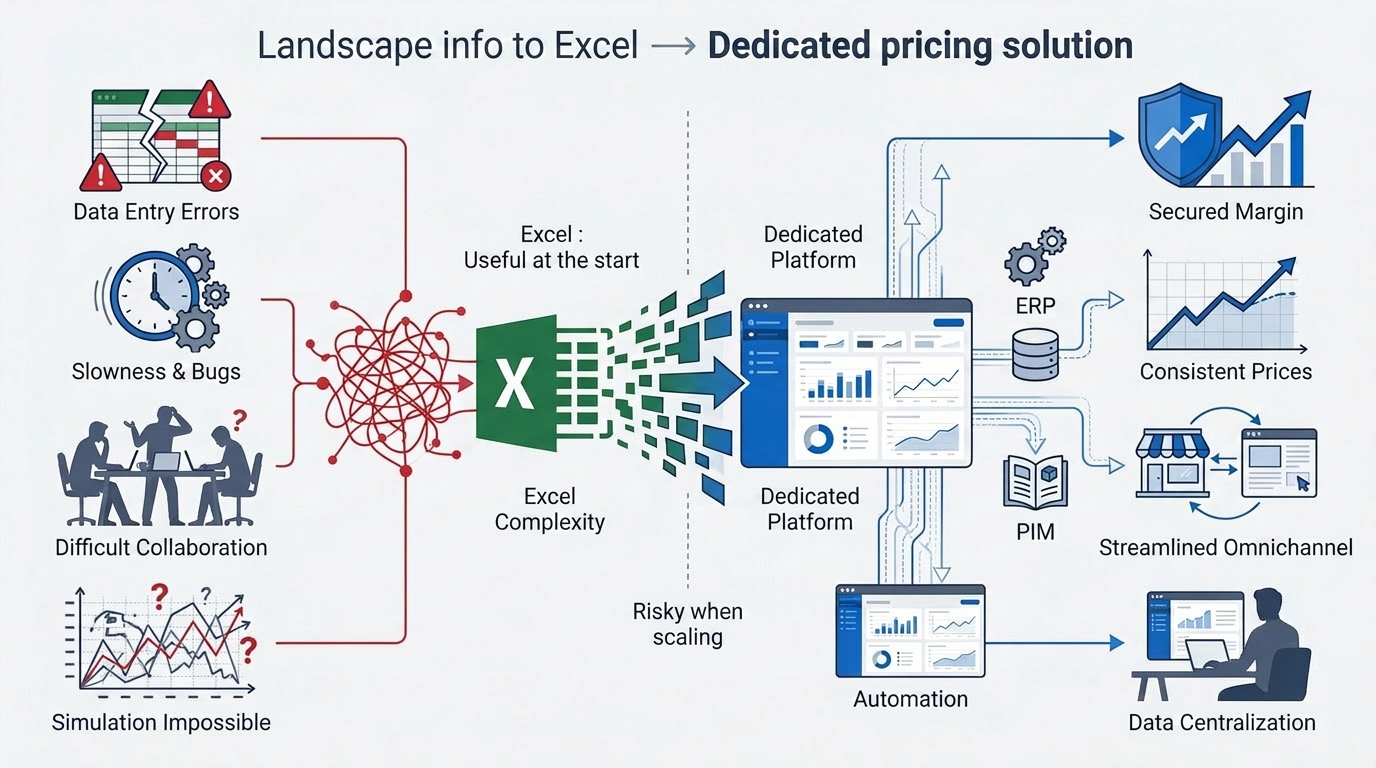
What a pricing platform offers (and why it’s a game-changer)
If Excel is showing its limitations, it’s because modern agility requires a tool capable of centralizing pricing intelligence while ensuring the security of every operation.
Source of truth: pricing + governance (workflows, logs)
The platform serves as your single source of truth for pricing. Every change is tracked, time-stamped, and assigned to a specific user, ensuring complete transparency.
Approval workflows automate the review process. A manager must approve changes that exceed a defined threshold for price reductions or increases.
In short, no more scattered files. Everyone is finally working with the same reliable, shared data.
Rules & Safeguards (corridors, price floors, exceptions)
Price ranges and automatic minimum prices protect your margins. These rules prevent you from selling at a loss, even in the event of a calculation error or an aggressive promotion.
Managing local exceptions becomes simple. You can override a global rule for a specific store without breaking the entire system.
Scenarios / “What-if” simulations
Testing before publishing changes the way you work. You can instantly simulate the impact of a 2% increase on volume and overall margin.
Comparing multiple strategies takes just a few clicks. It’sthe ultimate decision-making tool for your teams.
Seasonal uncertainty is fading. Forecasts are becoming more concrete.
Competition: monitoring + reliable matching
Automating price tracking eliminates tedious tasks. No more manually copying and pasting competitors' prices into a spreadsheet every morning.
Smart matching, or chaining, ensures reliability. The tool recognizes that two products are identical even though they have different names among your competitors.
You gain greater responsiveness to market conditions. You can adjust your pricing strategy in real time based on your own strategy.
Built-in promotions & markdowns
Manage the entire product lifecycle efficiently. From the initial launch to end-of-line markdowns to clear out inventory.
Coordinate promotions across all channels. Customers see the same discount both online and in-store, with no inconsistencies.
Maximize sales without sacrificing profit margins. The algorithms suggest the right markdown.
IT Integrations (ERP/POS/PIM/E-commerce/BI)
Data flows seamlessly between systems. The calculated price is sent directly to the ERP system and the electronic price tags.
Linking inventory and purchase costs is essential. Pricing becomes dynamic and truly aligned with your logistics reality.
Feed the BI system for accurate reports. Data flows without manual human intervention.
Preparing for the migration: data and prerequisites
Before installing any software, you need to clean up your data to lay a solid foundation.
Net price vs. list price, costs, margins
The first step is to clearly distinguish between the list price and the net price after discounts. Include all purchase costs when calculating your actual margin. Otherwise, your projections will remain approximate.
Next, define the target profitability metrics by product family. Each category can have its own method for calculating gross margin. This segmentation allows you to monitor performance with precision.
Finally, ensure consistency in tax calculations (VAT). Calculation errors often stem from improper handling of pre-tax and tax-inclusive amounts. A well-organized system helps avoid unpleasant tax surprises.
Inventory/out-of-stock items, channels, promotions
Take inventory levels into account when making decisions. You shouldn’t lower the price of a product that’s about to go out of stock. Scarcity should protect your margin.
Map out the various sales channels. Each touchpoint may have its own promotional constraints. Omnichannel marketing requires seamless coordination.
Track your past transactions. Understanding what worked helps you plan for the future. Past data is your best teacher.
Product catalog: attributes, variants, EAN/MPN
Clean up the PIM to ensure unique identifiers. EAN and MPN codes are the cornerstones of matching. Without them, effective comparison is impossible.
Manage size and color variations. Pricing should be consistent within the same product line. Avoid inconsistent pricing for similar products.
Standardize product descriptions. Clarity makes it easier for algorithms to do their job. Structured data ensures a smooth migration.
Competition: Specific Comparison Rules
Identify who your real competitors are strategic. You don’t compete with a web leader the same way you do with a local discount store. Here are the key criteria for identifying them:
- Geographical proximity
- Range width
- Pricing strategy
- Included services
Establish strict matching rules. Should a 3-pack be compared to a single unit? The accuracy of the matching process determines the relevance of your alerts.
Determine how often to check the data. Some markets fluctuate hourly, while others do so weekly. Tailor your monitoring to the actual volatility of your industry.
An 8-step method for migrating without disrupting operations
Migration isn't a technical "Big Bang," but a methodical transition that safeguards your daily revenue.
Mapping Excel files and actual usage
The first step is to identify all the spreadsheets used by the Category Managers. We need to understand who edits what and how often so that nothing is overlooked. Each file often reflects a specific business practice.
Identifying "custom" formulas and hidden macros helps avoid unpleasant surprises. These processes must be translated into logical rules in the future system.
Identifying bottlenecks is essential. Where are we wasting the most time right now?
Set goals and KPIs (margin, competitiveness, price-image)
Defining what success means to you is the top priority. Is it a 1% increase in profit margin or time savings for your teams? Without a clear direction, the tool will be nothing more than an expense.
Choosing clear performance metrics ensures rigorous monitoring. Track the competitiveness index and the data entry error rate to validate the transition. These metrics demonstrate the project’s value.
It is essential to align leadership and teams. Everyone must be working toward the same goals.
Segment products (KPI / margin drivers / long tail)
Identifying the products that drive traffic—the so-called KVI products—requires special attention. For these items, price elasticity is at its highest, and there is no room for error, as any mistake could damage your price reputation. These are your flagship products.
Identifying margin drivers helps ensure profitability. The goal here is to optimize margins without sacrificing sales volume. This requires careful management.
Treating the long tail differently frees up operational time. These slow-moving items can be further automated without significant risk.
Building "golden data" (a reliable data repository)
Merging data sources to create a single record is a massive undertaking. It is the most time-consuming step, but also the most rewarding for the rest of the project. Scattered data is useless data.
Eliminating duplicates and data entry errors ensures the reliability of future calculations. The platform will only perform well if the data is clean from the moment it is imported. Data cleansing is mandatory.
Automating update workflows secures the system. Data must always be up to date.
Define rules & governance (who approves what)
Creating a responsibility matrix (RACI) clarifies everyone’s role. Who proposes a price, who approves it, and who ultimately publishes it? This structure helps prevent costly human errors.
Setting automatic alert thresholds protects your margins. If a price fluctuation is too sudden, the system should pause to allow for a manual review. This is your safety net.
Documenting decision-making processes strengthens cohesion. Transparency helps prevent conflicts between departments.
Choose a platform (criteria + checklist)
Evaluating solutions based on their integration capabilities and user-friendliness is a strategic decision. The software must be easy for business teams to adopt without extensive training to ensure a quick return on investment. Here are the key points to consider:
- Native ERP connectors for synchronization.
- Simulation module for testing scenarios.
- Promotion and markdown management.
- Responsive and knowledgeable customer support.
- Technical scalability to keep pace with your growth.
Checking the provider’s financial and technical stability is a basic precaution. You’re entrusting the core of your business to this tool, so you need to have complete confidence in it. Don’t overlook the issue of long-term sustainability.
Requesting a demo using your own data is the ultimate test. It’s the only true test.
Driver (1 category + 1 channel + safety rails)
Launching the project on a limited scale helps minimize initial risks. Choose a product category that is representative but not too risky to get the system up and running. This full-scale test is a learning experience.
Testing workflows in real-world conditions allows you to fine-tune the settings. Adjust the pricing rules based on initial feedback from users. Flexibility is the key to success.
Measuring results after 4 weeks provides a clear picture. Verify the ROI before rolling it out on a larger scale.
Standardize (training, procedures, monitoring)
Rolling out the tool across all departments marks the end of the transition. Support the change with regular training sessions for all affected employees. Adoption must be comprehensive to be effective.
Establishing weekly price review rituals keeps momentum going. Use the platform’s dashboards to manage your business in real time. Data finally replaces intuition.
The ultimate goal is to adopt a mindset of continuous improvement. Refine your pricing rules over time.
Excel vs. Platform: Comparison Chart
To settle the matter once and for all, let’s compare the two approaches based on the key factors driving your sales performance.
Factual comparison of performance
This table summarizes the key differences between manual management and automation. It highlights the benefits in terms of security and time savings.
Actually, do you see the problem? Sticking with Excel means accepting a constant risk to your income, whereas a dedicated platform safeguards every penny.
How to Choose a Pricing Platform (10 Criteria)
Choosing the right tool is critical to the success of your digital transformation and to gaining your teams’ buy-in.
Functional (pricing, promotions, markdowns, competition)
Prioritize features that meet your day-to-day needs. Markdown and promotion management should be built-in. This allows you to effectively manage the product lifecycle.
Assess the sophistication of the competitive intelligence module. The tool must be capable of processing massive volumes of external data. Real-time price comparisons are essential to remain competitive.
Make sure that business rules are customizable. Avoid solutions that are too rigid or act like "black boxes." You need to maintain control over your pricing strategies.
Technical (integrations, scalability)
Consider how easily it integrates with your existing tools. The APIs must be well-documented and robust for the IT system. Near-real-time synchronization with your ERP is a major advantage.
Test the platform's data processing speed. The platform must be able to handle the growth of your catalog. A cloud-based architecture often provides the flexibility needed to handle traffic spikes.
Verify the security of your hosting providers. Your pricing data is highly confidential. Robust security measures are essential.
Organization (workflow, adoption, training)
The interface must be intuitive for non-technical users. A steep learning curve could cause the project to fail. Here are the key points to keep in mind:
- UX Design
- Built-in online help
- User Rights Management
- Customizable reports
Assess the quality of post-purchase support. Good customer service is essential during sales periods. Having a live representative available via chat or phone makes all the difference.
Plan for ongoing training modules. Your teams need to stay proficient in using the tool. This is the only way to ensure long-term success for your business.
30/60/90-Day Action Plan
To help you stay on track, here is a practical roadmap for your first three months of transition.
30: audit + quick wins + scope definition
The first month is dedicated to an initial assessment. Identify the most costly Excel errors to generate immediate results. Analyze the rate of duplicate entries and empty fields.
Define the scope of the pilot project. Bring together the stakeholders to approve the strategic objectives and budget. Select your key performance indicators.
Clean up your first critical datasets. Quality starts from day one. Now is the time to verify GDPR consent.
60: driver + dashboards + rules
Set up the platform for the selected category, such as high-margin products. Configure the initial dashboards to track performance in real time. View your inventory.
Test the automatic pricing rules on a sample. Adjust the price ranges and floor prices based on market reactions. Simulate your initial promotional scenarios.
Train your first key users. They will become your internal ambassadors. Their feedback is vital for the next steps.
90: Scaling + Governance + Continuous Improvement
Expand the platform’s use to your entire catalog, including the long tail. Now is the time to permanently phase out those outdated Excel files. Centralize your “source of truth” price repository.
Standardize governance and approval processes. Every employee must understand their specific role in the workflow. Audit logs now ensure complete transparency regarding every change.
Analyze the initial overall results across all channels. Compare KPIs with baseline figures to demonstrate ROI. Refine your end-of-season markdown strategies.
Common mistakes (and how to avoid them)
Even with the best intentions, certain common pitfalls can slow down your migration if you’re not careful.
Start with the tool without your own data
The tool won't magically fix incorrect data. Take the time to clean up your data before installing any software. You need to track down duplicates and empty fields right now.
An inaccurate purchase cost will result in an inaccurate price. The reliability of the source is essential to prevent a chain reaction of errors.
Prioritize quality over quantity. It’s better to have a small amount of data that’s accurate for your database.
Trying to automate everything at once
Full automation is a dangerous fantasy at first. Keep control over strategic decisions and KVI products. Losing control could be costly for your reputation.
Proceed in a step-by-step, logical manner. Let the algorithm handle the simplest tasks first, such as shelf-back products.
Keep a critical eye on things. Machines are helpful, but they don’t replace the professional expertise of category managers.
Forget about governance (exceptions, validations)
A tool without validation rules leads to operational chaos. Define who has the final say in the event of a dispute over a rate. Without a workflow, the risk of errors skyrockets.
Establish processes for handling exceptions. Business is full of unforeseen circumstances that require flexibility, such as responding quickly to competition.
Document every major decision. Your record is your best legal and business defense for justifying your pricing decisions.
Measuring ROI based solely on revenue
Revenue is only part of the equation. Focus instead on how your gross margin and time saved are changing. Rising revenue can mask plummeting profitability.
Emphasize the reduction in operational errors. Avoiding massive losses on sales is a direct and tangible benefit for your cash flow. This is where the tool pays for itself.
Keep employee satisfaction in mind. Employees who are less stressed by corrupted Excel files perform better in the long run.
Conclusion: Take the plunge to ensure your growth
Ultimately, migrating from Excel to a pricing platform is no longer an option for anyone who wants to stay competitive.
Success depends on accurate data and clear governance. The tool is designed first and foremost to support your HR strategy. This systematic transition ensures immediate operational peace of mind.
Start an internal audit of your files today. Learn how BOOPER can provide expert support for these complex transformations. Switching toautomation will secure your processes starting tomorrow.
This will help you protect your profit margins and price image over the long term. It’s the foundation of a modern, agile retail business. Technology is finally keeping pace with your ambitions.
Replacing your Excel pricing system with a dedicated platform protects your margins, automates your workflows, and finally centralizes your data. By following our 8-step migration plan, you’ll eliminate manual errors and gain omnichannel agility. Take action now to transform your pricing strategy into a driver of profitable, sustainable growth.
Frequently Asked Questions

Building a high-performing pricing team requires adopting a hybrid model that combines centralized strategy with local agility. This transition replaces intuition with data-driven decisions, guided by specialized roles and strict governance.
This proactive management directly improves financial performance, enabling companies to aim for an increase in profitability of between 100 and 500 basis points.

Facing a sudden drop in conversion rates because your competitors are adjusting their prices in real time means you need to equip yourself with the best data-driven retail pricing strategy tool for 2026 to stay competitive. Price transparency in 2026: Retailers are automating pricing to protect their margins against inflation, improve omnichannel responsiveness, and generate a quick ROI.
Discover how these tools automate your specific business rules while ensuring complete strategic control over your brand image and delivering a measurable return on investment in less than six months.
This detailed comparison analyzes specialized platforms capable of predicting price elasticity and managing your omnichannel inventory to turn every piece of raw data into immediate, tangible profit.

Product matching is the foundation of competitive monitoring because it prevents the comparison of non-equivalent products. Reliable matching safeguards margins by basing repricing on real-time, multi-source data.
Key finding: According to the Diamart study, 50% of French retailers still consider this challenge to be unresolved.