Retail Pricing Strategies: 5 Pricing Strategies (and how to put them into practice using data and AI)
.avif)
Edouard Calliati
Director of Marketing and Business Development
March 15, 2026
Key takeaway: The success of a retail pricing strategy hinges on moving away from outdated spreadsheets in favor of AI-driven automation. This technological shift allows for a precise balance between profitability and market appeal.
This is essential for building customer loyalty, given that 62% of consumers are willing to switch brands for a better price.
Are your outdated spreadsheets masking a silent erosion of your profit margins, while your direct competitors are already optimizing their retail pricing strategies using the power of artificial intelligence?
Here, we examine five practical methodological approaches for transforming your current pricing strategy into an agile growth driver, fully driven by data and new automation tools.
By moving away from gut instinct and toward data-driven decision-making, you’ll learn how to adjust your prices in real time to strike a balance between an attractive price-image and maximum profitability across your entire product catalog.

What is a retail pricing strategy?
Let’s get right to the point by defining what a pricing strategy actually is today.
Definition
Pricing Strategy: A method of setting prices based on a KPI (margin, traffic, price-perception, etc.) to determine the optimal price point.
Possible objectives: profit margin, traffic, price-image, market share
An effective pricing strategy is based on specific KPIs. It guides every decision toward profitability and customer flow. Your gross margin depends directly on it.
Your brand image builds customer loyalty. It is the foundation of your true competitive edge against discount retailers in the market.
Market share validates your decisions. Price remains the ultimate deciding factor in business.

Why strategy selection is a matter of “product × store × time period”
A one-size-fits-all pricing strategy is a costly mistake. Every retail location has its own unique local context. Tailor your prices to your catchment area and the competition.
Seasonality also influences perceived value. A product’s appeal varies depending on the time of year and current weather conditions.
The 5 Key Pricing Strategies in Retail
Continuity/stability of core products (when, why)
The stability strategy focuses on core products. These are your everyday staples. The goal is to reassure the end customer. We avoid any sudden price changes to maintain the balance of overall demand.
This is the ideal scenario for high-frequency purchase items. Consumers immediately notice even the slightest price change on these products.
Trust comes first. The customer knows the price by heart and feels secure.
Progressive margin gains (where applicable)
We raise prices in small, incremental steps. This allows us to gauge customers’ actual willingness to pay without causing a stir. It’s a cautious approach to boosting profitability.
The focus should be on less price-sensitive items, often purchased as last-minute additions. The price increase should be virtually unnoticeable to the customer at the checkout.
Keep an eye on your sales figures. If sales drop sharply, you need to stop.

Margin optimization using “margin enhancers”
Identify products with low price elasticity. These are often accessories or items exclusive to your store. The goal is to maximize profitability with minimal risk.
The term "margin enhancers" is used. These specific items offset the low margins generated in other departments that face stiffer competition.
A concrete example:
Margin enhancers: Exclusive accessories or items with low price elasticity. These maximize profitability without compromising the overall brand image.
Don't push it too far. The final price must be consistent with the overall offer.
Defending Against Competition (Territorial Pricing)
Defensive pricing involves matching the prices of your immediate competitors. You refuse to lose in-store traffic over a few euros. It’s a full-blown local turf war.
Competitive monitoring is becoming essential. You have to react quickly to your competitors’ moves. Up-to-date data is the key to staying in the game.
Be careful, however, of price wars. They can destroy the value of your entire industry very quickly.
Aggressive pricing on key items to protect the brand's price image
We’re willing to sacrifice profit margins on a few key items. These are your loss leaders. They shape the overall perception of your store. These standout items are often referred to as KVIs (Key Value Items).
A concrete example
KVI: Staple goods such as milk or bread, whose prices are remembered by 62% of shoppers.
The goal is to physically draw customers to the aisle. Once there, they tend to buy other items as well. It’s a calculated move aimed at increasing the average basket size.
Keep your list strictly limited. Too many products that are aggressively promoted will ultimately undermine your store’s overall profitability.
Checklist: Choosing a Strategy
- Analyze the price elasticity of the product.
- Check the customer's purchase frequency.
- Compare prices with local competitors.
- Define the product's role (KPI or margin).
Checklist: Deploy Without Breaking the Margin
- Simulate the impact on sales volume.
- Check stock availability.
- Align the price with current promotions.
- Monitor KPIs in real time after launch.
How to Choose the Right Strategy: The Simple Decision Matrix
Knowing what's out there is one thing, but deciding which card to play is another.
Criteria: elasticity, KVI, competition, product role, seasonality, inventory
When it comes to your retail pricing strategies, several factors drive the process. Price elasticity remains your primary indicator in the field. It measures how sales respond to changes.
Key decision factors
Carefully analyze these points. These are the four pillars of your immediate pricing strategy. This information will guide your final decision without a doubt.
- Price elasticity
- Competitive positioning
- Role within the category (image vs. margin)
- Current stock level
Inventory levels often dictate the urgency of the situation. A massive surplus requires a more aggressive approach to free up space. Seasonality also plays a major role in this equation.
Example of a mapping: objective → strategy → target products
Always link your ultimate goal to the actual execution. If your main objective is traffic, prioritize KVI articles. This is a highly effective logical sequence.
You never just pick a strategy at random. Your approach must remain educational and, above all, highly structured.
Consistency always wins. Each product serves a specific and unique purpose.
The Pitfalls of a Poor Strategy (and How to Avoid Them)
Be careful, though, because a misstep could end up costing the company dearly.
Major risks
Miscalculating price reductions erodes net margins. Uncoordinated price cuts lead to stockouts. Omnichannel inconsistency undermines customer trust.
Eroded margins, excess inventory/stockouts, customer confidence, omnichannel inconsistency
Lowering prices without careful calculation drastically erodes your net margin. Profits vanish instantly. Inventory then depletes far too quickly. You end up with empty shelves and sales lost forever.
Prices that change without any clear logic confuse shoppers. Trust is shattered. Omnichannel retailing makes management complex and risky for your overall brand image in the face of competition.

The online price must match the in-store price. Otherwise, it’s total and immediate chaos.
“Side effects” between teams (pricing vs. supply vs. operations)
Pricing strategies aim to sell at rock-bottom prices. Supply chains fear sudden stockouts. This internal conflict often undermines your modern retail business’s best growth efforts.
On the sales floor, staff are directly affected by these changes. They have to constantly relabel products under constant and exhausting operational pressure.
Collaboration is essential. Without it, nothing really works for the brand.
Moving from Excel to data-driven execution
To avoid these issues, we need to move beyond the rudimentary era of spreadsheets.
Basic data: sales, costs, prices, competition, promotions, channels
Managing pricing in Excel has become a recipe for disaster. The sheer volume of retail data far exceeds the capabilities of a simple spreadsheet. It’s no longer possible to manually juggle millions of rows without making mistakes.
- Sales history by channel
- Purchasing and logistics costs
- Real-time competitor prices
- Promotional calendar
Data must be consolidated. A single shared repository prevents conflicting decisions among teams.
Governance: rules, thresholds, exceptions, validation
Establish a strict framework with non-negotiable business rules. For example, strictly prohibit selling below cost. These safeguards protect your gross profit.
However, certain unusual or sensitive products require human validation. We retain control over these strategic exceptions.
Automate everything else. That’s where you’ll save valuable time.
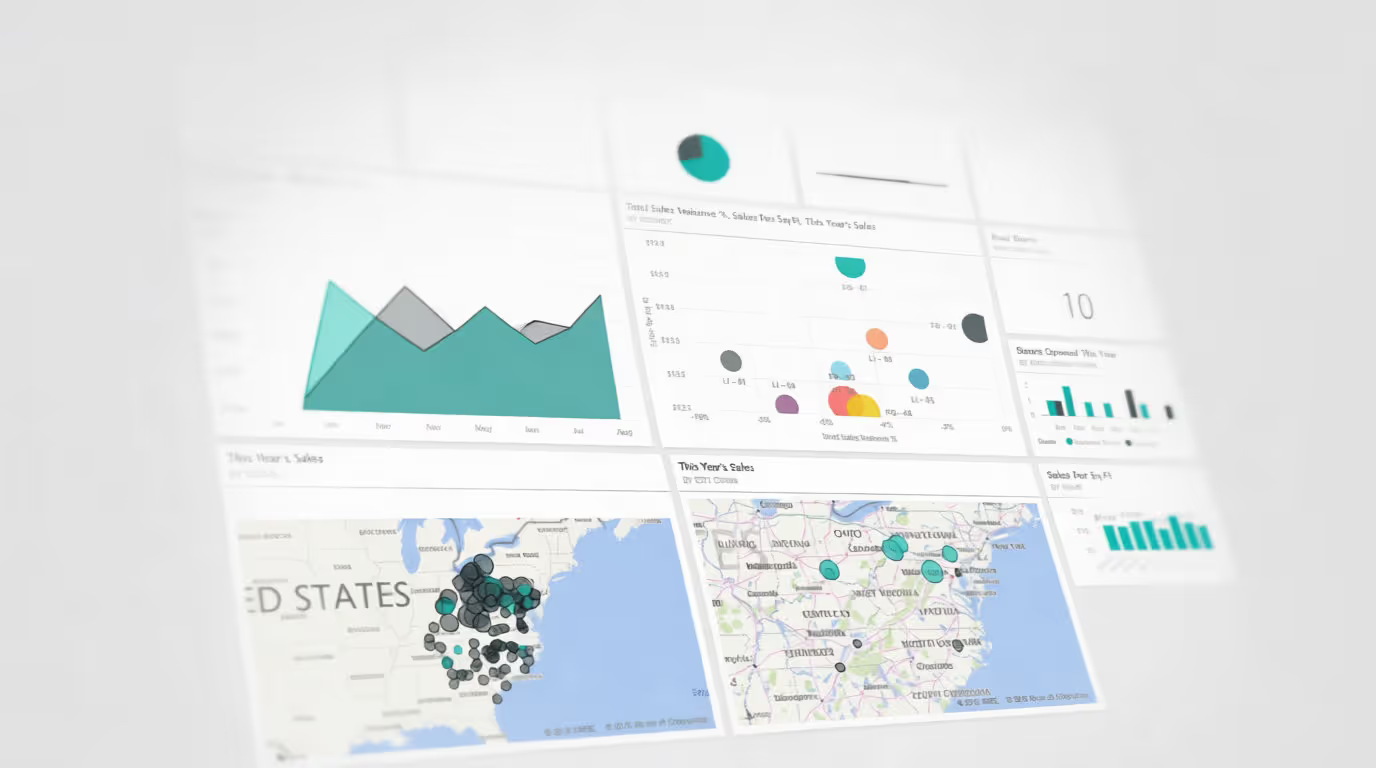
The Role of AI: Better, Faster, and at Scale
This is where artificial intelligence is a game-changer for modern retailers. It transforms retail pricing strategies into precision tools driven by your margin and traffic goals.
Data Analysis & Cleaning
AI sorts through the data and identifies anomalies. This provides a solid foundation for making accurate decisions.
No need to clean up your files manually anymore. The machine takes care of it to save you time.

Quality comes first. Without reliable data, pricing fails.
Pricing recommendations + business constraints
The algorithm makes suggestions, and you make the final decision. The recommendations take your inventory levels and actual goals into account.
You input your business constraints. The AI consistently adheres to your margin limits.
No more guesswork. We rely on facts.
Pre-deployment scenarios/simulations
Previewing before clicking helps prevent mistakes. You can see the effect on the margin right away.
We are comparing several scenarios. What is the best balance between traffic and profit margin?
We're reducing uncertainty. We know where we're going.
Multi-store / multi-category management
Managing thousands of SKUs is now possible. AI applies strategies by geographic region.
Every retail location has its optimal price. We maximize every local opportunity.
Scale is no longer a hindrance. It is a strength.
StrategyTargetObjectiveStabilityCore productsContinuityMargin gainsTroubleshootingPrudent growthMaximizationMargin enhancersMaximum profitDefensiveCompetitionTerritoryAggressiveAppeal (KVIs)Traffic
Checklists
- Select: Define the KPI, elasticity, and competition.
- Deploy: Simulate, check inventory, and monitor results.
Pricing + Promotions: Why Link Them
One final point that is often overlooked: the synergy between regular shelf prices and promotions.
Avoid inconsistencies and duplicates (regular price vs. sale price)
You're taking a big risk with price mismatches. Sometimes the promotional price ends up being higher than the regular price. It's an absolute disaster for your reputation as a value-for-money retailer. Customers immediately feel like they've been ripped off. With just one click, you lose all your credibility.
Linking these two factors helps avoid such blunders. It is essential that your perspective be comprehensive and based on real-time data.

Your profit margin is finally protected. No more mindlessly racking up discounts without even realizing it.
Standard process: timeline, rules, and decisions
Streamline your governance. The promotions and pricing teams need to communicate openly with each other. A shared calendar is essential for managing your operations without stepping on each other’s toes.
Adjust your strategy based on your inventory levels. Promotions clear out overstocked shelves, while pricing helps stabilize sales volumes.
It is a coherent, comprehensive strategy. No more working in isolated, inefficient silos.
Comparison Chart: Which Strategy for Which Goal?
Trying to manage pricing with a one-size-fits-all approach is like navigating by sight in a fog. Retail is not a monolithic entity but a mosaic of purchasing behaviors. You don’t treat a niche product the same way you treat a highly price-compared item. Yet many persist with outdated methods. The key lies in a decision matrix that links intent to concrete action. In short, we need to stop guessing and finally make precise decisions.
To give you a clearer picture, here is a summary of the key players involved.
"Select + Deploy" Checklist Without Breaking the Bank
Ready to get started? Follow these steps to make sure you don't miss a thing.
Strategy Selection Checklist
Before adjusting the slider, clarify your objective. Are you looking for immediate cash flow, or do you want to improve your price positioning? Answering this question immediately eliminates 80% of common strategic mistakes.
To avoid flying blind, rely on concrete data. Here are the essential checkpoints:
- Check historical elasticity
- Analyze competitor prices
- Identify the product's role in the shopping cart
- Check stock availability
Execution & Monitoring Checklist
Always roll out changes in successive waves. Changing your entire catalog all at once is a recipe for disaster. A pilot test in a few representative stores serves as a safety net.

Effective execution requires discipline. Don’t overlook any of these operational levers:
- Simulate the impact on the margin
- Brief the store teams
- Track volumes on D+1
- Review the post-mortem after 4 weeks
Learn from every cycle. Execution is a muscle that gets stronger with each iteration. Pricing is no longer a matter of intuition; it’s an operational science.
Choosing a direction is just the beginning. The real challenge lies in flawlessly executing your retail pricing strategies on the sales floor. To do this, data and AI are your strongest allies. Don’t get stuck with outdated tools that hold back your growth.
Start rethinking your approach to each item and each store right now. The health of your bottom line depends on every price tag you adjust. Don’t let chance continue to eat into your profits.
Take control of your margins once and for all. Request a demo to transform your pricing strategy today.
Mastering your retail pricing strategies requires combining tactical finesse with AI to automate your decisions. By adopting data-driven retail pricing, you can protect your margins while remaining competitive. Modernize your tools today: tomorrow’s profitability depends on your current price tags.
Frequently Asked Questions

Building a high-performing pricing team requires adopting a hybrid model that combines centralized strategy with local agility. This transition replaces intuition with data-driven decisions, guided by specialized roles and strict governance.
This proactive management directly improves financial performance, enabling companies to aim for an increase in profitability of between 100 and 500 basis points.

Facing a sudden drop in conversion rates because your competitors are adjusting their prices in real time means you need to equip yourself with the best retail pricing software of 2026 to stay competitive. Price transparency in 2026: Retailers are automating pricing to protect their margins against inflation, improve omnichannel responsiveness, and generate a quick ROI.
Discover how these tools automate your specific business rules while ensuring complete strategic control over your brand image and delivering a measurable return on investment in less than six months.
This detailed comparison analyzes specialized platforms capable of predicting price elasticity and managing your omnichannel inventory to turn every piece of raw data into immediate, tangible profit.

Product matching is the foundation of competitive monitoring because it prevents the comparison of non-equivalent products. Reliable product matching safeguards margins by basing repricing on real-time, multi-source data.
Key finding: According to the Diamart study, 50% of French retailers still consider this challenge to be unresolved.