Pricing simulation: test your pricing strategy risk-free
.avif)
Edouard Calliati
Director of Marketing and Business Development
Pricing simulation allows companies to virtually test the impact of pricing strategies on the income statement before implementing them in practice. This approach safeguards margins and speeds up decision-making by replacing intuition with reliable data. It serves as an essential safety net for optimizing profitability without exposing the company to market risks.
Changing your prices blindly exposes your profitability to immediate—and often irreversible—financial risks. Our pricing strategy simulation provides a controlled environment where you can anticipate the real-world impact of your decisions on your margins before implementing them in the market. Adopt our scenarios and safeguards so that chance never again dictates your financial performance.

Pricing simulations: How can you test multiple pricing strategies without putting yourself at risk?
Changing your prices without a safety net is like playing Russian roulette with your profitability. Yet many still set prices blindly. The solution? Run simulations before taking action.

Purpose of the article
Think of the "what-if" approach as a testing ground. A pricing strategy simulation virtually tests your assumptions before implementation. It’s an essential crash test.
The goal is to protect your profit margins. This way, you can avoid unpleasant financial surprises once the rate is applied.
Finally, we’re speeding up the decision-making process. Concrete data dispels internal doubts: we’re no longer guessing—we know.
Why simulate pricing decisions (instead of deciding “on a hunch”)
Think your gut instinct is enough? That’s a costly mistake. Without a rigorous pricing strategy simulation, you’re playing Russian roulette with your profitability.
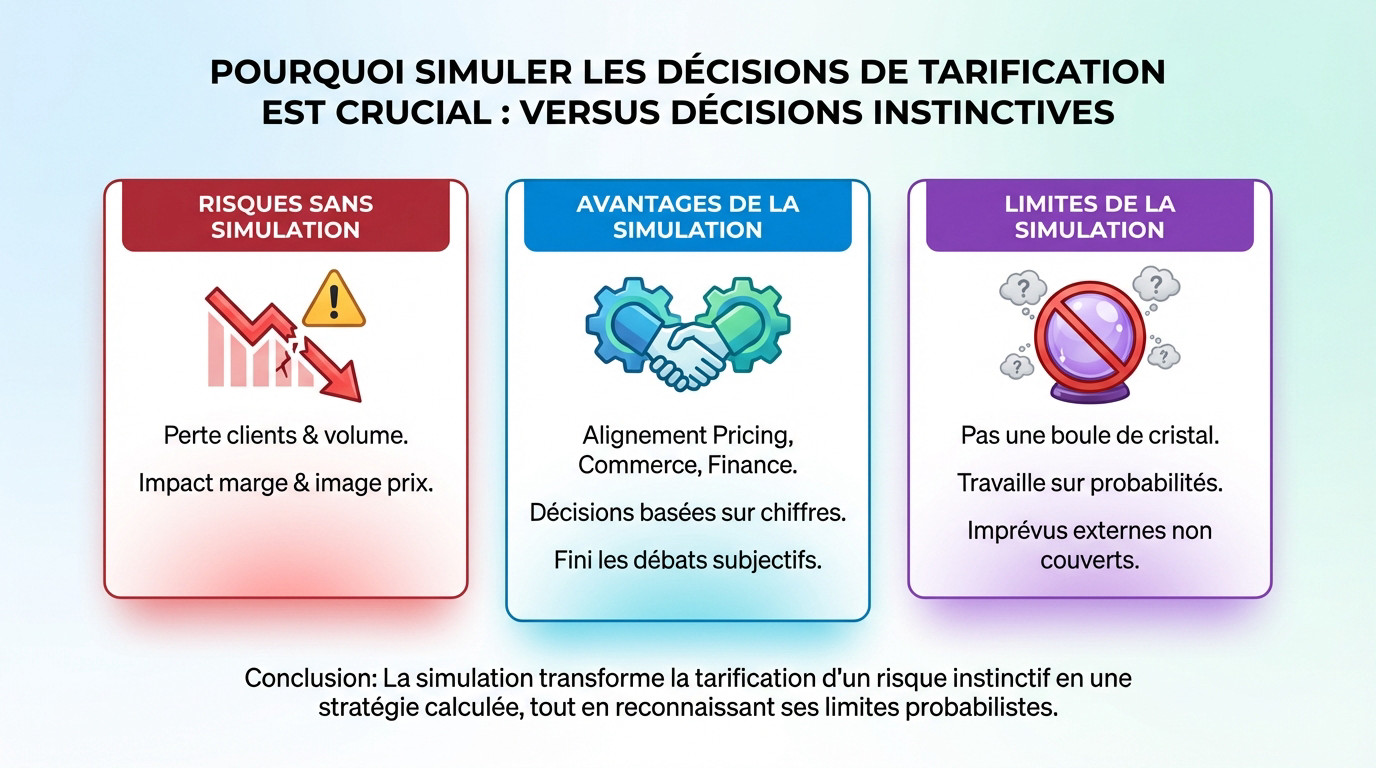
The risks of untested price changes (margin, volume, churn, price perception)
A poorly timed price increase will drive customers away and cause sales to plummet. Worse still, it will permanently damage your reputation for value. The profit you were hoping for will then turn into a net loss.
Simulation as an alignment tool (pricing, sales, finance)
No more fruitless debates: simulation brings everyone together around hard data. Finance and sales are finally speaking the same language. It’s a healthier approach.
What a simulation can (and cannot) predict
Please note: this is not a crystal ball. We’re working with probabilities, not certainties. External shocks remain unpredictable. Let’s remain humble when it comes to models.
The main types of pricing simulations
Now that we know why we simulate, let's take a practical look at which models to use based on your needs.
Simple "scenario" simulation (assumptions and ranges)
Using high and low ranges helps you frame your pricing strategy simulation. This is the foundation for seeing the immediate impact.
Segmentation-based simulation (customers, channels, products)
Not all customers react the same way to pricing. It is important to identify strategic segments or specific channels to avoid costly mistakes.
Simulation with elasticity (if data is available)
Incorporating price sensitivity allows you to refine your forecast volumes with precision. This is whereAI really comes into its own when it comes to your margins.
Simulation of promotions and product mix (substitution effects)
You need to anticipate the shift in sales from one product to another. A poorly planned promotion can sometimes erode your own profit margins without yielding any real gain.
Simulation of cost increases (partial vs. full pass-through)
We need to figure out how to absorb inflation without driving everyone away. It’s a constant balancing act to protect profitability.
The data needed to perform an accurate simulation
For these models to work, they need to be fed with clean, relevant data.
Transaction history (prices, volumes, discounts, customers)
You can’t make decisions in the dark. You need to analyze past data to understand actual purchasing behavior. Demand granular, thoroughly cleaned transaction data for a reliable pricing strategy simulation.
Costs and margins (COGS, logistics, service)
Include your actual costs—COGS and service—so you never run simulations that result in a loss. Logistics often account for just as much of the cost as purchasing alone.
Commercial constraints (contracts, schedules, exceptions)
Algorithms must comply with your framework agreements and existing contractual limits. You cannot modify a pricing schedule without verifying the legality of any deviations. This is an essential safeguard.
External factors (inflation, competition), if applicable
Keep an eye on inflation and competitors’ moves, as the market sets your ceiling. These external factors often limit your actual room to maneuver far more than your internal preferences.
A 7-step method for building a reliable simulation
Here is a step-by-step guide to setting up your simulation without getting lost along the way.
1) Define the objective (margin, volume, market share, price image)
Decide on your top priority—margin or volume—before running any calculations.
2) Choose a specific scope (products/segments/channels)
Start small. A representative sample is often enough to identify clear trends.
3) Define the assumptions (elasticity, churn, substitution)
Set the parameters: if you raise prices by 5%, how many customers will leave?
4) Develop three scenarios (conservative / realistic / aggressive)
Test both worst-case and best-case scenarios to immediately identify financial risks.
5) Analyze the results and sensitivity (which changes everything)
Identify the critical factors. Sometimes even the smallest detail can make all the difference in the final result.
6) Implement safeguards (corridors, exceptions, validations)
Set firm limits. No algorithm should fall below your critical threshold.
7) Launch a pilot program + measure results + iterate
Test it on a small scale, then make adjustments based on feedback from the field.
5 practical simulation scenarios (B2B/B2C)
Case 1: Price increase across a product line (margin target)
Simulating a targeted price increase helps restore profitability. This immediately reveals whether the resulting change in sales volume offsets the gain.
Case 2: Reduction of discounts and clarification of exceptions
It is essential to curb excessive sales promotions by limiting discounts. That is often where lost profit lies.
Case 3: Targeted promotion to clear inventory without damaging the brand’s price image
Find the right price to clear out the warehouse. The idea is to sell off inventory without getting customers used to constant clearance sales.
Case 4: Rising costs: What percentage should be passed on?
Check whether you need to pass on 50% or 100% of inflation. A pricing strategy simulation shows the break-even point.
Case 5: Declining competition: Follow, differentiate, or hold?
Assess the impact of aligning with low prices. Sometimes, doing nothing is the best financial strategy for the P&L.
Essential safeguards for your simulations
Ensure your pricing strategy simulation is supported by these essential safeguards:
- Minimum prices: Ban sales at a loss.
- Margin alerts: Prevent any critical margin erosion.
- Human validation: The expert must validate the output.
- Corridors: Stay in line with market trends.
Simulating your prices is no longer an option but a necessity to protect your bottom line.
Through rigorous modeling and robust safeguards, you turn uncertainty into a profitable strategy.
Adopt this approach to increase agility and ensure sustainable growth without putting your business at risk.
Frequently Asked Questions
Articles similar

Building a high-performing pricing team requires adopting a hybrid model that combines centralized strategy with local agility. This transition replaces intuition with data-driven decisions, guided by specialized roles and strict governance.
This proactive management directly improves financial performance, enabling companies to aim for an increase in profitability of between 100 and 500 basis points.

In response to the radical price transparency of 2026, the retail sector is adopting automated management. This strategy protects margins against inflation by ensuring immediate responsiveness across all channels.
A high-performance tool guarantees a return on investment in less than six months, making pricing a cornerstone of net profitability.

Product matching is the foundation of competitive monitoring because it prevents the comparison of non-equivalent products. Reliable product matching safeguards margins by basing repricing on real-time, multi-source data.
Key finding: According to the Diamart study, 50% of French retailers still consider this challenge to be unresolved.