How to Structure an Effective Pricing Organization: roles, governance, and processes

Edouard Calliati
CMO - CRO
June 11, 2026
An effective pricing organization relies on clear governance and a hybrid model that combines centralized strategy with local agility. By defining specific roles—such as Pricing Analyst or Head of Pricing—using a RACI matrix, the company safeguards its margins and competitiveness. This operational rigor transforms pricing into a lever for immediate and sustainable profitability.
Summary of the article:
Pricing is the most powerful driver of profitability in retail, but its effectiveness depends on a well-defined organizational and operational structure. Without a rigorous pricing strategy, companies face invisible margin erosion and pricing inconsistencies that erode customer trust.
We will explain how to build a strong governance framework by defining key roles, centralization models, and weekly processes to turn your strategy into tangible results.

Why pricing strategy makes all the difference
A structured pricing organization is based on three models (centralized, decentralized, or hybrid) and specific roles such as Pricing Strategist or Analyst. Effective execution ensuresa balance between margin and competitiveness through weekly routines.
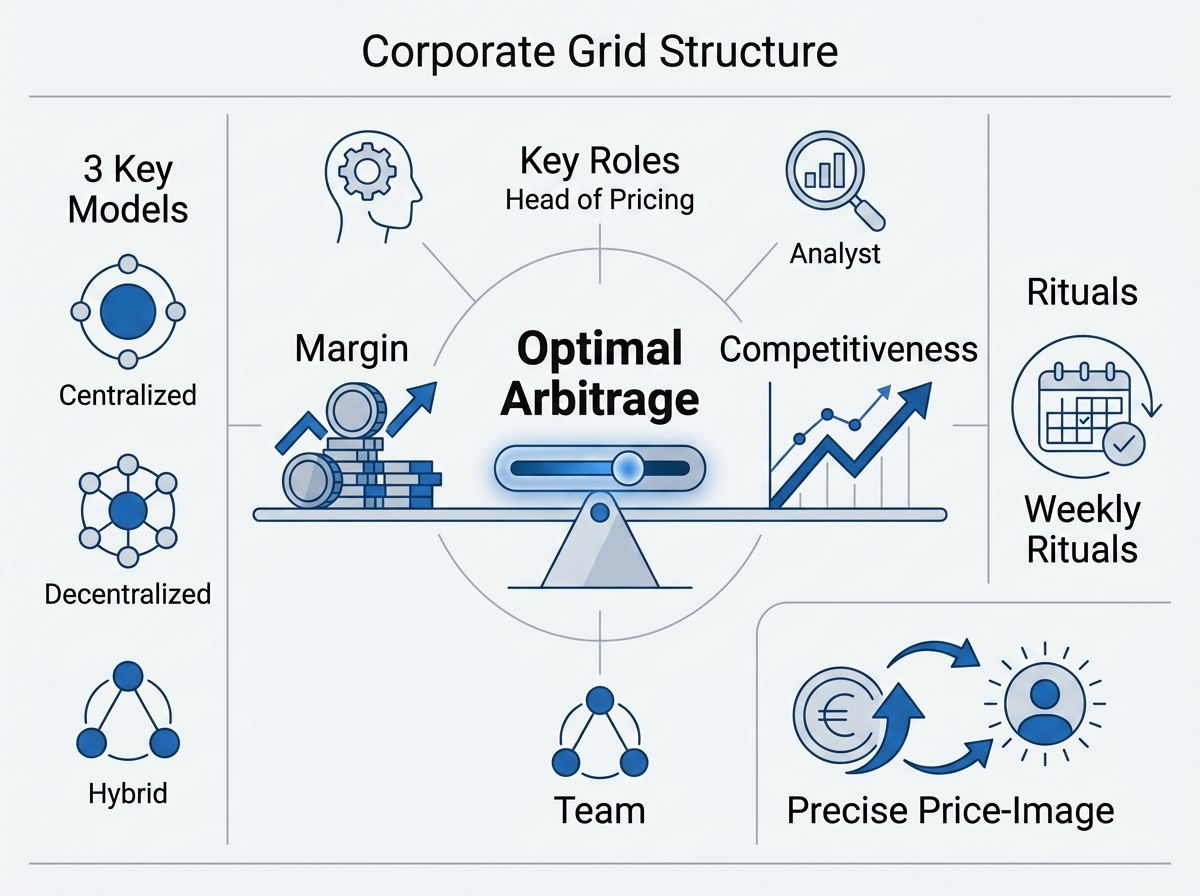
In fact, pricing isn't just a simple price tag; it's a constant balancing act between pure profitability and the price image perceived by your customers.
Margin / competitiveness / price-image: trade-offs + execution
Pricing is the most powerful driver of profitability. It requires a constant balancing act between protecting margins and remaining competitive.
Rigorous execution is what ultimately turns strategy into results. Without proper organization, your decisions remain theoretical and have no real impact on your revenue.
The price image depends on this accuracy. Every penny counts for the customer.
Signs of a "weak" pricing organization
Be on the lookout for delays in updates or data entry errors. Conflicts between purchases and sales are on the rise. No one knows who approves the final price. It’s total operational chaos.
Margins are eroding, and management is powerless to respond. As a result, competitive monitoring either ceases to exist or remains outdated and manual.
The 3 pricing models
To avoid these pitfalls, choosing a structural model is the first step in any transformation.
Model 1: Centralized (when ideal)
A single team manages all pricing from headquarters. This model ensures complete consistency and a comprehensive overview. It greatly simplifies margin control.
Ideal for organizations with a consistent product catalog. Specialized tools help improve efficiency.
However, responsiveness may suffer as a result. Field staff sometimes feel disconnected.
Model 2: Decentralized (Advantages/Risks)
Here, each category or country sets its own prices. Local knowledge is the strength of this approach. It allows for a quicker response to regional specifics.
The main risk remains an internal price war. The company's overall brand image is suffering.
The tools are often inconsistent. Financial management becomes a nightmare.
Model 3: Hybrid (the most common in omnichannel)
The center sets the strategic pricing framework and price limits. Local teams operate within this defined scope. This is the ideal balance for modern retail.
This model enables companies to manage the complexity of omnichannel operations with agility. It maintains a national pricing strategy while allowing for local adaptation. Both internal and external data flows related to pricing are better managed. Responsibilities are clearly allocated across different levels.
Communication must be seamless. Shared tools are essential here.
Key roles in a pricing team
Once the model has been chosen, you need to determine who does what to ensure that the system runs smoothly.
Head of Pricing / Pricing Strategist
This profile defines the company's long-term vision. It aligns pricing policy with overall financial objectives. It presents the strategy to the executive committee.
He mediates major conflicts between departments. His role is primarily political and strategic.
It ensures overall profitability. It is the driving force behind pricing.
Pricing Manager / Category Pricing
He manages a specific product line on a daily basis. His goal isto optimize the mix of margins and volume. He works closely with buyers.
He approves tactical price changes. He has a thorough understanding of his market and competitors.
Pricing Analyst
He is the expert in data and modeling. He analyzes price elasticity and simulates the impacts of future changes. He produces performance reports.
It identifies opportunities to increase margins. Its recommendations guide decision-making.
Pricing Operations (Execution & Monitoring)
This role ensures that prices are accurately updated in the systems. It verifies that the displayed price is correct. It is responsible for ensuring operational execution.
It manages data flows to labels or the web. It quickly corrects technical errors.
Data Steward / Data Quality
Without your own data, effective pricing is impossible. He ensures the quality of the product catalog and attributes. He regularly cleans up the databases.
He serves as the liaison with IT. Ensuring the reliability of the catalog is his top priority.
Trade Marketing / Promotions
He coordinates promotional activities with the sales calendar. He ensures that discounts do not undermine product value. He manages the visibility of promotional offers.
He analyzes the generosity of promotional offers. His focus is on in-store promotions.
E-commerce & marketplaces
He monitors price consistency across digital channels. Marketplace algorithms require constant monitoring. He adjusts prices to remain competitive.
It handles the unique aspects of the web. Responsiveness is the key factor here.
Finance / Margin Control
He ensures that pricing decisions stay within the annual budget. He monitors deviations in gross margin from forecasts. He serves as the organization’s financial safeguard.
He analyzes the actual cost. He provides the necessary accounting perspective.
RACI: Who Decides What
To ensure that these roles do not overlap, a matrix of responsibilities is essential.
Price and Exception Management
The table above illustrates the complexity of these interactions. Every decision must follow a specific approval process. This prevents isolated and risky initiatives.
There is often only one approver (A). The reviewers (C) provide the necessary expertise.
Transparency builds trust. Everyone knows their place.
Essential daily processes
An organization without rituals is a dead organization; here’s how to bring pricing to life.
Weekly Tactical Review (Prices/Promotions)
This weekly meeting allows us to respond to changes in the competitive landscape. We finalize the promotions for the following week. We also discuss inventory adjustments to ensure we remain agile.
This is a short, very practical meeting. We’re focusing on immediate steps to quickly boost sales.
Efficiency comes first. No lengthy theoretical debates. Decisions are made quickly.
Monthly Strategy Committee
We take a step back to assess the past month’s performance. We adjust the overall positioning as needed. The pricing structure is reviewed and revised in line with the established profitability targets.
Senior management often participates in these meetings. We finalize the key priorities for the coming quarter with the finance managers.
It's time to make a decision. We're looking at the underlying trend.
Pricing Alerts, Exceptions, and Monitoring
Automatic alerts flag price or margin anomalies. A validation workflow is triggered for cases that fall outside the limits. Everything must be logged for accurate future analysis.
Competitor monitoring runs continuously. Alerting tools notify teams in real time. This helps prevent needless lost sales. Responsiveness becomes a major competitive advantage for the brand in the marketplace.
Exceptions become lessons. We refine the rules as we go. That's what continuous learning is all about.
Organizational KPIs: Measuring Performance
You can only manage what you measure effectively, especially when it comes to operational pricing.
Indicators of responsiveness and quality
Time-to-market measures the time between a decision and its implementation. The error rate reflects the reliability of your processes. These two KPIs are critical to pricing strategy.
KPI coverage ensures your competitiveness in key products. The ROI of promotions allows you to discontinue ineffective campaigns. We also monitor the rate of exceptions handled manually. A rate that is too high indicates a lack of automation.
Finally, omnichannel consistency prevents customer frustration. Consistent pricing across all channels strengthens the brand. It’s the ultimate arbiter of your pricing strategy.
Implementation: 30/60/90-day plan
Building a team doesn't happen overnight, but here's a roadmap.
The Three Steps in Deploying a Pricing Tool
The first 30 days are used to define roles and establish routines. We identify gaps in data. This is the observation and diagnostic phase. This step allows us to analyze current workflows between headquarters and stores to identify disconnected systems. We then define initial performance metrics, such as product availability.
At the 60-day mark, we pilot the new processes for a specific category. We roll out the monitoring dashboards. The exception workflow is tested in a live environment. We adjust the tools based on feedback from the field. This design phase allows us to validate the solution’s architecture and plan the necessary training. We ensure that the automated workflows integrate properly with the information system without creating technical debt.
After 90 days, the method is rolled out company-wide. Team training is complete. We are entering a cycle of continuous improvement. The large-scale rollout is accompanied by rigorous tracking of return on investment and process stabilization. Governance procedures are now firmly established to ensure full traceability of pricing decisions across all sales channels.
Common mistakes (and how to avoid them)
The shift from an accounting-based approach to a true pricing strategy requires discipline, but above all, it requires avoiding common organizational blind spots.
The Pitfalls of Centralization and Isolation
Over-centralizing pricing decisions cuts the field team out of the loop. Prices then become theoretical and out of touch with local realities. It’s important to always listen closely to feedback from salespeople.
Conversely, decentralizing everything leads to total pricing chaos. Without a framework, margins quickly collapse. Pricing should never operate in a closed silo. Isolating pricing from e-commerce or inventory management is a fatal mistake.
The lack of logs prevents learning. Document every major decision to ensure transparency and auditability.
Checklists (ready to use)
Finally, here are two practical lists to help you get started tomorrow.
Structure and Governance
Set up your pricing structure:
- Definition of the model (centralized, decentralized, or hybrid).
- Appointment of the Head of Pricing.
- Audit of source data.
- Selection of technological tools.
- Creating the RACI matrix.
Managing governance and processes:
- Schedule of weekly tactical reviews.
- Monthly Strategic Committee Template.
- Automatic alert thresholds for competitors.
- Post-mortem process following each promotion.
- Secure access to change logs.
These checklists are your safety nets. Use them to assess your current organization. They ensure that nothing gets overlooked in the heat of the moment.
Conclusion
Pricing is a team effort that requires discipline and the right tools.
Successful pricing strategy isn't just about implementing powerful software. It's primarily a matter of the operating model: defining who makes decisions, following what processes, and using what data. By structuring your roles and governance, you can turn pricing into an agile driver of profitability.
Organizational structure always takes precedence over tools when getting started. Once your processes are up and running, automation will significantly boost your results. To help you organize your teams and refine your strategy, Booper’s experts will guide you through this operational transformation.
An effective pricing organization relies on clear governance, weekly routines, and a hybrid model that combines strategic control with local agility. Define your key roles now to secure your margins and reduce your time-to-market. Structure your team today to dominate your market tomorrow.
Frequently Asked Questions

Building a high-performing pricing team requires adopting a hybrid model that combines centralized strategy with local agility. This transition replaces intuition with data-driven decisions, guided by specialized roles and strict governance.
This proactive management directly improves financial performance, enabling companies to aim for an increase in profitability of between 100 and 500 basis points.

Facing a sudden drop in conversion rates because your competitors are adjusting their prices in real time means you need to equip yourself with the best data-driven retail pricing strategy tool for 2026 to stay competitive. Price transparency in 2026: Retailers are automating pricing to protect their margins against inflation, improve omnichannel responsiveness, and generate a quick ROI.
Discover how these tools automate your specific business rules while ensuring complete strategic control over your brand image and delivering a measurable return on investment in less than six months.
This detailed comparison analyzes specialized platforms capable of predicting price elasticity and managing your omnichannel inventory to turn every piece of raw data into immediate, tangible profit.

Product matching is the foundation of competitive monitoring because it prevents the comparison of non-equivalent products. Reliable matching safeguards margins by basing repricing on real-time, multi-source data.
Key finding: According to the Diamart study, 50% of French retailers still consider this challenge to be unresolved.