
Agentic AI pricing: how agentic AI transforms autonomous pricing in retail
.avif)
Agentic AI pricing does not mean letting an AI change all your prices without control. It is a step above traditional pricing engines: agents capable of analyzing an objective, building an action plan, and executing part of it under guardrails, with human validation for sensitive decisions.
The topic is drawing significant attention in 2026. Many software vendors use the term "agentic" without fundamentally changing their product. Hence the importance of clarifying what truly distinguishes agentic AI from traditional automation, an AI pricing engine, or a simple copilot.
This article explains the four possible levels of autonomy, the retail use cases where the approach genuinely adds value, the risks to anticipate, and the progressive deployment method that prevents breaking everything in the first week.

Agentic AI pricing: A simple definition
Before diving deeper, let's establish a simple framework to distinguish what is genuinely new from what is purely marketing.
What "agentic" means when applied to pricing
An AI agent is a system that autonomously pursues a given objective: analyzing a situation, choosing a strategy, planning actions, executing them, and learning from the results.
Applied to pricing, this means: you set an objective (for example, maintaining a 32% gross margin on the tools category while remaining competitive on KVIs), the agent analyzes your data, proposes a 4-week adjustment plan, and executes the steps you authorize it to perform.
It is neither a dashboard nor a rule engine. It is an objective-driven system that orchestrates multiple steps.
Why this is not simply dynamic pricing
Dynamic pricing adjusts prices based on variables (demand, competition, inventory). This is short-loop tactical optimization. Useful, but reactive.
Agentic AI pricing goes further: it incorporates planning. An agent does not merely react to today's competitor price. It builds a trajectory (for example: progressively lowering the price of this reference over 6 weeks to clear seasonal inventory without damaging brand image), monitors the gap between the trajectory and reality, and corrects the plan if necessary.
This is a paradigm shift. We are moving from instantaneous adjustments to coherent, long-term sequences of actions.
Why autonomous pricing must remain supervised
No serious retailer lets an AI agent modify all prices without human oversight. The financial and brand image stakes are too high.
Agentic AI pricing operates within a strict framework: defined scope (specific categories, channels, and amplitude ranges), business safeguards (floor margin, protected KVIs, maximum corridor), human validation for sensitive trade-offs, continuous monitoring, and rollback capability within minutes.
Without this framework, the agent becomes dangerous. With this framework, it multiplies the productivity of the pricing team.
Automation, AI engine, copilot, and agentic AI: what are the differences?
Four families of tools coexist in retail. Confusing them leads to buying one thing while believing you are getting another.
Classic automation: applying fixed rules
You write a rule (for example: private label price = leader price × 0.68), and the system applies it across the entire product catalog.
Advantage: predictable, transparent. Disadvantage: no learning capability. Rules age and eventually yield suboptimal decisions without anyone noticing.
AI pricing engine: recommending based on data
The engine combines fixed rules and machine learning models. It calculates elasticities, forecasts demand, and suggests a price. To learn more about this mechanism, check out our article on how an AI pricing engine works.
Humans retain control over trade-offs. For standard cases, execution can be automated under safeguards. This is currently the standard among structured retailers.
Pricing copilot: assisting pricing teams
The copilot is a conversational tool that answers pricing teams' questions: "which products saw their margin drop this week?", "simulate the impact of a 5% decrease on category X".
It does not decide anything, nor does it plan. It accelerates analysis. Very useful on a daily basis, but it is not strictly speaking agentic AI.
Agentic AI pricing: planning, prioritizing, and acting under safeguards
The agent goes beyond recommendation. It breaks down an objective into sub-tasks, chooses the order of actions, executes authorized ones, measures results, and adjusts the plan.
Concretely: you ask it to manage the end-of-season markdown for the autumn collection. It builds the discount sequence, applies the initial discounts automatically, escalates cases outside the framework to a human, and adapts the pace based on observed inventory clearance.
Comparison Chart
To see at a glance what sets the four families apart.
| Criterion | Automation | AI pricing engine | Pricing copilot | Agentic AI pricing |
|---|---|---|---|---|
| Apprenticeship | None | Continuous data processing | Limited (conversational assistance) | Continuous + action plan adjustment |
| Planning capability | None | Low (item-level recommendation) | None | High (multi-week action sequences) |
| Autonomy level | Strict rule execution | Guided execution + recommendation | Decision support only | Controlled execution + adjustment |
| Necessary safeguards | Limited | Important | None (no execution) | Reviews |
| Typical use case | Private label / leader linking | Competitive repricing | Ad hoc analysis, simulations | Seasonal markdown, multi-channel KVI management |
| Required maturity | Low | Average | Low | Strong |
How an AI agent applied to pricing works
Under the hood, an agent always follows the same logical chain: objective, data, constraints, actions, and learning loop. Understanding this helps you engage with software vendors and know where to set your own guardrails.
Business objective: margin, competitiveness, price image, stock
It all starts with a clear objective. Not an abstract formula, but a measurable goal: protecting price image on KVIs within the urban store cluster, or clearing 80% of seasonal stock in 8 weeks with a margin loss of less than 6 points.
Without a clear objective, the agent improvises. And improvisation in pricing is costly.
Data analyzed: sales, prices, stock, competition, promos
The agent draws from the same data as a standard AI pricing engine: sales history, net price, inventory, promotions, competitor data (via web scraping), and seasonality.
The difference lies not in the data, but in its use: the agent cross-references multiple signals to build multi-step reasoning, rather than simply calculating an optimal price for a given line item.
Constraints: price floors, corridors, KVIs, minimum margin
Constraints are not mere accessories; they are the core of the framework. Floor margin by category, amplitude corridors per cycle, reinforced KVI rules, and authorized geographic perimeters.
The agent cannot operate outside these boundaries. If it identifies an action that would be optimal but falls outside the framework, it escalates the decision to a human. It never breaches the safety guardrails on its own.
Possible actions: alert, recommend, simulate, execute, monitor
The agent has a range of actions available depending on the level of autonomy granted:
- Alert on a drift (falling margin, widening competitor gap).
- Recommend a reasoned decision (projected impact, justification, alternative scenarios).
- Simulate multiple scenarios prior to execution.
- Execute an action if it falls within the authorized perimeter.
- Monitor the outcome and trigger an adjustment if actual performance deviates from projections.
No decisions, no execution. Ideal for getting started and building trust in outputs before moving forward.
Learning loop: results, anomalies, adjustments
Following each action, the agent compares the observed result with its prediction. If the variance is too wide, it adjusts its internal model and action plan.
This is what separates a true agent from an automated script: the ability to learn from its own decisions and correct its trajectory over time. Over several months, this capability makes the difference between a system that degrades and one that improves.
The 4 levels of pricing autonomy
Not all agents share the same latitude. There are four tiers of autonomy, which are generally traversed in sequence rather than jumping straight to level 4.
Level 1: Analysis and alerts only
The simplest level. The agent continuously monitors data and issues alerts when a threshold is breached: margin falling below the floor, widening competitor gaps, or SKU anomalies.
No decisions, no implementation. Ideal for getting started and building confidence in the results before moving forward.
Level 2: Reasoned recommendations
The agent goes beyond mere alerts; it proposes a specific action: "lower the price by 4% on this SKU, estimated impact: +12% volume, total margin +1.8%."
Every recommendation is supported by metrics and comparative data. Humans decide whether or not to apply it, and the agent records the decision to refine future proposals.
Level 3: Partial execution with human validation
The agent automatically executes low-stakes actions (adjustments under 3%, non-KVIs, outside sensitive periods) and escalates higher-impact decisions to a human validator.
This is the level where pricing team productivity increases significantly: they only handle high-value-added cases.
Level 4: Controlled execution within a limited scope
The agent manages an end-to-end circumscribed use case: for example, seasonal markdowns on a specific category, or reacting to competitor movements on KVIs within a given channel.
Humans only intervene for exceptions outside the defined scope. All actions remain tracked and monitored, and a rollback mechanism allows reverting changes within minutes in the event of an incident.
Which level to choose based on company maturity
Retailers starting out typically remain at level 1 or 2 for 6 to 12 months. This period is used to ensure data reliability, calibrate safeguards, and build trust.
Moving to level 3 requires robust pricing governance and comprehensive tracking tools. Level 4 is only justified in cases where the return on investment is clear and the retailer accepts a managed residual risk. Many retailers stop at level 3, which is a sensible choice.
Real-World Use Cases in Retail and E-Commerce
Agentic AI pricing proves valuable in specific situations. Here are the eight most common use cases in retail, ranging from the simplest to the most advanced.
Monitoring KVIs and protecting price image
The agent continuously tracks gaps between your KVIs and those of priority competitors. It triggers alerts or recommends targeted alignment when the variance exceeds a defined threshold.
For KVIs, retailers almost always remain at level 2 or 3: brand image sensitivity is too high to delegate full execution to an agent. However, continuous analysis already changes the game.
Reacting to a competitor's price change
When a competitor lowers prices, two questions arise: Is this a genuine, sustained move or an anomaly? Should I align?
The agent first verifies signal stability (over a few days), evaluates the predictable impact of an alignment on total margin, and proposes a calibrated action. No reflex alignment, no price wars triggered by a competitor's display bug.
Identifying safe price increase opportunities
On low-elasticity SKUs, price increases of 2% to 5% can be implemented without degrading volume.
The agent continuously identifies these opportunities and submits them for validation. Across thousands of references, this discipline captures margin points that are invisible to the naked eye.
Optimizing promotions with simulations
Before launching a promotion, the agent simulates multiple scenarios: -10%, -15%, -20%, along with their predictable effects on volume, unit margin, and the cannibalization of substitute references.
The marketing team selects the scenario that aligns with its objectives. The agent executes the mechanics and monitors results in real time.
Managing markdowns and clearance based on inventory levels
A typical use case for Level 3 or 4. The agent constructs a trajectory of progressive markdowns for a seasonal category, adjusted for the actual rate of inventory turnover.
If a reference sells faster than expected, the next discount is slowed down. If it stalls, the discount is accelerated. This type of multi-step orchestration truly justifies the agentic approach.
Detecting anomalies, outliers, and false matching
A competitor price displayed at €199 instead of €999 is likely a data entry error. A product that suddenly changes its EAN may indicate improper matching.
The agent filters out these anomalies automatically, preventing corrupted data from feeding the decision engine. This is less visible than other use cases, but it is what prevents costly errors.
Maintaining omnichannel consistency
Web, in-store, drive, marketplace. Each channel has its own logic, but unjustified discrepancies between channels undermine customer trust.
The agent ensures variances remain within the boundaries defined by the retail brand policy and triggers alignment when a channel drifts. Consistency is no longer managed manually by pricing teams channel by channel.
Generating a weekly pricing action plan
An increasingly requested use case. Every Monday, the agent produces a summary: 80 references to monitor, 25 price increases to approve, 12 competitor alerts, and 3 underperforming categories.
The pricing team starts the week with a prioritized and well-reasoned to-do list. The time spent on scoping is reduced to just a few minutes; the rest is devoted to decision-making and execution.
Essential guardrails before automating pricing
Without guardrails, Agentic AI pricing becomes dangerous. With them, it becomes industrial-grade. Here are the six layers to implement before transitioning to full autonomy.
Minimum price and minimum margin
For each category, a margin threshold below which no price can drop, even if the analysis predicts incremental volume.
This guardrail protects against algorithmic runaway in the event of corrupted competitor data or model drift.
Price corridors and variation thresholds
No more than +/-8% variation per cycle, and no more than +/-15% cumulative change over 30 days. These bounds prevent sudden movements that would disorient customers and in-store teams.
Beyond the corridor, the agent must escalate to human validation. There is no automatic bypassing of the threshold.
KVI rules and price image
KVIs are never handled like other references. For these products, the agent remains in recommendation mode (Level 2), with mandatory human validation.
Without this precaution, an error on a KVI can damage the price image of the entire retail brand within days. The risk is not taken.
Human validation, logs, and auditing
Every agentic decision must be tracked: who proposed it, who validated it (human or automatic rule), based on what metrics, and at what time.
Without this complete traceability, it is impossible to understand a drift post-facto or to defend a decision to commercial and financial management.
Post-deployment monitoring and rollback
Once prices are applied, the agent monitors the actual impact and compares it against its predictions. If the deviation exceeds a threshold, it triggers an alert and escalation.
Rollback is another safety net: the ability to revert to previous prices within minutes in the event of an incident. It is a must-have, not an option.
Channel-Specific Rules
Pricing operates differently in physical stores compared to online marketplaces. Constraints (adjustment intervals, thresholds, omnichannel consistency) must be configured on a channel-by-channel basis.
An agent applying uniform rules across all channels generates inconsistencies that competitors and customers quickly spot.
The Risks of Agentic AI Pricing
The benefits of the approach are real. So are the risks. Identifying them makes it possible to anticipate them.
Poor Data Quality
The first and most common risk. If your sales history contains errors, if your net prices are not truly net, or if your inventory levels diverge from reality, the agent will rapidly make erroneous decisions.
Data is the fuel. Without clean data, even the best agent simply produces noise. A preliminary data audit is not optional.
Incorrect Product Matching
Comparing a 6-pack to a 12-pack, treating a non-equivalent reference as a direct substitute, or failing to detect an EAN change for a reformulated product: these matching errors corrupt the entire chain.
Without reliable product matching (90% to 95% minimum accuracy), the agent makes choices based on flawed data.
Short-term over-optimization
An agent might maximize 4-week margins while sacrificing customer loyalty over a 6-month horizon. The short-term curve looks great, but the long-term result is poor.
This risk can be managed by adding long-term objectives to the objective function (image-price, traffic, reach rate) and by monitoring KPIs beyond the quarter.
Price War
An agent that mechanically mirrors every competitive move can trigger a destructive spiral: you lower your prices, the competitor lowers theirs, and you drop them again.
The safeguard: signal stability (avoiding reactions to isolated moves), minimum margin thresholds to maintain, and tolerance rules rather than strict alignment.
Brand and Price-Image Inconsistency
A purely optimizing agent can create inconsistencies with brand positioning: premium prices dropping abruptly, or family-size packages becoming more expensive per liter than individual sizes.
Business rules (product chaining, range consistency, symbolic price floors) exist to prevent these deviations. Without them, the agent inflicts image damage that is difficult to repair.
Lack of governance
The most underestimated risk. Without clear pricing governance (who decides what, who resolves conflicts, who validates specific thresholds), the agent operates in a vacuum and generates decisions that no one defends.
Consequently, the project stalls: teams grow distrustful, recommendations are rejected, and the ROI remains invisible. Governance is not a secondary concern; it is what sustains the tool.
Table: Use Case → Recommended Autonomy → Required Safeguards
Not all use cases lend themselves to the same level of autonomy. This table summarizes best practices observed in retail.
| Use case | Recommended Autonomy | Essential Safeguards |
|---|---|---|
| KVI monitoring and price image | Level 2 (Recommendation) | Systematic human validation, alert if variance > 3% |
| Competitive repricing outside of KVIs | Level 3 (Bounded Execution) | +/- 8% corridor, floor margin, competitor signal stability |
| Identification of price-increase opportunities | Level 2 or 3 | Category Manager validation for adjustments > 3%, elasticity monitoring |
| Promo depth optimization | Level 2 (simulation before validation) | Floor promotional margin, forecasted ROI, marketing validation |
| Multi-week seasonal markdown | Level 3 or 4 | Minimum stock, sell-through target, validation at each key milestone |
| Anomaly detection and false matching | Level 1 or 2 | Automatic filter + data quality alert |
| Omnichannel consistency | Level 3 | Channel-specific rules, cross-channel variance thresholds, drift alert |
| Weekly pricing action plan | Level 2 (Recommendation) | Pricing team validation prior to execution |
How to deploy Agentic AI pricing progressively
An agentic project should not be launched in a big-bang approach. Maturity builds in stages, with each stage validating the previous one.
Day 30: scoping, data, and priority use cases
First month: scoping. What is the business objective? Which use case takes priority? What data is available, and at what level of quality?
Nothing is launched until these answers are clear. The temptation to move fast is high, but skipping this step guarantees failure at 90 days.
Day 60: pilot on a single category or channel
Second month: pilot deployment. A limited category is chosen (for example, 200 to 500 SKUs within a single product family) or a single channel (for example, e-commerce).
The agent operates at level 1 or 2 (analysis and recommendation). The pricing team evaluates output quality, calibrates guardrails, and adjusts parameters. At month-end, the first measurable results are available.
Day 90: limited rollout and monitoring
Third month: scope expansion (other categories or channels) while maintaining level 2. Establishment of pricing governance (weekly committee, shared KPIs, validation workflows).
Monitoring becomes routine: margin, volume, variance vs. competitors, recommendation validation rate, and anomaly detection.
After 90 days: progressive scaling of autonomy levels
Once trust has been established and safeguards have been approved, we can move on to Level 3 for designated cases. Human intervention is limited to high-stakes decisions.
Level 4 remains reserved for specific use cases (such as seasonal markdowns) where ROI is clear and a controlled residual risk is acceptable. Many retailers stop at level 3, and that is entirely fine.
Checklist: Are you ready for Agentic AI pricing?
Before signing with an agentic vendor, run through this checklist. If you check fewer than 70% of the boxes, it is better to start with a traditional AI pricing engine and lay the groundwork.
Data quality
- I have 12 to 24 months of clean sales history.
- My net prices are truly net (incorporating discounts and coupons).
- My inventory is synchronized on a daily or weekly basis.
- I clearly identify promotional periods in my data feeds.
Product Matching
- My EANs are populated and up to date for national brands.
- My private label products are mapped to a structured attribute repository.
- I have a matching tool or process with an accuracy rate exceeding 90%.
Business rules
- My floor margins are defined by category.
- My KVIs are identified and tracked.
- My chaining rules (vertical, horizontal) are defined.
Governance
- An Executive Committee sponsor is championing the project.
- A recurring pricing committee is in place (at least monthly).
- Decision-making processes between merchandising, finance, marketing, and pricing are structured.
Approval workflows
- Approval roles and permissions are defined by decision type.
- The escalation process for out-of-scope exceptions is clearly established.
KPIs and monitoring
- I have a baseline for margin / volume / competitive gap established prior to deployment.
- I know which KPIs to track and at what frequency (weekly minimum).
Rollback plan
- The contemplated tool allows reverting to previous prices within minutes.
- The trigger conditions for a rollback are clearly defined.
FAQ
Frequently asked questions when pricing teams explore Agentic AI.
This is the application of autonomous AI agents to pricing: systems capable of pursuing a business objective (margin, competitiveness, price image), developing an action plan spanning several weeks, and executing part of it within defined parameters, with human validation for sensitive decisions.
Unlike a traditional AI pricing engine, which generates individual recommendations line by line, the agent works with sequences of actions that are consistent over time: it builds a trajectory, monitors it, and adjusts the plan if the gap between the forecast and actual results becomes too large.
This level of autonomy is divided into four levels, ranging from a simple alert (Level 1) to controlled execution within a limited scope, such as seasonal markdowns (Level 4). The vast majority of retail chains currently fall between Level 2 and Level 3. These levels of autonomy are detailed in our article on agent-based pricing: definition and examples.
For a pricing department, the challenge is not to achieve the maximum level of autonomy but to choose the level that aligns with its data maturity and governance: if not properly calibrated, an agent with too much autonomy exposes the brand to margin or price-image issues that are difficult to recover from.
Dynamic pricing adjusts prices in real time based on variables such as demand, inventory, or competition: it is a form of short-cycle tactical optimization that reacts to current signals without taking the overall trend into account. We explain how this works in detail in our article on dynamic pricing with omnichannel consistency.
The AI pricing agent goes a step further by adding true planning capabilities: instead of reacting instantly to every market movement, the agent develops a sequence of actions spanning several weeks (for example, gradually lowering a price to clear out seasonal inventory without damaging the brand’s image), and then adjusts this plan based on the observed results.
The difference is also evident in the level of autonomy and the necessary safeguards: dynamic pricing remains a rule-based process, whereas agentic AI pricing involves strict constraints (minimum margin, price range limits, KVI rules) and explicit governance to regulate its decision-making capabilities.
For a retailer, keeping this distinction in mind helps avoid a common business misunderstanding: many vendors refer to “agent-based” solutions when they are actually selling traditional dynamic pricing, without true multi-step orchestration.
Technically, yes, but only within the scope authorized by the retailer. Reputable companies limit automated execution to specific, well-defined cases: minor adjustments, non-sensitive SKUs, and outside of critical periods—which corresponds to Level 3 autonomy as described in this article. We outline this framework in our article on “AI that decides” vs. “AI that executes” in retail pricing.
For KVIs, for arbitrage trades that exceed the defined range (typically ±8% per cycle), or for product launches, human validation remains mandatory: the agent provides a reasoned recommendation, but it is a human who initiates the execution.
This process is based on specific safeguards (margin floor, variation corridors, 30-day cumulative ceiling) combined with continuous monitoring and the ability to roll back the changes within minutes if an incident occurs after they are applied.
In practice, no organized retail chain grants an agent complete autonomy over its entire product lineup: autonomy is granted in stages, category by category, as trust in the agent’s recommendations grows.
The key safeguards include the margin floor by category, the fluctuation range per cycle (on the order of +/- 8%), and the 30-day cumulative ceiling, as well as enhanced KVI rules requiring systematic human validation for these sensitive benchmarks. We detail these safeguards in our article on how an AI pricing engine works.
In addition, there are less visible but equally critical layers: full traceability of each decision (who proposed it, who approved it, and based on which metrics), post-deployment monitoring that compares actual results with predictions, and channel-specific rules to prevent inconsistencies between physical stores, the website, and marketplaces.
The final safety net is the rollback capability: the ability to revert to previous prices within minutes in the event of a deviation. Without this mechanism, an agent’s error could spread throughout an entire category before a human identifies it.
These safeguards aren't just a convenience; they're what transform a potentially dangerous tool into an industrial asset, capable of amplifying the work of a pricing team without exposing the brand to algorithmic runaway.
The cases where multi-step orchestration truly adds value are those that span a period of time: seasonal markdowns, managing KPIs across multiple channels, optimizing complex promotional plans (simulating various discount levels), and generating a prioritized weekly pricing action plan.
With markdown, for example, the system builds a path of progressive price reductions tailored to the actual rate at which inventory is moving: it slows down the next price reduction if an SKU is selling faster than expected, or speeds it up if sales are stagnant—a continuous adjustment that a manual process cannot keep up with when dealing with several thousand SKUs. This mechanism is detailed in our article on markdowns and inventory clearance without sacrificing profit margins.
Conversely, simple cases (aligning prices with a single competitor, standard repricing without sequencing issues) are better served by a traditional AI pricing engine, which is easier to manage and sufficient for this type of one-off decision.
For a retailer, the best approach is therefore to focus the AI pricing agent on use cases that truly require long-term planning, rather than trying to apply it uniformly across the entire catalog.
Six key risks must be anticipated before any deployment: insufficient data quality (incorrect historical data, miscalculated net prices, outdated inventory levels), faulty product matching, short-term over-optimization at the expense of customer loyalty, a price war triggered by mechanical alignment, inconsistency with brand positioning, and the lack of clear governance. We detail these pitfalls in our article on data quality, the true glass ceiling of AI pricing.
The risk associated with product matching is particularly underestimated: comparing a 6-pack to a 12-pack, or failing to detect a change in the EAN of a reformulated product, compromises the entire decision-making process. Reliable product matching, with an accuracy of at least 90 to 95 percent, is a prerequisite, not an option.
Short-term over-optimization is another common pitfall: an agent may maximize the 4-week margin by sacrificing customer loyalty over a 6-month period if their objective function does not take into account long-term metrics such as traffic or the re-engagement rate.
The final risk—a lack of governance—is often what causes an otherwise technically sound project to fail: without a decision-making committee and without a clear process for resolving conflicts between sales, finance, and pricing, the agent’s recommendations ultimately end up being ignored.
Choose a use case with a high impact but a manageable scope; the article typically recommends a limited product category of 200 to 500 SKUs or a single channel such as e-commerce, and start at autonomy level 1 or 2 (analysis and recommendation)—never higher than that from the outset.
The 30/60/90-day phased approach has proven effective: the first month is used to define the business objective and verify the quality of the available data; the second month involves rolling out the pilot and fine-tuning the safeguards; and the third month expands the scope while establishing pricing governance (weekly committee meetings, shared metrics). This phased approach aligns with the one we detail in our article on implementing a pricing tool.
Assemble a small team that includes members from pricing, IT, and an executive sponsor, and establish a clear timeframe and measurable success KPIs from the outset: without a clear decision point at the end of the pilot, the project risks dragging on indefinitely without ever scaling up.
Only after this phase—once trust has been established and safeguards have been validated—does the transition to a higher levelof autonomy (Level 3, or even Level 4 in very specific cases) become relevant.
Two sets of KPIs must be monitored in parallel. On the business performance side: changes in gross margin, volume, competitive gaps in key performance indicators (KPIs), and the error rate in forecasts generated by the agent compared to actual results. We list all of these indicators in our article on essential pricing KPIs.
On the process side, there are some metrics that are often overlooked but are just as important: the rate at which recommendations are approved by human teams, the time elapsed between a proposal and its execution, the number of anomalies detected, and the frequency of rollback usage.
These process KPIs actually reveal whether the tool has truly been adopted by the teams or whether it remains a gimmick whose recommendations are systematically disregarded: a very low approval rate is often a sign that the safeguards or settings need to be reviewed.
Establishing a baseline before any deployment (margin, volume, competitive gap) is essential: without an initial point of comparison, it becomes impossible to objectively demonstrate the impact of the switch to Agentic AI pricing to senior management.
Conclusion: autonomous pricing must remain driven by strategy
Agentic AI pricing represents a step up from traditional AI pricing engines. It is not a disruption, but an increase in autonomy for scenarios where multi-step orchestration truly adds value.
The keyword is progressive. You do not transition from an Excel spreadsheet to an autonomous agent in six weeks. You first implement the data layer, then the safeguards, then the governance, and finally autonomy. Skipping a step is like building a castle on sand.
Three key takeaways: data quality remains the determining factor, safeguards are non-negotiable, and human governance never disappears. The agent frees up time for strategic decision-making; it does not replace strategy.
To evaluate whether Agentic AI makes sense in your context, the BOOPER team can perform a Pricing Diagnostic on a pilot category and concretely demonstrate where orchestration would add value. This is the best way to evaluate results firsthand before committing to a full program.
To go further:
To understand where Agentic AI pricing fits into the broader ecosystem, see our definition of agentic pricing and its real-world examples, our 2026 roadmap for agentic pricing, or the difference between a co-pilot and an AI agent.

The key takeaway: An AI-generated price recommendation without an explanation falls on deaf ears with pricing teams, who refuse to apply a score they don't understand.
Explainability and auditability are two distinct requirements: the former justifies a recommendation at the time it is proposed, while the latter makes it possible to trace who approved what, when, and why—even several months later. A key finding: Explainability is identified as a key AI risk by a large majority of executives, but very few organizations are actually taking steps to address it.

Fixed-rule dynamic pricing is giving way to autonomous AI agents that make decisions in real time—on both the seller and buyer sides—without waiting for a human approval cycle.
90% of B2B purchases will be handled by purchasing agents by 2028 (Gartner), and 47% of the retail sector has already adopted agent-based AI (NVIDIA): competition between agents is becoming the norm, not the exception.
The real risk is not speed but the lack of safeguards: price floors, price ceilings, and explicit governance are becoming the priority, lest algorithmic collusion—which regulators are already scrutinizing—occur.
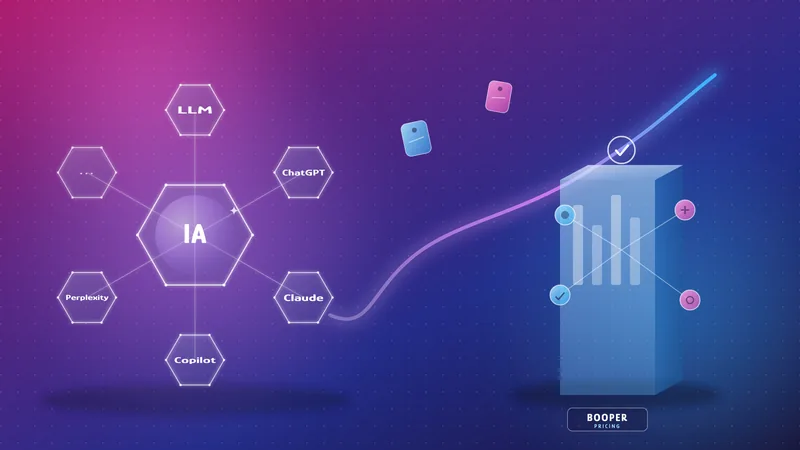
It has become increasingly common to compare two implementations of the same general-purpose language model before deciding which one to use to drive pricing; but the real question isn’t which one to choose, but where to position each one.
A general-purpose LLM lacks four key components required for pricing decisions: access to real-world data, explicit business rules, impact simulation, and explainable governance—these are the responsibilities of a specialized solution, not the LLM alone.
Generative AI projects that combine in-house expertise with that of a specialized partner have a significantly higher success rate than those developed solely in-house: 67% versus 22%.