
Agent-based pricing: definition and examples
.avif)
Retail agentic pricing replaces rigid automation with an autonomous AI and pricing engine capable of reasoning and executing complex strategies. This technology transforms teams into strategic pilots to optimize profitability in real time.
By adjusting prices up to 100 times per day, it can drive margin growth ranging from 15% to 25%.
Are you still constrained by the limitations of rigid automation while agentic pricing allows you to delegate your pricing decisions to an intelligence capable of reasoning and acting autonomously? This article details how these new agents transform your teams into strategic operators capable of securing your margins on KVI products while detecting invisible profit opportunities.
You will discover how this surgical responsiveness boosts your actual profitability without ever losing control over your business rules and long-term brand objectives.

Agentic pricing: Simple definition (and why it's a hot topic in 2026)
E-commerce can no longer rely on static methods. Agentic pricing is emerging as a necessary disruption to legacy models.
Agent vs. automation: The core concept in a single sentence
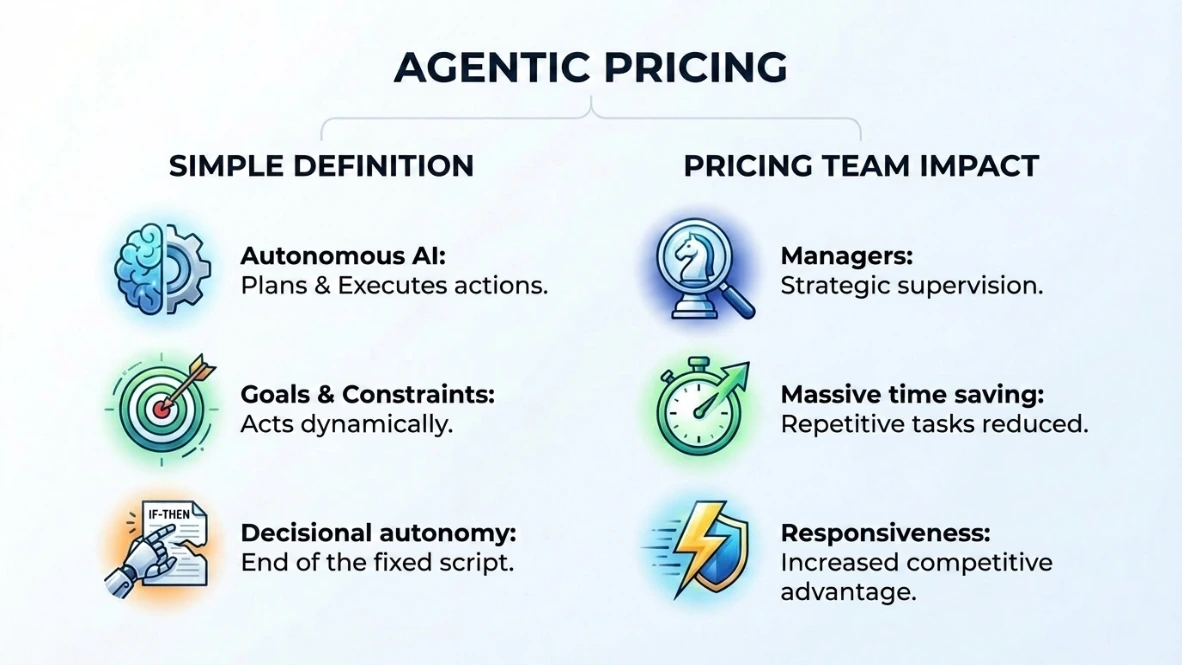
Agentic pricing refers to an AI agent or copilot capable of planning and acting independently. It goes beyond mere automation. In fact, this system no longer blindly follows if-then rules.
This agent possesses specific objectives and constraints. It adapts in real-time to market fluctuations.
Its decision-making autonomy renders rigid scripts obsolete. It acts as an active collaborator.
What this changes for a pricing team
Managers shift toward strategic supervision. They set intents and guardrails. They no longer input prices manually.
Time savings on repetitive tasks are substantial. The team can finally analyze actual performance.
Instead, agility becomes your strength. Human errors are finally eliminated.
Retailers are already using AI to optimize their prices, a practice that is now common in mass retail (Deloitte, Global Retail Industry Outlook 2026).
Traditional automation vs. AI copilot vs. agentic pricing (a clear comparison)
To fully grasp this technology, it must be contextualized alongside the tools your teams already use daily.
.png)
Rules-based automation: strengths and limitations
Traditional rules are predictable and reassuring for business teams. They apply fixed formulas without any flexibility for unexpected events, making them ideal for Price Diagnostics.
However, they quickly become unmanageable with thousands of SKUs. The system ultimately stalls and restricts your operational agility.
Pricing copilot: what AI recommends (without executing)
The copilot suggests changes based on data. It analyzes trends and identifies opportunities to increase or decrease prices through competitive monitoring. To understand this approach in detail, read our comparison of the copilot and agentic pricing.
Humans must validate every line before publication. This provides valuable assistance, but remains too slow for managing your Promotions.
Agentic pricing: planning + acting + learning (under constraints)
The agent takes full control of the execution of decisions. It plans its actions to achieve a specific margin target using Pricing Optimization Software.
It learns from past successes and self-corrects in real-time to adjust Markdowns and Forecasting & AI.
Everything operates under strict control. Guardrails prevent pricing drifts without requiring constant human intervention.
Comparative matrix (decision / execution / control / risks)
This table illustrates the transition from a passive to an active framework. Autonomy increases while manual workload plummets. This serves as a decision-making tool for your architecture.
| Technology | Decision Model | Execution | Human Role | Main Risk |
|---|---|---|---|---|
| Rules-based | Fixed | Manual | Manual | Rigidity |
| Copilot | Assisted | Manual | Validator | Latency |
| Agentic Pricing | Autonomous | Autonomous | Supervisor | Drift |
How a Pricing Agent Works (Essential Building Blocks)
For an agent to be effective, it must rely on robust technological and business foundations. Here is how agentic pricing comes to life.
Data: sales, inventory, competitors, promotions, cost, elasticity
The agent ingests massive flows of heterogeneous data—cross-referencing inventory levels with competitive intelligence pricing. This integration powers its decision engine.
AI-driven price elasticity is continuously calculated for each product. This enables you to anticipate the impact of a price change on your volumes.
Without clean data, the agent is blind. Matching quality is critical.
Warning
Without clean data, the agent is blind. Matching quality is critical to prevent cascading errors.
Objectives: margin, volume, price image, sell-through
You must set clear priorities for the machine. Does gross margin take precedence over sales volume? The system adjusts its mathematical parameters accordingly.
The brand image must remain consistent. The agent manages these metrics via the web Pricing Optimization Software.
Objectives can vary by season. Flexibility is absolute.
Constraints (guardrails): floor prices, KVIs, corridors, compliance
Guardrails represent the inviolable limits of the agent. A floor price prevents selling at a loss by mistake, securing your commercial strategy.
Here are the core security pillars from the Pricing Glossary:
- Floor price based on purchase cost
- Maximum variance corridor relative to current pricing
- Adherence to price indices on Key Value Items (KVIs)
- Legal compliance rules
These guardrails ensure security and provide reassurance to commercial management.
Available actions: recommend, simulate, publish, alert, rollback
The agent is equipped with actionable tools. It can simulate the impact of promotions before launching them, acting as a real sandbox environment.
It triggers alerts in case of anomalies. Markdown strategies can also be driven directly by inventory levels.
Automatic publication represents the ultimate step, requiring absolute trust.
Workflow & traceability: who approves what, logs, and audit trails
Every AI decision is recorded in an audit log. It must always be possible to explain why a price has changed. Transparency is key to human oversight.
The workflow depends on the level of risk. Auditability is required alongside Price Diagnosis or Forecasting & AI.
Transparency fosters internal adoption. Nobody trusts a black box.
6 concrete examples of agentic pricing in retail
Moving beyond theory, let's examine how these agents transform the daily operational lives of retailers.
Gross margin gains observed on pilot categories after a few months of AI-driven dynamic pricing, with a parallel +3% increase in business volume (McKinsey, Dynamic Pricing in e-Commerce).
KVIs: Staying competitive without eroding margins
Agentic pricing continuously monitors your most sensitive items, aligning with market leaders in minutes. This responsiveness protects your competitive monitoring efforts without manual intervention.
It also seeks to offset these adjustments on less visible products, preserving overall margins with exceptional precision.
This establishes a continuous dynamic equilibrium, keeping your price image under total control.
Opportunity detection: potential price increases on inelastic products
The AI identifies references where demand remains stable despite price increases, subsequently proposing upward micro-adjustments. This is the core of modern Price Diagnosis.
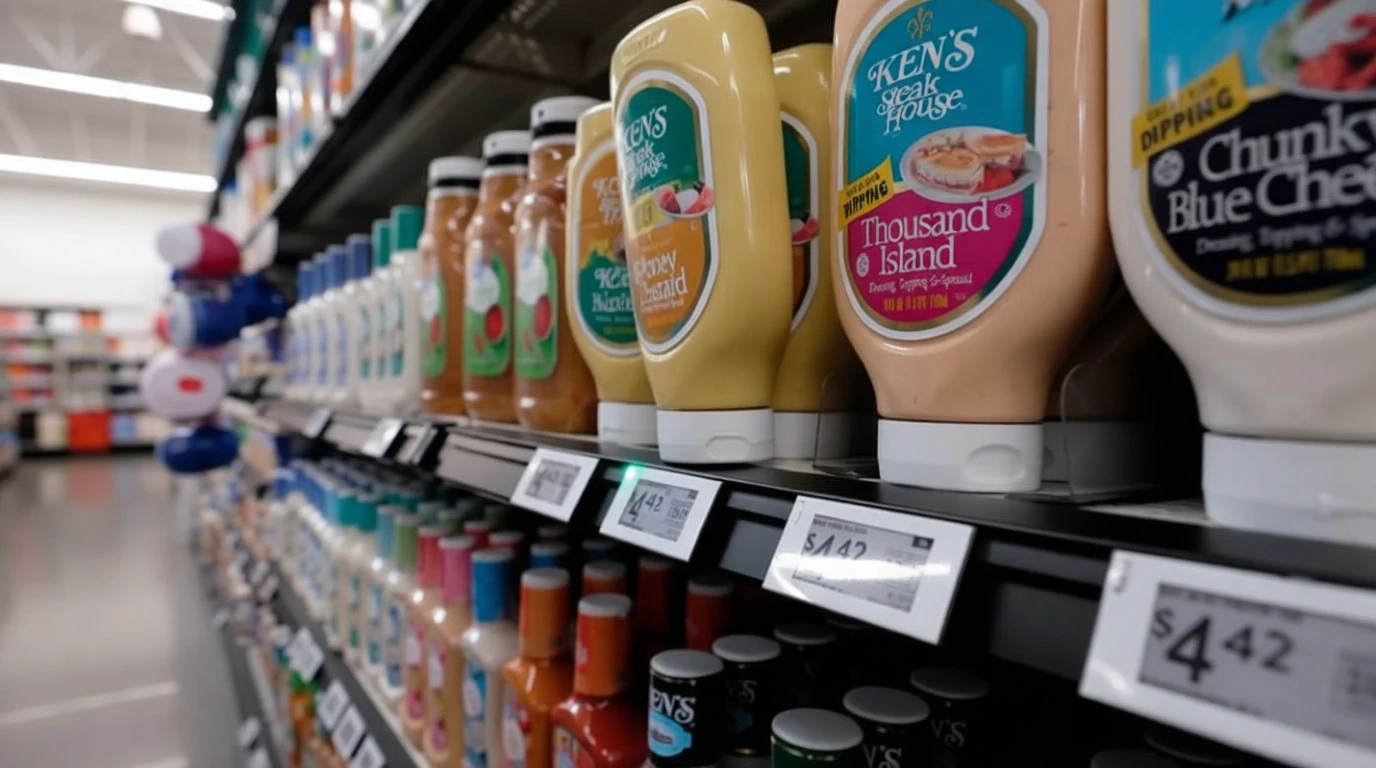
These cumulative marginal gains are substantial, boosting profitability without alienating loyal and price-conscious customers.
The agent tests these hypotheses cautiously and analyzes the results immediately.
Promotions: recommending optimal mechanics and simulating ROI
Gone are the days of blanket 30% off promotions across entire categories. The agent selects the ideal promotional mechanics for each individual product, radically transforming your promotions into high-precision tools.
It simulates the return on investment prior to launch, ensuring you only approve scenarios that drive business profitability.
Promotional efficiency is finally measurable, leading to optimized budget allocation.
Markdown: clearing inventory without cannibalizing best-sellers
At the end of the season, the agent drives price markdowns to clear inventory at the best possible price. The markdown module then becomes fully automated.
It prevents underselling items that are still performing well. The markdown pace is tailored to stock levels.
Inventory management becomes surgical, minimizing stockout and write-off losses.
Anomalies: outliers, matching errors, omnichannel inconsistencies
The agent acts as a sentinel for your data, detecting abnormally low competitor prices caused by errors. It relies on robust forecasting & AI.
It blocks suspicious updates through built-in guardrails, preventing careless losses and reducing cognitive load.
Web and in-store consistency is guaranteed, eliminating price discrepancies for the customer.
Marketplaces: adjusting under buy box / commission constraints
Winning the Buy Box requires split-second responsiveness. The agent adjusts your prices based on competitors' moves. It boosts your analysis speed via Pricing Optimization Software.
It factors commission costs into its calculations, ensuring you never sell at a loss on these sales channels.
The strategy is driven by profitability. Check our Pricing Glossary for more details.
Example: Winning the Buy Box on Amazon
The agent detects a price change by a third-party competitor and instantly recalculates your optimal price, factoring in the marketplace commission to maintain profitability while targeting the pole position.
Recommended autonomy levels (progressive and secure)
Adopting agentic pricing is not a leap into the unknown, but a phased scale-up.
Retailers plan to adopt agentic AI within the next 12 to 24 months, signaling that strategic supervision will quickly become the norm (Deloitte, Global Retail Industry Outlook 2026).
Level 1: suggestions only (human validation)
The agent observes the market and suggests adjustments without taking autonomous action. You retain full control over every click—the ideal step to build lasting trust.
Experts verify the viability of recommendations, refining technical settings without putting revenues at risk.
This phase validates data quality, marking the beginning of the transition to artificial intelligence.
Level 2: Partial execution (thresholds + safeguards)
The agent autonomously publishes minor changes within strict price or volume limits, preventing any drift in your overall margins.
As soon as an action exceeds these boundaries, human oversight takes over. Autonomy remains governed by constant human monitoring.
Productivity gains become tangible as repetitive, straightforward tasks are finally fully automated.
Level 3: controlled execution (stable categories + monitoring)
On your predictable segments, the agent now operates with complete autonomy. Control is exercised a posteriori via detailed performance reports sent directly to your pricing teams alongside the AI.
Anomalies trigger immediate, intelligent alerts. Your system is now mature, reliable, and ready to scale.
The team can focus on geographic expansion, maximizing human added value.
When to avoid autonomy (unstable data, sensitive categories...)
Certain scenarios require reverting to manual control. A massive stockout or inventory bug would skew the AI's calculations and sales forecasts.
Strategic product launches demand a political and marketing vision. The machine still ignores the subtleties of your brand image.
Having the ability to override the agent is a major safeguard. Caution remains your best ally.

Table: Use Cases → Recommended Autonomy → Necessary Safeguards
Not all use cases are suitable for the same level of autonomy. This table summarizes the previous examples and links them to the recommended level and the safeguards that must be put in place before any system goes into production.
| Use case | Recommended Autonomy | Essential Safeguards |
|---|---|---|
| KVI monitoring and price image | Level 1 (suggestions) | Systematic human validation, alert if variance > 3% |
| Competitive repricing outside of KVIs | Level 2 (partial completion) | +/- 8% corridor, floor margin, competitor signal stability |
| Identifying Opportunities for Growth | Level 1 or 2 | Validation based on adjustments > 3%, elasticity monitoring |
| Optimizing Promotion Depth | Level 1 (simulation prior to validation) | Floor promotional margin, forecasted ROI, marketing validation |
| Multi-week seasonal markdown | Level 2 or 3 | Minimum stock, sell-through target, validation at each key milestone |
| Detection of Anomalies and False Matches | Level 1 | Automatic filter + data quality alert |
| Omnichannel consistency | Level 2 | Channel-specific rules, cross-channel variance thresholds, drift alert |
| Weekly pricing action plan | Level 1 (recommendation) | Pricing Team Approval Before Execution |
Risks & Best Practices (preventing the "rogue agent"ing phenomenon)
To prevent your agentic pricing strategy from spiraling out of control, a few hygiene rules are essential.
Data Quality & Product Matching (the true critical point)
If the agent compares a six-pack with a single unit, the price will be incorrect. Matching is the Achilles' heel of pricing. An error here distorts the entire analysis chain.
Clean your data pipelines before plugging in the AI. Dirty data yields absurd decisions and destroys your credibility.
Regularly audit your product mappings. It is an endless task, but vital for your performance.
Short-Term Hyper-Optimization vs. Brand Strategy
The AI may seek immediate margin at the expense of loyalty. Excessively volatile prices alienate your regular customers, risking the loss of their trust over the long term.
Maintain a long-term vision of your positioning. Do not let the algorithm destroy your image for a few extra euros.
Pricing is also a matter of perception. Remain vigilant on this point to ensure consistency.
Compliance & Commercial Rules
Pricing laws are strict and vary by country. The agent must flawlessly integrate local legal constraints. Regulatory compliance is a non-negotiable safety barrier.
Supplier agreements sometimes mandate minimum prices. The machine must comply with these contracts to avoid disputes.
An error can prove costly in fines. Compliance is a top priority to protect your business.
Rollback Plan + Alerting
You must be able to revert all modifications with a single click. An emergency stop button is essential in the event of a crisis. Reversibility ensures overall continuity.
Configure alerts for unusual margin fluctuations. Be notified before an issue escalates and becomes unmanageable.
IT security is also a factor. Protect access to your agent to prevent any malicious hacking.
This is the principle we apply in our BOOPER MPS pricing tool : AI recommends, business rules frame, and each price is simulated and then validated by your teams before being deployed.
30/60/90-day adoption plan
Here is a concrete roadmap for deploying your first agentic pricing agent without disrupting the entire organization.
Day 30: Scoping + Data + Guardrails + KPIs
The first month is dedicated to defining the project scope. Choose a product category with clean data, as this forms the foundation to prevent matching errors.
List all necessary safeguards to reassure stakeholders. Set success metrics such as margin or time saved.
Set up the technical infrastructure. Connect your data streams using reliable Pricing Optimization Software s tools.
60: Pilot on 1 category + 1 channel + weekly review
Launch the agent in suggestion mode on a specific channel. Analyze recommendations during focused weekly meetings. Verify whether the pricing proposals make sense.
Adjust settings based on initial field feedback. The learning loop must run quickly to increase accuracy.
Test the system's reactivity. Observe competitor reactions using Competitive Monitoring.
90: industrialization + training + continuous improvement
Expand the agent's usage to other product categories. Train teams on interpreting new reports. Now is the time to scale.
Move certain workflows to controlled automated execution. The tool is now part of the daily routine for retail teams and data leaders.
Celebrate initial margin gains. Plan ahead with Forecasting & AI modules.
Checklist: "Are we ready for agentic pricing?"
Before getting started, thoroughly audit your organization.
Data / processes / governance / integrations / KPIs
This checklist summarizes the essential prerequisites for a successful transformation. Do not overlook any point, otherwise you risk slowing down the project. The human aspect matters just as much as the technology. Make sure to secure the backing of your executive leadership.
Validate these technical pillars to keep the AI performing at its best. Your Competitive Monitoring must be completely reliable before delegating any decision.
- Operational real-time data flows
- 95% reliable product matching
- Clear category-specific safeguards
- Human validation processes
- Shared performance KPIs
A quick glossary also helps drive alignment. Clearly define terms like agent, safeguards, or elasticity. This prevents misunderstandings during strategic meetings.
Adopt this common language to streamline your internal communications:
- Agent: Goal-driven autonomous AI
- Safeguards: Inviolable safety limits
- KVI: Key Value Items for price image
- Markdown: End-of-season management
Conclusion: Agentic pricing is primarily about governance and guardrails.
Ultimately, remember that technology is merely a means to serve your commercial vision.

Agentic pricing is not a silver bullet. It is a powerful tool that requires a rigorous and structured framework. Its success relies on the clarity of your business objectives. Do not aim for total autonomy from day one.
Start small and learn as you go. Trust is earned through concrete proof of achieved results. Your teams will be your best allies in this paradigm shift.
The future of retail now belongs to those who master AI. This is the moment to gain a competitive edge. Prepare your data now to succeed tomorrow.
Agentic pricing surpasses traditional automation through an AI capable of reasoning and acting independently. Adopt this technology in phases to transform your margins and empower your teams starting today. Stop reacting to the market and become a driver of an autonomous, highly responsive, and sustainably profitable retail operation.
FAQ
Here are the answers to the most frequently asked questions we receive on this topic.
Agentic pricing refers to a new generation of pricing engines driven by agent-based AI: an agent capable of planning a strategy, executing pricing decisions, and learning from its results, without being limited to applying rigid if-then rules.
In practical terms, the agent relies on four building blocks discussed earlier in this article: proprietary data (sales, inventory, competition, elasticity), prioritized business objectives (margin, volume, price-image), non-negotiable safeguards (minimum prices, variation ranges, KVI indices), and a range of actions—from simple recommendations to automatic publication with full traceability.
This autonomy unfolds in stages : level 1 is a simple suggestion validated by a human, level 2 is partial execution under strict thresholds, and level 3 is controlled execution on stable categories that are monitored retrospectively. It is this progression that distinguishes agentic pricing from a simple automatic repricing algorithm.
For a retailer, the challenge goes beyond technology: it’s the ability to secure prices for KVI products while capturing margin opportunities invisible to the human eye, with gains already measured at up to +10 gross margin points in pilot categories.
Traditional dynamic pricing adjusts prices based on predefined rules or thresholds: it reacts, but does not reason. Agent-based pricing goes a step further by combining strategic planning, autonomous execution, and continuous learning under human oversight.
As shown in the comparative table in this article, the difference lies in three areas: the decision-making process (fixed for the rules, autonomous for the agent), execution (manual vs. automated), and the human role, which shifts from that of a pilot to that of a supervisor. The agent does not simply apply an “if-then” rule; rather, it continuously balances margin, volume, and price-image.
Unlike a repricing algorithm that mechanically aligns with the competition, the agent seeks an optimal balance: for example, it can offset a forced price reduction on a KVI product with a targeted price increase on a less visible item, while adhering to its safeguards.
For a pricing team, this distinction changes how the issue is managed: dynamic pricing is audited based on rules, while agent-based pricing is audited based on objectives, decision logs, and margin results, which requires a more rigorous control framework.
No: Agent-based pricing does not replace pricing managers; rather, it transforms their role from that of executors to that of strategic leaders responsible for setting the agent’s objectives, priorities, and limits.
As this article explains, managers are shifting toward a supervisory role: they set the framework for objectives, define safeguards (floor prices, price ranges, KVI rules), and arbitrate complex decisions that the machine should not make on its own—particularly regarding strategic launches or sensitive categories.
The system handles volume, execution speed, and combinatorial complexity by adjusting thousands of SKUs while taking into account competition, inventory, and price elasticity, while humans remain the sole decision-makers regardingbusiness strategy and brand image.
This is more of a shift toward adding value than a job elimination: teams now have more time—time previously spent on manual data entry—to focus on performance analysis and long-term pricing strategy.
Sales representatives need accurate, up-to-date data on sales, inventory, competitor prices, promotions, costs, and price elasticity; without this foundation, their recommendations lose all credibility.
The most critical issue remains the quality of product matching: comparing a six-pack to a single unit immediately skews the calculation and can lead to a cascade of absurd decisions. That is why this article emphasizes the importance of regularly auditing product matches before integrating AI into production.
Price elasticity must also be recalculated on an ongoing basis to anticipate the impact of a price change on volumes, rather than being set once a quarter. The timeliness of incoming data is just as important as its completeness to ensure that the agent does not make decisions based on outdated information.
This is the number-one prerequisite for any scaling effort: an agent-based pricing project launched with dirty data will replicate those errors at high speed rather than correcting them, which undermines the teams’ confidence in the tool.
The essential safeguards are the floor price based on the purchase cost, the maximum fluctuation range relative to the current price, compliance with the KVI price indices, and legal compliance rules.
These limits, detailed in the section on agent building blocks, are what distinguish controlled agent-based pricing from an algorithm left to its own devices: they prevent accidental sales at a loss, avoid undermining the price image of a sensitive product, and ensure that price fluctuations do not exceed a range deemed too aggressive by the business unit.
The level of safeguards must be calibrated according to the degree of autonomy granted: simple suggestions for cases that are still uncertain, strict thresholds for partial execution, and post-execution monitoring and smart alerts once the category is deemed stable and mature.
A rollback plan and an alert system for unusual margin fluctuations round out this system: the ability to reverse a decision with a single click is essential for gradually granting agents more autonomy without compromising margin or compliance.
The two key indicators remain gross margin and sales volume, supplemented by the adoption rate of recommendations and changes in price perception over time.
From an operational standpoint, it is also necessary to monitor data response speed, the competitive matching rate, and the quality of recommendation implementation: these indicators reveal whether the agent is working on a reliable basis or whether it is necessary to revert to a more conservative level of autonomy.
The gains observed in pilot categories provide a useful benchmark for setting one’s own goals: up to a 10-point increase in gross margin, accompanied by a 3% increase in revenue, through AI-driven dynamic pricing, according to McKinsey.
Tracking these KPIs over time allows us to measure both the business performance of the system and its technical robustness—two aspects that must improve in tandem before we can expand the agent’s scope to include new categories.
Allow about 90 days for a credible agentic pricing pilot, structured in three 30-day phases detailed in this article.
The first month is devoted to setting the framework: selecting a category with relevant data, defining safeguards, and establishing success KPIs. The second month launches the agent in suggestion mode on a single channel, with a weekly review of recommendations to adjust settings based on feedback from the field.
The third month marks the transition toindustrial-scale operations: expansion to other categories, training teams to read reports, and switching certain workflows to controlled automated execution once trust has been established.
This phased approach protects the margin during the learning phase: it’s better to conduct a longer pilot on a limited scale than to rush into full-scale implementation based on data that is still uncertain.
The first risk is poor-quality source data, which can lead to inconsistent recommendations and undermine the teams’ trust in the tool within the first few weeks.
Next comes short-term over-optimization: an agent focused on immediate profit margins may make frequent price adjustments at the expense of customer loyalty and catalog consistency. That is why this article recommends maintaining a long-term brand vision that goes beyond mere algorithmic gains.
Regulatory compliance is a third area of concern: pricing rules vary by country, and supplier agreements sometimes impose contractual minimums that the agent must adhere to without fail, or face fines.
The lack of traceability in AI decisions remains the most underestimated risk: without a one-click rollback plan, internal adoption eventually stalls, regardless of the model’s technical quality.
To learn more, discover how an AI-powered pricing engine works step by step, or check out our 2026 roadmap for agent-based pricing. To assess your own level of maturity, BOOPER offers pricing strategy consulting.

Goal-based pricing starts with the target outcome (margin, revenue, category competitiveness) and lets AI calculate the prices needed to achieve it, rather than piling on rules one product at a time.
The engine simulates thousands of scenarios by factoring in business constraints, purchasing behavior, and product cannibalization; if the objective is unattainable, it identifies the best compromise.
For retailers supported by Booper: +0.5 to +3 percentage points of margin in a few months and -70 to -90% reduction in price preparation time . The pricing manager retains the final decision.

The key takeaway: An AI-generated price recommendation without an explanation falls on deaf ears with pricing teams, who refuse to apply a score they don't understand.
Explainability and auditability are two distinct requirements: the former justifies a recommendation at the time it is proposed, while the latter makes it possible to trace who approved what, when, and why—even several months later. A key finding: Explainability is identified as a key AI risk by a large majority of executives, but very few organizations are actually taking steps to address it.

Fixed-rule dynamic pricing is giving way to autonomous AI agents that make decisions in real time—on both the seller and buyer sides—without waiting for a human approval cycle.
90% of B2B purchases will be handled by purchasing agents by 2028 (Gartner), and 47% of the retail sector has already adopted agent-based AI (NVIDIA): competition between agents is becoming the norm, not the exception.
The real risk is not speed but the lack of safeguards: price floors, price ceilings, and explicit governance are becoming the priority, lest algorithmic collusion—which regulators are already scrutinizing—occur.