
5 Common Mistakes Pricing Teams Make When Dealing with AI
.avif)
Artificial intelligence must never drive pricing strategy. Its deployment requires the establishment of rigorous safeguards, such as price corridors and human validation, to protect financial margins. This alliance between computing power and expert oversight transforms raw data into sustainable profitability without the risk of algorithmic drift.
These reflexes can't be improvised: that's what the BOOPER Pricing Training is for—to give your teams the right guidelines before implementing AI in your pricing.
Are your margins quietly eroding due to poorly managed automation? AI pricing errors now pose an invisible threat to business profitability, often turning this technological tool into a source of uncontrolled risks. We pinpoint the five major strategic weaknesses—from data quality to the lack of human oversight—so you can take immediate corrective action.
This expert content provides you with the safeguards and validation protocols you need to take control. Strengthen your pricing strategy and turn these technical challenges into a driver of sustainable financial performance.
![AI Pricing Errors - 5 Mistakes That Kill Margins [Pro]](https://cdn.prod.website-files.com/694009df702b124533223c9e/6a8748054d99582e6cd1c595_6a54a54cdd0bbf13136330f8_5-erreurs-frequentes-des-equipes-pricing-face-a-lia-et-comment-les-eviter.webp)
Artificial intelligence is no longer an optional extra; it’s a tool that must be mastered to avoid eroding profit margins.
Purpose of the article
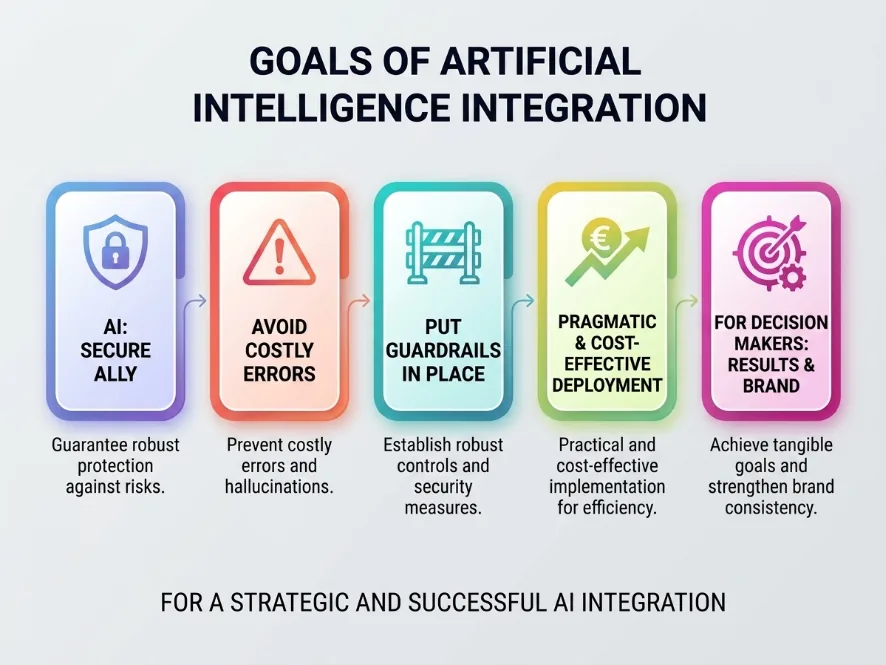
This guide is designed to help you turn AI into a reliable ally for your organization. We’ll help you avoid common AI pricing mistakes and costly miscalculations that undermine value.
We present a method for establishing concrete and actionable safeguards. The goal is to move from theory to a pragmatic and cost-effective implementation as quickly as possible.
This article is intended for decision-makers who demand immediate financial results without ever compromising their brand consistency.
AI and Pricing: What AI Does Well (and What It Won't Do for You)
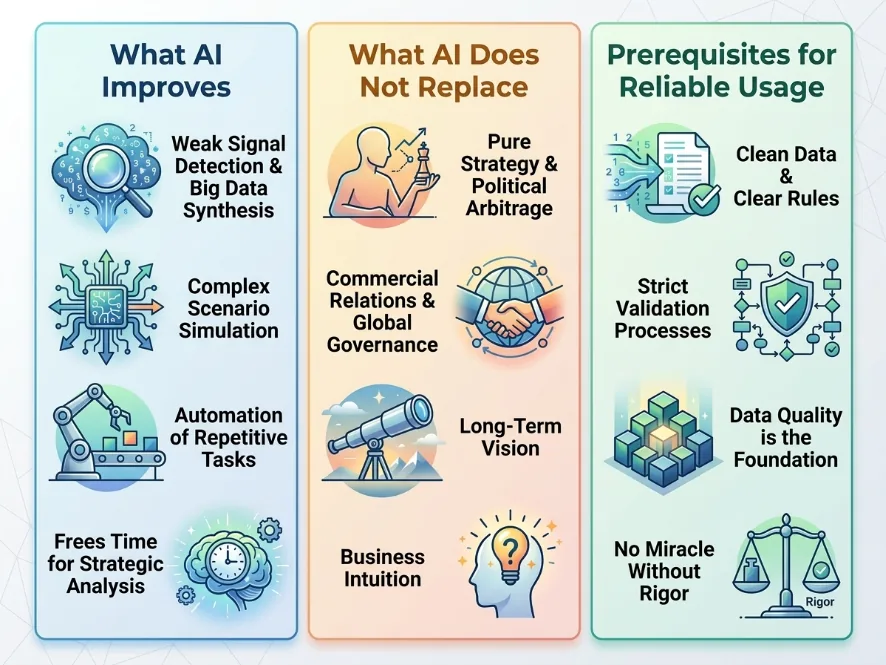
Before jumping in, it’s important to distinguish between the machine’s superpowers and the responsibilities that remain purely human, in order to avoid AI pricing errors.
What AI Actually Improves
AI excels at detecting weak signals and synthesizing large amounts of data. It simulates complex scenarios in record time to inform decision-making.
It automates repetitive tasks. This frees up time for strategic analysis.
What AI Can't Replace
Pure strategy and political maneuvering remain the exclusive domain of humans. AI also cannot handle the subtleties of business relationships or overall corporate governance.
The long-term vision is human. Machines lack business intuition.
Requirements for reliable use
Without its own data and clear guidelines, the tool becomes dangerous. Strict validation processes must be established to oversee each algorithmic recommendation before it is implemented.
Data quality is the foundation. There are no shortcuts to success.
Mistake #1: Confusing AI with pricing strategy

The first mistake is to believe that the tool determines the direction, when in fact it is merely a driver. This is one of the most common AI pricing mistakes.
Symptoms: opportunistic decisions, no goals, no segmentation
Price changes are often observed that lack any overarching logic. The absence of clear segmentation leads to erratic pricing that confuses loyal customers and partners.
Management is based on visual assessment. There are no specific targets.
Risks: inconsistency, loss of profit margin, price war
The danger is accidentally triggering a destructive price war. Price inconsistencies across sales channels ultimately erode gross margins irreversibly.
The brand's reputation suffers. Customers lose confidence.
How to Avoid: Objectives, Segmentation, Discount Policies, Price Corridors
Set minimum and maximum price ranges to guide the algorithm. Establish a strict discount policy and segment your customers based on their actual value rather than their volume.
A human must validate the thresholds. The strategy dictates the tool.
Mistake #2: Using incomplete, dirty, or ungoverned data
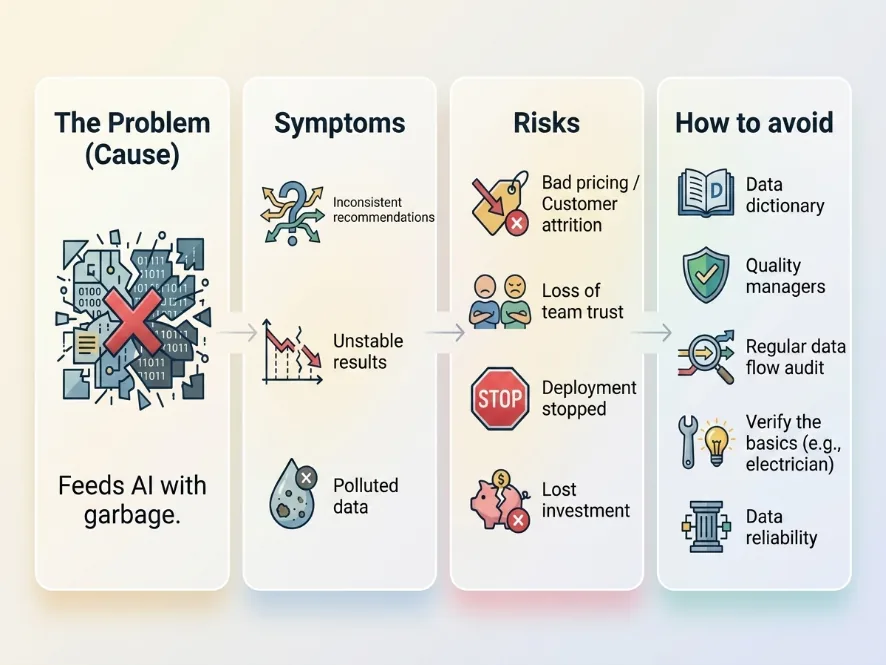
If you feed the AI junk data, don’t be surprised if it gives you toxic advice for your business.
Symptoms: inconsistent recommendations, unstable results
The recommendations vary wildly for no apparent reason. There are glaring inconsistencies between similar products, indicating that the source data is contaminated by data entry errors.
The models lose all stability. The predictions become unusable.
Risks: incorrect pricing, loss of team confidence
A poor price can drive away your best customers. Worse still, your sales teams may reject the tool altogether if they consider its pricing to be unreasonable.
The rollout comes to a sudden halt. The investment is completely lost.
How to Avoid: Data Readiness, Data Dictionary, Ownership, Quality
Create a data dictionary to standardize definitions. Appoint quality assurance leads and ensure that data flows are regularly audited before feeding them into your models.
AI projects will be abandoned by 2026 due to a lack of AI-ready data (Gartner, February 2025).
Mistake #3: Over-automating without safeguards ("free-wheeling" pricing)
Full automation is a dangerous fantasy that can turn your catalog into an algorithmic battlefield.
Symptoms: changes that occur too frequently, uncontrolled exceptions
Prices fluctuate several times a day without any market justification. These AI-driven pricing errors generate a growing number of exceptions in an opaque manner, making it impossible for management to assess sales performance.
The system is stuck in a loop. No one understands the fluctuations.
Risks: brand image, pricing, margins, customer experience, operational chaos
Customers feel cheated by excessive volatility. This creates internal chaos, with salespeople spending their time justifying prices they don't even understand themselves.
The margin is quietly disappearing. The shopping experience is deteriorating.
This is the number of U.S. customers who encounter a pricing error at the register at least once a month, according to a survey of 2,011 consumers (University at Buffalo, Center for Marketing Analysis, 2025).
How to Avoid: Min/Max Ranges, Thresholds, Exception Rules, Validations
Set strict limits that the AI must never cross. Set up automatic alerts whenever a recommendation strays from the norm, requiring immediate human approval.
Use simple rulers to frame the machine. Here are the supports you need to install:
- Tight price ranges.
- Automatic alert thresholds.
- Human verification is required for large accounts.
Keep the final say. The machine suggests, the human decides.
Mistake No. 4: Treating a recommendation as a decision (without assessing its impact)
Blindly following what the AI says is like driving with your eyes closed on a mountain road. It’s one of the most dangerous mistakes in AI pricing.
Symptoms: no testing, no monitoring, no rollback
The new prices are being rolled out on a massive scale without any prior testing. There is no procedure in place to quickly reverse the changes if sales figures suddenly take a nosedive.
We're sailing without a map. Unfortunately, the actual impact remains unknown.
Risks: Hidden Negative Effects (Volume, Churn, Margin)
You could lose sales volume without realizing it right away. The churn rate could skyrocket if the AI misjudges your customers' price sensitivity.
Financial damage often goes unnoticed. By the time it becomes apparent, it’s already too late.
How to avoid: A/B tests or pilot studies, monitoring KPIs, review committee
Always test on a small scale before rolling out the changes. Convene a weekly review committee to analyze key performance indicators and adjust the models based on feedback from the field.
Caution is the key to profitability. Always take things one step at a time.
Mistake #5: Neglecting Risks (Confidentiality, Compliance, Competition, Bias)
AI is not a lawless zone; ignoring these threats is one of the worst mistakes in AI pricing.
Symptoms: Sharing of sensitive data, uncontrolled access
Confidential data ends up in open models. Access to tools is not restricted: anyone can modify strategic margins.
Safety is being neglected. It's dangerous.
Risks: information leaks, noncompliance, biased decisions
A data breach undermines your competitive advantage. Biased algorithms expose you to heavy penalties for illegal price discrimination.
Your reputation is on the line. Fines are lurking.
Bills regulating algorithmic pricing were introduced in 24 U.S. states during the first seven months of 2025, compared with 10 in all of 2024 (Consumer Reports, July 2025).
How to prevent this: access control, anonymization, audit trail, usage policies
Traceability of decisions is a lifeline for your pricing strategy when dealing with regulators.
Anonymize the data. Implement a comprehensive audit trail to track every price change and ensure compliance.
Secure your expertise. Technical rigor prevents disasters.
Essential safeguards for AI-powered pricing
To ensure peace of mind and avoid costly AI pricing errors, your system must incorporate native, tamper-proof security measures.
Price corridors, discount rules, multi-level approvals
Price corridors contain the algorithm's deviations. Require human approval for any out-of-range discounts to prevent margin erosion. It's your safety net.
The framework remains rigid. The AI operates solely within these strict boundaries.
Audit trail: who decided what and why
Every price change requires an indelible digital record. Always document the reason behind each decision so you can analyze your futuresuccesses or failures. You can't manage what you don't know.
Your history becomes your greatest asset. Never underestimate the power of logs.
Monitoring: margin, discount leakage, win rate, churn, perceived price
Track discount leakage to stop the drain on your profits. Analyze the win rate in real time to adjust the sensitivity of your models to sudden market reactions.
The data never lies. Keep your eyes on this dashboard.
"Safe" and Useful AI Use Cases for a Pricing Team
There’s no need to revolutionize everything all at once; start with quick wins that don’t involve any major risks.
Summary and organization: policies, arguments, rules
Use AI to draft your pricing policies and sales pitches. It organizes your internal guidelines in a consistent manner, making it easier for all sales teams to adopt them.
It saves a tremendous amount of time. It makes things much clearer.
Anomaly detection: unusual discounts, inconsistent prices
The algorithm instantly detects unusual discounts. It identifies inconsistent prices in your catalog, allowing you to correct AI-driven pricing errors before they impact your annual financial results.
It's an effective safety net. Mistakes are quickly corrected.
Simulation: margin/volume impact, scenarios, sensitivity
Simulate the impact of a price increase on your overall sales volume. Test different sensitivity scenarios to anticipate competitors’ reactions and protect your net margins.
Plan for the future without risk. Simulation is a powerful tool.
Workflows: Speed Up Approvals Without Losing Control
Automate the special offer approval process. AI filters out simple requests and forwards only complex cases to experts, thereby accelerating the company’s sales responsiveness.
Business moves faster. Control remains complete.
30-Day Rollout Plan (Simple and Realistic)
Here’s a practical, four-step weekly plan to transform your pricing strategy and avoid common AI pricing mistakes.
Week 1: Choose 1 use case, define the baseline and KPIs
Start by identifying a single priority pricing issue. Establish your current baseline based on historical performance. Select key performance indicators to measure the immediate financial impact.
Avoid spreading yourself too thin. A clear vision ensures success.
Week 2: Securing Data and Rules (Guardrails)
Filter the data specifically required for this use case. Set up technical safeguards to prevent any inconsistent price quotes. Enforce strict rules to mitigate major financial risks.
Secure your system now. Security comes first.
Week 3: Pilot program on a limited scale + adjustments
Launch the pilot program on a limited range of products. Analyze daily results to identify anomalies. Adjust the algorithm’s parameters based on real-world feedback.
Learn by moving quickly. Agility determines the project's viability.
Week 4: Formalize processes, training, go/no-go decision
Document each step to ensure the process is reproducible. Train your teams on the new pricing tools. Approve the full rollout only based on solid, quantifiable evidence.
Make the change in methodology official. The implementation will then proceed smoothly.
"AI-Ready for Pricing" Checklist
Before pressing the button, make sure you’ve checked all the boxes on this checklist to ensure your margins are secure.
Data, rules, governance, adoption, monitoring
| Criterion | Status | Action |
|---|---|---|
| Proprietary data | To be audited | Clean and organize the history |
| Active guardrails | Essential | Set price ranges |
| Trained teams | In progress | Confirm Sales Membership |
| Dashboard ready | Required | Set up deviation alerts |
Your historical data must be completely reliable to feed the algorithm. We establish strict business rules to govern every automated decision. Governance clarifies who approves the final prices.
The buy-in of the sales teams ensures the success of the field rollout. Robust monitoring immediately detects margin anomalies. Use this table to assess your level of operational readiness.
Don’t skip any steps to avoid AI pricing errors. A thorough checklist helps prevent unexpected operational issues.
FAQ
No: Full automation is technically feasible, but it remains a major AI pricing mistake when operated without safeguards. An engine left to “run wild” adjusts prices several times a day without market justification, which confuses sales teams and erodes margins.
Best practice involves setting minimum and maximum price ranges for the algorithm and requiring mandatory human approval for sensitive recommendations or large accounts, as detailed in this article. In the United States, a 2025 study conducted by the University at Buffalo shows that one in four customers encounters a pricing error at the register at least once a month—a stark reminder of the cost of poorly supervised automation.
AI must remain a recommendation engine, with pricing experts retaining the right to veto—that is the crux of the balance between AI that decides and AI that executes. This hybrid approach protects the brand image while harnessing the algorithm's computational power.
For a retailer, the stakes go beyond the technical aspects: margin management and customer trust are at stake at this level of oversight.
Quality takes precedence over volume: An AI pricing project starts withsales history, cost of goods sold, and competitor prices, rather than with an exhaustive but poorly managed database.
As noted in Mistake No. 2 in this article, feeding the algorithm incomplete or ungoverned data results in unstable and inconsistent recommendations across similar products—a typical sign of what is known as the “data glass ceiling” in AI pricing. It is therefore essential to create a shared data dictionary and appoint quality assurance leads before feeding the models.
You don't have to wait for a perfect foundation to get started: the key is to clean up the priority data streams (sales, costs, competition) to ensure the reliability of the initial recommendations, even if that means gradually expanding the scope.
This approach avoids the most costly pitfall of an AI deployment: teams permanently rejecting the tool if its initial outputs are deemed nonsensical.
Detecting pricing anomalies and optimizing discounts are the use cases that generate the fastest ROI, as they immediately reduce losses caused by human error and pricing inconsistencies.
This article identifies several low-risk, “safe” AI use cases: synthesizing pricing policies and sales pitches, detecting anomalies, simulating margin/volume impact, and accelerating validation workflows, as detailed in our guide on pricing alerts and management workflows. These are quick wins that do not require letting the algorithm set prices on its own.
These initial successes often fund the transition to more advanced applications, such as simulating price sensitivity scenarios or partially automating the approval processes for special offers.
For a pricing team, starting with these practical levers minimizes the risk of internal resistance while quickly demonstrating the financial value of AI—a necessary prerequisite before considering more complex predictive models.
Pricing policy should never depend solely on competitors' moves: the rules must take into account the perceived value of the offering, margin targets, and brand positioning, or else a price war may ensue.
This is precisely the No. 1 mistake described in this article: confusing the tool with the strategy. Without clear segmentation or quantified objectives, the algorithm mimics the behavior of competitors instead of monitoring them without damaging its price image, which often irreversibly erodes gross margin and alienates loyal customers.
The solution involves establishing price ranges and a strict discount policy that set limits on the algorithm, and segmenting customers based on their actual value rather than solely on their purchase volume. Humans approve the thresholds; the strategy drives the tool, never the other way around.
This approach safeguards long-term profitability: the goal is not to track the market price for price, but to optimize performance while adhering to the chosen positioning.
Adoption is fostered by presenting AI as a decision-making tool, never as a replacement for salespeople: teams embrace the tool when they can simulate scenarios, understand the impact of their negotiations, and rely on a pricing structure with clearly defined roles.
This article points out that a poorly prepared rollout can, in fact, alienate teams: recommendations deemed absurd—due to a lack of specific data—are enough to cause the tool to be rejected outright. The quality of the initial releases therefore directly determines adoption in the field.
By giving salespeople autonomy within price ranges (rather than relying on full automation), you leverage their expertise while safeguarding margins. AI then becomes a practical tool for selling faster, not a constraint imposed from above.
The training scheduled for Week 4 of the rollout plan described above serves the same purpose: it turns the tool into an instinctive part of the job rather than just a dashboard that users are forced to use.
A transition becomes necessary when Excel files become too cumbersome to maintain, too slow to use, or a source of recurring errors that directly affect the prices displayed.
The clearest indicator, as discussed in this article regarding data quality: if your teams spend more time consolidating data than managing pricing strategy, the investment in migrating to a dedicated pricing solution is already justified. A spreadsheet has no built-in safeguards, no audit trail, and no automated price corridors.
Dedicated pricing software makes it possible to industrialize business rules (corridors, discount policies, multi-level validations) and to make processes more reliable that neither the volume nor the complexity of Excel can absorb anymore.
It is also a prerequisite for effective governance: without reliable traceability of pricing decisions, it becomes impossible to document who approved what, or to respond confidently to a regulator or an internal audit.
Looking ahead, explore the future of agent-based pricing.
For specific examples, see " agent-based pricing: definition and examples."

The model is the easy part. A recommendation engine can be up and running in a few months; what takes years is the knowledge base, competitive matching, the rule set, explainability, and compliance. According to Exclaimer (2025), 71% of in-house development projects are abandoned, and 83% in regulated industries: the breaking point is almost never deployment—it’s maintenance.
The hidden cost is a cost of continuity: an in-house tool relies on two or three people, and if they leave, the asset becomes a liability. The build remains useful within a narrow and stable scope, as a complement to a solution rather than a replacement for it. The deciding factor isn’t the team’s expertise; it’s their ability to last ten years.

Data and context are two distinct assets: data describes what happened, while context explains what we are allowed to do and what would be absurd. This context is implicit by nature: it has never been written down because there was never a need to do so as long as decisions were made by humans who shared it.
Four categories cover the essentials: price benchmarks, relational constraints, unwritten rules, and commercial objectives by category. Formalizing them provides lasting value, because the context outlasts the models: algorithms are replaced every two or three years, but a written context remains a company asset.

A business case for a pricing solution combines two types of return on investment that are completely different. Friction ROI refers to the hours saved: easy to measure, but capped. Decision ROI refers to the margin points gained from better-set prices: difficult to measure, and unlimited.
Confusing the two explains the gap identified by IBM in 2025: 66% of executives report productivity gains from AI, but only about one in five has met their return on investment (ROI) goals. The ROI of a decision isn’t measured by comparing “before” and “after,” but rather against a control group; otherwise, seasonal factors, inflation, or a competitor’s actions will be credited to the tool. The test to apply to a business case: if you remove all the “time saved” lines, is the project still profitable?