
Structuring an efficient pricing organization

A high-performing pricing organization relies on clear governance and a hybrid model, combining central strategy with local agility. By structuring precise roles such as Pricing Analyst or Head of Pricing via a RACI matrix, the company secures its margins and competitiveness. This operational rigor transforms pricing into an immediate and sustainable profitability lever.
Structuring this governance is precisely the role of BOOPER's Operational Pricing Consulting module.
Article summary:
Pricing is the most powerful profitability driver in retail, but its effectiveness relies on a precise human and operational structure. Without a rigorous pricing organization, businesses suffer from invisible margin erosion and price inconsistencies that undermine customer trust.
We will detail how to build a robust governance by defining key roles, centralization models, and weekly processes to transform your strategy into tangible results.

Why pricing organization matters
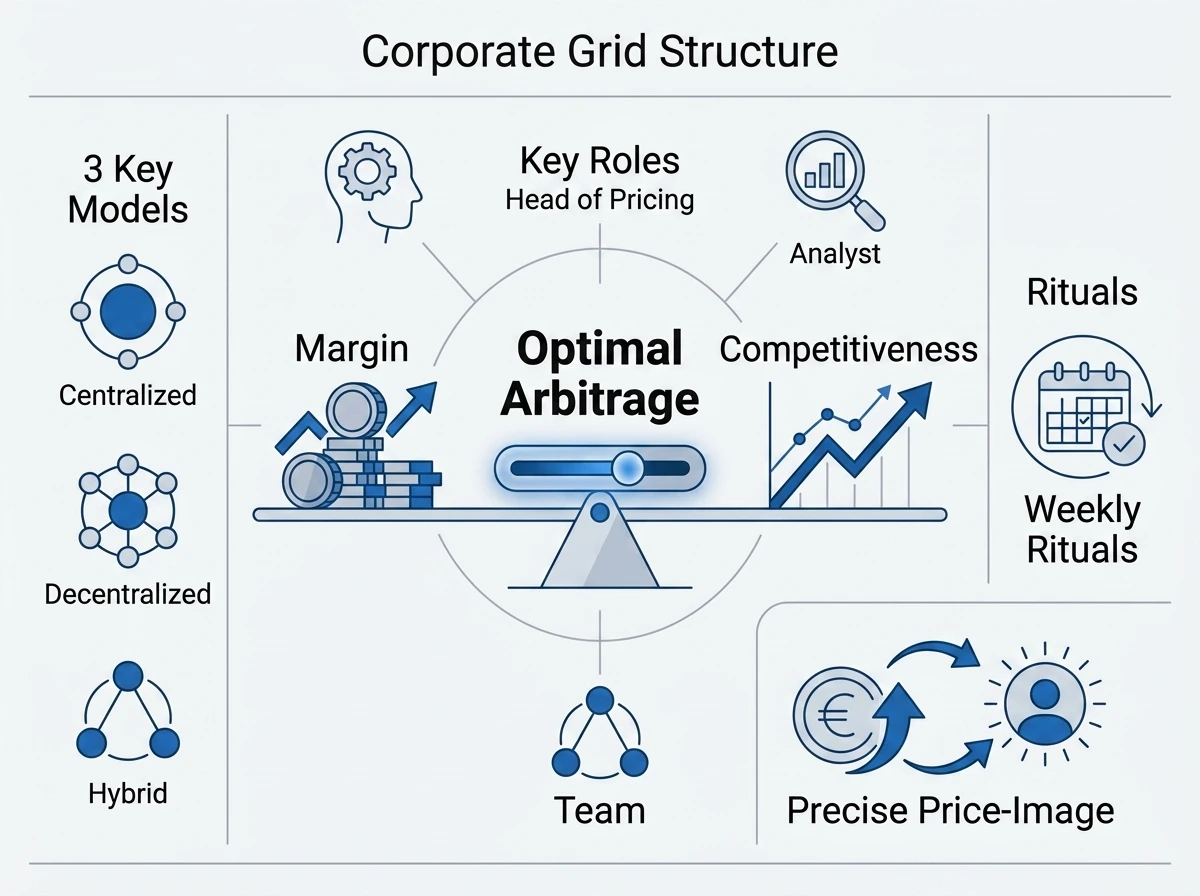
A structured pricing organization relies on three models (centralized, decentralized, or hybrid) and precise roles such as the Pricing Strategist or Analyst. Effective execution ensures the balance between margin and competitiveness through weekly routines.
In fact, pricing is not just a simple label; it is a permanent trade-off between pure profitability and perceived price image by your customers.
B2B companies that structure their pricing around a dynamic pricing model driven by a dedicated organization achieve an average gain of 2 to 7 percentage points in Return on Sales (RoS), based on over 25 observed deployments (McKinsey / Periscope).
Margin / competitiveness / price image: trade-offs + execution
Pricing is the most powerful profitability driver. It requires a constant trade-off between margin protection and attractiveness against competitors.
Rigorous execution ultimately turns strategy into results. Without an organization, your decisions remain theoretical, devoid of any real impact on your revenue.
Price image depends on this precision. Every cent counts for the customer.
Symptoms of a "weak" pricing organization
Watch out for update delays or data entry errors. Conflicts between purchasing and sales are multiplying. No one knows who validates the final price. This is total operational chaos.
Margins are eroding without management being able to react. Competitor monitoring becomes nonexistent or remains archaic and manual.
84% of companies report having strong pricing power, yet most capture only 50% or less of their targeted price increases due to a lack of organization and execution processes (Zilliant survey, June 2025).
The 3 pricing organization models
To avoid these pitfalls, choosing a structural model is the first step in any transformation.
Model 1: Centralized (when it's ideal)
A single team manages all pricing from headquarters. This model guarantees perfect consistency and a global overview. It greatly simplifies margin control.
Ideal for structures with a homogenous catalog. Efficiency is gained through tool specialization.
However, responsiveness may suffer. Field teams sometimes feel disconnected.
Model 2: Decentralized (advantages/risks)
Here, each category or country decides its own prices. Local knowledge is the key strength of this approach, allowing for faster reactions to regional specifics.
The major risk remains internal price wars. The global brand image frays.
Tools are often disparate. Financial management becomes a nightmare.
Model 3: Hybrid (the most common in omnichannel)
Headquarters defines the strategic pricing framework and pricing boundaries. Local teams execute within this defined perimeter. This is the ideal compromise for modern commerce.
This model enables you to manage omnichannel complexity with agility, maintaining a national price image while adapting locally. Endogenous and exogenous pricing data flows are better controlled, and responsibilities are clearly distributed across levels.
Communication must be fluid. Shared tools are essential here.
Key roles in a pricing team
Once the model is chosen, you must define who does what to keep the machinery running smoothly.
Head of Pricing / Pricing Strategist
This profile defines the company's long-term vision . It aligns pricing policy with overall financial objectives . It presents the strategy to the management committee.
They arbitrate major conflicts between departments. Their role is primarily political and strategic.
They guarantee overall profitability. They are the conductor of pricing.
Pricing Manager / Category Pricing
They manage a specific product family on a daily basis. Their goal is to optimize the margin and volume mix. They work closely with buyers.
They validate tactical price changes. They have an expert understanding of their market and competitors.
Pricing Analyst
He is the specialist in figures and modeling. He analyzes the price elasticity of demand and simulates the impacts of future changes. He produces performance reports .
He detects opportunities to increase margins. His recommendations guide decision-making.
Pricing Ops (execution & control)
This role ensures the effective updating of prices across systems. He verifies that the displayed price is correct. He is the guarantor of operational execution.
He manages feeds to electronic shelf labels or the web. He rapidly corrects technical errors.
Data Steward / Data Quality
Without clean data, effective pricing is impossible. He oversees the quality of the product catalog and attributes. He regularly cleanses databases.
He ensures liaison with IT. Catalog reliability is his absolute priority.
Trade Marketing / Promotions
He coordinates promotional operations with the commercial calendar. He ensures that discounts do not destroy value. He manages the visibility of offers.
He analyzes the generosity of promotions. His focus is on in-store engagement.
E-commerce & Marketplaces
He monitors price consistency across digital channels. Marketplace algorithms require constant monitoring. He adjusts pricing to remain competitive.
He manages the specific requirements of the web. Agility is the key success factor here.
Finance / Margin Control
He validates that pricing decisions align with the annual budget. He monitors gross margin deviations against forecasts. He acts as the organization's financial safeguard.
He analyzes actual cost of goods sold. He provides an essential accounting perspective.
RACI: Who Decides What
To prevent role overlap, a responsibility matrix is essential.
| Process | Responsible (R) | Accountable (A) | Consulted (C) | Informed (I) |
|---|---|---|---|---|
| Regular Price | Pricing Manager | Head of Pricing | Category Manager | Finance |
| KVI Protection | Pricing Analyst | Head of Pricing | Marketing | Sales |
| Special offers | Trade Marketing | Category Manager | Pricing Manager | Finance |
| Markdown | Category Manager | Finance | Pricing Analyst | Logistics |
| Competitive Response | Pricing Analyst | Pricing Manager | Category Manager | E-commerce |
| Exceptions | Pricing Ops | Head of Pricing | Data Steward | Finance |
| Omnichannel | E-commerce Manager | Head of Pricing | Marketing | Sales |
Pricing and Exception Management
The table above illustrates the complexity of these interactions. Every decision must follow a precise approval workflow to prevent isolated and risky initiatives.
The approver (A) is typically singular. Consulted stakeholders (C) provide the necessary expertise.
Transparency builds trust, ensuring everyone understands their role.
Essential day-to-day processes (planning and pricing combined)
An organization without rituals is stagnant; here is how to keep your pricing strategy dynamic.
Weekly tactical review (pricing/promotions)
This weekly meeting allows teams to react to competitor movements, validate promotions for the following week, and discuss inventory adjustments to maintain agility.
This is a brief, highly operational meeting focused on immediate actions to rapidly drive sales.
Efficiency is paramount. Avoid lengthy theoretical debates in favor of swift decision-making.
Monthly strategic committee
This session provides a high-level review of the past month's performance, allowing teams to adjust overall market positioning as needed and realign pricing architecture with profitability targets.
Executive management often participates, working with financial leaders to validate key strategic directions for the upcoming quarter.
This is the time for arbitration, focusing on underlying market trends.
pricing alerts, exceptions, and monitoring
Automated alerts flag price or margin anomalies. A validation workflow is triggered for out-of-bounds cases. Everything must be logged for precise subsequent analysis.
Competitor monitoring runs continuously. Alerting tools notify teams in real time, preventing avoidable sales losses. Agility becomes a major competitive advantage for the retailer in the market.
Exceptions become lessons. Rules are refined along the way. This is continuous learning.
Organizational KPIs: measuring performance
You can only manage what you measure, especially in operational pricing.
Reactivity and quality indicators
Time-to-market measures the delay between decision and display. The anomaly rate reflects the reliability of your processes. Both KPIs are vital for price image.
KVI coverage ensures your competitiveness on key products. Promotion ROI helps stop unnecessary operations. The rate of manually handled exceptions is also monitored. A figure that is too high indicates a lack of automation.
Retailers deploying a real-time competitive response module, backed by a mature pricing organization, become operational within 8 weeks and gain up to 3 incremental margin points (McKinsey, "Pricing in retail: Setting strategy").
Finally, omnichannel consistency prevents customer frustration. Identical pricing everywhere reinforces the brand. This is the ultimate test for your pricing organization.
Implementation: 30/60/90-day plan
Structuring a team does not happen overnight, but here is a roadmap.
The three steps of deploying a pricing tool
The first 30 days are used to outline roles and launch rituals. Data gaps are identified. This is the observation and diagnostic phase. This step helps analyze current workflows between headquarters and stores to detect disconnected systems. Initial performance indicators, such as product availability, are then defined.
At the 60-day mark, we pilot the new processes for a specific category. We roll out the monitoring dashboards. The exception workflow is tested in a live environment. We adjust the tools based on feedback from the field. This design phase allows us to validate the solution’s architecture and plan the necessary training. We ensure that the automated workflows integrate correctly with the information system without creating technical debt.
After 90 days, the method is rolled out company-wide. Team training is complete. We are entering a cycle of continuous improvement. The large-scale rollout is accompanied by rigorous tracking of return on investment and process stabilization. Governance procedures are now firmly established to ensure full traceability of pricing decisions across all sales channels.
Common mistakes (and how to avoid them)
Moving from an accounting perspective to a genuine pricing strategy requires rigor, but above all, avoiding classic organizational blind spots.
The pitfalls of centralization and isolation
Over-centralizing the pricing organization cuts the team off from the field. Prices then become theoretical and unsuited to local realities. You must always keep an attentive ear to feedback from sales staff.
Conversely, total decentralization creates complete pricing anarchy. Without a framework, margins quickly collapse. Pricing must never operate in a closed silo. Isolation from e-commerce or inventory is a fatal mistake.
The absence of logs prevents learning. Document every major decision to ensure transparency and auditability.
Checklists (ready to use)
Finally, here are two concrete lists to take action starting tomorrow.
Structuring and governance
Launching your pricing organization:
- Definition of the model (centralized, decentralized, or hybrid).
- Appointment of the Head of Pricing.
- Source data audit.
- Selection of technological tools.
- Drafting the RACI matrix.
Managing governance and operational rituals:
- Schedule of tactical weekly reviews.
- Strategic monthly committee template.
- Automatic competitor alert thresholds.
- Post-mortem process following each promotion.
- Secure access to modification logs.
These lists are your safeguards. Use them to audit your current organization. They ensure nothing is overlooked in the heat of operational execution.
Conclusion
Pricing is a team sport that requires discipline and the right tools.
Succeeding in your pricing organization goes beyond simply installing high-performance software. It is primarily a matter of operating model: defining who decides, according to which rituals, and with what data. By structuring your roles and governance, you transform pricing into an agile profitability lever.
Organization always takes precedence over the tool at launch. Once your processes are fine-tuned, automation will exponentially boost your results. To structure your teams and refine your strategy, Booper's experts support you through this operational transformation.
A high-performing pricing organization relies on clear governance, weekly rituals, and a hybrid model combining strategic control with local agility. Define your key roles now to secure your margins and reduce your time-to-market. Structure your team today to dominate your market tomorrow.
FAQ
The choice depends primarily on the size and complexity of your catalog. The centralized model ensures complete consistency from headquarters and simplifies margin control, but it carries the risk of a disconnect with the field and slower response times.
Conversely, the decentralized model offers strong local responsiveness and a good understanding of the local market, but at the cost of the risk of internal price wars and a brand image that erodes if decisions are not properly guided.
For players in modern retail and omnichannel retail, the hybrid model is, in practice, the dominant one: headquarters sets the strategic framework and price ranges, while local teams execute and make adjustments within that defined scope. This hybrid model aligns with what we discuss in our article on how to structure a data-driven pricing team.
This structural choice has financial implications: according to McKinsey/Periscope, B2B companies that structure their pricing around a dedicated organization see an average increase of 2 to 7 percentage points in return on sales across more than 25 observed implementations.
The Head of Pricing (or Pricing Strategist) defines the long-term vision, aligns pricing policy with overall financial objectives, and presents the strategy to the executive committee; this is the organization’s policy and strategic role. This role is discussed in detail in our article on the definition and methodology of strategic pricing.
The Pricing Manager and the Pricing Analyst handle day-to-day operations: optimizing the margin/volume mix by category, approving tactical price changes, analyzing price elasticity, and simulating the impact of upcoming decisions.
The Finance department acts as a safeguard: it verifies that pricing decisions—particularly large-scale price reductions or exceptions—stay within the annual budget and monitors deviations in gross margin from forecasts.
This division is only meaningful if it is explicitly defined: the RACI matrix described in this article—with a single approver for each type of decision—is what prevents these three levels from canceling each other out or contradicting one another regarding a single pricing decision.
The key driver is a clear RACI matrix, which precisely defines who is responsible, who approves, who is consulted, and who is simply informed for each type of decision—regular pricing, KVI protection, promotions, markdowns, and responses to competition.
The key point of this matrix, as highlighted in this article, is that there must always be only one approver (A) per process: when multiple people can approve the same decision, conflicts and contradictory decisions become almost inevitable.
The other factor is technical: a centralized pricing tool with shared data aligns everyone around a single source of truth, which prevents the typical friction between online and brick-and-mortar stores over pricing. We discuss this type of tool in detail in our article on the definition and functionality of a pricing tool.
Documenting every important decision and maintaining complete change logs rounds out the system: without this traceability, it becomes impossible to understand after the fact why a conflict arose—and thus to avoid it next time.
Prioritize time-to-market—which measures the time between the pricing decision and when the price is actually displayed—and the ROI of promotions, which allows you to discontinue campaigns that do not generate net value despite their apparent volume. We list all the metrics to track in our article on essential pricing KPIs.
The price discrepancy rate is a second key indicator: it directly reflects the reliability of your processes and affects your pricing reputation, since any discrepancy between the advertised price and the price actually charged is immediately visible to the customer.
Omnichannel consistency deserves special attention: a price that differs for no reason between the website and the physical store causes customer frustration and undermines trust in the brand, even when each channel is managed well on its own.
One final metric that is often overlooked: the rate of exceptions handled manually. A figure that is too high indicates a lack of automation and an organization that spends more time managing special cases than steering its pricing strategy.
The first step is an audit: an assessment of your current processes and, most importantly, the quality of your data (product catalog, sales history, competitor prices). Without this reliable foundation, no organization—no matter how well-designed on paper—can function.
Involve frontline teams from the start to overcome resistance to change by clearly explaining the concrete benefits for the sales force; this is often what determines whether new processes are adopted or circumvented.
Appoint a pricing manager and establish some simple routines before adding any complexity: a weekly tactical review is enough to get started; once the groundwork is laid, this can then be supplemented by a monthly strategic committee meeting.
This approach aligns with the 30/60/90-day plan detailed in this article: scoping and assessment in the first month, piloting in a test category in the second, and company-wide rollout in the third—never the reverse, lest we automate a system that has not yet proven itself. This plan is detailed in our article on the method for implementing a pricing tool.

The volume sold during a promotion does not indicate whether it created value: part of it comes from similar products (cannibalization), and another part from purchases that were simply brought forward.
Each promotional scenario must be costed out prior to launch using the same metrics: base sales, actual incremental sales, cannibalization, carryover, halo effect, net margin for the category, and cost per unit actually gained.
Margin-volume arbitrage can then be explained: a stated objective, visible forecasting factors, constraints adhered to, and a documented validation process.

A national food retailer with more than 1,700 stores and several million price points per year: With Booper, its pricing teams simulate the impact of each decision on margins, competitiveness, and price perception before implementing it.

Key takeaway: Pricing, promotions, and markdowns are three factors that constantly influence one another, but are still managed using separate tools at most retailers.
This fragmentation creates inconsistencies that are invisible in the short term (a muddled pricing image, margins eroded by promotions that aren’t properly coordinated with markdowns) but costly in the long term. Gartner has, in fact, formalized this convergence as a distinct market category: unified optimization of pricing, promotions, and markdowns.