
AI pricing: from copilot to agentic
.avif)
Retail pricing is shifting from a copilot mode—where AI assists humans—to agentic pricing capable of autonomous decision-making. This technology optimizes margins in real time by adjusting prices based on inventory and competition. With a 4.8/5 satisfaction score for current assistants, proactive automation is becoming a major profitability driver.
The market for agentic AI price elasticity in retail is projected to reach $218.37 billion by 2031. This massive growth marks the shift from simple algorithmic assistance to complete decision-making autonomy, driven by an AI pricing engine capable of optimizing profitability in real time. Yet, many retailers still struggle to move past rigid manual rules for adjusting prices. This article breaks down the evolution of AI in retail pricing, from copilot to autonomous agent, helping you transform your data into a strategic growth driver.

AI pricing in retail: what are we actually talking about?
AI automates pricing decisions via predictive algorithms, moving from a simple decision-support copilot to autonomous agentic pricing. This technology optimizes margins in real time based on demand, inventory, and competition.
This technological evolution is radically redefining how retailers balance rigid automation with adaptive intelligence.
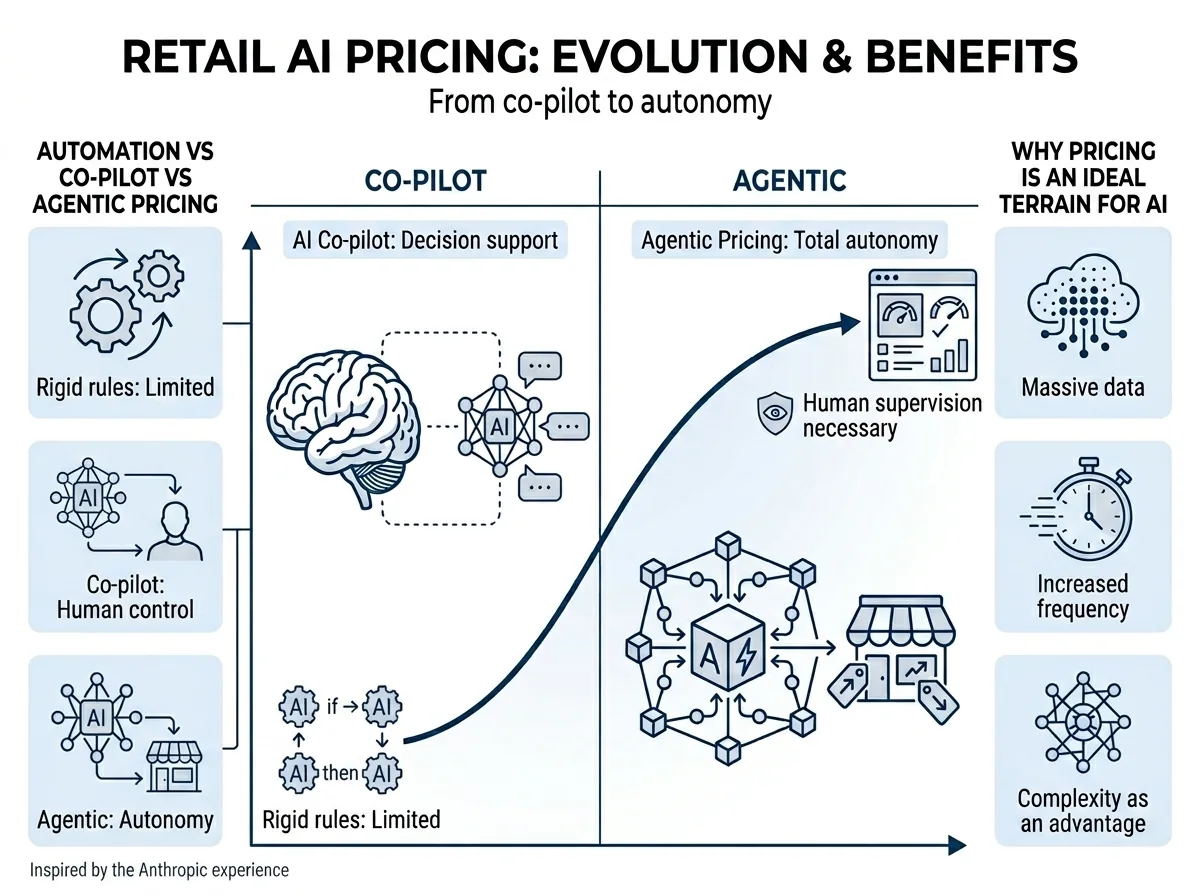
Rule-based automation vs. AI copilot vs. agentic pricing
Traditional "if-then" rules quickly reach their limits. AI copilots suggest relevant prices, while humans retain final control through validation.
Agentic pricing enables AI to act autonomously, as demonstrated by Anthropic's agentic pricing experiment with its Claudius agent. However, total autonomy remains a complex challenge for true profitability.
Human supervision thus remains indispensable. This subtle balance guarantees overall commercial performance.
Why pricing is the ideal terrain for AI (data + frequency + complexity)
Retail generates millions of data points. AI processes this massive volume, which is impossible to analyze manually, and specifically detects weak consumer signals.
The frequency of price changes is now accelerating. Algorithms react instantly to the slightest fluctuations in the global market.
Complexity thus becomes a competitive advantage. AI simplifies the execution of your pricing strategy.
The 8 AI use cases transforming retail pricing
Beyond theory, pricing AI is embodied in concrete applications that directly boost the bottom line.
Price recommendations (margin/volume) with guardrails
AI suggests the optimal price to maximize margin or volume. It makes decisions based on established strategic objectives . Safeguards prevent absurd pricing excesses.
The system learns from past customer responses and refines its proposals over the weeks.
Human validation remains central here, operating in a classic copilot mode.
This is the margin gain observed by McKinsey on pilot categories of AI-powered dynamic pricing, accompanied by a 2% to 5% sales growth (McKinsey, "How retailers can drive profitable growth through dynamic pricing", 2025).
KVI & price image protection (corridors, index)
Known Value Items (KVIs) define your price image. AI prioritizes the monitoring of these strategic items. It maintains precise competitiveness indices against competitors.
Pricing corridors prevent you from losing touch with the market. The brand's image is thus preserved.
Customer perception is protected for the long term. This is a driver for customer retention.
More reliable competitor monitoring and product matching (chaining)
AI identifies identical products across competitors despite different names. Matching becomes automated and ultra-precise. This replaces tedious and error-prone manual tracking.
It should be noted that AI shopping features, such as ChatGPT Shopping, also help consumers compare. Retail-side AI must therefore be faster. It continuously scans websites. Prices adjust according to competitor stock realities.
Market visibility is total. No opportunity escapes you.
This is the number of daily price changes made by Amazon on its catalog, a pace that illustrates why manual monitoring is no longer sufficient (Profitero, data relayed by Retail Week).
Demand forecasting: seasonality, events, cannibalization
Anticipating sales spikes is the core strength of predictive models. AI integrates weather, holidays, and local events. It adjusts prices before stock-outs occur.
It also calculates the cannibalization effect between products. Lowering the price of one item must not hurt another.
Management becomes proactive rather than reactive. Inventory turnover improves.
Elasticity models (regular price vs. promotional price)
Elasticity measures how demand varies according to price. AI defines the precise curve for each reference. It distinguishes baseline behavior from promotional mode.
You know exactly when a price drop becomes profitable. Margin leakage stops completely.
Promotional optimization (uplift, cannibalization, ROI)
Gone are generic 30%-off promotions across the entire catalog. AI simulates volume uplift for each offer. It optimizes the overall ROI of the commercial campaign.
The system suggests the best promotional mechanics. A virtual bundle may perform better than a direct discount.
Every euro invested in promotions is profitable. Effectiveness is measurable immediately.
Markdown driven by inventory
Markdown involves gradually lowering prices on end-of-series items. AI calculates the ideal pace to clear inventory. It avoids overly aggressive and premature markdowns.
Management is based on remaining inventory coverage. The objective is to reach zero at the right time.
Terminal margin on collections is preserved. End-of-life management is automated.
Anomaly detection (outliers, omnichannel inconsistencies)
Data entry errors can be costly in retail. AI detects aberrant prices or inconsistencies between the web and stores. It immediately alerts teams in the event of a drift.
Omnichannel monitoring guarantees a seamless customer experience. Prices are aligned everywhere or properly justified.
Pricing data reliability becomes absolute. This is an essential safety net.
To move from theory to execution, here is a summary of the pillars of your AI pricing strategy:
| Use case | Required data | KPI | Autonomy level |
|---|---|---|---|
| Price recommendation | Costs, Sales history, Competitor prices | Gross margin, Volume | Copilot |
| KVI Protection | Competitor price indices, Product brand awareness | Competitiveness index, Price image | Agent |
| Promo Optimization | Marketing calendar, Elasticity, Inventory | Uplift, Promotional ROI | Copilot |
| Markdown | Stock coverage, End-of-life date | Flow Rate, Terminal Margin | Agent |
Checklist: Are you ready for AI?
- Are your net pricing and cost data centralized and clean?
- Do you have access to a real-time competitive data feed?
- Are your inventory levels and stockouts tracked daily?
- Have you defined pricing corridors (guardrails) for your agents?
- Are your business teams ready to validate recommendations rather than manually entering prices?
Action plan: Your 90-day rollout
- Days 1-30 (Audit & Data): Pricing audit and catalog cleansing. Identification of KVIs.
- Days 31-60 (Pilot): Implementation of competitor monitoring and elasticity testing on a single category.
- Days 61-90 (Scale): Deployment of automated recommendations and omnichannel monitoring.
Data & prerequisites: what you need to make it work
For these algorithms to run at full capacity, a robust data infrastructure is the non-negotiable foundation of your project.
Net price, costs, margins
AI needs to know your true costs to ensure you never sell at a loss. Factor in supplier discounts and logistics fees. Net margin is the only reliable compass .
Without this data, the algorithm operates blindly. The quality of the output depends on this accounting accuracy.
Inventory/stock-outs & availability
A low price on an out-of-stock product is useless. AI must sync its recommendations with inventory levels. It can raise prices if availability drops.
Flow data is fundamental here. It allows you to regulate demand intelligently.
Catalog & attributes (variants, EAN/MPN)
A well-structured catalog. EAN and MPN codes must be unique and verified. Attributes like color or size matter.
This allows products to be grouped into logical families. The chaining between old and new versions is automated.
Database cleanliness prevents duplicates. This is the foundation of the business.
Competition (monitoring + matching)
Quality scraping provides the fuel for competitive intelligence. You must target the right market players. The collection frequency must match your commercial reactivity.
AI then processes this data to identify opportunities. It filters out the noise of short-lived promotions.
You gain agility against market leaders. Monitoring becomes a weapon.
Omnichannel (store, e-commerce, marketplaces)
Prices can vary by sales channel. AI must manage these specifics without creating confusion. It harmonizes strategies to avoid internal conflicts.
A 360-degree view of the customer is necessary. Pricing becomes a consistent experience everywhere.
How to make AI "actionable" (process + governance)
AI must not be a black box; its success depends on a rigorous and transparent human management framework.
Validation workflows (who validates what)
The manager and the algorithm share roles. Sensitive categories require manual validation. AI handles long-tail catalog items on its own.
The workflow must remain smooth to ensure responsiveness. Clear processes turn distrust into operational efficiency.
Humans retain final control. This is the very essence of the copilot.
Thresholds, corridors, floor prices
Set strict boundaries to govern price movements. Price floors secure your minimum margin, while corridors prevent erratic fluctuations.
These rules act as permanent safeguards. They protect brand perception and build confidence across internal teams.
Logs, audit, monitoring drift
Every price modification must be recorded in an audit trail to ensure immediate traceability of decisions. Monitoring detects any model drift.
If accuracy drops, retraining becomes necessary. Total transparency drives user adoption.
Every analyzed data point strengthens the system, creating a continuous learning loop.
Rollback: safety plan
A rollback procedure must be in place. In the event of an anomaly or crisis, instantly revert to manual management. An emergency stop button is essential.
Business continuity supersedes automation. A robust contingency plan prevents major financial failure.
On a pricing platform like BOOPER MPS, this governance is integrated into the tool: validation workflows, configurable business rules and simulation of the impact on revenue, margin and price image before each change.
Table: use case → required data → KPI → autonomy level
Here is an operational summary to help prioritize your initiatives based on your resources and objectives.
Strategic overview of use cases
This table cross-references technical needs and business gains to structure your AI trajectory, from a simple assistant to an autonomous system.
| Use case | Required data | Key KPIs | Autonomy level |
|---|---|---|---|
| Price recommendations | Cost of goods sold (COGS), sales history, current prices. | Gross margin, Revenue. | Copilot (Suggested) |
| KVI Protection | Competitor pricing, elasticity, brand image. | Competitiveness index, Traffic. | Copilot / Agent (Safeguards) |
| Monitoring | Competitor price feeds, product matching. | Average price gap, Share of voice. | Agent (Autonomous collection) |
| Demand forecasting | Seasonality, inventory levels, promotional calendar. | Accuracy forecasting (MAPE), Out of stocks. | Copilot (Purchasing Assistant) |
| Elasticity | Granular transactions, price changes. | Sales volume, ROI. | Copilot (Analysis) |
| Special offers | Promo cost, cannibalization, inventory. | Sales uplift, net margin. | Agent (Optimization) |
| Markdown | Stock levels, end-of-season dates. | Sell-through rate, Average Selling Price. | Agent (Inventory Management) |
| Anomalies | Price logs, omnichannel feeds, matching errors. | Number of errors corrected. | Agent (Remediation) |
30/60/90-day deployment plan
Avoid automating everything at once; adopt a phased approach to secure your gains.
30 days: scoping + data + quick wins (copilot)
The first month is dedicated to data cleansing. Identify a test product category. Activate copilot mode to generate initial quick-win recommendations.
The objective is to prove value immediately. Focus is placed on low-hanging fruit.
60 days: pilot on 1 category + KPIs + guardrails
Launch the live pilot on the selected scope. Measure margin and volume trends. Adjust guardrails based on initial field feedback.
Validate algorithm reliability with business teams. Trust is built through proof.
90: industrialization + training + continuous improvement
Deploy retail pricing AI across the entire catalog. Train pricing teams on the new tools. Implement a continuous model improvement cycle.
The project becomes a standard process. The organization gains technological maturity.
Common mistakes (and how to avoid them)
Even with the best technology, certain classic pitfalls can ruin your pricing efforts.
Poor Data Quality
"Garbage in, garbage out" remains the golden rule. Erroneous costs lead to disastrous pricing decisions. Invest heavily in cleaning your databases.
Data is the fuel for AI. Never neglect this tedious yet essential step.
This is the average annual cost of poor data quality for an organization, according to Gartner — a cost that primarily impacts automated pricing decisions (Gartner, 2020).
Incorrect Competitor Matching
Comparing apples to oranges distorts your strategy. Inaccurate matching triggers a futile price war. Manually verify critical product mappings.
Matching precision is vital. It prevents erroneous price alignment.
Short-term over-optimization
AI can maximize immediate margins at the expense of price image. Maintain a long-term vision of your market positioning. Do not sacrifice customer loyalty for quick profits.
Pricing is a marathon. Balance is the key to sustainable success.
Ignoring Promotions, Stock, and Omnichannel Dynamics
Isolating pricing from other retail levers is a major mistake. Promotions and inventory levels directly influence demand. Integrate all these signals into your model.
A siloed approach is ineffective. Omnichannel consistency must be preserved.
Lack of Governance
Allowing AI to make autonomous decisions without oversight is risky. Establish robust control and accountability protocols. Who is responsible in the event of an algorithmic error?
Governance provides the necessary security, establishing boundaries for technological innovation.
Checklist: Are you ready to implement AI in your pricing strategy?
Before getting started, evaluate your organization against this operational checklist.
Data, Process, and Governance Checklist
First, assess the maturity of your data flows. Are your cost and inventory figures 95% reliable? This is the minimum prerequisite for a smooth implementation.
Here are the essential checkpoints:
- Data: Accessibility of net costs, real-time inventory, and competitor pricing.
- Process: Implementation of a validation workflow and clear definition of roles.
- Governance: Establishment of price thresholds, rollback plans, and audit logging.
If you check all the boxes, you are ready. Otherwise, focus your efforts on the foundational elements. AI implementation will follow.
Conclusion
Pricing is no longer a matter of intuition, but of mathematical precision driven by artificial intelligence.
AI pricing transforms your data into a growth driver. From monitoring to agentic pricing, the opportunities are massive. The key is starting with a solid foundation.
Would you like to audit your current strategy? Contact our experts for a customized data audit.
Take action today. The future of retail is already here.
AI pricing transforms your data into a growth driver, evolving from copilot assistance to agentic pricing autonomy. Master your inventory flows and price corridors now to secure your margins. Adopt this mathematical precision to dominate a constantly shifting market. The future of retail is already here.
See also: How Agent-Based AI Is Transforming Autonomous Pricing in Retail; Automating Pricing Without Losing Control.
FAQ
The AI co-pilot acts as a strategic assistant: it analyzes your data and generates pricing recommendations that a human must approve—a productivity partner that automates repetitive tasks without ever making decisions on its own.Agent-based pricing represents the next level of autonomy: the AI dynamically adjusts prices in real time and acts proactively to meet profitability goals, without requiring systematic human approval.
This article classifies each use case on this scale: price recommendations and promotional optimization remain in co-pilot mode, while KVI protection, competitive monitoring, and markdowns can switch to agent mode, provided that robust safeguards (price corridors, floor prices) are in place.
The Project Vend experiment conducted by Anthropic using its agent Claudius illustrates the current limitation: full autonomy remains a challenge in terms of robustness, which explains why human supervision remains essential even in the most automated segments, as detailed in our framework for distinguishing between decision-making AI and execution-oriented AI.
The market for agent-based AI in retail is estimated to reach $218.37 billion by 2031—a strong indication that this shift from co-pilot to agent is structural, but it is unfolding gradually, category by category, rather than all at once across the entire product lineup.
No: AI frees teams from tedious manual analysis, allowing them to focus on high-level strategy and the management of complex exceptions. People remain the guardians ofthe brand’simage and long-term vision.
This article emphasizes that even in an advanced model, rigorous governance remains essential: managers define safeguards—thresholds, corridors, and floor prices—to ensure that the algorithm’s decisions remain aligned with the brand’s values, within a pricing organization with clearly defined roles.
The use case table confirms this: even use cases classified as “Agent,” such as KVI protection or Markdown, are still governed by approval workflows that define who approves what based on the sensitivity of the category.
The role of the category manager is therefore shifting toward dispute resolution and exception handling, rather than manual price entry—a change in job responsibilities, not a job elimination.
Success depends above all on data quality: reliable streams of net costs, real-time inventory levels, and competitor prices. Without a clean database, the algorithm risks making erroneous decisions, at a cost that is far from negligible.
This article cites Gartner’s figures on this topic: poor data quality costs an organization an average of $12.9 million per year —a cost that primarily impacts automated pricing decisions, as we detail in our article on the data glass ceiling in AI pricing.
It is also crucial to adopt an omnichannelapproach: AI must understand the interactions between physical stores, e-commerce sites, and marketplaces to maintain pricing consistency and avoid channel conflicts.
The checklist in this article adds one final, often-overlooked prerequisite: predefined price ranges and teams ready to approve recommendations rather than enter prices manually.
By setting safeguards and competitiveness ranges: rather than blindly following every price cut by competitors, the AI analyzes price elasticity and the actual impact on sales volume to determine whether price alignment is strategically profitable.
This article also highlights the role of product matching: accurate matching prevents errors in comparing items that are not actually identical—a common pitfall that triggers unjustified pricing adjustments. See our method for ensuring reliable product matching.
The competitive landscape has become more intense: Amazon makes approximately 2.5 million price changes daily across its catalog—a pace that renders manual monitoring obsolete and justifies relying on automated price tracking rather than one-off checks.
The protection of KVIs, described in this article as a use case in its own right, applies this same principle: strict alignment with the most visible products, but always within a range, never as an automatic and comprehensive reaction to every competitor’s move.
ROI is managed through specific KPIs: changes in gross margin, increases in sales volume (uplift), and reductions in dead stock through better management of markdowns, all tracked in a single pricing KPI dashboard.
This article cites the order of magnitude results observed by McKinsey in pilot programs using AI-driven dynamic pricing: a 5 to 10 percent increase in margins, accompanied by 2 to 5 percent sales growth—useful benchmarks for setting a realistic goal before getting started.
The recommended method is a phased 90-dayapproach: scoping and data collection in the first month, a pilot in one category in the second, and full-scale implementation in the third—which allows for a comparison of AI performance with traditional methods before any full-scale deployment.
This phased approach ensures accurate ROI calculations: we measure actual gains within a controlled scope before extrapolating them to the entire catalog.
Recent experiments, such as Anthropic's Project Vend with its agent Claudius, show that while AI agents are making progress in inventory management and sourcing, achieving full autonomy still presents real challenges in terms of robustness.
This article draws a clear practical conclusion: human oversight remains necessary to avoid ill-advised decisions or sales at a loss, particularly in sensitive categories or for KPIs, as evidenced by the frequent mistakes made by pricing teams when dealing with AI.
The recommendation, therefore, is to start in “co-pilot” mode: once trust has been established and the models have been refined using the brand’s specific historical data, autonomy can be delegated gradually, one product segment at a time.
This principle aligns with the 30/60/90-day rollout plan detailed in this article: you never switch an entire catalog to agentic pricing all at once; instead, you gradually expand autonomy as the safeguards prove their worth.
To learn more, check out our definition of agent-based pricing with real-world examples. BOOPER offers pricing optimization software that takes you from a "co-pilot" approach to AI-driven execution.

Goal-based pricing starts with the target outcome (margin, revenue, category competitiveness) and lets AI calculate the prices needed to achieve it, rather than piling on rules one product at a time.
The engine simulates thousands of scenarios by factoring in business constraints, purchasing behavior, and product cannibalization; if the objective is unattainable, it identifies the best compromise.
For retailers supported by Booper: +0.5 to +3 percentage points of margin in a few months and -70 to -90% reduction in price preparation time . The pricing manager retains the final decision.

The key takeaway: An AI-generated price recommendation without an explanation falls on deaf ears with pricing teams, who refuse to apply a score they don't understand.
Explainability and auditability are two distinct requirements: the former justifies a recommendation at the time it is proposed, while the latter makes it possible to trace who approved what, when, and why—even several months later. A key finding: Explainability is identified as a key AI risk by a large majority of executives, but very few organizations are actually taking steps to address it.

Fixed-rule dynamic pricing is giving way to autonomous AI agents that make decisions in real time—on both the seller and buyer sides—without waiting for a human approval cycle.
90% of B2B purchases will be handled by purchasing agents by 2028 (Gartner), and 47% of the retail sector has already adopted agent-based AI (NVIDIA): competition between agents is becoming the norm, not the exception.
The real risk is not speed but the lack of safeguards: price floors, price ceilings, and explicit governance are becoming the priority, lest algorithmic collusion—which regulators are already scrutinizing—occur.