
Pricing Manager and AI: what the machine does, what the expert decides

November 13, 2026
AI handles the volume at every stage of the data journey: collection, product matching, verification, forecasting, and simulation. The expert selects competitors, resolves ambiguous cases, provides context, formulates the strategy, and makes decisions.
At Booper, Booper Mind makes suggestions, MPS monitors, and the user decides. Knowing how to interpret elasticity and question a forecast is more important than knowing how to code.
An AI agent can write a price-collection script, an automated report, or a simulation model overnight. The question is no longer whether it can be built.
The question is who will run it, correct it, and be accountable for it when it manages thousands of prices every week. And, ultimately, that still depends on the pricing manager.
AI has changed what a pricing manager can do on their own
An AI agent can now write a price-collection script, an automated report, or a simulation model with adjustable assumptions in just one night.
Many pricing managers have done this this year. Some have even built their own pricing hub in Python, with the help of coding agents.
Some respondents say their organization decided not to purchase at least one software product or feature because it could build it in-house using agent-based coding tools.
(McKinsey, “The State of AI in 2026,” 1,719 respondents, August 2026)
It's a good idea to test an idea. It becomes risky when the prototype goes into production without anyone having decided who will maintain it.
We've discussed the actual cost of an in-house pricing tool elsewhere. Here's another question: whether or not you use an in-house tool, what still depends on the expert?
The Data Journey: What the Platform Does, What's Left for the Expert
A pricing tool is not a model—it’s a data journey. Prices are collected, matched to your products, verified, transformed into forecasts, checked against your rules, simulated, and then validated and measured.
At each stage, the machine handles the volume. And at each stage, a human decision changes the outcome.
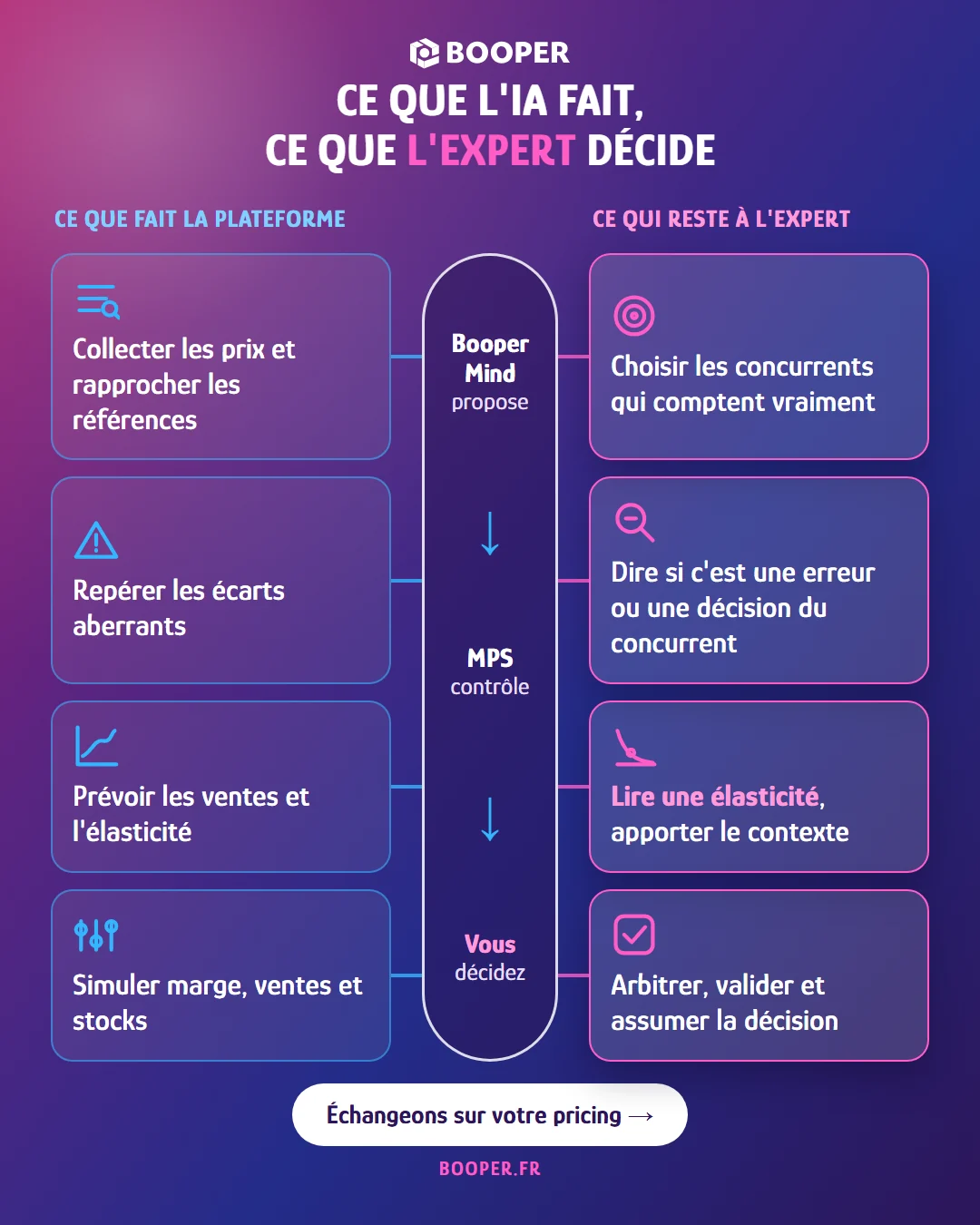
| Step | What the platform does | What's Left for the Expert |
|---|---|---|
| Collection | Prices, promotions, shipping costs, and availability—updated daily if needed | Choose the competitors that really matter |
| Product Matching | Matching by EAN, label, and image, with a confidence score | Resolve ambiguous cases, which help in learning the algorithm |
| Control | Outliers, data range inconsistencies, alerts | Determine whether the anomaly is an error or a decision by the competitor |
| Forecast | Sales and Elasticity: An Explanation of These Factors | Provide the context that the data lacks |
| Rules | Category roles, limits by retail location, selling at a loss, Egalim, reference prices | Develop the strategy |
| Simulation | Impact on sales, margins, and inventory: several scenarios | Balancing Margin, Volume, and Price Image |
| Decision | Validation Process, Audit Log | Accept, Reject, Take Responsibility |
| Measurement | Rate of adoption of recommendations, impact on margin | Review the assumptions |
The technical workings of each component are described in our article on how an AI pricing engine works. Let's take a look instead at where the expert comes in.
Product Collection and Matching: The Expert Selects and Decides
Booper collects online prices itself—from websites, marketplaces, and apps—daily if necessary, covering tens of thousands of products.
Prices, promotions, shipping costs, and availability are tracked in the price monitoring system. Your store data and panelist data are imported and analyzed in one place.
But the platform doesn't know which competitors are truly important for each of your stores. That decision is up to the team, and it determines everything else.
Product matching then compares your product listings to those of competitors using EAN codes, product name analysis, and image recognition, generating a confidence score for each product.
When a user confirms or corrects a questionable match, the algorithm learns. This is one of the few areas where a few minutes of expert input can lead to lasting improvements in the system (see also: How to Improve Matching Accuracy).
Forecasting: AI calculates, the expert asks questions
Sales forecasts andprice elasticity are calculated based on numerous factors, including the weather. Each forecast includes an explanation of the factors that influenced it.
the reliability of our sales forecasts. This high level makes it all the more useful to read the explanation for each forecast.
(Booper, key figures published in September 2026)
This figure does not mean you can skip reading the explanation. It is the explanation that reveals a false assumption before it becomes a price.
The model does not take into account that a competitor is opening 500 meters away or that a supplier is planning a price increase. This context remains the team’s context, as we explain in “Business Context Is Not Data.”
Rules and Decisions: Where Responsibility Comes Into Play
An accurate recommendation may still be commercially incorrect. It may violate a pricing tier, consistency across formats, or a legal requirement.
That is why business rules and French compliance requirements are built right into the platform: the threshold for selling at a loss, Egalim promotional limits, and 30-day reference prices.
An in-house tool must recode them, keep them up to date, and demonstrate that it applies them. A platform, on the other hand, must justify every decision—which is what we advocate regardingthe explainability of pricing recommendations.
AI provides: recommendations, product groups, and analyses. The platform monitors: business rules, compliance, and product line consistency. The user makes the decision, and every decision is tracked.
No recommendation is implemented without validation. This isn't just a matter of being cautious under the circumstances—it's what allows us to entrust the volume to the machine without losing control over prices.
The same division of roles already applies to the AI-driven management of product line chaining, our first use of Booper Mind in production.
Do you need to know how to code to be a pricing manager?
Our stance: Understanding the data—yes; coding—not required. Interpreting elasticity, analyzing a forecast, writing a rule, and identifying an outlier carry more weight than writing a script.
Code remains a real asset for prototyping an analysis or testing an idea. But a pricing team whose output depends on scripts written by a single person is vulnerable.
The case of the Barbotteau Group illustrates this point. Its pricing director managed four retail chains on his own, using Excel, while a competitor had a pricing team of about ten people.
The direct transition from Excel to a hybrid AI resulted in a 1-point increase in the " Markup " score for the products tested over the course of a quarter. The platform handled the volume; the pricing director maintained the strategy.
Where to draw the line between what AI does on its own and what it submits for approval depends on the stakes, the volume, and the possibility of backtracking. We discuss this in detail in “AI That Decides, AI That Executes.”
What the platform will never do for you
Choose a pricing strategy. Decide which category will focus on price and which will focus on profit margin.
Taking responsibility for a price increase when dealing with a buyer, franchisee, or customer. Rejecting a recommendation because you know something that the data doesn't.
AI speeds up everything else: building, testing, and simulating. The more capable the tools become, the more value shifts toward those who know what to ask of them.
Would you like to free your pricing team from the burden of data processing?
Our experts will use your own data to show you what the platform supports and where your expertise makes a difference.
Let's discuss your pricingFrequently Asked Questions About the Pricing Manager and AI
AI handles the volume: collecting prices, matching products, detecting anomalies, forecasting sales, and simulating scenarios.
The pricing manager retains the tasks that require judgment: selecting the competitors that matter, resolving borderline cases, providing the context that the data lacks, drafting the pricing strategy, and making decisions. The role is shifting from setting prices to managing them.
No, it's not required. The key skill is data literacy: interpreting elasticity, questioning a forecast, writing a rule, and identifying outliers.
Knowing how to code remains an asset when prototyping an analysis or testing an idea with an AI agent. However, a production process that relies on scripts written by a single person makes the pricing team vulnerable.
For a prototype, yes: a coding specialist can quickly write a data collection script, a report, or a simulation. The challenge comes later.
You have to keep up with data collection when sites change, ensure reliable product matching across thousands of SKUs, keep legal requirements up to date, and document every decision. That’s where the cost of an in-house tool really adds up—much more so than in the model.
Technically, an AI can set prices without human intervention. At Booper, we don't do this for decisions that affect our profit margin or pricing strategy.
Our approach: Booper Mind provides the solution; the MPS platform enforces business rules and compliance; and the user makes the decision. No recommendation is implemented without approval, and every decision is logged in an audit trail.
The platform matches your product listings with those of your competitors using EAN codes, product name analysis, and image recognition, and assigns a confidence score to each match.
The expert resolves cases with low confidence scores by determining whether they involve the same product, an equivalent product, or a different product. The expert's validations and corrections help the algorithm improve, which reduces the number of questionable cases over time.
We start by configuring what already exists: category roles, pricing tiers, price ranges by retail location, and legal requirements. The AI then makes recommendations within this framework, without questioning it.
The rollout begins in a test environment, where the recommendations are compared to the team's usual decisions before being expanded. The strategy remains the company's own; the tool simply implements it faster and on a larger scale.
The two are not mutually exclusive. Data profiles remain valuable for company-specific analyses and for testing models.
On the other hand, price collection, product matching, compliance, and traceability do not need to be rebuilt in-house. A price diagnostic allows you to assess where your room for improvement lies before making a decision.
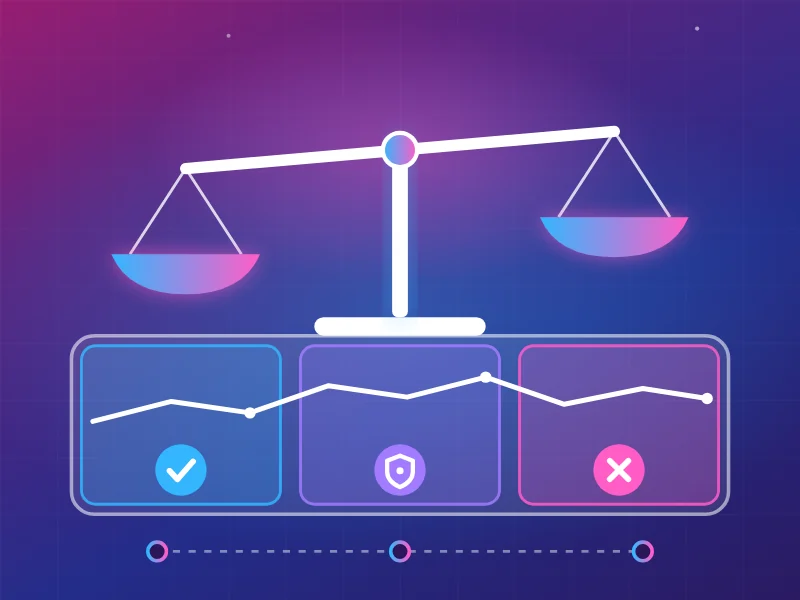
Dynamic pricing is permitted in France. Personalized pricing based on automated decisions is allowed, but customers must be notified of it. Algorithm-based price-fixing remains prohibited, even in the absence of contact between competitors.
The strongest safeguard for a retailer: being able to say, for each price, which rule generated it, what data it was based on, and who approved it.

An AI agent does not simply look at a listed price: it compares the actual price—which includes applicable promotions, shipping, availability, and unit price—for the products the customer requests.
Competitiveness is now measured rather than perceived. The accuracy and consistency of pricing data across channels have become the brand's new calling card.

An LLM can match differently worded descriptions and suggest groups of products from the same line. It can also be confidently wrong.
Booper's AI-driven chaining system combines AI, programmed controls that correct its errors, and human validation. No group is created without the user's consent.