
Customer-Centric: Building a Pricing Strategy Centered on the Customer
On this page
Are your prices based on what your customers value?
Schedule a meetingLearn about our pricing strategy consulting servicesA customer-centric approach places the customer's needs, usage patterns, and perceived value at the center of business decisions, including pricing. It therefore prioritizes value-based pricing over pricing based solely on costs or competition.
The Essentials in 6 Questions
Decisions—including pricing—based on the value perceived by the customer.
Management, marketing, pricing, category management.
With every decision regarding positioning and pricing.
By segment or use, when the perceived value actually differs.
Align pricing with true value and strengthen customer loyalty.
Measure willingness to pay, test prices, and differentiate by segment.
Why Adopt a Customer-Centric Pricing Strategy?
Because a price that aligns with perceived value makes customers less sensitive to occasional price cuts by competitors.
- Align pricing with the actual value perceived by each segment, rather than using a uniform price that undervalues certain uses.
- Reduce the risk of decisions that are out of touch with the market by incorporating customer insights into every decision.
- Building loyalty: Aligning the price paid with the value received protects against competition.
When applied to pricing, this approach results in value-based pricing (see also the pricing fact sheet).
Real-world example: a 4–6% premium justified by the advisory firm
A home improvement retailer charges 4 to 6 percent more than discounters for renovation products, and its customer retention is on the rise.
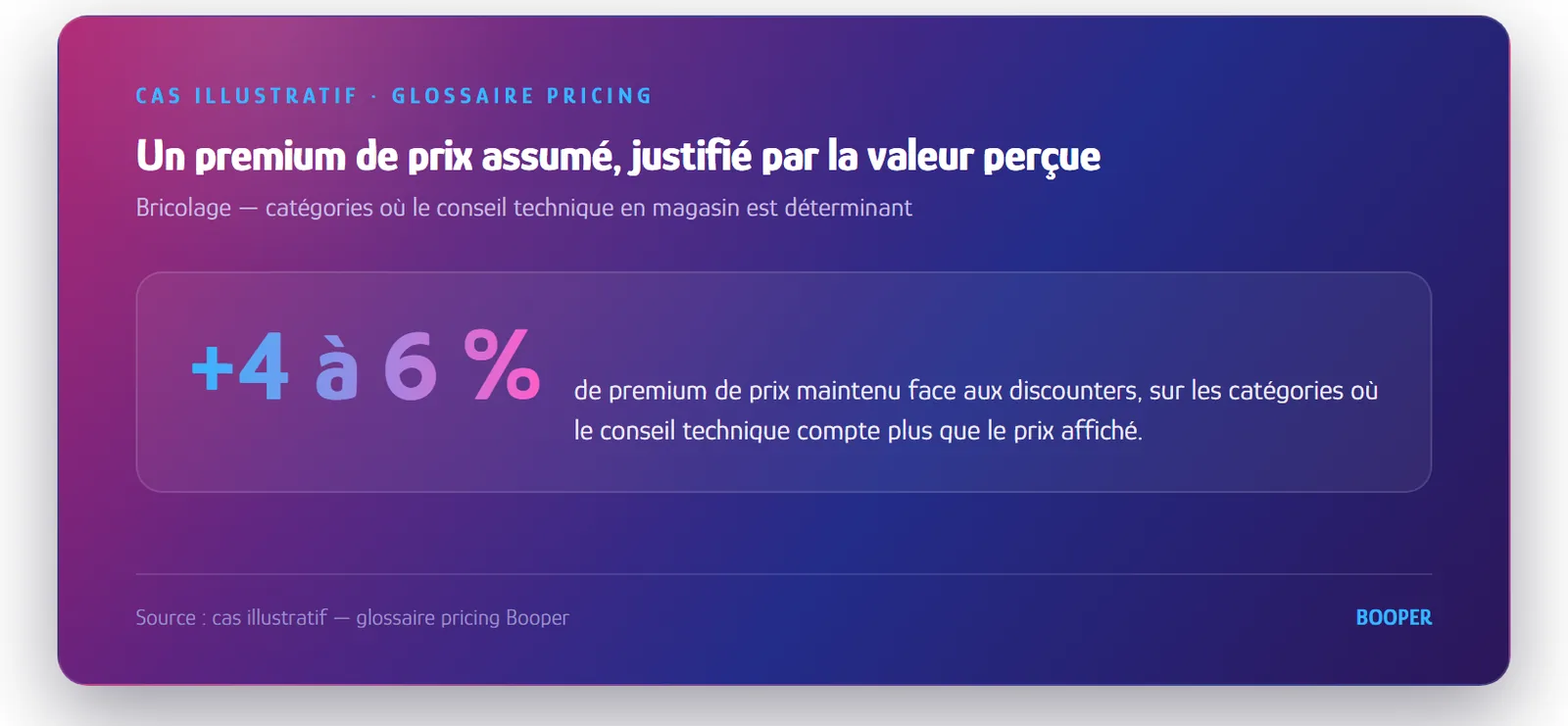
Surveys show that home improvement shoppers value in-store technical advice more than the listed price. Rather than matching discounters’ prices, the retailer maintains a slight premium on these product categories and explicitly highlights the associated service.
How can you implement customer-centric pricing?
By measuring perceived value and then differentiating the price where it actually differs.
The approach is based on willingness-to-pay surveys, price tests, and price sensitivity analysis by segment, rather than on cost or benchmarks alone. It differentiates prices by segment or use when perceived value truly differs. Our pricing strategy consulting services structure this positioning; our pricing training instills these habits in teams.
The 3 Common Mistakes in "Customer-Centric" Pricing
Claiming to be one without measuring up, differentiating without justification, or confusing it with discount shopping.
- Claiming to be customer-centric without ever measuring perceived value, while continuing to set prices based on costs or the competition.
- Pricing differences without a justificationthat is perceived as legitimateare seen as unfair rather than personalized.
- Confusing "customer-centric" with "discount": putting the customer first does not mean lowering prices.
Frequently Asked Questions
Short answers to the most frequently asked questions about the customer-centric approach.
What is a customer-centric approach?
A customer-centric approach places the customer's needs, behaviors, and perceived value at the center of business decisions, including pricing, where it prioritizes value-based pricing over an approach based solely on costs or competition.
What is the difference between customer-centric and value-based pricing?
Customer-centricity is a business philosophy; value-based pricing is its practical application to pricing, where prices are set based on perceived value rather than cost or competition.
Does a customer-centric approach mean lower prices?
No: it can justify a higher price where perceived value is high, provided that value is actually delivered.
How can you tell if a pricing policy is customer-centric?
If it is based on an actual measurement of perceived value by segment (surveys, price tests, behavioral data) rather than on intuition or an internal margin target.
What metrics should you track to implement a customer-centric pricing strategy?
These three categories complement each other. Perception, as measured by price-image surveys and positioning relative to benchmark products. Behavior, as reflected in conversion rates, loyalty, and the percentage of returning customers. And profitability, tracked by margin per customer segment rather than by average margin. Looking solely at the overall margin obscures the trade-offs that displease the most loyal customers.
How can a customer-centric approach be reconciled with a profit margin goal?
By acknowledging that margins are not earned uniformly. The benchmarks the client monitors are in line with market levels, and margins are rebuilt on those the client does not compare. This asymmetry requires the ability to distinguish between the two, which is a data-driven task rather than a commercial arbitrage opportunity.
Does a customer-centric approach also apply to B2B?
Yes, with a slight difference in approach. In B2C, perceived value is measured by broad segments. In B2B, each customer has its own usage, volume, and service cost: the approach, therefore, is to create pricing grids by customer segment rather than a single price adjusted by discounts granted on a case-by-case basis.
Key Takeaways
- Customer-centric pricing is based on the value perceived by the customer.
- It measures willingness to pay and sets different prices for each segment.
- It's not a bargain: it can justify a premium price.
Would you like to set your prices based on the value your customers perceive?
Booper factors in perceived value alongside cost and competition in every pricing decision.
Let's talk about the perceived value of your offerings →Learn about our pricing strategy consulting servicesYou might also be interested in these articles

Perceived value (what the customer believes a product is worth before purchasing it) and actual value (what the customer finds it to be worth afterward) are two distinct concepts, and the right price is the one that matches the former, not the latter. A misalignment (undervaluation or overvaluation) costs profit margin or customers; a retailer’s price image depends on a limited number of highly visible items (the KVI), not on the average price.

An effective pricing strategy relies on rigorous segmentation between key value items (KVIs) and margin drivers. To protect profitability, retailers must move away from blind competitive matching by establishing strict governance and pricing corridors. Data-driven management using cleansed data allows companies to restore their price image and margins in just 30 days.

Justifying the price after the fact (by citing costs) and explaining its value upfront (by communicating the customer benefit before the purchase) are two approaches to price communication that have radically different effects on perceived value. The first is defensive and comes too late; the second is proactive and shapes perception before the price becomes an issue.