
Price Adjustments
On this page
Are your price adjustments simulated before they are approved?
Schedule a meetingDiscover our pricing optimization softwarePrice adjustment refers to a one-time or recurring change to a price that is already in effect for a specific product, category, or product line. It is driven by changes in costs, competitive moves, margin targets, or seasonal shifts. It is an ongoing management process that requires clear governance.
The Essentials in 6 Questions
Changing a price that is already in effect.
Pricing teams, category managers, store teams.
Daily for e-commerce, weekly for food, monthly for other sectors.
For reference, when looking at the entire product line.
Maintain profit margins in the face of rising costs and competition.
Competitive position, elasticity, minimum margin, validation workflow.
Why Adjust Prices Continuously?
Because a fixed price is at the mercy of the market: costs rise, competitors lower their prices, and seasons change.
- Maintain profit margins when costs rise or a competitor lowers its prices.
- Testing the flexibility of a reference: a controlled and measured adjustment improves subsequent decisions.
- Maintaining product line consistency: a single adjustment can disrupt the balance between entry-level, mid-range, and premium products.
Concrete example: €84.90 rather than rounding down to €79
A reasonable adjustment recovers 12% of the lost volume and increases net income by 5%, resulting in a 6% decrease in the unit margin.
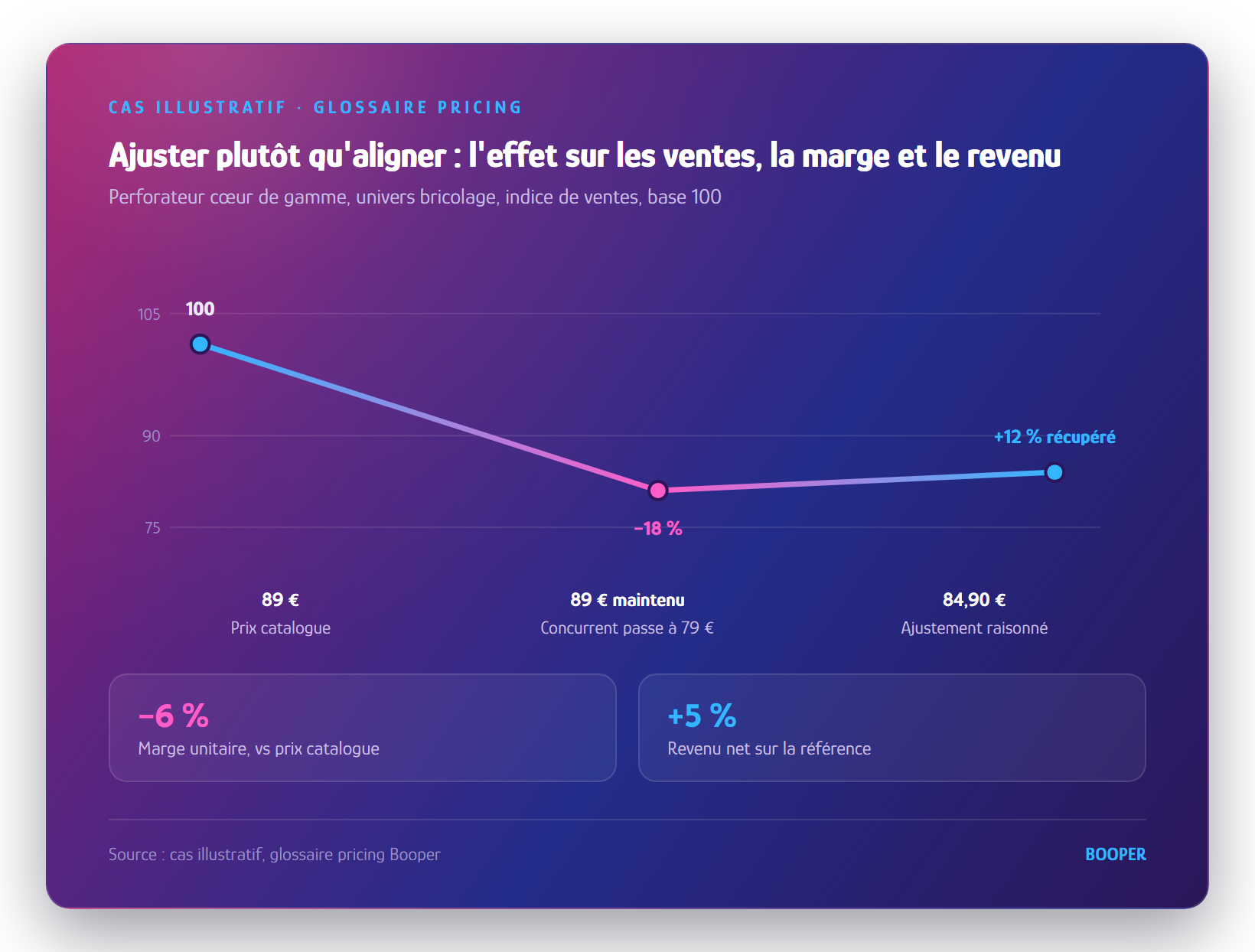
A hole punch priced at €89 loses 18% of its sales in two months after a competitor lowers its price to €79. Rather than matching the competitor's price, the retailer adjusts its price to €84.90 and maintains a €5.90 price difference, justifying it with a better warranty.
How do you manage a price adjustment?
Three input data points, a rules engine, and a validation workflow.
Competitive Position
Price monitoring or web scraping, performed continuously on sensitive SKUs.
Historical Elasticity
The response of volume to comparable price changes.
Floor margin
The threshold set by finance, below which the adjustment can no longer be managed locally.
Validation
The engine proposes, the team approves, with amplitudinal safeguards.
Our price optimization software simulates the impact of each adjustment across the entire product line before approval; our MPS pricing solution enforces the rules andcapping thresholds.

3 Mistakes to Avoid When Adjusting Prices
Adjust without stretching, without looking at the scale or too often.
- Adjusting prices without considering elasticity: Lowering the price of a product with low price elasticity erodes profit margins without increasing sales volume.
- Adjust a single reference without checking for consistency with its neighboring values in the range.
- Making too many minor adjustments: Daily changes make it harder for customers and store teams to understand the information.
To put this adjustment into context, see the difference between strategic pricing and tactical pricing.
Frequently Asked Questions
Short answers to the most frequently asked questions about price adjustments.
What is price adjustment?
Price adjustment refers to a one-time or recurring change to a price that is already in effect for a specific product, category, or product line. It is implemented in response to a change in costs, a competitor’s move, a margin target, or a shift in seasonality.
How often should you adjust your prices?
It depends on the category: daily for e-commerce, weekly for key performance indicators (KPIs), and bimonthly for the rest of the food retail sector, and monthly for specialty non-food retailers.
Should store teams be notified of every adjustment?
Yes, for high-visibility items (KVI, end caps) to avoid errors at the register. Other transactions can be processed through an automated system.
What safeguards are in place to prevent abuses?
A maximum amplitude threshold (for example, ±8% over 30 days) and a frequency limit (no more than two adjustments per month for the same reference).
Key Takeaways
- Pricing adjustments are made to an existing price in response to costs, competition, or seasonal factors.
- It is based on competition,price elasticity, and a minimum margin.
- It remains consistent with the product line and is subject to certain restrictions.
Would you like to adjust your prices without disrupting the consistency of your product line?
Booper simulates the impact of each adjustment across your entire product line before confirming it.
Let's talk about your price adjustments →Discover our pricing optimization softwareYou might also be interested in these articles

Strategic pricing sets the framework for profitability and long-term brand image, while tactical pricing executes this vision through agile, short-term actions. This alignment protects your margins while allowing you to respond to inventory levels and competition. A 15% growth target perfectly illustrates this synergy. Establishing this strategic framework before executing it tactically is the focus of BOOPER’s Pricing Strategy Development module.

A price set at launch becomes, without any explicit decision, a permanent benchmark that no one ever revisits, even though all the factors that originally justified it (costs, competition, perceived value) continue to change. Treating price as a continuously adjusted variable, with a defined revision schedule, prevents lost profit and the loss of responsiveness that comes with a fixed price.

Strategic pricing defines long-term positioning to maximize profitability and price image, unlike daily operational adjustments. This framework structures range architecture and governance to prevent gut-feeling decisions. In retail, 62% of buyers prioritize price, making this compass essential for protecting margins against competition.