
Copier paper and filing supplies each declined by 6.1% year-over-year as of the end of September 2025 (GfK / Ufipa). Supplies retailers are therefore focusing on hygiene, cleaning, coffee, and protective gear. But adding a product line to the catalog does not mean it is effectively managed: too often, it is assigned a single markup rate, set when the line is introduced and rarely revised.
White Paper
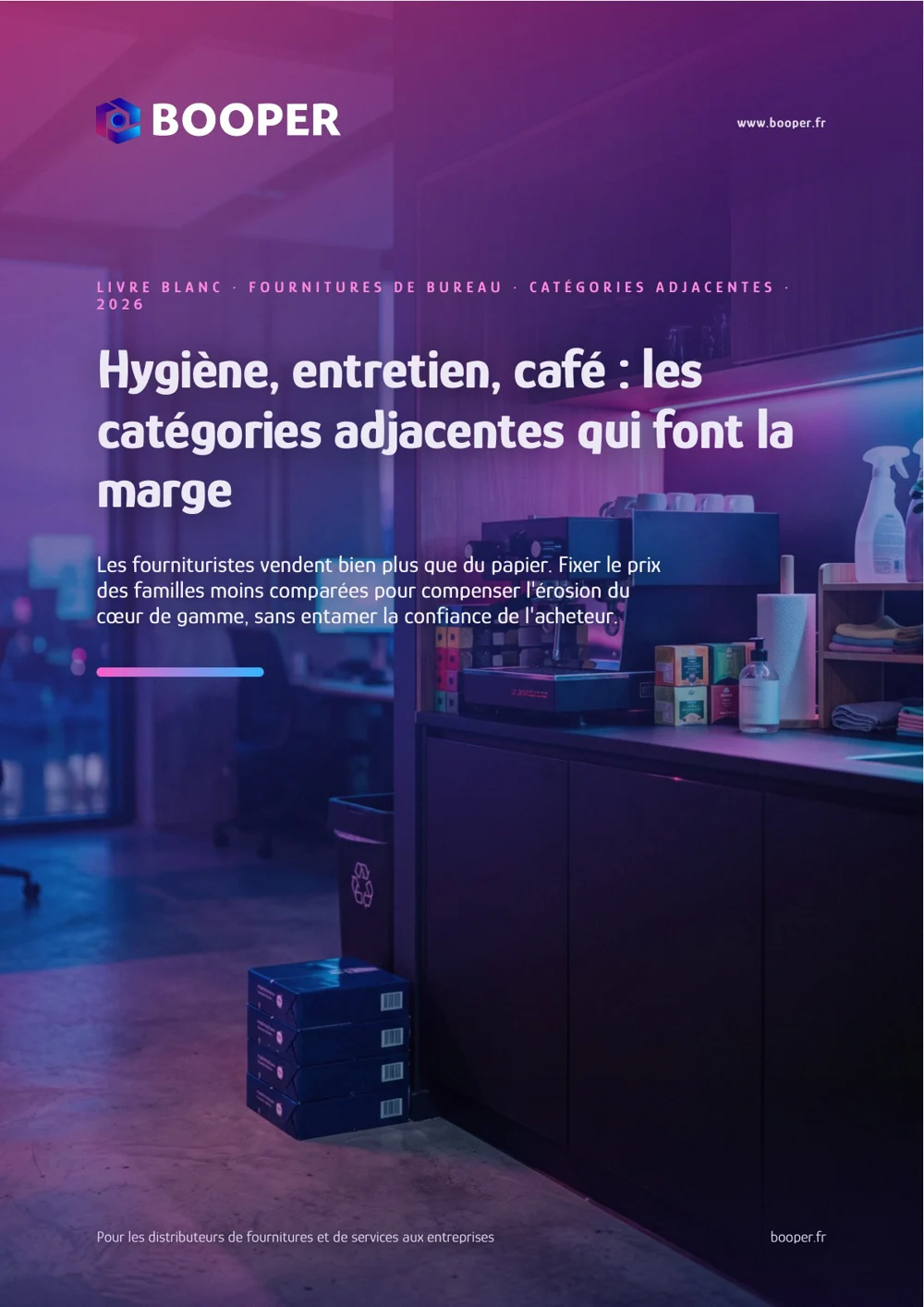
Hygiene, housekeeping, coffee: the related categories that drive profit margins
This white paper explains how to price adjacent product categories using their own rules: align the brand products that customers compare, calculate the price of other products based on cost per use (per cup, per wash, per liter diluted), and track volatile purchase costs such as those for coffee. Figures verified and dated from 2023 to 2026 (GfK / Ufipa, Fiducial Office Solutions, Lyreco, Unite and HTWK Leipzig, Ifop, Insee).
When you download it, you'll discover
- Why hygiene, maintenance, and coffee are in a league of their own: the median threshold at which companies launch a procurement project is approximately €15,000
- How to identify the benchmark products to use for pricing—such as those from major brands—and set prices for all the others
- How to Sell Based on Cost Per Use Rather Than Per Box, with a Numerical Example Using Paper Towels
- How to Track Volatile Costs: Coffee and tea prices rose 12.4% between mid-2023 and May 2025, compared with 1.9% for food (excluding fresh produce)
- How much margin can adjacent families deposit into an account, and what safeguards are in place to ensure that the offsetting remains justifiable?
The Essentials
Item by item, not using a family multiplier. Less commonly compared to paper, these categories can carry the margin that the core product line no longer carries, provided they are actively managed and not just added to the catalog.
−6.1%for both copy paper and filing paper, over a 12-month period ending in September 2025, across all distribution channelsGfK / Ufipa, via Fiducial Office Solutions, January 2026
+12.4%for coffee and tea prices between mid-2023 and May 2025, compared with +1.9% for food excluding fresh produceINSEE, Economic Report, June 2025
65%of companies source at least a portion of their indirect purchases through marketplacesUnite and HTWK Leipzig, Study on Indirect Procurement, May 2025
What You'll Take Away
The industry's key players say it themselves: growth will come from general services, not from paper.
It takes just two clicks to compare a ream of paper, and even fewer to compare a box of hand towels for a wall-mounted dispenser. But within the same product family, there are items we know by heart and others we’ve never compared.
Coffee involves a steady volume of sales and a purchase cost that has fluctuated significantly. A pricing structure—inherited from the paper industry—that is revised once or twice a year cannot keep pace with these changes.
Compensation that is too obvious backfires on the distributor: a buyer who discovers a discrepancy in the coffee calls the entire contract into question.
Free Download
Get the white paper by email.
Thank you! We'll email you the white paper very soon.
Oops! Something went wrong while submitting the form.
By downloading, you agree to be contacted by Booper regarding this content. Your data will never be shared with third parties.