
Branch and franchisee: Two pricing strategies under one brand

October 9, 2026
A franchisor cannot impose a minimum resale price: doing so is punishable by law; the franchisor may only recommend a price or set a maximum. A franchisee’s margin is therefore governed by a documented target, defined by network segment and applied uniformly across each segment.
The best indicator of this governance is not adherence to the suggested retail price, but the rate of compliance with it by segment. A suggested retail price that franchisees in a given area do not follow often signals a poorly set price, not a lack of discipline.
The same brand, the same product, and yet two legitimate ways to set the markup: one for a company-owned store, and one for a franchisee-owned store that negotiates its own markup.
To ignore this discrepancy is to treat the network as a homogeneous entity, which it is not. To document it is to transform a recurring source of friction into a stable, enforceable, and defensible rule.

Short answer: Two margin approaches, one method
In a mixed-model network, a company-owned store’s margin is an internal target set and adjusted by the corporate headquarters. A franchisee’s margin, on the other hand, represents the profitability of an independent business owner, who negotiates it.
Both are valid, and a one-size-fits-all rule ultimately fails to serve either of them well. The solution is not to decide on a case-by-case basis, but to establish a rule for each network segment—one that is documented and applied consistently across all points of sale within that segment.
A mixed network is not a homogeneous network
From headquarters, a network appears as a single line: price, margin, brand. From the field, it appears as two distinct groups.
On one hand, company-owned stores, where profit margin is an internal goal. On the other, franchisees who have invested their own capital and make decisions each month based on their own income statements.
franchised retail locations in France in 2025, up 2.9% year-over-year, across 2,035 networks. The federation sees this as evidence of the model’s growing strength compared to company-owned chains.
(French Franchise Federation, 2025 Indicators, March 2026)
Managing such a system with a one-size-fits-all approach means ignoring the fact that half the network—and sometimes more—does not respond to the same incentives. A branch manager implements a policy. A franchisee adapts it.
What a franchisor can—and cannot—require regarding pricing
A legal reality underlies this entire issue, and it is often discovered too late: under French law, a franchisor cannot impose a minimum resale price on its franchisee.
The Commercial Code imposes a fine of €15,000 for setting a minimum resale price (Article L442-6), and antitrust law applies in full to franchise agreements.
What the law allows: recommending prices or setting maximum prices, with the goal of ensuring pricing consistency and maintaining a positive brand image, provided that the franchisee retains control over the final decision.
It is this point that changes the nature of an “optimized margin” target. It is not an order. It is a documented and justified target that the franchisee follows because the economic benefit is demonstrated, not decreed.
The same principles apply to exceptions and exemptions under a pricing policy.
Three pricing strategies, one consistent brand image
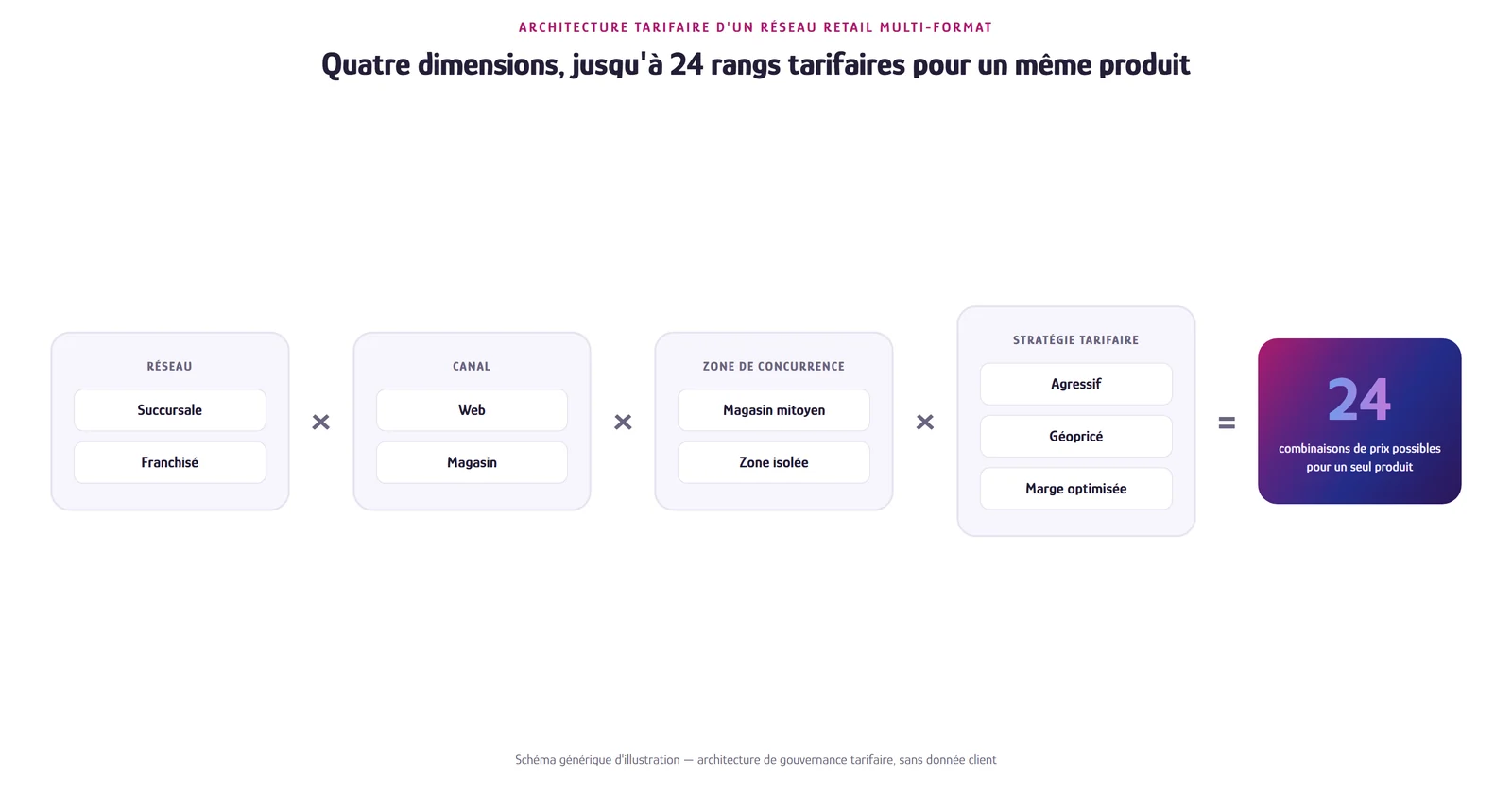
In a mixed, multichannel network, we typically see three pricing strategies. The table below is a framework for understanding these strategies, not a template to be copied: each network has its own unique characteristics.
| Bearing | Where it applies | What it protects | Who's driving it? |
|---|---|---|---|
| Aggressive | Web channel, national comparison | Perceived Competitiveness in the Online Market | Headquarters, across all brands in the network |
| Geopriced | Store, depending on the level of local competition | Real competitiveness relative to the closest competitor | Automatic Rule by Catchment Area |
| Optimized Margin | Franchise store, negotiated rent | The franchisee's profitability, without going overboard | A documented policy, discussed with the franchisee |
These three tiers are not three levels arranged from cheapest to most expensive.
These are three answers to three questions: how much to cut to stay competitive in the market, how much to adjust in response to the local competitor, and how much to preserve so that the franchisee continues to invest.
Consistency between online and in-store shopping, on the other hand, depends on price differences across channels.
One rule per segment, not one negotiation per store
The most common approach is to handle each request on a case-by-case basis: a franchisee calls, a manager makes an adjustment, and the exception becomes the unofficial norm.
It works with five franchisees. With fifty, it becomes the primary source of inconsistency within the network—and the main cause of disputes when two franchisees compare their terms.
A group that operates several franchise chains has taken the opposite approach to pricing on a store-by-store basis.
One price per store group, revised every six weeks.
The group used to manage several retail chains using Excel and manual processes. Now, prices are linked, simulated in batches, and applied by store group. Each pricing cycle starts from its own baseline.
- Issue
- Manage multiple franchise locations, each with its own pricing.
- What Has Changed
- Reference linking, batch simulations, suggested prices by store cluster.
by price cycle, simulated in batches across all retail chains.
Pricing Management · Multi-brand franchise group. Case study written by Booper based on an actual client project; the client has been anonymized.
This case illustrates the approach we advocate: a policy defined by store group and reviewed at regular intervals, rather than a price adjusted store by store as orders come in.
It also provides the best protection for the franchisor. If a fee increase is ever contested, a written rule that is applied consistently can be defended. A history of adjustments made over the phone cannot.
Key takeaway: The real indicator is when the suggested retail price isn't followed
Most networks view franchisees' deviations from the suggested retail price as a violation of policy. We view it first and foremost as information.
When a significant number of franchisees in the same area deviate from the suggested retail price in the same direction, it is often the suggested retail price that is incorrect for that area: misjudged local competition, underestimated costs.
That is why we are convinced that the true indicator of effective governance is not adherence to the suggested retail price, but rather the compliance rate by segment—and how it changes over time. A suggested retail price that no one follows protects neither the brand nor the margin.
Franchisees compare each other more quickly than headquarters compares its stores. Any rule that doesn't stand up to this comparison won't last, no matter how sound it may seem on paper.
The specifics for each activity are detailed in the sector-specific pricing.
See also in this feature
- The Booper Solution: Operational Pricing Consulting
- Building an Effective Pricing Organization: Models, Roles, and RACI
- Pricing Rollout: Successfully Managing Change in the Workplace
- Where a pricing team's time really goes: the actual breakdown
- Category Management: Definition, Challenges, and Its Relationship to Pricing
FAQ
Recurring questions about margin governance in a hybrid network.
A tool capable of setting a margin target for each network segment while allowing each retail location to make its own decisions and highlighting any variances.
BOOPER MPS manages target, minimum, and maximum price rules that vary from one retail location to another, with an alert triggered when a local price falls outside these limits. The modular platform defines this scope.
No. Imposing a minimum resale price is punishable by a fine of €15,000 under the Commercial Code (Article L442-6), and antitrust law applies to franchise agreements.
A franchisor may, however, recommend prices or set maximum prices, provided that the franchisee retains control over the final decision.
In a company-owned store (branch), the retailer collects the retail margin and sets it itself. In a franchise, the retail margin goes to the franchisee, who sets their own prices; the franchisor is compensated in other ways.
Consequence: Headquarters directly controls the profit margins of its branches, but can only influence those of its franchisees.
These aren't two levels; they're two different approaches. In a company-owned store, profit margin is an internal goal. For a franchisee, it's the profitability of an entrepreneur who has invested their own capital.
A one-size-fits-all rule ultimately does both a disservice.
By segment, never store by store. We cross-reference the type of retail location, the channel, and the competitive area, then apply the same method to all retail locations within a segment.
Exceptions are once again becoming rare and justifiable.
By building it together with them and documenting it. A milestone that is perceived as having been negotiated holds, while one that is perceived as having been imposed is circumvented.
Two franchisees in the same segment must arrive at exactly the same calculation.
Rarely. The level of competition varies from place to place, and a single price results in a loss of profit margin in one area or a loss of competitiveness in another.
That is the purpose of geopricing, which should be distinguished from the price range negotiated with a franchisee.
Sources
- French Franchise Federation, press release on the 2025 indicators, March 2026, franchise-fff.com
- Commercial Code, Article L442-6 (mandatory minimum resale price), in effect since April 26, 2019, legifrance.gouv.fr
- Booper, an anonymized case study of a multi-brand franchise group
Quicklizard is a dynamic pricing platform that originated in e-commerce and has been extended to stores with electronic price tags. At Intersport Germany, it manages e-commerce, not the stores.
For a chain of stores in France, look for a software provider with deep industry expertise and built-in compliance with French regulations, such as BOOPER. For an online-focused retailer, consider Competera or Omnia Retail. For market intelligence, try Minderest. In the B2B sector, consider Pricemoov.

Management doesn't approve a price; it approves a trade-off between margin, volume, and price image. Presenting a single recommendation means asking management to trust you. Presenting the cost of each option gives management the information it needs to make a decision.
A sound projection provides a range rather than a single figure, specifies what is being excluded, and anticipates the gap between the projected increase and the actual increase. When compared with actual results, it establishes the credibility of the next projection.

Optimix merged with Maxxing in July 2025, and PricingHUB was acquired by Akeneo in June 2026. For their customers, the question of the independence of the pricing roadmap has become a legitimate concern.
What sets a query apart in France isn't the processing speed: it's the native support for French rules, pricing by store or by zone, the validation process, and testing with your own data.