
Category Manager / Catman
On this page
Do your category managers have an overview of prices, margins, and the competition?
Schedule a meetingLearn about our operational pricing consulting servicesThe category manager (or "catman") oversees a product family within a retail chain, managing the product assortment, merchandising, supplier negotiations, promotions, and pricing. As a key liaison between purchasing, marketing, and sales, the category manager manages their category as a profit center, with a direct impact on margins and price perception.
The Essentials in 6 Questions
The manager responsible for a product category, from product selection to pricing.
Retail chains and their suppliers.
Weekly update, monthly committee meeting, annual product lineup review.
At the intersection of purchasing, marketing, and sales.
Having a single decision-maker per category prevents conflicting decisions.
Performance, competitive intelligence, supplier terms, customer insights.
Why the Category Manager Is a Key Role
Because it brings together under a single responsibility all the decisions that determine the profit margin of a category. Its role is part of a broader approach, category management .
- Centralize responsibility for a product family to avoid conflicting trade-offs between functions.
- Provide a long-term perspective (product lifecycle, innovations, changes in demand) that complements the short-term focus on pricing.
- Serve as the sole point of contact for suppliers regarding product assortment, pricing, promotions, and product placement.
A concrete example: the wine section
A category manager removes 35 references, introduces 18 including a premium private label and repositions 3 core products.
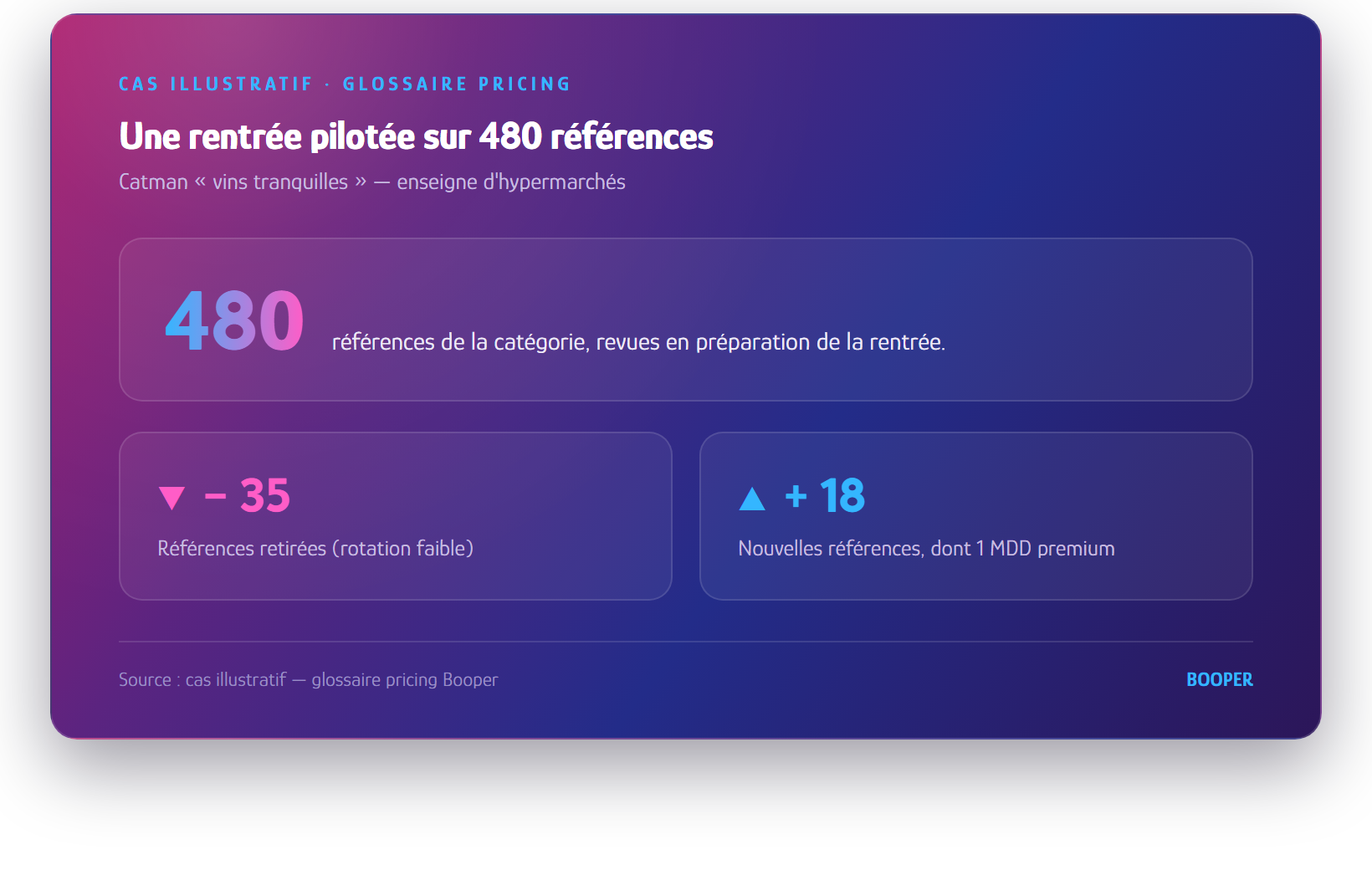
As the manager of 480 still wine SKUs at a hypermarket chain, she is preparing for the back-to-school season by balancing the supplier margins negotiated in June, sales forecasts for new SKUs, and the company’s competitive position on key sales indicators.
How the Category Manager Manages Their Category
It cross-references four data sources and simulates its decisions before implementing them.
| Source | Contents |
|---|---|
| Commercial performance | Volume, revenue, and margin by product code. |
| Competitive intelligence | Pricing strategy, promotions, new products. |
| Supplier Terms and Conditions | Front margin, back margin, commercial cooperation. |
| Consumer Insights | Focus groups, image studies. |
Pricing Optimization Software 's tools make it possible to simulate the impact of a decision before implementation. Our operational pricing consulting equips sales representatives with the tools they need for their day-to-day work, and our pricing training instills in them the instincts needed to balance price and margin. Among theirkey metrics isthe sales index.
The 3 Mistakes a Category Manager Should Avoid
Focusing on unit margins, cutting prices too quickly, or confusing negotiation with the selling price.
- Decide based solely on the unit margin, without considering the actual contribution to the total margin (volume × margin).
- Underestimating the impact of discontinuing aproduct: A low-performing product can serve as a loss leader for a niche customer base.
- Confusing negotiation with arbitrage pricing: A good supplier agreement does not automatically justify lowering the selling price.
Frequently Asked Questions
Short answers to the most frequently asked questions about the category manager.
What is a category manager (catman)?
The category manager, often abbreviated as "catman," is responsible for managing a product family within a retail chain. Their responsibilities include product assortment, merchandising, supplier negotiations, promotions, and pricing.
What is the difference between a category manager and a pricing manager?
The category manager oversees the entire strategy for their category (assortment, promotions, merchandising, performance); the pricing manager specializes in defining and optimizing prices . The two work closely together.
What metrics does a category manager track?
Revenue, margin, volume, inventory turnover, out-of-stock rate, promotional performance, market share, average basket size, sales index, and price indices.
Why does the category manager work with the pricing teams?
Because decisions regarding product assortment, promotions, and new product launches directly influence pricing strategy: together, they strike a balance between competitiveness, profitability, and price image.
How does AI help category managers?
It analyzes large volumes of data, forecasts sales, identifies pricing opportunities, measures cannibalization, and simulates scenarios before decisions are made.
Key Takeaways
- Catman manages its category as a profit center.
- He evaluates product lines, prices, promotions, and supplier terms.
- He determines the total margin and runs a simulation before rolling it out.
Do you want to equip your category managers with the tools they need to manage pricing?
Booper provides each category manager with an overview of prices, margins, and competition for their product family.
Let's talk about your categories →Learn about our operational pricing consulting servicesYou might also be interested in these articles

Building a high-performing pricing team requires adopting a hybrid model that combines central strategy with local agility. This transition replaces intuition with data-driven decisions, orchestrated by expert roles and strict governance.
This proactive management directly transforms financial performance, targeting profitability increases of 100 to 500 basis points.

A high-performing pricing organization relies on clear governance and a hybrid model, combining central strategy with local agility. By structuring precise roles such as Pricing Analyst or Head of Pricing via a RACI matrix, the company secures its margins and competitiveness. This operational rigor transforms pricing into an immediate and sustainable profitability lever.
Structuring this governance is precisely the role of BOOPER's Operational Pricing Consulting module.

Pricing is the most profitable and quickest-to-implement lever in the marketing mix, yet very few companies assign it a dedicated role or governance structure; it remains scattered across sales, marketing, and finance, with no identified person in charge. Moving beyond this ad-hoc approach does not require hiring an entire department: a clear mandate, a review schedule, and centralized data are enough to get started.
That is exactly what BOOPER’s Operational Pricing Consulting module is designed to do: help you move beyond flying by the seat of your pants without having to wait to hire an entire department.