
The Veblen Effect: When a Higher Price Leads to Higher Sales
On this page
Do your promotions devalue your premium products?
Let's plan an exchangeDiscover our Pricing Strategy ConsultingThe Veblen effect refers to goods for which demand increases as their price rises, contrary to the classical law of demand. The high price is part of the product’s perceived value: it signals status, exclusivity, or scarcity. The concept stems from the economist Thorstein Veblen and his theory of “conspicuous consumption.”
The Essentials in 6 Questions
Positive priceelasticity: the more expensive it is, the more desirable it is.
Premium and luxury brands, pricing and marketing teams.
Before any price reduction or promotion on a premium product.
Focusing on a small number of items with strong symbolic significance.
Avoid discounts that undermine the brand's value.
By analyzing the price-to-volume relationship based on historical data and through testing.
Why the Veblen Effect Matters for Pricing
Because with certain premium products, lowering the price causes demand to drop rather than stimulate it.
- Understanding the limitations of classicalprice elasticity: for these products, the price signal works in reverse.
- Avoid a counterproductive promotional strategy that would undermine perceived value more than it would boost sales volume.
- Distinguish the Veblen effect from Giffen goods, another case of positive elasticity, but one driven by budget constraints.
This should not be confused with the psychological price, which influences the perception of a listed price (€9.99 versus €10) without changing the product's positioning.
Real-world example: a price cut that leads to a decline in sales
For an iconic bag, a 15% price cut caused sales to drop by 9%.
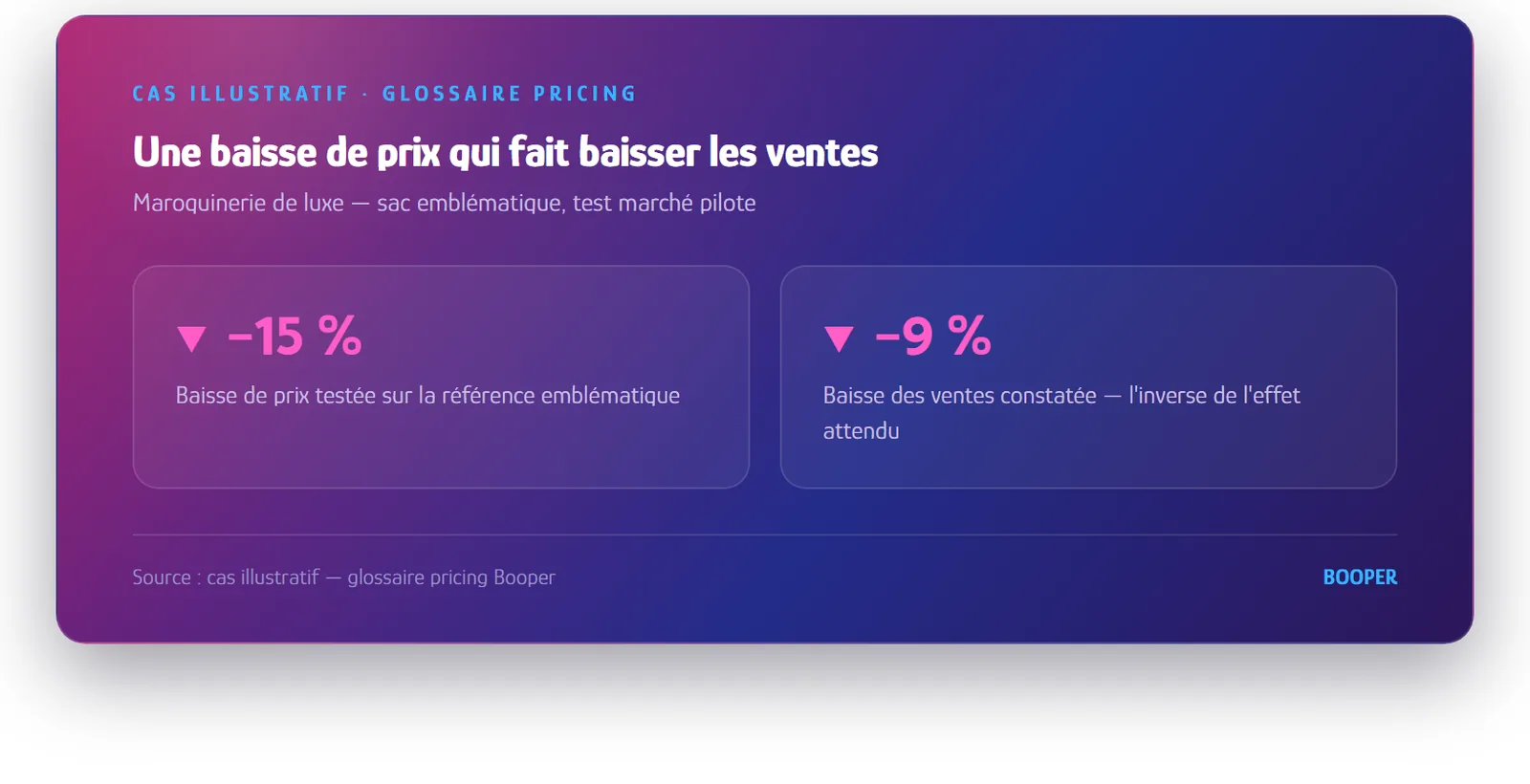
After being tested in a pilot market by a luxury leather goods brand, the price reduction was perceived by long-time customers as a devaluation of the brand, and the new customers it attracted did not make up for this decline. After returning to the original price the following quarter, the brand saw demand gradually recover.
How can you identify a Veblen effect?
By identifying past price increases for premium products that did not lead to a decline in demand.
If a historic price increase has been accompanied by stable or rising demand, the product likely exhibits Veblen-type behavior. This applies to only a minority of products: most products remain subject to classic negative price elasticity. A price diagnostic allows you to identify these products in historical data; incorporating them into your brand positioning is part of your pricing strategy.
The 3 Common Mistakes Related to the Veblen Effect
To sell everything off, to overestimate the phenomenon, or to mistake it for a passing fad.
- Make discounts the norm without singling out Veblen goods, which lose their appeal when sold at a discount.
- Overestimating the number of products involved: the Veblen effect remains the exception, even in the premium segment.
- Confusing the Veblen effect with temporary scarcity (out of stock), which has a different and temporary effect on demand.
Frequently Asked Questions
Short answers to the most frequently asked questions about the Veblen effect.
What is the Veblen effect?
The Veblen effect refers to goods for which demand increases as their price rises, contrary to the classical law of demand: the high price itself contributes to the perceived value of the product, as a symbol of status or exclusivity.
What is the difference between a Veblen good and a Giffen good?
Both have positive price elasticity, for opposite reasons: the Veblen good is attractive because of the status its high price confers; the Giffen good is a necessity, and when its price rises—under severe budget constraints—consumers are driven to consume more of it for lack of alternatives.
Are all luxury goods Veblen goods?
No. Many premium products still exhibit classic price elasticity: their sales decline when the price rises, even if this sensitivity is lower than for everyday products. Only a limited number of products with strong symbolic value exhibit a true Veblen effect—those for which the high price is part of what the customer is buying. Treating the entire high-end product line as price-insensitive leads to price increases that sales ultimately penalize.
How should pricing handle references to the Veblen effect?
By avoiding price cuts and systematic promotions, which undermine perceived value rather than attracting buyers. The pricing of these products is managed as a tool for brand positioning rather than as a driver of short-term sales volume. Specifically, we exclude them from automatic price-matching rules with competitors, ensure they remain consistent with the rest of the product line, and prioritize non-price benefits—such as a service or a limited edition—over discounts.
Does the Veblen effect exist in the retail sector?
It rarely occurs in its pure form, but its mechanisms can be observed in specific product categories. For wines, spirits, premium cosmetics, and certain regional specialty products, the price is seen as an indicator of quality. Setting the price too low causes customers to doubt the product rather than convincing them. This phenomenon is limited to a few product lines and cannot be generalized to the entire product range.
How can you identify a Veblen effect in your sales data?
By measuring the price elasticity of the benchmark and looking for a positive sign—that is, sales that increase as the price rises. Caution is warranted: a correlation of this type is most often explained by a hidden factor, such as a seasonal trend, a promotional campaign, or a supply disruption at a competitor. It is therefore necessary to isolate these effects before drawing any conclusions.
Does lowering the price of a Veblen good reduce sales?
This is the theoretical scenario, and it sometimes holds true beyond a certain threshold. The real risk lies less in an immediate drop in sales volume than in a lasting deterioration of brand positioning: once a brand’s standing has fallen too low, it is difficult to recover, because customers have revised the value they assign to it. It is better to test small price adjustments than to offer outright discounts.
Key Takeaways
- The Veblen effect: Demand rises as the price increases, because the price signals status.
- It applies only to a small number of premium items with strong symbolic significance.
- For these products, price is used as a tool for positioning, not for driving volume.
Would you like to know if a higher price can lead to more sales?
Booper tests and measures the actual impact of a price on your sales volume, including when prices go up.
Let's talk about your premium references →Discover our Pricing Strategy ConsultingThese articles can interest you

Perceived value (what the customer believes a product is worth before purchasing it) and actual value (what the customer finds it to be worth afterward) are two distinct concepts, and the right price is the one that matches the former, not the latter. A misalignment (undervaluation or overvaluation) costs profit margins or customers; a retailer’s price image hinges on a limited number of highly visible items (the KVI), not on the average price.

An effective pricing strategy relies on a rigorous segmentation between image-building products (KVI) and margin-generating products. To protect profitability, companies must move away from blind competitive alignment by implementing strict governance and price corridors. Management based on cleaned data can restore price-image and margins in as little as 30 days.
Maintaining a high price protects the unit margin but slows sales; quickly lowering the price speeds up sales but erodes the margin. The right balance is calculated, not guessed.
The total annual cost of holding inventory (capital, storage, obsolescence) averages 20 to 30 percent of its value. The purpose of BOOPER’s Markdown & markdown module is to quantify this trade-off between margin and turnover on a per-SKU basis.