
Intra-category cannibalization: a lever to master
On this page
Do your product launches really generate new sales?
Schedule a meetingDiscover AI-Powered Sales ForecastingIntra-category cannibalization is the phenomenon whereby sales of Product A capture a portion of the sales of Product B within the same category or retail chain. It can be intentional (a new product replacing an older one) or involuntary (a promotion that erodes the margin of a competing product). When managed effectively, it serves as a lever; when left unchecked, it destroys value.
The Essentials in 6 Questions
A shift in sales between products within the same category.
Pricing, category managers, brands, promotional teams.
During a product launch, a promotion, or a price change.
Among similar references: formats, ranges, private label and national brands.
Measure net value creation, not gross volume.
Before and after, test and control, cross-elasticity.
Why Measure Cannibalization?
Because a product launch or promotion is only profitable if the value it adds exceeds what it takes away from competing products.
- Measuring net value creation: Only the additional revenue counts, after deducting what is taken from the category.
- Calibrating promotions: A promotion that cannibalizes 80% of sales of a similar product generates only 20% in actual incremental revenue.
- Optimizing the product mix: identifying redundant products to streamline shelf space.
Real-world example: 100 units sold, 35 actually earned
A new yogurt sells 100 units, but the old one loses 65: the net gain is only 35 units.
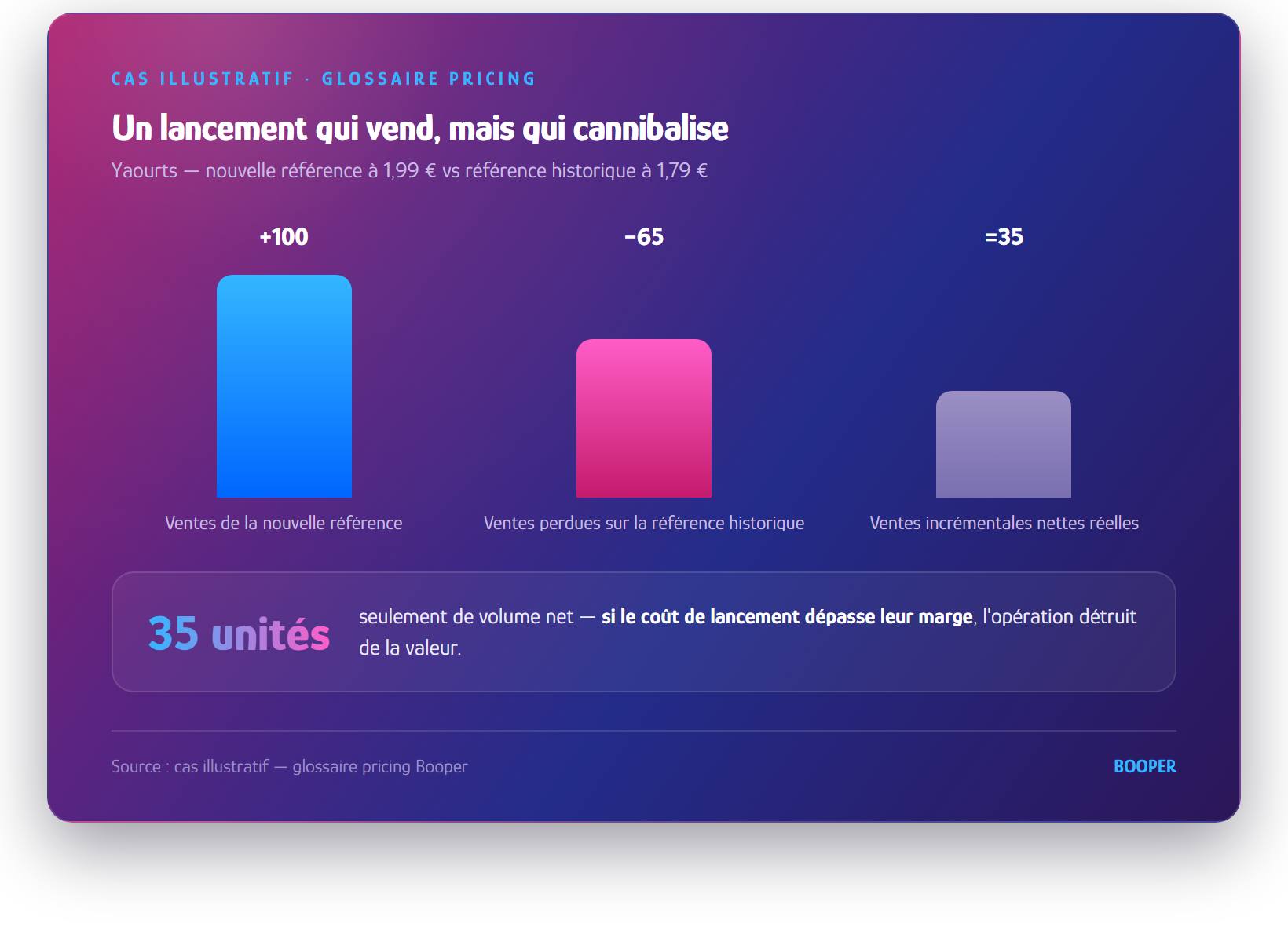
The new product at €1.99 complements an existing product priced at €1.79. If the launch costs (advertising, promotional activities) exceed the profit margin on these 35 units, the launch will destroy value despite an apparently impressive sales volume.
How do you measure cannibalization?
By separating the market effect (growth of the category) from the substitution effect (shift between products).
We compare sales before and after a launch or promotion, then use econometric techniques (test-and-control, difference-in-differences) to isolate the net effect.Cross-elasticity quantifies these shifts between products. Our AI-powered sales forecasting measures the impact of a price on neighboring products, and our promotion management calculates the actual incremental revenue from each campaign. Automated pricing alerts can flag a product that is cannibalizing more than 50% of its neighboring product’s sales.
3 Mistakes to Avoid When It Comes to Cannibalization
Focusing on gross volume, underestimating the impact of promotions, or launching without testing.
- Measure only sales of the new product: it's the net balance that counts.
- Underestimating the cannibalization effect of promotions: An aggressive promotion can wipe out 60 to 80 percent of sales of a similar product sold at full price.
- Launching without a pilot test: A massive nationwide rollout makes it difficult to correct cannibalization.
Frequently Asked Questions
Short answers to the most frequently asked questions about cannibalization.
What is intra-category cannibalization?
Intra-category cannibalization is the phenomenon whereby sales of Product A capture a portion of the sales of Product B, which belongs to the same category or the same retail chain. It can be intentional or involuntary; when managed effectively, it serves as a lever; when mismanaged, it destroys value.
How can you identify cannibalization?
When a rise in sales of one product is accompanied by a significant decline in sales of another product in the same category, without an overall increase in sales volume. This phenomenon can be measured using sales receipts and cross-elasticities.
Is cannibalization always a bad thing?
No: it may be intended to replace a less profitable product with one that has a higher margin. The goal is category performance, not that of a single product.
How can we limit cannibalization?
By clearly differentiating products, managing price variances, tailoring promotions, and simulating volume shifts before making a decision.
Key Takeaways
- Cannibalization is a shift in sales between similar products.
- What matters is the net profit for the category, not the gross volume.
- It is measured (test & control, cross-elasticity) and simulated before a decision is made.
Would you like to identify cannibalization among your products?
Booper measures the impact of a price change on sales of related products.
Let's talk about your sales transfers →Discover AI-Powered Sales ForecastingYou might also be interested in these articles

An effective pricing strategy relies on rigorous segmentation between key value items (KVIs) and margin drivers. To protect profitability, retailers must move away from blind competitive matching by establishing strict governance and pricing corridors. Data-driven management using cleansed data allows companies to restore their price image and margins in just 30 days.

Product matching or linking is the foundation of competitive monitoring, as it prevents the comparison of non-equivalent products. Reliable matching safeguards margins by basing repricing on actual, multi-signal data.
Key finding: According to the Diamart study, 50% of French retailers still consider this challenge to be unresolved.
These similarity algorithms rely heavily on natural language processing (NLP) to match the descriptions of different products.

A price change results in both cannibalization (of substitute products) and the halo effect (on complementary products). Ignoring this mechanism is equivalent to measuring only half of the actual impact of a pricing decision.
On average, 22% of the increase in sales of a product on promotion comes from a simple shift from other SKUs in the same product line.