
Predictive Pricing: Anticipating Demand with AI
On this page
What if you knew the impact of a price before changing it?
Schedule a meetingLearn about our MPS pricing solutionPredictive pricing uses machine learning models to anticipate demand, changes in competitors’ prices, and the impact of a price change before implementing it. It transforms pricing from a reactive discipline (adjusting after the fact) into a proactive one.
The Essentials in 6 Questions
Models that predict the impact of a price on volume and margin.
Pricing teams, category managers, sales departments.
Before a price change, a sale, or a season.
By reference, category, store, or channel.
Secure les décisions à fort enjeu et optimiser le mix prix-volume-marge.
Sales history, competitor prices, schedule, weather, machine learning models.
Why Switch to Predictive Pricing
Because it allows you to determine the likely effect of a pricing decision before making it.
- Be proactive rather than reactive: Set the optimal price for the coming week by factoring in emerging trends.
- Ensuring high-stakes decisions are sound: A major promotion or a price change for a bestseller is simulated before launch.
- Optimizing the price-volume-margin mix: The model calculates the price that maximizes a target (revenue, margin, market share) subject to constraints.
This is a key step toward the future of agent-based pricing.
Real-world example: Three pricing scenarios for a drill
For a drill priced at €89, the model identifies the price increase to €99 as the most profitable, a prediction confirmed to within 4% of the actual result.
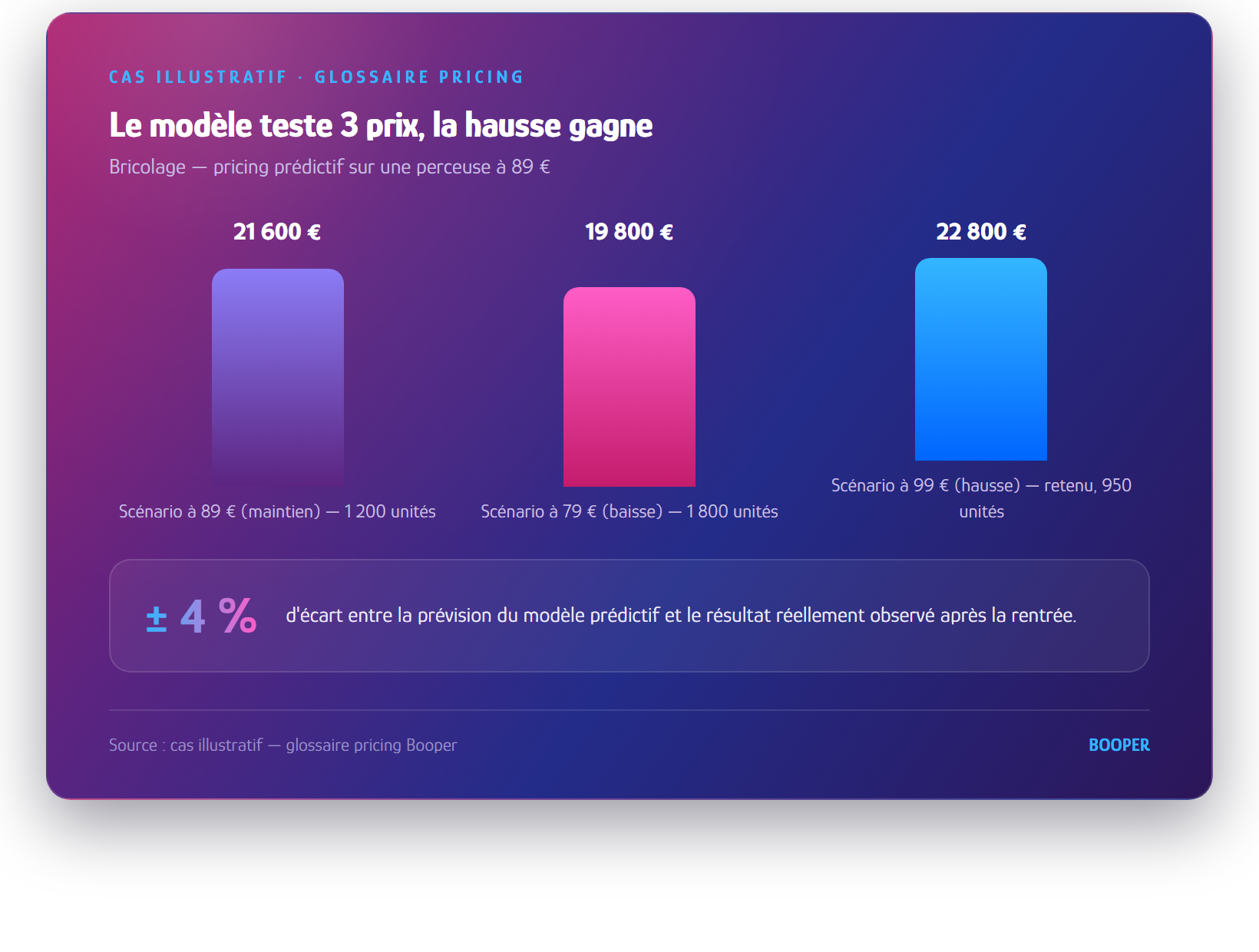
| Screenplay | Predicted volume | Unit Margin |
|---|---|---|
| Price remains at €89 | 1,200 units | 18 € |
| Price drop to 79 € | 1,800 units | 11 € |
| Price increase to €99 | 950 units | 24 €, for a total margin of 22,800 € |
Case Study: Booper Pricing Glossary.

How does predictive pricing work?
Models learn the relationship between demand and numerous variables, and then a business interface converts their predictions into recommendations.
Collect the data
Sales history, competitor pricing, promotional calendar, weather, macroeconomic trends.
Train the models
Gradient boosting, neural networks, and Bayesian models learn the effects on demand.
Simulate Scenarios
Each nominated product is evaluated based on volume, revenue, and margin.
Validate and Measure
The category manager approves; forecasts and actual results are compared on an ongoing basis.
The demand models are based on AI-driven sales forecasts; our MPS pricing solution combines them with business rules to generate actionable AI pricing recommendations that can be approved or modified.
The 3 Common Mistakes in Predictive Pricing
A model is only as good as its data, its supervision, and its monitoring.
- Blindly trusting the model: A recommendation must be validated by subject-matter experts, especially when it comes to strategic issues.
- Underestimating data quality: Incomplete data leads to biased predictions.
- Don't measure performance: continuously compare predictions with actual results and retrain the model regularly.
Frequently Asked Questions
Short answers to the most frequently asked questions about predictive pricing.
What is predictive pricing?
Predictive pricing involves estimating the impact of a price on sales, margins, and revenue before implementing it, using machine learning models. The model learns from historical sales data, prices, promotions, and competitor pricing, then simulates several scenarios for each product. Instead of lowering a price and observing the results three weeks later, the team compares the options before making a decision. It relies on two key elements: sales forecasting and price elasticity .
What is the difference between reactive pricing and predictive pricing?
Reactive pricing adjusts prices after an observed event, while predictive pricing anticipates the effect of a price before changing it. A reactive retailer will match a competitor's price when they lower it, or mark down prices when stock builds up. A predictive retailer has already simulated these situations and knows which products benefit from price matching. The two often coexist: reactive rules act as safeguards, while forecasts guide pricing decisions. The webinar "Is your pricing predictive or reactive?" presents real-world insights into this transition.
How accurate can we expect from a predictive pricing model?
The accuracy of a predictive pricing model depends on the richness of the historical data and the stability of the market. For products that have been sold for a long time, with several past price changes, the model accurately measures customer reaction. For new products, highly seasonal products, or during a market shock, uncertainty increases significantly. A good tool therefore displays a confidence interval rather than a single figure and highlights the products where the forecast is unreliable. This transparency allows users to decide when to follow the model and when to retain human judgment.
Does predictive pricing replace the category manager?
No, predictive pricing equips the category manager without replacing them. The model handles recurring trade-offs across thousands of SKUs and quantifies the likely impact of each option. The category manager retains control over what the model ignores: supplier negotiations, product launches, range strategy, and local events. They also set the rules that recommendations must adhere to, such as a minimum margin or a maximum price difference compared to a competitor. This division of labor saves time on routine tasks and frees up more time for strategic decision-making.
How long does it take to deploy predictive pricing?
A predictive pricing deployment typically takes two to four months, depending on the quality of available data, the number of categories covered, and the systems to be connected. The first step involves retrieving and cleaning historical sales, pricing, and promotional data. This is followed by model training, testing on a pilot category, and comparison with a control group. The scope then expands category by category. The timeframe depends less on the technology itself than on the availability of data and the team.
Key Takeaways
- Predictive pricing simulates the impact of a price before implementing it.
- It is based on machine learning models trained on sales data, competition, and context.
- He reports to the category manager, who has the final say.
Would you rather plan your prices in advance rather than be at their mercy?
Booper combines machine learning and business rules to recommend your prices in advance.
Let's talk about predictive pricing →Learn about our MPS pricing solutionYou might also be interested in these articles

Agentic pricing transforms AI for price elasticity from a mere assistant into an autonomous teammate capable of executing complex strategies. This shift toward automation enables real-time profitability management in the face of market volatility.
88% of current Excel spreadsheets contain errors—a financial risk eliminated by this new technological era.

Retail agentic pricing replaces rigid automation with an autonomous AI and pricing engine capable of reasoning and executing complex strategies. This technology transforms teams into strategic pilots to optimize profitability in real time.
By adjusting prices up to 100 times per day, it can drive margin growth ranging from 15% to 25%.

Transition from reactive pricing to predictive management by combining demand forecasting, elasticity, and simulation to anticipate decisions and secure margins and volumes.
That's exactly what BOOPER's AI-powered Sales Forecasting module covers: explainable demand scenarios that help you make decisions beforehand, not afterward.